AMLR Solutions
 AMLR Consultation
 Onboarding
 Ongoing Monitoring
 FRAML
FRAML KYC
KYC KYB
KYB KYI
KYI Age Assurance
 Workforce IAM
 Candidate Verification
 Account Takeover
 Bonus/ Promotion Abuse
 Chargeback Fraud
 Deepfake
 Document Fraud
 Fraud Networks
 Impersonation Fraud
 Money Mule Activity
 Multi-Accounting
 Party Fraud
 Regulatory & Compliance Risks
 Synthetic Identity Fraud
 Adult Content
 Banking
 Crypto
 Fintech
 Forex
Forex Compliance
 Fraud prevention
 Trust & safety
 Global expansion
 Compliance Officers
 Developers
 Fraud Analysts
 Product Managers
 Advanced Journey Builder (AJB)
 Global Trust Platform
 Customer Profiles
 Vendor Comparison
 IDV Case Management
 AML Case Management
 Regulatory Reporting
 Travel Rule Protocols
 Agentic Rule Builder
 AI Compliance Co-Pilot
 Fraud Analytics
 Fraud Hub
 OCR
OCR Shufti AI
 Bank Account Verification
 Biometric Duplication
 Database Checks
 Document Intelligence
 Government ID
 Mobile Driver's License
 NFC
NFC Selfie Liveness
 Brand Personalisation
 Deployment Options
 Identity Methods
 IDV Modes
 Multi-tenancy
 On-Premise IDV
 Secure Capture











TL;DR
- Fake FIFA sites are multiplying fast ahead of the 2026 World Cup.
- Domain registrations using FIFA keywords hit 9,741 in April 2026, Check Point found.
- UK ticket fraud losses rose 47% to £9.79 million in 2024, Action Fraud reports.
- Verifying buyer identity at checkout stops fraud before the chargeback lands.
In April 2026, two months before the FIFA World Cup opened, cyber criminals registered 9,741 new web domains carrying FIFA or World Cup keywords. Check Point Research, which tracked the surge, found that by early May, one in every 41 of those domains was already confirmed suspicious or malicious. The tournament had not started. The fraud infrastructure had.
Domain spoofing on this scale is not background noise. Every fake FIFA site is built to take money or identity data from a fan, and the loss rarely stops with that fan. Banks process the payment. Ticketing platforms field the dispute. Fintechs absorb the account takeover that follows.
Fans are the target, but platforms carry the cost. This guide is the platform-side playbook for the FIFA 2026 fraud window.
What is domain spoofing, and why does FIFA 2026 amplify it?
Domain spoofing is the practice of registering or presenting a web domain that imitates a trusted brand, so a visitor believes they are dealing with the real organization. For FIFA 2026, the impersonated brand is FIFA itself, along with its ticketing and merchandise sites.
How do spoofed domains trick fans and platforms?
A spoofed domain works because it borrows trust the attacker never earned. The web address carries FIFA branding, host-city names, or words like “tickets” and “store,” with a small change that a hurried buyer misses. Check Point Research documented look-alike FIFA merchandise stores advertising official jerseys at up to 80 percent off, a discount no genuine retailer offers. Knowing how to identify fake shopping websites comes down to a few habits. Check the exact domain against the official one. Treat a steep discount as a warning rather than a deal. Distrust any site reached through a paid ad instead of the brand’s own channel.
Why FIFA 2026 multiply the attack surface?
A single global tournament hands attackers a ready-made lure that millions of people are already searching for. The scale is shown in the registration data. Check Point Research recorded 9,741 new domains carrying FIFA or World Cup keywords in April 2026, more than four times the February figure and over five times the peak of the Qatar 2022 tournament. By early May, one in every 41 of those domains was confirmed suspicious or malicious, and the ratio was still climbing. AI tooling lets one actor spin up convincing scam sites in minutes, so the attack surface widens faster than any manual takedown process can close it.
|
Fraud vector |
How it works |
Platform exposure |
|
Spoofed FIFA and store domains |
Look-alike sites copy FIFA branding to sell fake tickets or merchandise |
Brand abuse, customer phishing, and chargebacks on cloned checkouts |
|
Ticket resale scams |
Non-existent or duplicated tickets are sold on social media and resale sites |
Disputed payments, refund liability, and reputational damage |
|
Phishing and account takeover |
Stolen credentials are used to seize fan and staff accounts |
Fraudulent transactions, data exposure, and direct fraud losses |
The anatomy of a World Cup ticket scam
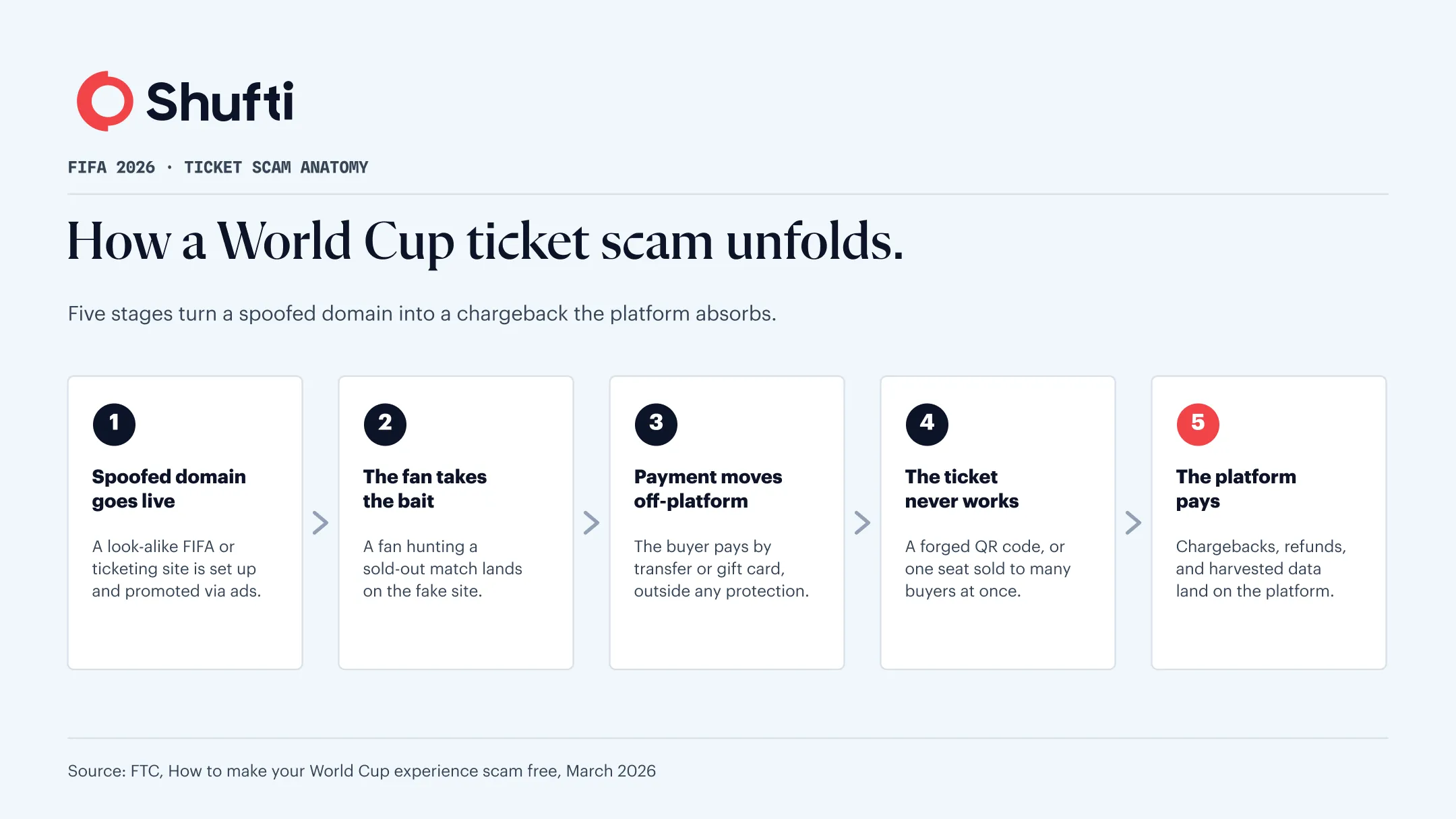
A World Cup ticket scam follows a predictable arc. A fan hunts for a sold-out match, finds a listing that looks too good on social media or a resale site, pays through a channel with no protection, and ends up with a ticket that is fake, duplicated, or never sent.
Where ticket fraud starts?
Ticket fraud starts wherever demand outruns supply. Sold-out matches push fans toward social posts and resale listings, which is exactly where event ticket fraud thrives. The financial picture is already documented. UK ticket fraud losses rose 47 percent to £9.79 million in 2024 across 9,826 reports, and 16 percent of those reports named sporting events, according to Action Fraud. Ticket resale fraud is the harder version to catch, because the listing often sits on a platform the buyer already trusts. A FIFA ticket scam rarely looks like a scam at the point of sale. It looks like a lucky find.
The digital-ticket twist for 2026
The 2026 tournament changes one detail that matters. The Federal Trade Commission (FTC) notes that most World Cup tickets are delivered electronically through the FIFA app, so anyone selling a printed ticket, a PDF, or a screenshot is almost certainly a fraudster. That shift has not stopped the scams. It has reshaped them. Fraudsters now sell forged QR codes or sell one legitimate-looking seat to many buyers at once, so several people reach a turnstile holding the identical ticket. For a ticketing platform, the damage is concentrated. A single duplicated seat can generate a dozen chargebacks and a dozen angry customers in one afternoon.
Why are banks and platforms the first line of defense?
Banks, payment processors, and platforms are the first line of defense because fraud has to pass through them to pay off. A fake ticket only earns money once a payment clears. An account takeover only matters once a transaction goes through. Each of those moments is a checkpoint.
Catching fraud at the payment stage
The payment stage is where intent becomes lost and where it can still be stopped. Banks and payment processors see signals a buyer never does, such as a card used from a new device, a billing address that does not match the card, or a sudden run of purchases on one account. Most FIFA-related ticket fraud runs on card-not-present transactions, where the card is never physically shown, so liability sits with the platform when a charge is disputed. Declining or stepping up a suspicious payment costs a few seconds. Absorbing the chargeback weeks later costs the sale, a fee, and staff time.
Phishing-driven account takeovers
Account takeover is the quieter half of tournament fraud. A spear phishing scam targets a specific person with a tailored message, a fake FIFA ticket confirmation aimed at a fan, or a fake supplier email aimed at a platform employee. Once credentials are captured, the attacker signs into a real account and operates as the legitimate user. For fintechs moving money during a traffic spike, that is the dangerous case, because a taken-over account passes every check built to trust the account holder. The defense is to re-verify the person, not just the login, when behavior changes.
The platform playbook for the FIFA 2026 fraud window
The platform playbook for FIFA 2026 reduces to one principle. Verify who is on the other side of a transaction before the money moves, not after the chargeback. Two checks carry most of the weight.
Verify buyer identity at the point of purchase
High-value and secondary-market purchases deserve a real check, not just a card and an email. Identity verification at the point of purchase confirms a genuine person is behind the transaction, which breaks the economics of bulk-resale rings that depend on disposable accounts. A document check paired with a biometric face match raises the cost of using a stolen identity. Behavioral signals add a second layer. A brand-new device, a foreign IP address, and a rushed checkout are each ordinary alone, but together they describe a transaction worth a closer look.
Verify the sellers, not just the buyers
Most platform fraud strategies check buyers and overlook sellers, which leaves the resale side exposed. A ticket resale marketplace that does not confirm who is listing tickets invites the bulk-resale rings that the buyer checks were meant to stop. A business verification check on commercial sellers confirms a real, registered entity stands behind a listing. Pairing that with a fraud prevention layer that watches for coordinated behavior across accounts closes the loop. The platforms that come through the FIFA 2026 window cleanly will be the ones that have verified both ends of every trade.
How Shufti helps banks, ticketing platforms, and fintechs harden against tournament fraud?
A tournament traffic spike is when fraud rings move fastest. Bulk-resale operations, taken-over fan accounts, and synthetic buyers all blend into the crowd when the checkout queue is long and the fraud team is stretched.
Shufti gives banks, ticketing platforms, and fintechs one owned identity verification flow that confirms a real, present person is behind a high-risk transaction. Document verification and biometric liveness run together, so a stolen ID or a deepfake selfie fails the check before a payment clears. Because Shufti builds and owns the full stack, the same verification holds whether a buyer presents a document from the United States, Mexico, or any country where fans travel. Shufti’s liveness holds iBeta Level 3 conformance under ISO/IEC 30107-3, the highest published independent standard for liveness attack detection.
One platform. Fully owned technology. Global coverage with real local depth.
See how Shufti verifies who is behind a transaction before a payment clears. Book a demo.
Frequently Asked Questions
What are the most common FIFA World Cup 2026 ticket scams?
The most common are spoofed FIFA or ticketing sites selling non-existent tickets, duplicated tickets where one seat is sold to many buyers, and forged digital tickets, such as fake QR codes. Most pair the scam with an off-platform payment request that removes buyer protection.
What identity data do FIFA-themed phishing sites try to steal?
FIFA-themed phishing sites typically harvest names, email addresses, passwords, and payment card details. Many also request government ID images or passport data under the guise of ticket delivery or visa help, which fuels later identity theft and account takeover.
How can ticket resale platforms verify sellers?
Ticket resale platforms can verify sellers with identity checks on individuals and business verification on commercial resellers, confirming a registered entity stands behind a listing. Combined with behavioral monitoring across accounts, this disrupts the bulk-resale rings that rely on disposable seller profiles.
How can fintechs protect users from FIFA-themed phishing attacks?
Fintechs can protect users by re-verifying identity when account behavior changes, not only at login. A taken-over account passes password checks, so a biometric step-up on high-risk transactions catches the fraud that stolen credentials would otherwise clear.