AMLR Solutions
 AMLR Consultation
 Onboarding
 Ongoing Monitoring
 FRAML
FRAML KYC
KYC KYB
KYB KYI
KYI Age Assurance
 Workforce IAM
 Candidate Verification
 Account Takeover
 Bonus/ Promotion Abuse
 Chargeback Fraud
 Deepfake
 Document Fraud
 Fraud Networks
 Impersonation Fraud
 Money Mule Activity
 Multi-Accounting
 Party Fraud
 Regulatory & Compliance Risks
 Synthetic Identity Fraud
 Adult Content
 Banking
 Crypto
 Fintech
 Forex
Forex Compliance
 Fraud prevention
 Trust & safety
 Global expansion
 Compliance Officers
 Developers
 Fraud Analysts
 Product Managers
 Advanced Journey Builder (AJB)
 Global Trust Platform
 Customer Profiles
 Vendor Comparison
 IDV Case Management
 AML Case Management
 Regulatory Reporting
 Travel Rule Protocols
 Agentic Rule Builder
 AI Compliance Co-Pilot
 Fraud Analytics
 Fraud Hub
 OCR
OCR Shufti AI
 Bank Account Verification
 Biometric Duplication
 Database Checks
 Document Intelligence
 Government ID
 Mobile Driver's License
 NFC
NFC Selfie Liveness
 Brand Personalisation
 Deployment Options
 Identity Methods
 IDV Modes
 Multi-tenancy
 On-Premise IDV
 Secure Capture











TL;DR
|
On June 11, 2026, the opening whistle sounds in Mexico City. Within the same six-week window, 48 teams play across 16 US cities, three Canadian cities, and three Mexican cities, making it the most geographically distributed World Cup in history. For every licensed sportsbook and iGaming platform serving those markets, this is not a growth event. It is a compliance stress test.
iGaming identity verification requirements don’t pause for tournament traffic. They apply to every new registration, every returning player, and every high-value transaction, simultaneously across three jurisdictions with three distinct regulatory frameworks. An operator who handles US bettors correctly but misses Canadian or Mexican KYC obligations doesn’t get partial credit. Regulators in each jurisdiction will be watching tournament-window activity closely, and enforcement records show that high-visibility events are exactly when compliance gaps surface.
This article gives iGaming operators a functional readiness checklist: the verification stack requirements, the KYC and AML distinctions that matter, the multi-jurisdiction compliance differences, and the specific fraud vectors that spike during major tournaments. Everything you need to have in place before the first match kicks off.
Why FIFA 2026 will stress-test every iGaming KYC system?
The challenge isn’t just traffic volume. It’s the traffic composition.
The tournament volume problem: what peak traffic actually looks like
A major sportsbook in a regulated US state might onboard thousands of new players during a normal NFL season week. During a World Cup group stage, that number concentrates into days. First-time bettors who don’t normally engage with online gambling platforms create a registration spike unlike anything the standard operating calendar produces. These are accounts with no behavioral history on the platform, creating a higher fraud surface, tighter regulatory scrutiny, and a KYC queue that can overwhelm manual review processes.
The same spike hits age verification, source-of-funds checks, and AML screening simultaneously. Platforms that run sequential checks rather than parallel pipelines will see onboarding times stretch. Players abandon incomplete registrations. The operator loses the conversion and still carries the compliance liability for the incomplete file.
Three jurisdictions, three regulatory regimes, one window
The US, Canada, and Mexico do not share an AML or KYC framework. A platform serving bettors in New Jersey, Ontario, and Mexico City in the same week is operating under the Bank Secrecy Act (BSA) and FinCEN rules, Canada’s Proceeds of Crime (Money Laundering) and Terrorist Financing Act (PCMLTFA) enforced by FINTRAC, and Mexico’s Ley Federal para la Prevención e Identificación de Operaciones con Recursos de Procedencia Ilícita (LFPIORPI), all at once. Each has different KYC trigger thresholds, different reporting forms, and different requirements for what constitutes adequate identity verification. The operator who treats FIFA 2026 as a single-jurisdiction compliance exercise will have gaps in at least two of the three.
What is the difference between KYC and AML for iGaming platforms?
KYC and AML are related, but legally distinct obligations, and conflating them is the most common source of audit findings in the gaming sector.
KYC: what operators must verify at onboarding
Know Your Customer (KYC) is the identity verification layer. It answers one question: Is this person who they say they are? At onboarding, KYC requires operators to verify a player’s full name, date of birth, residential address, and the authenticity of the identity document used to establish those facts. In most regulated jurisdictions, this must happen before a player can deposit or place a bet, not after their first transaction.
KYC also encompasses age verification, confirming the player meets the minimum gambling age for the jurisdiction they’re betting in. That minimum differs across the FIFA 2026 host nations: 21 in most US states, 18 or 19 in Canada, depending on the province, and 18 in Mexico.
AML: what operators must monitor beyond onboarding
Anti-Money Laundering (AML) compliance begins where KYC ends. Once a player is verified, the AML obligation requires operators to monitor that player’s behavior continuously: their transaction patterns, deposit and withdrawal amounts, betting behavior, and any changes in their risk profile over time. Politically Exposed Person (PEP) screening and sanctions watchlist checks sit at the intersection, informing both the onboarding risk decision and the ongoing monitoring posture.
In Canada, FINTRAC requires ongoing monitoring at a minimum of monthly intervals under the PCMLTFA. In the US, the Bank Secrecy Act requires casinos with annual gross gaming revenue over $1 million to file Currency Transaction Reports (CTRs) for cash-equivalent transactions of $3,000 or more per gaming day and Suspicious Activity Reports (SARs) when transactions suggest criminal activity. Those reporting obligations apply to licensed online operators in regulated states, not only land-based casinos.
Where KYC and AML overlap, and where they don’t?
The overlap is in risk scoring. A player who passes KYC onboarding but whose subsequent betting behavior is inconsistent with the verified profile triggers an AML flag, not a KYC one. The compliance failure regulators cite most often is treating that as a separate team’s problem, assuming a clean onboarding file means the account is permanently low-risk. It does not. During a tournament window, when high-value bets concentrate around specific match outcomes, behavioral monitoring needs to run in real time, not in a monthly batch.
The identity verification stack every operator needs before June 11
A tournament-ready iGaming compliance stack has three components that must work in parallel, not in sequence.
Document verification and biometric face match
The document layer is where identity claims get anchored to something verifiable. A player submitting a passport or driver’s licence is giving the platform a government-issued credential whose structural features, including MRZ data, security holograms, microprint, and chip data, where present, can be checked forensically, not just visually. A basic image-match check catches simple forgeries. A forensic document verification layer catches manipulated documents that pass photo checks.
The biometric face match confirms that the person presenting the document is the person in the document. Liveness detection, either passive (micro-expression and depth analysis running in the background) or active (prompted gesture or movement), confirms the face is live and present, not a still image or a deepfake replay. For tournaments that attract professional fraud rings targeting multiple operators simultaneously, liveness is not optional.
Real-time age verification without conversion loss
Age verification is a conversion bottleneck when it is built as a separate step. Platforms that embed age checks into the document verification flow, confirming date of birth from the ID at the same moment as identity, do not add friction. The check happens in the same session, on the same document, and the result is available before the player reaches the deposit screen.
For jurisdictions where document-based age verification creates barriers for users without physical IDs, a real consideration for the international fan demographic that FIFA 2026 will bring to North American platforms, age estimation models that work from a biometric scan offer a supplementary path. These models carry their own accuracy and recalibration obligations, and operators should confirm their chosen solution is benchmarked quarterly against demographic accuracy data.
Docless proof of address for international bettors
International bettors are the highest-friction segment of the FIFA 2026 registration wave. A Brazilian fan betting on their national team from a US sportsbook app may not have a US utility bill or bank statement to verify their address. Docless address verification against authoritative databases removes that barrier without reducing the evidential standard. For operators licensed in jurisdictions where address verification is a KYC requirement, docless paths widen the registration funnel without creating compliance gaps.
How do operators detect bonus abuse and multi-accounting during peak traffic?
Bonus abuse is the dominant fraud vector in iGaming, and tournament windows amplify it because operators are deploying large promotional inventories to capture the betting spike.
How bonus abuse patterns shift during tournament windows?
During FIFA 2026, operators will push welcome bonuses, match-odds boosts, and parlay promotions to attract new registrations. Fraudsters exploit this window by creating multiple accounts under different identities, either stolen, synthetic, or using variations of genuine documents, to claim the same promotion repeatedly. The individual claim is small enough to pass automated review. The aggregate across hundreds of accounts is not.
The tell is behavioral, not documentary. A cluster of accounts registered within the same tournament window, from similar device fingerprints or IP ranges, with identical deposit-then-claim-then-withdraw patterns, is a bonus abuse ring even if every account passed KYC individually.
Detection requires a behavioral analytics layer that scores account-opening sessions for risk signals invisible to a document check alone: anomalous typing cadence, copy-paste patterns in form fields, device reputation, geolocation mismatches against the declared address, and repeated PII appearing across distinct accounts.
Behavioral signals that static KYC misses
Static KYC is a point-in-time check. It answers whether this was a real person on the day they registered. It does not answer whether the same person is using the account six weeks later. Account takeover, where a legitimate account is compromised and used by a fraudster, is undetectable through document verification because the document was genuine at onboarding.
During tournament windows, account takeover attempts increase because high-value promotional credits make dormant accounts worth targeting. The detection layer is ongoing behavioral monitoring: login patterns inconsistent with the account holder’s history, device changes without re-authentication, large withdrawal requests in unusual timeframes, and location signals inconsistent with the registered address. Operators who separate their onboarding compliance stack from their ongoing iGaming fraud prevention layer create the gap that tournament-window attacks exploit.
Enhanced due diligence for VIP players: what triggers it and what it requires
Standard due diligence applies to most players. Enhanced due diligence (EDD) applies to players whose risk profile, through transaction behavior, PEP status, declared occupation, or deposit and withdrawal patterns, places them in a higher-risk category.
The EDD trigger threshold
Regulatory frameworks differ on exactly what triggers EDD, but the common conditions include: cash-equivalent transactions above the reporting threshold, PEP identification at onboarding or through ongoing screening, geographic risk signals where the player is connected to a high-risk jurisdiction on the Financial Action Task Force (FATF) list, and unusual source-of-funds patterns relative to the declared income. During a tournament window, VIP players placing large bets on specific match outcomes warrant heightened scrutiny. The reason isn’t that betting on football is suspicious. It’s that the convergence of high-value activity with a major sporting event is a documented pattern in money laundering cases.
Source of funds and ongoing monitoring for high-stakes bettors
EDD for iGaming VIPs typically requires source of funds documentation: pay slips, tax returns, bank statements, or business ownership records that explain why the player has the funds they are depositing. This is where most operator processes break down, not at the policy level, but at the evidence-collection level. Asking a player to provide source of funds documentation mid-session loses the account. Building the request into the onboarding flow for accounts that cross-defined thresholds keeps the compliance requirement intact without the friction of a reactive ask.
Ongoing monitoring for VIP accounts should run at shorter intervals than the standard monthly cadence during high-activity windows. A VIP who places normal bets in February but unusual bets in June and July 2026 has a behavioral change that warrants a real-time alert, not a flag on the next monthly report.
Multi-jurisdiction compliance: US, Canada, and Mexico compared
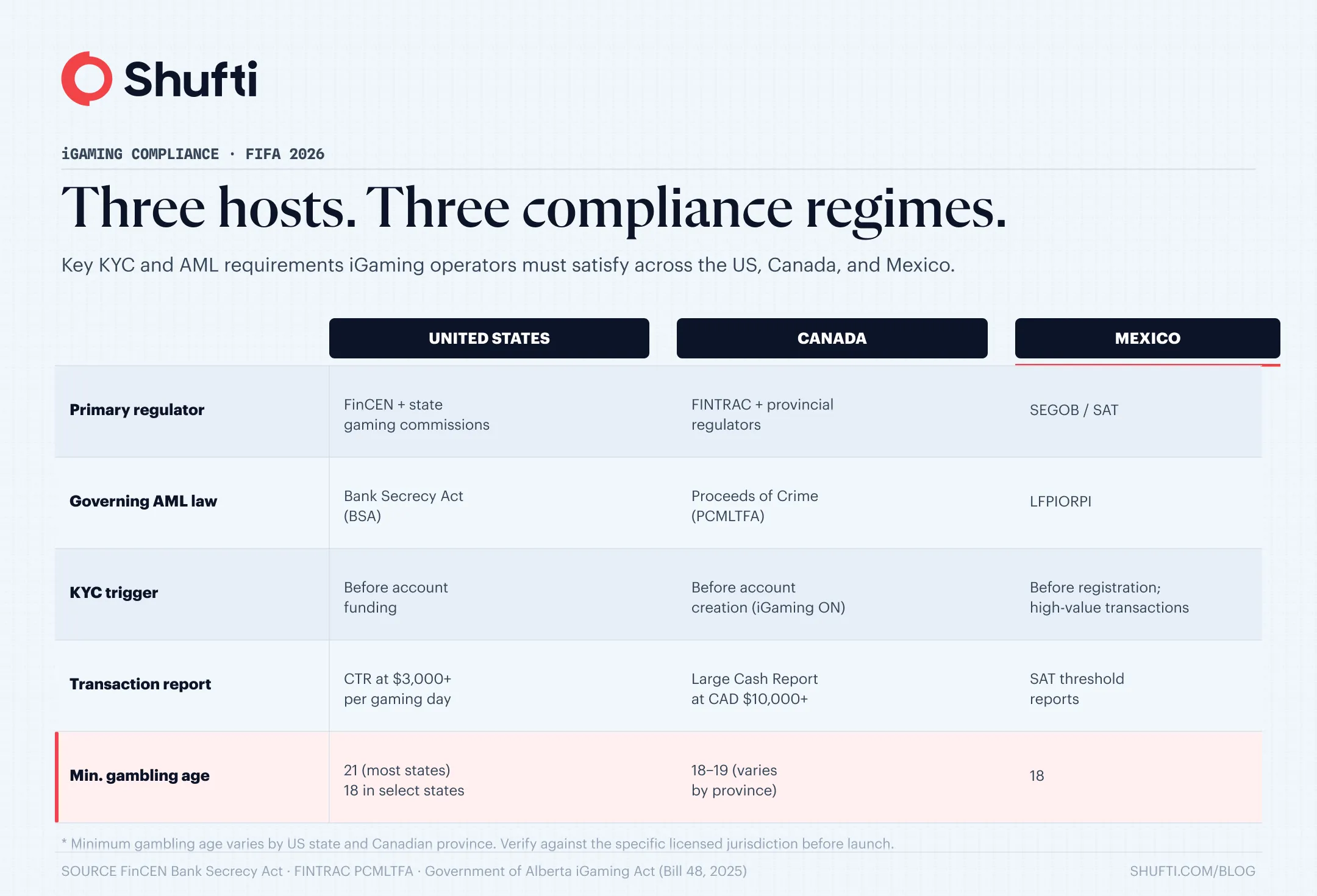
The three FIFA 2026 host nations represent three distinct compliance regimes. The table below maps the key attributes operators need to account for across all three.
|
Attribute |
United States |
Canada |
Mexico |
|
Primary regulator |
FinCEN (federal) + state gaming commissions |
FINTRAC (federal) + provincial regulators (iGaming Ontario, BCLC, others) |
SEGOB / SAT |
|
Governing AML law |
Bank Secrecy Act (BSA) |
Proceeds of Crime (Money Laundering) and Terrorist Financing Act (PCMLTFA) |
Ley Federal para la Prevención e Identificación de Operaciones con Recursos de Procedencia Ilícita (LFPIORPI) |
|
KYC trigger point |
Before account funding in most licensed states |
Before account creation (iGaming Ontario), varies by province |
Before registration; additional checks at high-value transaction thresholds |
|
Transaction reporting |
CTR at $3,000+ per gaming day; SAR for suspicious activity |
Large Cash Transaction Reports at CAD $10,000+; Suspicious Transaction Reports |
Threshold reports to SAT for transactions above defined limits |
|
Minimum gambling age |
21 (most states); 18 in select states |
18 (Alberta, Manitoba, Quebec); 19 (Ontario, BC, and others) |
18 |
|
Ongoing monitoring cadence |
Continuous; SAR filing obligation for suspicious activity |
Monthly minimum under FINTRAC; more frequent for high-risk accounts |
Ongoing; reporting obligations to financial intelligence unit |
|
Notable 2026 development |
Continued state-by-state legalisation expansion |
Alberta iGaming Act (Bill 48, March 2025); regulated market launches July 13, 2026 |
Regulatory uncertainty persists; strict AML obligations remain in force |
Operators licensed in only one of these jurisdictions who want to accept bets from fans across all three will need to either hold the appropriate licences or geo-restrict their player base. The compliance obligation follows the player’s location, not the operator’s registration.
KPMG’s Sports Betting AML and Fraud Risks analysis notes that US regulators alone assessed over $15 billion in AML-related penalties between 2010 and 2024. The iGaming sector is not exempt from that trajectory, and the FIFA 2026 window is precisely the kind of high-visibility event that follows elevated enforcement attention.
The FIFA 2026 operator readiness checklist
Use this checklist as a functional audit against your current verification and compliance stack. Items marked critical require resolution before June 11, 2026.
Pre-tournament stack audit (complete by May 2026)
- Document verification covers ID types from all three FIFA 2026 host nations: US state IDs and passports, Canadian provincial IDs, Mexican CURP and INE credentials
- Biometric liveness detection is active on all new account registrations, not only flagged accounts
- Age verification is embedded in the document flow, not a separate step added post-submission
- Docless address verification is available for international bettor onboarding (no utility bill requirement)
- PEP, sanctions, and adverse media screening are configured for all three host-nation jurisdictions
- KYC and AML workflows are documented separately and mapped to each jurisdiction’s specific trigger points
- EDD trigger thresholds are set and tested for VIP account onboarding before the tournament window opens
Onboarding controls (active from June 11, 2026)
- Real-time identity verification with sub-60-second decisioning under peak load conditions
- Parallel document verification, biometric check, and AML screening (not sequential) to prevent queue bottlenecks
- Bonus claim verification: device fingerprint and behavioral checks are active on all promotional registrations
- International bettor onboarding path tested with non-US, non-Canadian document types before go-live
- Age verification decision logged and retained per the jurisdiction-specific retention requirement
Ongoing monitoring (throughout tournament window: June 11 to July 19, 2026)
- Real-time alerts are configured for VIP accounts showing behavioral anomalies
- Monitoring cadence increased from monthly to weekly for high-value accounts during the tournament window
- SAR and CTR filing queues are reviewed daily on peak match days (US-licensed operators)
- Bonus abuse detection: cluster analysis for multi-accounting active on all promotional inventory
- Account takeover monitoring: re-authentication triggers are active for unusual login patterns or device changes
Post-tournament review (complete by August 2026)
- All SAR and CTR filings reconciled and submitted within regulatory deadlines
- VIP account reviews completed for any accounts that triggered EDD thresholds during the window
- Fraud pattern debrief: document which attack types appeared and what the detection rate was against each
- KYC file completeness audit: confirm all registered accounts have a complete, compliant onboarding file
How Shufti fits into a tournament-grade iGaming compliance stack?
Running parallel verification across three jurisdictions in a six-week window exposes every fragmentation point in a verification stack. Most platforms weren’t built for that scope. They were licensed in one market and extended coverage jurisdiction by jurisdiction, adding document types and AML databases as afterthoughts.
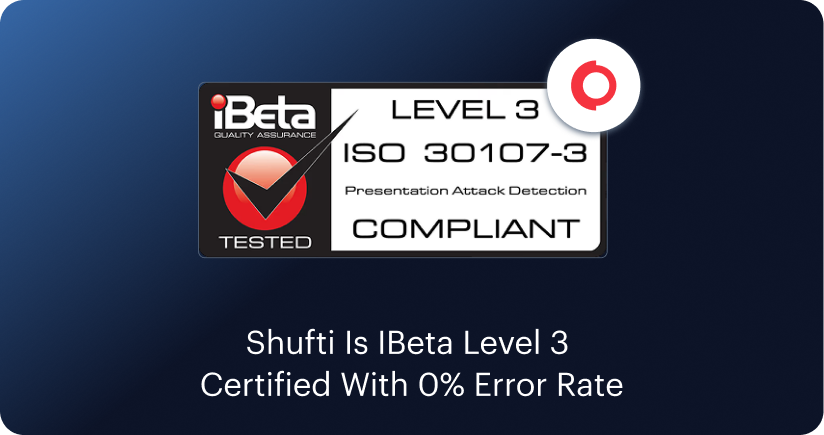
Shufti’s document intelligence covers 10,000+ document types across 240+ countries natively, including Mexican CURP and INE credentials, all Canadian provincial IDs, and US state-issued documents, through one API. The same integration runs real-time age verification, docless address verification across 85+ countries, and AML screening against PEP, sanctions, and adverse media databases. For tournament-window bonus abuse, the behavioral analytics layer flags device and PII clustering across registration sessions before a fraud ring claims a single promotional credit. Shufti holds iBeta Level 3 conformance under ISO/IEC 30107-3, the highest published independent standard for liveness attack detection, introduced in June 2025 in response to AI-driven fraud.
See how Shufti’s iGaming verification stack handles tournament-window load on real data. Book a demo.
Frequently Asked Questions
What identity verification do iGaming operators need for FIFA 2026?
Operators need document verification, biometric face matching with liveness detection, age verification, address verification, and AML screening, with all five components active before a player deposits or places a bet. Requirements vary by jurisdiction: US, Canadian, and Mexican operators each have distinct KYC trigger points and AML reporting obligations that must be satisfied simultaneously during the tournament window.
How does KYC differ between the US, Canada, and Mexico for sports betting?
In the US, KYC requirements are set at the state level for licensed operators, with federal Bank Secrecy Act AML obligations layered on top. In Canada, iGaming Ontario requires full verification before account creation under FINTRAC's PCMLTFA framework; Alberta's regulated market launches July 13, 2026, under the iGaming Alberta Act. Mexico requires registration-stage KYC and additional checks for high-value transactions under LFPIORPI. The minimum gambling age also differs: 21 in most US states, 18 or 19 in Canada, depending on the province, and 18 in Mexico.
What is the difference between KYC and AML for iGaming platforms?
KYC is the onboarding identity check: confirming who the player is, their age, and their address before they can gamble. AML is the ongoing obligation: monitoring player transactions, filing suspicious activity reports, and screening against PEP and sanctions databases continuously. KYC creates the verified identity record; AML uses that record as the baseline for detecting behavioral anomalies. Treating a clean KYC file as proof that AML is satisfied is the most common source of enforcement findings in gaming audits.
How do iGaming operators verify age and identity in real time?
Age and identity verification run in real time when the document verification flow extracts the date of birth from the ID at the same moment as identity. The biometric face match and liveness check happen in the same session. Sub-60-second decisioning is achievable on parallel pipelines. The bottleneck is typically sequential processing (document check, then liveness, then AML) rather than any inherent latency in the checks themselves. Parallel pipelines resolve this.
What is enhanced due diligence in iGaming?
Enhanced due diligence (EDD) is a deeper verification and monitoring process applied to players who meet a higher-risk threshold: PEPs, high-value depositors, players from high-risk FATF jurisdictions, or accounts showing unusual behavioral patterns. EDD typically requires source-of-funds documentation, more frequent ongoing monitoring, and manual review of transaction history. During FIFA 2026, operators should have EDD trigger thresholds pre-configured for VIP accounts before the tournament window opens, not during it. Blog ends here