AMLR Solutions
  AMLR Consultation
 EUDI Wallet
 Onboarding
 Ongoing Monitoring
 FRAML
FRAML KYC
KYC KYB
KYB KYI
KYI Age Assurance
 Workforce IAM
 Candidate Verification
 Account Takeover
 Bonus/ Promotion Abuse
 Chargeback Fraud
 Deepfake
 Document Fraud
 Fraud Networks
 Impersonation Fraud
 Money Mule Activity
 Multi-Accounting
 Party Fraud
 Regulatory & Compliance Risks
 Synthetic Identity Fraud
 Adult Content
 Banking
 Crypto
 Fintech
 Forex
Forex Compliance
 Fraud prevention
 Trust & safety
 Global expansion
 Compliance Officers
 Developers
 Fraud Analysts
 Product Managers
 Journey Builder
  Global Trust Platform
 Customer Profiles
 Vendor Comparison
 IDV Case Management
 AML Case Management
 Regulatory Reporting
 Agentic Rule Builder
  AI Compliance Co-Pilot
  Fraud Analytics
 Fraud Hub
  OCR
OCR Shufti AI
 Bank Account Verification
  Biometric Duplication
 Database Checks
 Document Intelligence
 Government ID
 Mobile Driver's License
 NFC
NFC Selfie Liveness
 Brand Personalisation
 Deployment Options
 Identity Methods
 IDV Modes
 Multi-tenancy
 On-Premise IDV
 Secure Capture
 Shufti MCP













Secondary sanctions are not enforced with penalties, so OFAC enforcement data hides your exposure. Where the risk is actually recorded, and what puts a non-US firm there.
“Do non-U.S. companies risk exposure to sanctions for providing ammunition or other military goods to Russia or for supporting Russia’s military-industrial complex?”. This particular question was asked in the published guidance of the US Office of Foreign Assets Control (OFAC), and its answer to put it simply was, yes.
No US office is needed for that answer to reach you, and neither is a US customer, a US bank account, or an American on the payroll. Most compliance teams outside the United States go hunting for their exposure in OFAC’s enforcement record, where the penalties are published and the figures are large. That record will not show it, because secondary sanctions are not enforced with penalties at all.
What are Secondary Sanctions?
Secondary sanctions are measures one country imposes on foreign companies for doing business with parties that country has sanctioned, even when the transaction never touches its territory. The United States; government actively applies them at scale.
Primary sanctions work in a way most people expect laws to work. The US prohibits US persons, meaning US citizens, US-incorporated companies, and anyone physically in the United States, from dealing with a sanctioned party. If this rule is broken then it is synonymous to having broken a US law.
Secondary sanctions, however, work differently. A bank in Dubai, a trading house in Singapore, or a shipping agent in Istanbul is not bound by US sanctions law in the first place. But, there is instead a consequence attached to this relationship. If a deal goes through with the wrong counterpart or a rival then there is a risk of losing one’s entire access to the American market, the correspondent banking relationships and one’s ability to clear payments in American dollars.
Difference Between Primary and Secondary Sanctions
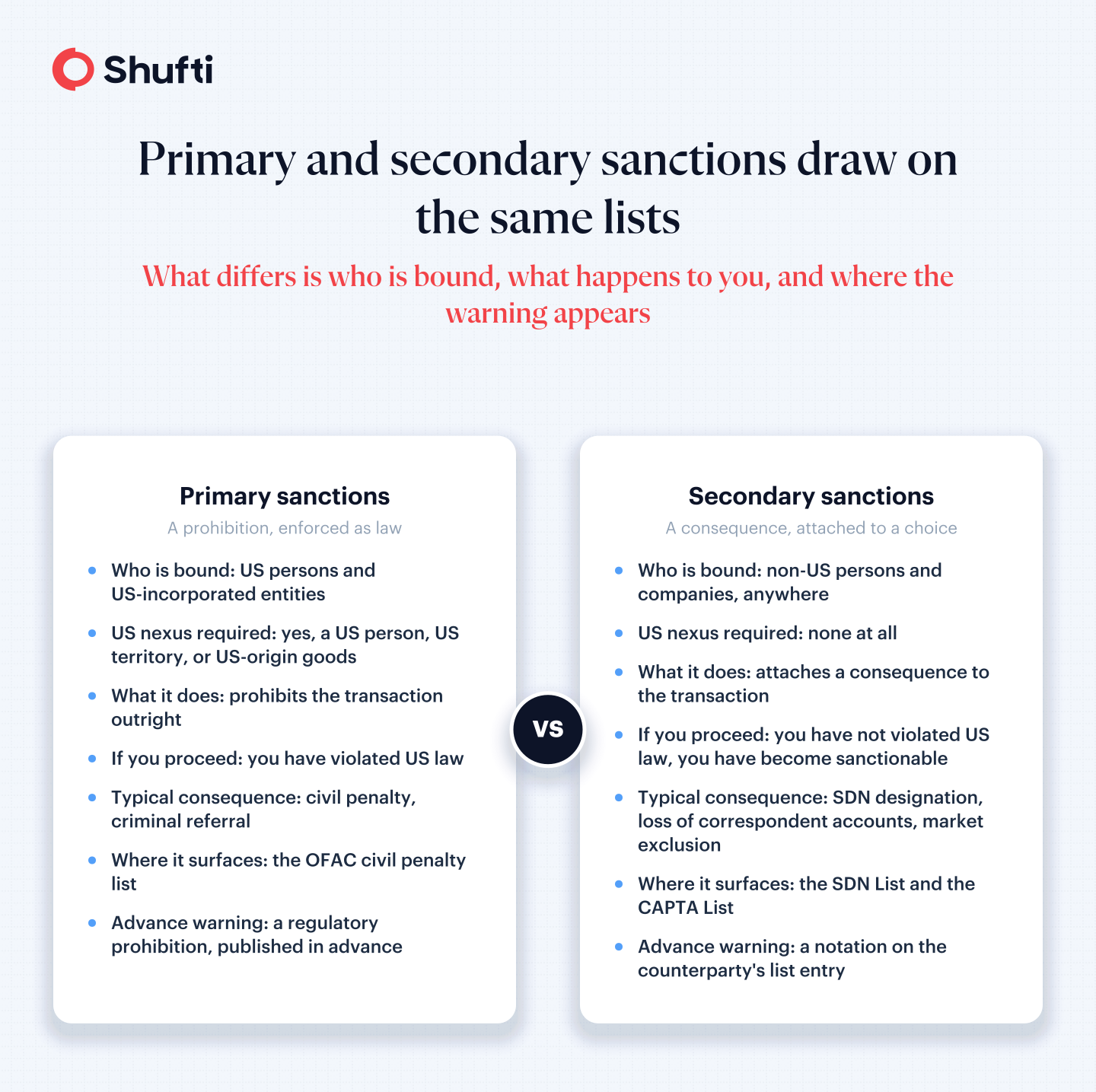
The two regimes draw on the same watchlists, so the names look identical. What differs is who is bound, what happens to you, and where the warning appears.
| # | Primary sanctions | Secondary sanctions |
| Who is bound | US persons and US-incorporated entities | Non-US persons and companies, anywhere |
| US nexus required | Yes, a US person, US territory, or US-origin goods | No |
| What it does | Prohibits the transaction outright | Attaches a consequence to the transaction |
| If you proceed | You have violated US law | You have not violated US law, you have become sanctionable |
| Typical consequence | Civil penalty, criminal referral | SDN designation, loss of correspondent accounts, market exclusion |
| Where it surfaces | OFAC civil penalty list | SDN List and CAPTA List |
| Advance warning | Regulatory prohibition, published in advance | A notation on the counterparty’s list entry |
Where the Distinction Holds, and Where it Fails
The distinction sounds academic until you try to brief a board on it. The Congressional Research Service puts the mechanism plainly. In its analysis of the North Korea programme, it notes that such restrictions:
The same structure runs through every secondary sanctions authority, and OFAC’s own drafting follows it, because its guidance describes non-US persons as risking “exposure” to sanctions rather than committing violations.
There is an important establishment, though. Non-US firms can still break US sanctions law directly. OFAC states that non-US persons are prohibited from causing or conspiring to cause a US person to violate sanctions, from engaging in conduct that evades US sanctions, and in some programmes from re-exporting US-origin goods or technology in breach of the rules. A foreign firm that routes a payment through a New York bank while concealing the sanctioned party has not incurred designation risk, it has caused a violation, and that is prosecutable.
Which OFAC programmes carry secondary sanctions provisions?
Not every OFAC programme includes secondary sanctions authority. The ones that generate most of the exposure for non-US firms sit in a handful of country programmes, with Iran and Russia carrying the widest reach.
Iran, the oldest and widest authority
Iran-related authorities have carried secondary sanctions provisions the longest, and they remain the most detailed. Non-US persons, including foreign banks, can be sanctioned for knowingly engaging in significant transactions with Iranian parties on the SDN List, or with persons designated in connection with terrorism support or weapons proliferation.
Because the authority is old and heavily used, it is also the programme where OFAC’s list annotations are most developed, which matters for the practical question of how you spot the risk.
Russia, under E.O. 14024 as amended by E.O. 14114
Russia is where the reach expanded most recently. Executive Order 14114, issued on 22 December 2023, amended Executive Order 14024 to let OFAC sanction foreign financial institutions that handle transactions involving Russia’s military-industrial base.
The order gives OFAC two tools. It can block the institution outright, or it can prohibit or impose strict conditions on that institution’s correspondent accounts and payable-through accounts in the United States. A correspondent account is the account a foreign bank holds with a US bank so it can move dollars, so losing one removes a bank’s ability to serve dollar-paying customers.
The covered sectors are named in the order and include technology, defence and related material, construction, aerospace, and manufacturing.
The Three Mechanisms OFAC Actually Uses
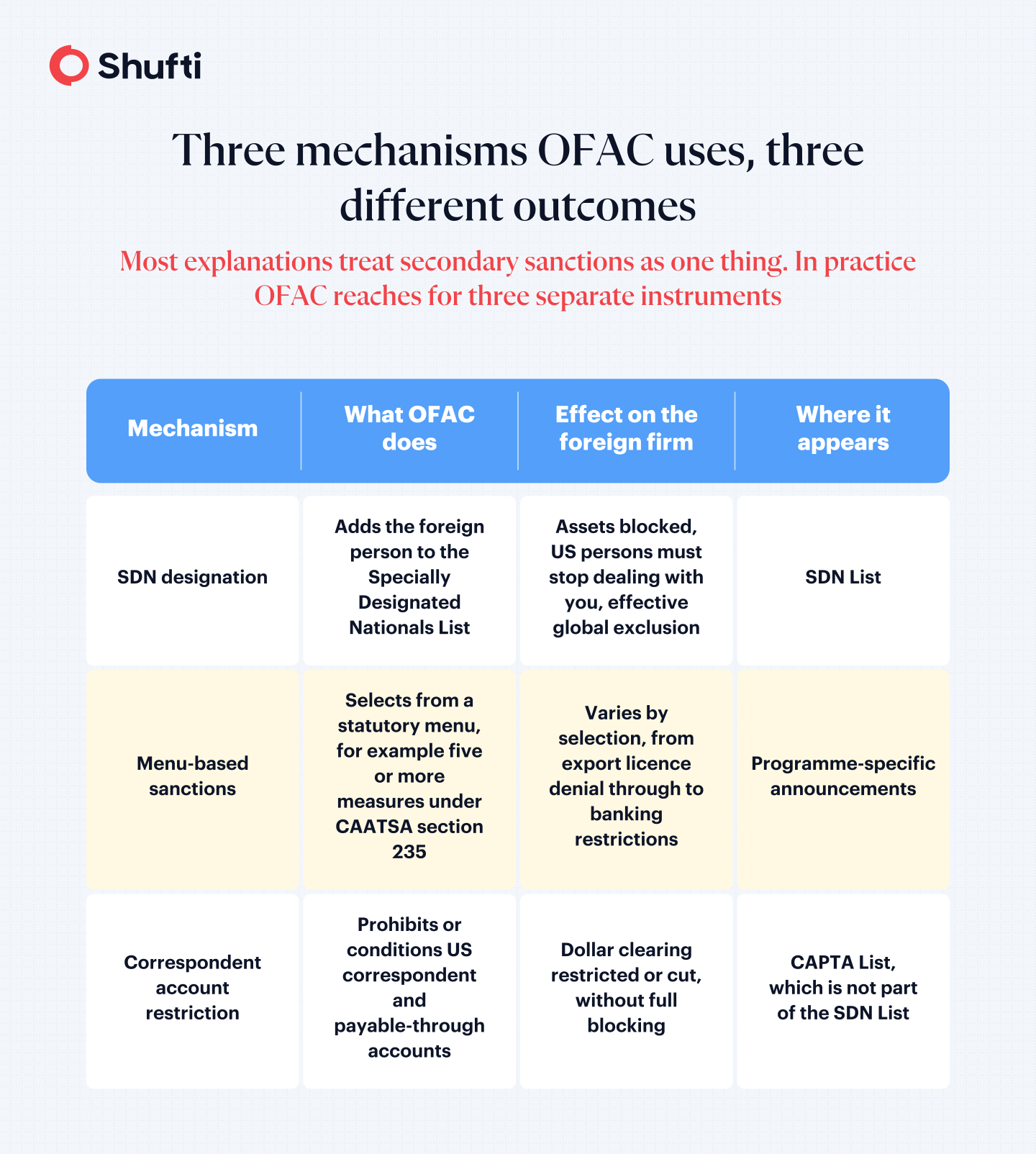
Most explanations treat secondary sanctions as one thing. In practice OFAC reaches for three separate instruments, and they produce very different outcomes.
| Mechanism | What OFAC does | Effect on the foreign firm | Where it appears |
| SDN designation | Adds the foreign person to the Specially Designated Nationals List | Assets blocked, US persons must stop dealing with you, effective global exclusion | SDN List |
| Menu-based sanctions | Selects from a statutory menu, for example five or more measures under CAATSA section 235 | Varies by selection, from export licence denial to banking restrictions | Programme-specific announcements |
| Correspondent account restriction | Prohibits or conditions US correspondent and payable-through accounts | Dollar clearing restricted or cut, without full blocking | CAPTA List |
The CAPTA List is worth knowing about specifically, because it is not part of the SDN List. It sits with OFAC’s other non-SDN lists in the consolidated list, which means a screening configuration pointed only at the SDN List will not see it.
What Triggers Secondary Sanctions Exposure for a Non US Firm?
Exposure rarely arrives through a decision anyone made deliberately. It arrives through a payment route, a counterparty’s counterparty, or an ownership structure nobody traced to the end.
Dollar clearing and correspondent banking
Most global trade is still priced and settled in dollars. When a dollar payment clears, it typically passes through a correspondent bank in the United States, and at that moment the transaction becomes visible to US authorities.
That visibility is what gives secondary sanctions their practical force. A firm can have no US entity, no US staff, and no US customers, and still route almost every payment it makes through US infrastructure. What the US holds is not legal reach over your business but a chokepoint in the payment plumbing that carries your money.
Counterparties, Vessels, and the 50% Rule
Your own customer is the easy part to screen. Secondary sanctions exposure usually sits one step further out, in the counterparty your customer pays, the vessel that carries the cargo, or the parent company behind the trading entity on the invoice.
Ownership is where this gets technical. Under OFAC’s 50 Percent Rule, an entity is treated as blocked if it is owned 50 percent or more, directly or indirectly, by one or more blocked persons, and OFAC aggregates those holdings. Two designated individuals holding 25 percent each is enough to block the company they jointly own, even though neither crosses the threshold alone. The company itself never appears on any list, so a name-matching check will clear it.
One nuance is easy to miss. The 50 Percent Rule addresses ownership and not control, so an entity controlled by a blocked person without the ownership stake is not automatically blocked, which means it needs a judgement call rather than a rule lookup.
The Jurisdictional Gap
Sanctions evasion tends to exploit the seams between regulators rather than any single institution’s controls. Andrei Sribny, who leads the AML Certification Center, framed the pattern this way in a Shufti panel discussion.
For secondary sanctions the observation is exact. A structure is assembled where corporate transparency is thin, then used in a market where controls are assumed to have already happened upstream. Your screening engine performs correctly at every step and still misses the exposure, because the gap is in registry quality rather than in match logic.
Where Should you Look to Find Secondary Sanctions Risk?
Here is the part almost no explainer covers. OFAC does not leave secondary sanctions exposure for you to infer, because it writes the warning directly into the list entry.
When a person is designated under an authority that carries secondary sanctions consequences, OFAC adds a notation reading “Additional Sanctions Information – Subject to Secondary Sanctions” to that person’s SDN List entry, alongside the tag for whichever programme designated them. The tag tells you why they were listed. The notation tells you what dealing with them would do to you.
That single field changes the compliance question from a research project into a screening configuration. A team that ingests the SDN List but discards the additional-information field has thrown away the only machine-readable indicator of its own secondary sanctions exposure.
Three sources carry the picture between them:
- The SDN List: This is for designations and the secondary sanctions notation attached to them.
- The CAPTA List: This is for foreign financial institutions whose US correspondent accounts have been restricted rather than blocked.
- The civil penalty list, This for telling about primary sanctions enforcement and almost nothing about your position as a non-US firm.
The 2025 penalty figures make the last point concrete. OFAC published 14 civil penalties totalling $265,746,819 that year, and the roster is American. The largest, a $215,988,868 penalty against GVA Capital Ltd., went to a firm in San Francisco. That is not evidence that non-US firms escaped scrutiny during 2025, it is evidence that the instrument used against them leaves no trace on that particular page.
Are secondary sanctions legal under international law?
The honest answer is that the question has never been settled.
What the critics argue
The United Nations Special Rapporteur on unilateral coercive measures examined secondary sanctions in a 2022 report and basically reached a conclusion that
The report grounds that view in sovereignty and non-intervention, and in the observation that targets are generally designated without charge or trial.
The European Union reached a similar conclusion much earlier. The recital to Council Regulation (EC) No 2271/96 states that by their extraterritorial application, such laws violate international law.
Against that, no court has agreed or disagreed. No international court or tribunal has ruled on the legality of US secondary sanctions. The International Court of Justice case most often cited in this context, Certain Iranian Assets, concerned the attachment of Iranian state assets under US terrorism judgments rather than secondary sanctions, and the separate Iranian challenge to the 2018 sanctions snapback has never reached a merits judgment.
Secondary sanctions vs extraterritorial jurisdiction
The two terms get used interchangeably, and they are not the same thing.
Extraterritorial jurisdiction means a state applying its own law to conduct outside its borders, so that the foreign conduct becomes lawful or unlawful under that state’s rules. Secondary sanctions, in their classic form, do something narrower. They leave the foreign conduct legally untouched and instead condition a benefit, namely access to the US market and financial system, on whether you engage in it.
That framing is the strongest defence of the practice, and it is worth being precise about its provenance. The argument is made mainly by legal scholars rather than by the US government, and where Washington has set out a jurisdictional theory in statute, as in the 1996 Helms-Burton Act, it asserted the effects doctrine outright rather than the market access argument.
The distinction also has limits. Once a penalty rather than an exclusion is imposed, the “we are only withholding a privilege” reasoning becomes much harder to sustain.
The EU Blocking Statute problem
For EU-based firms the tension is not theoretical. The Blocking Statute prohibits EU operators from complying with the listed US measures, which are the Cuba and Iran regimes. In 2021 the Court of Justice of the European Union held in Bank Melli Iran v Telekom Deutschland that the prohibition applies even where a company complies voluntarily and was never ordered to by a US authority.
An EU company caught between the two regimes therefore faces a genuine conflict of laws rather than a compliance preference, which is a matter for external counsel and not for a screening policy.
How can a non-US firm manage secondary sanctions risk?
Effective practice here goes beyond a name check against the SDN List, because the exposure sits in fields, lists, and structures a basic screening pass never reads.
- Screen the full list suite, not just the SDN List: Add the CAPTA List and OFAC’s other non-SDN lists. A configuration pointed only at the SDN List misses correspondent account restrictions entirely.
- Capture the secondary sanctions notation: Ingest the additional-information field, not only the name and programme tag, and route matches carrying that notation to a separate queue. It is a different risk that needs a different decision.
- Trace ownership to the natural persons: Apply the 50 Percent Rule with aggregation, and treat control without ownership as a judgement call requiring enhanced due diligence rather than an automatic clear.
- Extend screening past your direct customer: Counterparties, vessels, ports, and intermediaries carry the exposure in trade finance and shipping, so screen the transaction chain and not only the account holder.
- Re-screen continuously and document the reasoning: Designation happens between your periodic reviews, and a defensible file records why a decision was made rather than only what was flagged.
The fifth point is where most programmes are thinnest. Noor Ali, Partner and Head of Middle East at Bit Comply, drew the distinction sharply during a Shufti panel.
How Shufti helps compliance teams see secondary sanctions exposure
The gap most teams hit is not the customer in front of them, it is everything one step behind that customer. Secondary sanctions exposure travels through counterparties, vessels, and ownership layers that a name check against a single list will never surface, and it changes between periodic reviews rather than at onboarding.
Shufti’s AML screening screens corporate entities, vessels, aircraft, and ports on the same data foundation as individuals, against 215+ sanction regimes, with continuous re-screening that refreshes every 15 minutes rather than in a daily batch. A counterparty designated on a Tuesday afternoon reaches your alert queue that afternoon, which is the difference between stopping a payment and explaining one.
Frequently Asked Questions
What is the difference between primary and secondary sanctions?
Primary sanctions bind US persons and prohibit them from dealing with sanctioned parties, so breaching them violates US law. Secondary sanctions apply to non-US firms with no US nexus and do not prohibit anything, they attach a consequence, usually designation or loss of US market access.
Can a non-US company be penalised under US secondary sanctions?
Not usually with a fine. The standard consequence is designation on the SDN List or a restriction on US correspondent accounts. A non-US company can face direct penalties separately, if it causes a US person to violate sanctions, evades them, or breaches re-export rules.
What triggers secondary sanctions exposure?
Conducting a significant transaction with a designated party, or with a person operating in a covered sector such as Russia's defence or aerospace industries. Dollar clearing through US correspondent banks is what typically makes the transaction visible.
What is the difference between secondary sanctions and extraterritorial jurisdiction?
Extraterritorial jurisdiction applies a state's law to conduct abroad, making that conduct lawful or unlawful under its rules. Secondary sanctions leave foreign conduct legally untouched and instead condition access to the US market on it, which is why exposure means designation risk rather than illegality.