




 Face Verification
 Address Verification
 Document Verification
 Age Verification
 VideoIdent
 Fast ID
 Docless Verification
 Consent Verification
 NFC Verification
 Business Verification
 Due Diligence
 Investor Verification
 E-Signature

 QES
QES
 AML Screening
 Transaction Monitoring
 Adverse Media
 Business AML Screening
 PEP & RCA
 Sanctions
 Watchlist
 Behavioural Biometrics
 Device Fingerprinting
 Biometric Face Authentication
 MFA
MFA
 Fraud Hub
 Onboarding
 Ongoing Monitoring
 KYC
KYC
 KYB
KYB
 KYI
KYI
 Age Assurance
 Identity Verification
 Workforce IAM
 Candidate Verification
 Compliance
 Fraud prevention
 Trust & safety
 Global expansion
 Product Managers
 Compliance Officers
 Fraud Analysts
 Developers
 Deepfake Detection
 Bonus Abuse / Promotion Abuse
 Account Takeover
 Synthetic Identity Fraud
 Document Fraud
 Impersonation Fraud
 Multi-Accounting
 Fraud Networks
 Chargeback Fraud
 Money Mule Activity
 Party Fraud
 Regulatory & Compliance Risks
 Fintech
 Crypto
 iGaming
 Forex
Forex
 Social Network
 Marketplace
 Banking
 Gig Economy
 Payments
 Ride Hailing
 Adult Content
 Blind Spot Audit
 Deepfake Detector
 Liveness Spoofs
 Document Originality
 Document Deepfake
 Global Trust Platform
 Journey Builder
 Case Management
 Shufti AI
 Fraud Analytics
 Vendor Comparison
 Brand Personalisation
 AI Compliance Co-Pilot
 OCR
OCR
 Secure Capture
 Deployment Options
 Identity Methods
 API Documentation
 Mobile SDKs
 Service Status
 Help Center
 Contact Us
 Technical Support
 Supported Documents
 Supported Countries

 Content library
 Blogs
Blogs
 News
News
 Reports
 Insights
 Knowledgebase
 ROI calculator
 About
About
 Career
 Press Release
 Certifications
 Partnership
 Awards
 Events & Webinar
 Interactive Demo
 Podcast Studio
 Spotlight Studio
Address Verification for Fintechs & Neobanks: Compliance Without Friction 2026

TL;DR
- Address verification is a mandatory KYC requirement for fintechs and neobanks. Regulators including FinCEN, the FCA, and FINTRAC require firms to collect and verify customer addresses as part of Customer Due Diligence (CDD) and AML compliance.
- Poor address verification creates both compliance and fraud risks. Synthetic identities, fake addresses, and AI-generated proof-of-address documents can bypass basic checks and expose firms to regulatory penalties and financial losses.
- Doc-less verification reduces onboarding friction. By cross-referencing address data against trusted databases, fintechs can verify many customers in seconds without requiring document uploads, improving conversion rates.
- Risk-based verification is the industry standard. Modern onboarding workflows use a cascade approach, starting with electronic verification and escalating to document-based verification and forensic analysis only when required.
- A strong address verification solution must be audit-ready. Beyond confirming an address match, firms need clear records of the verification method, data sources, and decision logic to satisfy regulatory examinations and compliance reviews.
In October 2024, the Financial Conduct Authority (FCA) fined a UK digital bank £29M for opening 54,000 accounts for 49,000 high-risk customers in breach of its own requirements. The bank’s onboarding had scaled rapidly while the compliance controls meant to govern it stayed flat. Address verification for fintech sits at that exact fault line. Regulators require it, fraudsters probe every gap in it, and mobile users abandon it at the point where it creates the most friction.
This guide walks through what FinCEN, the FCA, and FINTRAC actually require from digital account opening, how synthetic identities exploit address verification gaps, and what a digital bank address compliance stack looks like when it must satisfy both a regulator and a mobile user.
Address verification is the process of confirming that a customer’s declared residential or business address is real, belongs to them, and was collected in a way that satisfies the relevant regulator’s documentation standard. It is a mandatory step in Customer Due Diligence (CDD) under every major AML framework.
Why address verification is now a regulatory non-negotiable
Three major regulatory frameworks tightened their address collection requirements for digital accounts between 2024 and 2025, each from a different direction. Meeting all three is not about building three separate compliance workflows. One well-designed verification stack can satisfy all of them, but only if it produces auditable evidence of method, not just a data match result.
FinCEN and the US address baseline
Under the Financial Crimes Enforcement Network (FinCEN) Customer Identification Program (CIP) Rule, every US financial institution must collect and verify a residential or business street address before opening an account. For fintechs processing large volumes of fintech proof of address verification, this is a statutory floor: risk-based verification procedures must produce a reasonable belief about the customer’s identity, with address as one of four mandatory data points alongside name, date of birth, and identification number.
FCA Consumer Duty after the £29M fine
As of October 2024, the FCA has used its Consumer Duty enforcement powers to hold digital banks accountable across the full customer identification programme, including address verification. The Consumer Duty framework requires examination-ready documentation for every address verification decision, with the methodology documented and proportionality rationale retained. Firms that cannot demonstrate auditable AML compliance fintech onboarding face the same exposure.
FINTRAC’s October 2025 updates
Canada’s Financial Transactions and Reports Analysis Centre (FINTRAC), through its identity verification guidance updated effective October 1, 2025, requires all reporting entities to verify customer addresses as part of client identification, with records available for production within 30 days. The update expanded acceptable electronic verification methods, which benefits digital-first firms, but the obligation to document the address and the verification method used remains unchanged.
The hidden cost of friction at the address step
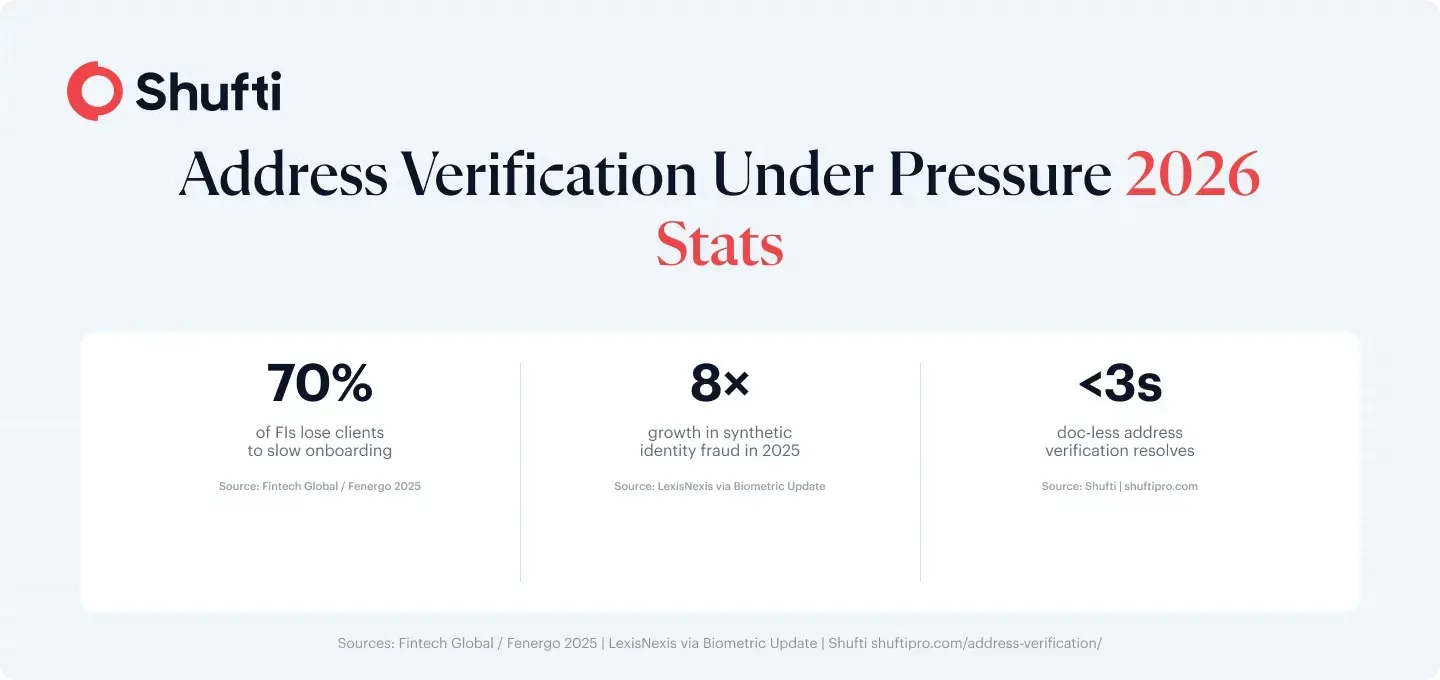
Document upload at the address step is one of the most reliable ways to lose a mobile user mid-onboarding. A 2025 report from Fintech Global found that 70% of financial institutions lost clients due to slow or complex onboarding, with the digital onboarding address check identified as one of the most friction-dense points in the mobile flow.
A user opening a neobank account on a smartphone at 11pm is unlikely to photograph a utility bill, crop it, and re-upload it twice because the first attempt failed OCR. They will close the app. At 10,000 monthly applicants with typical drop-off rates at the proof of address step, the revenue impact from that single friction point is real and trackable. The compliance obligation has not changed. What has changed is that the method used to satisfy it no longer has to be the most friction-intensive one available.
How do fake addresses slip through standard checks?
Fraudsters have industrialised address manipulation well beyond what a basic OCR scan or database match detects. Understanding the attack surface is the starting point for choosing a neobank address verification method that stops the problem at the point of entry, not downstream in manual review.
Fake address generators online produce plausible residential and business addresses that pass formatting validation and geolocation proximity checks but have no genuine connection to the person providing them. Fake ID address checks are central to synthetic identity fraud, where a real government ID number is combined with a fabricated name and a ghost address. In April 2026, synthetic identity fraud grew 8x globally in 2025, with 11% of all detected fraud cases now involving a synthetic identity. AI-generated utility bills add a second layer. The text passes OCR, but EXIF metadata, PDF structure, and print-geometry patterns diverge from authentic documents. Standard verification that stops at character recognition misses all of it.
How fintechs verify customer addresses in 2026
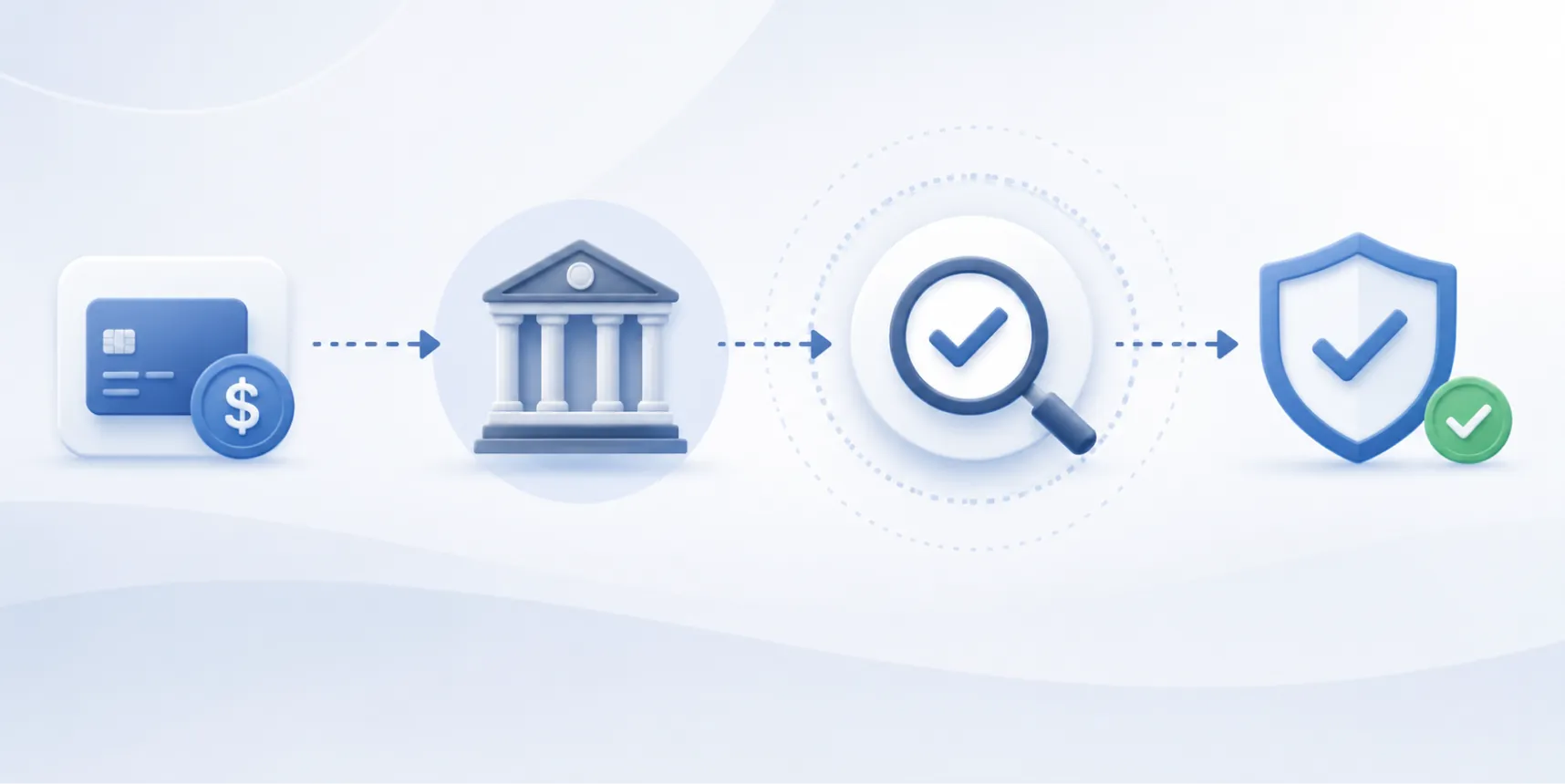
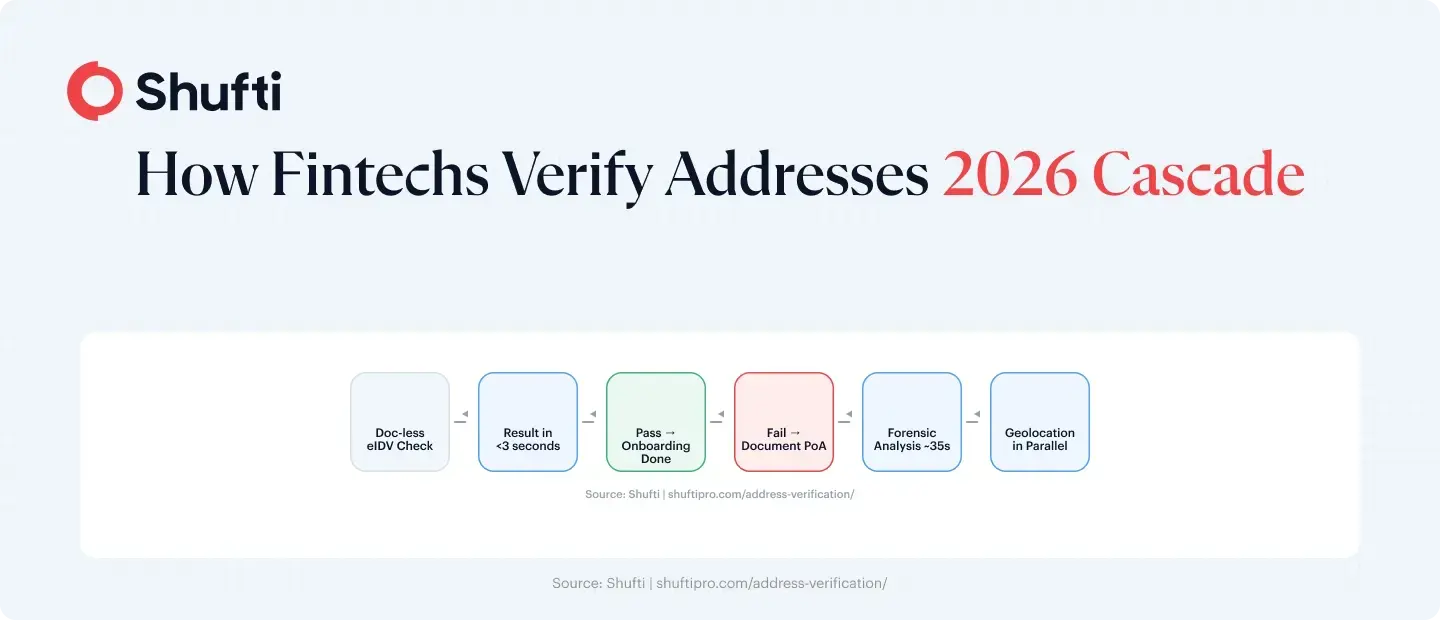
Neobank address verification in 2026 operates across three methods, each suited to a different risk level and regulatory requirement. Most well-designed stacks use a cascade model, attempting the fastest method first and escalating automatically when a risk signal or jurisdictional rule demands higher evidence. An electronic identity verification layer typically runs first in markets where database coverage is available.
Doc-less eIDV
Docless address verification cross-references a user’s declared address against government registries, telecom records, credit bureau files, and utility databases without asking for a document upload. In covered markets, the check returns in under 3 seconds. This is the default method for standard-risk CDD onboarding because it produces auditable results that satisfy FinCEN and FINTRAC documentation requirements without creating abandonment at the proof of address verification online step. Coverage spans 85+ countries across North America, Western Europe, and APAC.
Document proof of address
When regulation demands documentary evidence, document proof of address applies. This covers high-risk customer profiles, enhanced due diligence onboarding, and markets where database coverage is thin. Uploaded documents go through forensic analysis that checks EXIF metadata, PDF structure, AI-manipulation patterns, and layout geometry, catching AI-generated utility bills that standard OCR accepts. This method meets identity verification in fintech compliance contexts where the FCA’s Consumer Duty requires a documentary record of verification method, not just a match result. Processing takes approximately 35 seconds.
Geolocation and risk signals
Geolocation checks run in parallel with both methods. The declared address is compared against the user’s IP location, with VPN, proxy, and Tor usage flagged automatically. For neobank address check workflows where jurisdiction matters, such as crypto platforms, regulated investment products, and cross-border BNPL lending, this layer enforces geographic restrictions that document or database checks alone cannot provide.
What should a KYC address verification API actually do?
Choosing a KYC address verification API comes down to two capabilities that matter in regulated environments. The first is coverage that does not create a new operational problem every time the product expands to a new market. The second is an audit trail an examiner can read without requesting supplementary documentation.
Coverage matters because an API that returns “no data found” on 30–40% of international users pushes them into manual review queues or drops them entirely. A mature KYC for fintech integration spans 240+ countries, with doc-less verification in data-rich markets and automatic document fallback in markets where bureau coverage is thin. Under Financial Action Task Force (FATF) Recommendation 10 (updated June 2025), address verification methodology must be documented, not just the result. An API response that records only “address verified: true” will not satisfy the FCA’s Consumer Duty documentation standard. The audit record needs to show the method used, the data sources cross-referenced, and the decision logic applied, all in a format an examiner can read without requesting additional documentation.
How Shufti helps fintechs verify customer addresses
Address verification and fintech compliance needs to satisfy three audiences at once. Compliance officers need a defensible audit trail, product teams need conversion rates to hold, and engineers need a single integration rather than a patchwork of regional vendors. Shufti’s Address Verification Suite is built around that constraint.
The suite runs doc-less database verification across 240+ countries in under 3 seconds. It processes over 1 million verifications per day at 99.5% fraud detection accuracy, per the address verification product page. Where regulation or risk level requires documentary evidence, the suite escalates automatically to document proof of address with forensic analysis that catches AI-generated documents passing OCR. For compliance teams evaluating the best KYC software for their fintech onboarding stack, the differentiator is the unified audit trail. Every verification decision, regardless of method, produces a single evidence record aligned to FATF Recommendation 10 and FCA Consumer Duty documentation standards.
When regulators require documented proof of address and your users are abandoning at the upload screen, the only answer is a verification stack that starts frictionless and escalates only when risk or regulation demands it. Shufti’s address verification suite runs doc-less checks in under 3 seconds across 240+ countries, escalating automatically to forensic document proof when the risk profile or jurisdiction requires a higher standard of evidence. Request a demo to see how the cascade approach works against your actual onboarding volumes and compliance requirements.
Frequently Asked Questions
What is address verification in fintech?
Address verification in fintech confirms a customer's declared address is real, tied to them, and collected through a method their regulator accepts as proportionate evidence. Under FinCEN's Customer Identification Program rule, FCA Consumer Duty, and FINTRAC, it is a mandatory step at every digital account opening.
How do neobanks verify address without documents?
Most neobanks run a doc-less electronic identity verification check first, cross-referencing the declared address against government registries, telecom records, and credit bureau files. Results return in under 3 seconds in covered markets. If the check fails or regulation requires documentary evidence, the user is escalated to document proof of address.
What documents are required for proof of address?
Commonly accepted documents include utility bills, bank statements dated within three months, and official government correspondence. Some regulators also accept tenancy agreements. Under FCA Consumer Duty guidance, document age matters as much as document type, with older documents typically triggering enhanced due diligence.
Is address verification mandatory for digital account opening?
Yes. FinCEN's Customer Identification Program rule requires US institutions to collect and verify a street address at account opening. The FCA requires it under Customer Due Diligence rules, as does FINTRAC under its October 2025 guidance. Digital-only and mobile accounts are not exempt.
How do fintechs reduce onboarding drop-offs during address verification?
The most effective approach is doc-less verification first. Cross-referencing a declared address against government and telecom databases takes under 3 seconds with no document upload required. Document proof of address is reserved for high-risk cases or where regulation demands it, keeping upload friction away from most applicants.