





 Face Verification
 Address Verification
 Document Verification
 Age Verification
 VideoIdent
 Fast ID
 Docless Verification
 Consent Verification
 NFC Verification
 Business Verification
 Due Diligence
 Investor Verification
 E-Signature

 QES
QES
 AML Screening
 Transaction Monitoring
 Adverse Media
 Business AML Screening
 PEP & RCA
 Sanctions
 Watchlist
 Behavioural Biometrics
 Device Fingerprinting
 Biometric Face Authentication
 MFA
MFA
 Fraud Hub
 Onboarding
 Ongoing Monitoring
 KYC
KYC
 KYB
KYB
 KYI
KYI
 Age Assurance
 Identity Verification
 Workforce IAM
 Candidate Verification
 Compliance
 Fraud prevention
 Trust & safety
 Global expansion
 Product Managers
 Compliance Officers
 Fraud Analysts
 Developers
 Deepfake Detection
 Bonus Abuse / Promotion Abuse
 Account Takeover
 Synthetic Identity Fraud
 Document Fraud
 Impersonation Fraud
 Multi-Accounting
 Fraud Networks
 Chargeback Fraud
 Money Mule Activity
 Party Fraud
 Regulatory & Compliance Risks
 Fintech
 Crypto
 iGaming
 Forex
Forex
 Social Network
 Marketplace
 Banking
 Gig Economy
 Payments
 Ride Hailing
 Adult Content
 Blind Spot Audit
 Deepfake Detector
 Liveness Spoofs
 Document Originality
 Document Deepfake
 Global Trust Platform
 Journey Builder
 Case Management
 Shufti AI
 Fraud Analytics
 Vendor Comparison
 Brand Personalisation
 AI Compliance Co-Pilot
 OCR
OCR
 Secure Capture
 Deployment Options
 Identity Methods
 API Documentation
 Mobile SDKs
 Service Status
 Help Center
 Contact Us
 Technical Support
 Supported Documents
 Supported Countries

 Content library
 Blogs
Blogs
 News
News
 Reports
 Insights
 Knowledgebase
 ROI calculator
 About
About
 Career
 Press Release
 Certifications
 Partnership
 Awards
 Events & Webinar
 Interactive Demo
 Podcast Studio
 Spotlight Studio
How to Improve Age Verification Conversion Rates and Reduce Drop-Off

-
Add us as a Preferred Source
- 01 The conversion cost of heavy age gates
- 02 How friction level varies by age verification method
- 03 What is a risk-based approach to age verification?
- 04 What does seamless age verification actually require?
- 05 A/B testing your age verification flow
- 06 How Shufti helps operators reduce age gate abandonment
Baymard Institute’s analysis of 49 e-commerce studies puts the average checkout abandonment rate at 70.19%, with more than one in five shoppers citing a long or complicated process as the direct cause. Add a mandatory age check to that flow, and the friction compounds. For operators in gambling, alcohol delivery, and age-restricted e-commerce, the age gate lands at precisely the moment users are most likely to leave.
Businesses that treat age verification conversion rate as an active metric are redesigning their checkout flows around how users actually behave, not just what regulations require. This article breaks down where age gates lose users, how friction differs across verification methods, and what risk-based orchestration looks like in a live checkout flow.
The conversion cost of heavy age gates
Document-heavy age gates create compounded dropout at the point of purchase. Baymard’s checkout usability research shows that fixing documented checkout usability problems can recover up to 35.26% in lost conversions, and mandatory document uploads rank among the most disruptive interruptions in an otherwise complete flow. When a user finalising a purchase of an age-restricted product hits a passport upload request mid-session, many will not complete the step.
Where users exit the checkout flow
The exit rate is highest when the age check is unexpected. A user who has already entered payment details does not anticipate a second identity step. Returning to find a physical document breaks purchase intent, and for impulse purchases, especially, that window closes quickly. Checkout flow age verification placed after cart completion and before payment confirmation generates the steepest abandonment because users are already committed to buying when the interruption hits.
Why does mobile compound the problem
The majority of e-commerce traffic arrives on mobile, yet mobile conversion already runs at roughly half the rate of desktop. Document upload on a mobile device adds camera-angle difficulty, lighting sensitivity, and multi-app switching to an already interrupted transaction. Any age gate built for a desktop-first user will fail the majority of sessions where customers actually are.
How friction level varies by age verification method
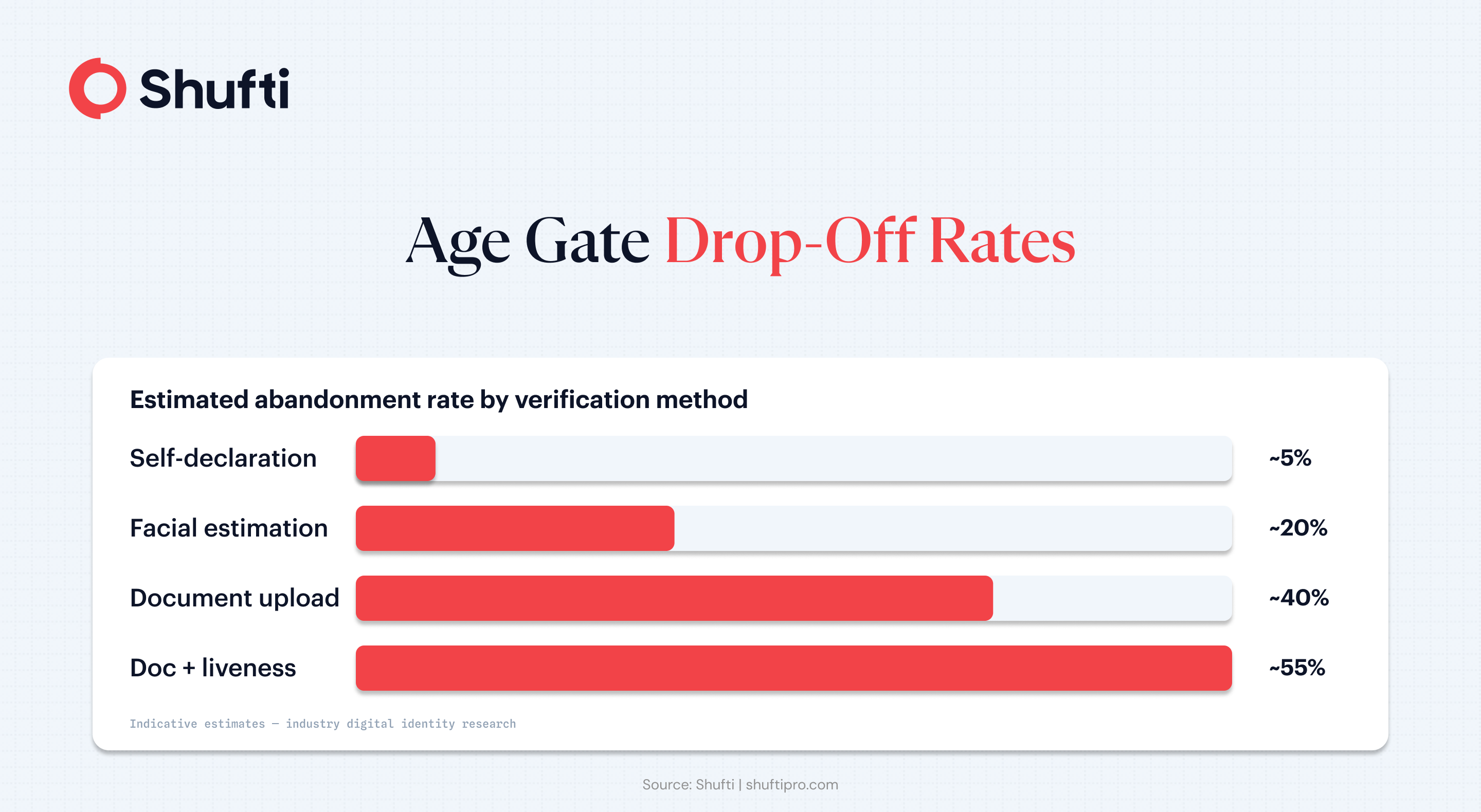
Not every age verification method carries the same abandonment cost. The gap between the lowest-friction and highest-friction approaches is large enough that method choice directly determines where your conversion loss sits.
Self-declaration
Self-declaration, such as a date-of-birth entry or a checkbox confirmation, creates almost no measurable friction. It also provides almost no assurance. In most regulated contexts, self-declaration alone does not meet the threshold for highly effective age assurance. Ofcom’s Protection of Children guidance, published in January 2025, lists approved methods including facial age estimation, Open Banking checks, and digital identity services. Self-declaration works as a first filter in a layered flow, not as a standalone control.
Facial age estimation
Facial age estimation uses a selfie to estimate a user’s age without requiring a document. For users clearly above the age threshold, the check completes in seconds with low effort. Systems apply an age buffer, clearing users only when the estimated age exceeds the threshold by several years, which means users close to the boundary may be prompted for a follow-up step. Despite that edge case, abandonment rates are materially lower than document upload for the majority of users who pass the estimate.
Document upload
Document upload delivers strong assurance and creates real friction. Users who reach a document upload step without a document accessible at that moment have a high abandonment rate, particularly in impulse-purchase contexts where the session was not planned around an identity check. The friction scales with how unexpected the request is.
Document upload with liveness detection
Document upload combined with a liveness check delivers the highest assurance and the most steps. For sensitive platforms or high-risk transaction categories, this level of confidence is warranted. For standard age-gated purchase flows, applying the same requirement to every user leaves conversion on the table.
What is a risk-based approach to age verification?
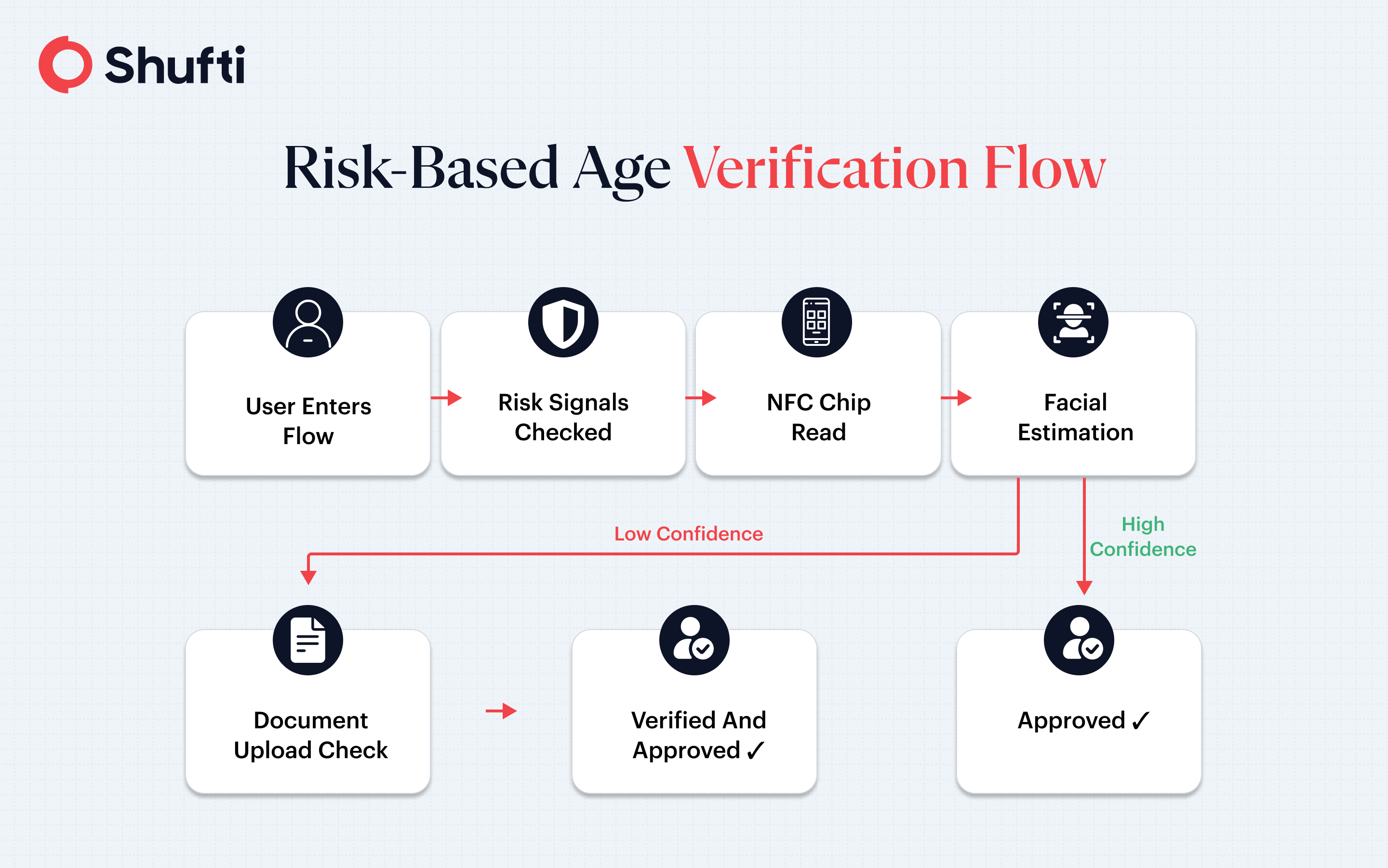
A risk-based approach to age verification applies the minimum friction needed to meet the required confidence level for a given user and transaction. Instead of a single method applied uniformly, the flow starts with the lowest-friction check and escalates only when confidence falls short.
Escalation decisions are typically based on transaction value, product category, the confidence score returned by the initial check, and account history. A returning user with a verified identity and prior purchases in the same age-restricted category may clear an age estimate alone. A new user on a high-value or high-risk product may need document verification before proceeding.
The International Association of Privacy Professionals (IAPP) frames proportionality as the core principle in its analysis of risk-based age verification approaches. The method should match the level of harm risk, not simply default to the most invasive option. That framing brings verification strategy into alignment with both conversion goals and GDPR data-minimisation obligations.
Reduce checkout friction age gate design starts from this logic. Applying the right method to the right user, in the right order, cuts abandonment across the majority of sessions without reducing assurance for the sessions that need it most.
What does seamless age verification actually require?
Age gate UX on mobile is not primarily a technology problem. It is a sequencing and feedback problem. Four design decisions drive most of the difference between a flow users complete and one they abandon.
Facial and liveness checks should launch the device camera automatically, without requiring the user to open a separate application. Document capture flows should accept multiple orientations, correct for lighting without user intervention, and return real-time feedback on capture quality rather than error codes after submission. Verification results should return within two seconds. Users begin to disengage once a process appears stuck, and a loading spinner with no progress signal reads as failure.
For returning users, a stored verification record removes the age check entirely on repeat visits. Operators running subscription services or platforms with recurring purchases can implement a first-visit full check and a returning-user token, which cuts checkout friction to a minimum on all subsequent sessions.
A/B testing your age verification flow
A/B testing is underused in age gate optimisation. Most operators configure a verification flow at launch and leave it in place, even as user behaviour shifts and mobile traffic grows.
Variables worth testing include where in the checkout sequence the age check appears, whether facial estimation is offered as the first-pass method, how retry messages are phrased, and whether the check is framed as a security measure or a regulatory requirement. Different framings produce measurably different completion rates on first-attempt document uploads.
The metrics that matter are age gate conversion rate by device type, drop-off point within the verification flow, first-attempt success rate on facial checks, and retry rate on document capture. These signals distinguish method-selection failures from execution failures in your age gate UX. For operators running flows across multiple markets, age verification regulations vary significantly by jurisdiction, which shapes which methods qualify as compliant in each test variant.
How Shufti helps operators reduce age gate abandonment
Shufti’s age verification platform is built around orchestrated flows, not single-method checks. The Journey Builder is a no-code workflow tool that lets teams configure escalation logic directly, setting the order of verification methods, the confidence thresholds that trigger escalation, and the rules that apply across device types or user risk categories. No API code is required to build a working risk-based flow.
For operators running facial age estimation as the first-pass method, Shufti’s face verification achieves a 95% first-attempt face capture success rate across global populations, with results returned in under 15 seconds. At that success rate, the large majority of sessions resolve at the lowest-friction step, with document checks reserved for the smaller share of users who need them.
The mobile SDK handles camera launch, real-time capture guidance, and orientation correction at the platform level. Operators building age-gated flows on mobile do not need to engineer those behaviours separately at the application layer.
For returning users, a verified identity stored in the platform removes re-verification on subsequent sessions, reducing repeat-visit checkout friction substantially. Operators in gambling, alcohol delivery, and subscription-based services can configure first-time users through the full orchestrated check, while returning verified users proceed directly to purchase.
Shufti holds Level 1,2 and iBeta Level 3 certification for liveness detection and Kommission für Jugendmedienschutz (KJM) approval for age verification in Germany, covering the compliance requirements for operators in EU-regulated markets.
Conversion losses at the age gate are a flow design problem more often than a compliance problem, and every friction step applied uniformly has a measurable cost when users can simply close the tab. Shufti’s age verification platform, built around the no-code Journey Builder, gives operators configurable orchestration that applies the right method to the right user at the right point in the checkout flow. Book a demo to walk through an orchestrated age verification flow built for your product category and risk profile.
Frequently Asked Questions
Q: How much does age verification reduce conversion rates?
Age verification can reduce checkout completion by 10–30% depending on method, placement, and user segment. Document upload consistently drives higher abandonment than facial estimation. The gap narrows when the check is placed earlier in the flow and when low-friction methods serve the majority of users.
Q: How can I reduce friction in age verification?
Start with the lowest-friction method your compliance requirements allow, such as facial age estimation or a database check, before requiring document upload. Position the check early in the user journey. Use a reusable verification record so returning users skip the step on subsequent visits.
Q: What is a risk-based approach to age verification?
A risk-based approach applies the minimum verification method needed to meet the required confidence level for a given user and transaction. Low-risk users clear a facial check. Higher-risk signals trigger document verification. Escalation is driven by confidence scores and transaction context rather than applied uniformly.
Q: What is orchestrated age verification?
Orchestrated age verification chains multiple verification methods into a single configurable flow. A user who passes the facial age estimate is approved. A user who does not is automatically routed to document upload without a separate manual step. The escalation logic is defined once and runs across all sessions.
Q: Should I use facial estimation or document upload for better conversion?
Facial estimation produces materially lower abandonment for users who clear the confidence threshold. Document upload delivers stronger assurance but costs more in drop-off. The best approach is facial estimation first, with document upload reserved for users where the estimate does not meet the required confidence level.