AMLR Solutions
 AMLR Consultation
 Onboarding
 Ongoing Monitoring
 FRAML
FRAML KYC
KYC KYB
KYB KYI
KYI Age Assurance
 Workforce IAM
 Candidate Verification
 Account Takeover
 Bonus/ Promotion Abuse
 Chargeback Fraud
 Deepfake
 Document Fraud
 Fraud Networks
 Impersonation Fraud
 Money Mule Activity
 Multi-Accounting
 Party Fraud
 Regulatory & Compliance Risks
 Synthetic Identity Fraud
 Adult Content
 Banking
 Crypto
 Fintech
 Forex
Forex Compliance
 Fraud prevention
 Trust & safety
 Global expansion
 Compliance Officers
 Developers
 Fraud Analysts
 Product Managers
 Advanced Journey Builder (AJB)
 Global Trust Platform
 Customer Profiles
 Vendor Comparison
 IDV Case Management
 AML Case Management
 Regulatory Reporting
 Travel Rule Protocols
 Agentic Rule Builder
 AI Compliance Co-Pilot
 Fraud Analytics
 Fraud Hub
 OCR
OCR Shufti AI
 Bank Account Verification
 Biometric Duplication
 Database Checks
 Document Intelligence
 Government ID
 Mobile Driver's License
 NFC
NFC Selfie Liveness
 Brand Personalisation
 Deployment Options
 Identity Methods
 IDV Modes
 Multi-tenancy
 On-Premise IDV
 Secure Capture











TL;DR
- OFSI closed the Consolidated List on 28 January 2026, moving designations to the UK Sanctions List.
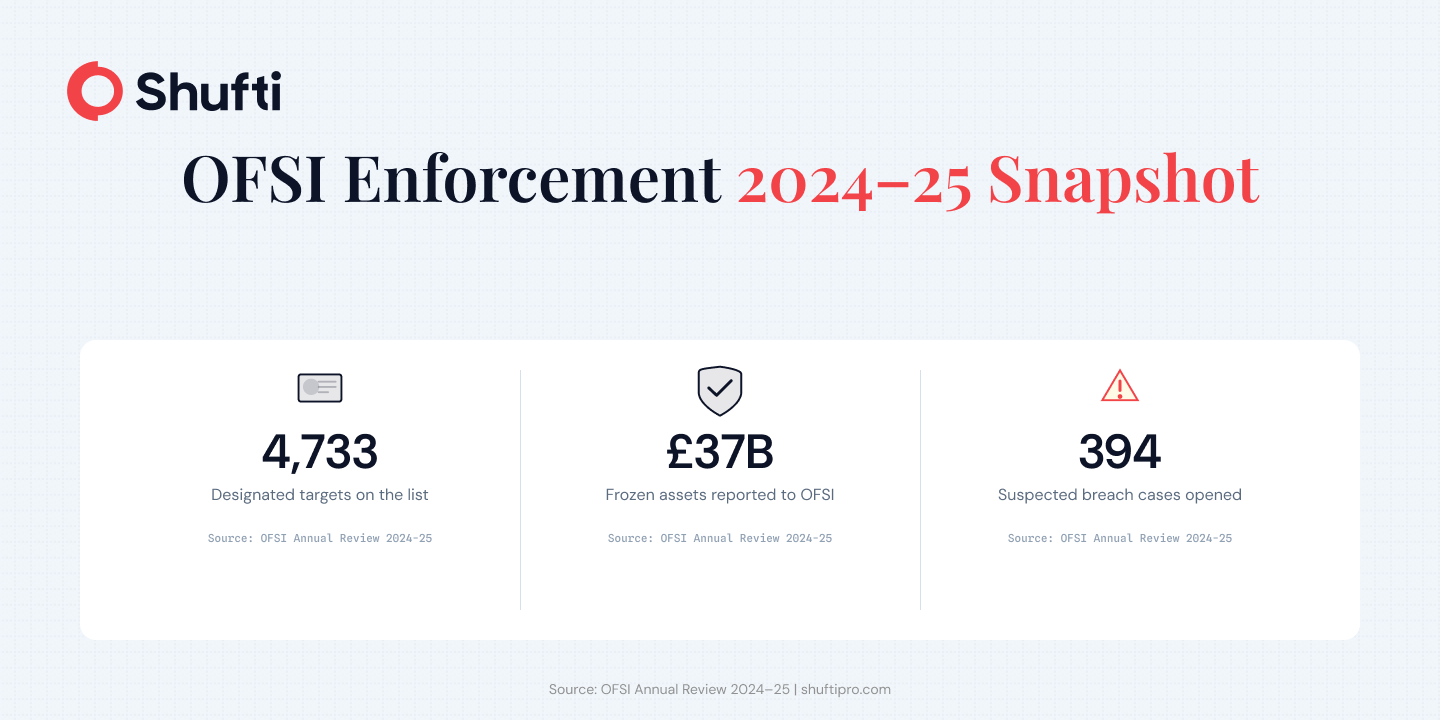
- The list covered 3,750 individuals, 968 entities, and 15 ships in 2024-25.
- OFSI opened 394 suspected breach cases and 57 enforcement actions that year.
- The maximum civil penalty is the greater of £1 million or 50% of the breach value.
- Shufti covers the UK Sanctions List and 215+ regimes, refreshed every 15 minutes.
On 28 January 2026, the UK government closed the Office of Financial Sanctions Implementation (OFSI) Consolidated List and moved all HM Treasury sanctions designations to the UK Sanctions List, the single authoritative database for HMT sanctions from that date. Any compliance team whose screening systems still pointed at the old database was pulling from a frozen dataset that OFSI would no longer maintain. The OFSI Annual Review 2024-25 shows 394 suspected breach cases opened in that reporting year alongside 57 enforcement actions, a volume that confirms this is an actively enforced regime. This guide covers what the HM Treasury Sanctions List contains, who is legally required to run HM Treasury Sanctions List screening, what a breach costs, and how to report a suspected violation.
The HM Treasury (HMT) sanctions list is the UK government’s register of individuals, entities, and vessels subject to financial restrictions under the Sanctions and Anti-Money Laundering Act 2018 (SAMLA 2018). As of 2024-25, it covered 3,750 designated individuals, 968 entities, and 15 ships across more than 30 sanctions regimes, per the OFSI Annual Review 2024-25.
What is the HM Treasury Sanctions List?
The HM Treasury sanctions list names every person, company, and vessel that UK-regulated businesses are prohibited from dealing with financially. It covers financial sanctions specifically (restrictions on funds, assets, and economic resources) and sits within a broader suite of global AML sanction regimes that internationally active organizations are required to screen against. Businesses must check the list before onboarding customers, processing payments, or entering into economic agreements with new counterparties and must rescreen as the list is updated.
From the HM Treasury consolidated list to the UK Sanctions List
Before January 2026, OFSI maintained the Consolidated List of Asset Freeze Targets (widely called the HM Treasury consolidated list or HMT consolidated list) alongside the UK Sanctions List (UKSL) as two separate databases. The UKSL launched in 2020 as the primary SAMLA 2018 register, but many compliance teams kept screening against the older list because legacy workflows were built around it. That changed on 28 January 2026 when OFSI retired the Consolidated List entirely.
The OFSI Consolidated List Search portal remains available for historical lookups, but the data it holds is frozen at the closure date and carries no new designations. Any tool or system sourcing its sanctions data from that portal is no longer fit for current compliance purposes.
What the HMT sanctions list contains?
Each entry on the UK Sanctions List includes the designated person’s full name, aliases, nationality, date of birth where available, and the grounds for listing. Entries now carry a “Unique ID” that replaces the OFSI Group ID used in the old Consolidated List. Compliance teams feeding downstream screening systems need to update any identifier-based lookups to use the new format before running checks.
The list covers designations under SAMLA 2018 across regimes including Russia, Belarus, Iran, North Korea, Myanmar, and counter-terrorism programmes. The financial prohibitions attached to each designation can vary by regime, so confirming a name appears on the list is the starting point, not the end point. The statutory instrument governing each designation sets out exactly what restrictions apply, and reading it is part of a sound compliance process.
How does HMT sanctions list screening work in practice?
“HM Treasury Sanction List Screening” means checking a customer’s name, entity name, or vessel against the UK Sanctions List before and during a business relationship. The obligation applies at onboarding and, for most regulated sectors, continues on an ongoing basis as OFSI updates the list throughout each working day.
Who must screen against the HMT list?
UK financial institutions, payment service providers, and businesses operating under the UK Money Laundering Regulations carry a legal obligation to run HMT sanctions screening. The mandate also extends to law firms, accountants, estate agents, and high-value dealers who handle client funds. Businesses with a UK nexus (meaning they involve UK persons, conduct transactions in sterling, or operate within UK territory) are within scope even if headquartered outside the UK. Effective sanctions screening in this context covers initial checks at onboarding, rescreening when the list is updated, and maintaining an audit trail of every check completed.
What the HM sanctions list screening process involve?
A sound HMT screening process runs the customer’s name and any known aliases against the UK Sanctions List, applies fuzzy-matching logic to catch spelling variations, flags potential matches for analyst review, and records the outcome with a timestamp. The list updates continuously throughout the day, so weekly or monthly batch screening is not adequate for organizations with fast onboarding volumes or high transaction frequency. Systems that screen only at account opening leave a compliance gap. A customer who was clean at onboarding can be designated after that fact, and any subsequent transaction with that person without a hit alert creates a breach. For a broader view of the global watchlists organizations need to cover alongside the HMT list, the required screening scope typically extends to OFAC, UN, and EU registers as well.
HMT sanctions: the enforcement reality
Breaching HMT sanctions carries both civil and criminal consequences. As of April 2026, OFSI’s financial sanctions enforcement guidance sets out a penalty framework that OFSI applies actively, not selectively.
Civil penalties and criminal prosecution
The current maximum civil penalty for a financial sanctions breach is the greater of £1 million or 50% of the breach value, per OFSI’s monetary penalties guidance. A 2025 OFSI consultation proposed doubling that ceiling to the greater of £2 million or 100% of the breach value, with implementation pending parliamentary time. Criminal prosecution remains available for the most serious cases under SAMLA 2018, carrying a maximum sentence of seven years’ imprisonment.
The OFSI Annual Review 2024-25 recorded £37 billion in frozen assets for the period, up from £24.4 billion the previous year, with £22.5 billion sitting under the Russia regime alone, which gives a sense of the compliance exposure for any institution transacting near Russia-connected counterparties.
How to report a suspected HMT breach?
If your organization knows or reasonably suspects that a customer is a designated person, or that a financial sanctions prohibition has been breached, you must report to OFSI as soon as practicable. The report should include the relevant sanctions regime, details of the transaction or relationship involved, and documentation explaining how the breach was identified. OFSI launched online submission forms for breach reporting in July 2025, replacing the previous email-only route. Confidential reporting is also available for whistleblowers who have no formal statutory obligation but become aware of a potential breach during the course of their work.
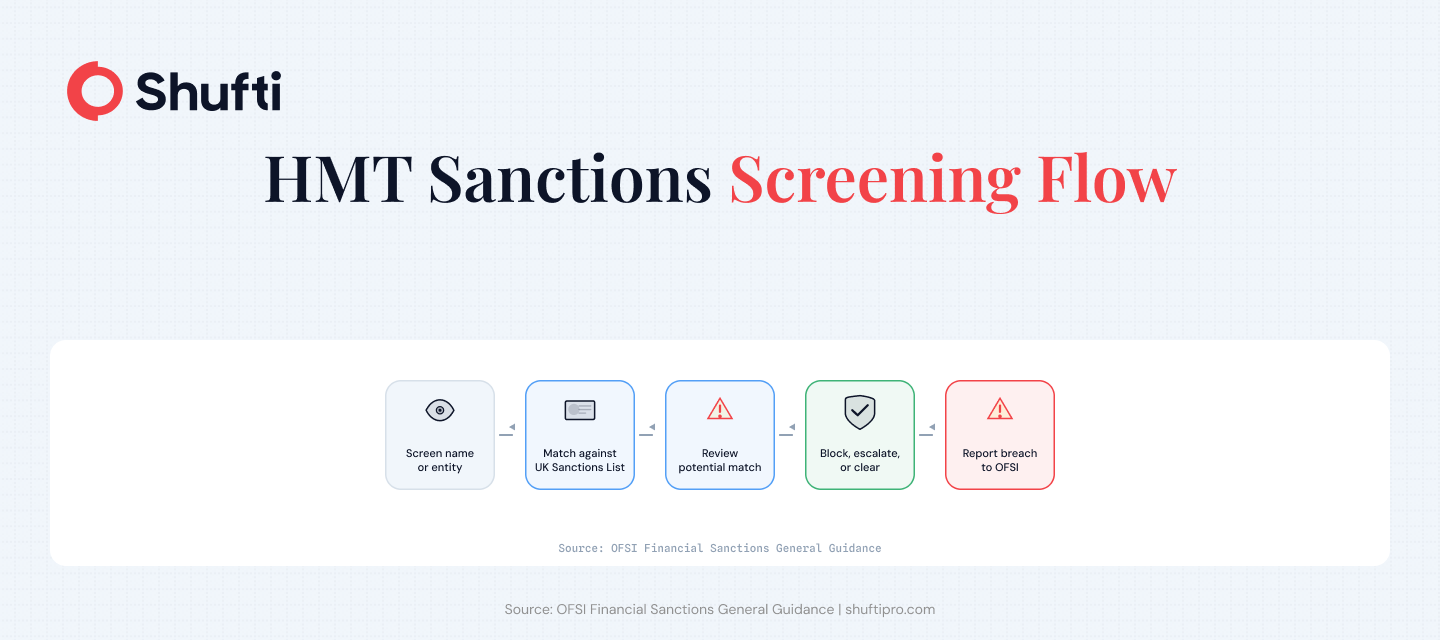
Request a demo to see how the screening flow handles live HMT list updates and what the output looks like on your own onboarding data.
Frequently Asked Questions
What is HM Treasury Sanctions List?
The HM Treasury sanctions list is the UK government's official register of individuals, entities, and vessels subject to financial restrictions under SAMLA 2018. It is administered by OFSI. As of 2024-25, it covered more than 4,700 designated targets across 30-plus regimes, per the OFSI Annual Review 2024-25. From January 2026, it exists exclusively as the UK Sanctions List.
Is the HMT list the same as the UK sanctions list?
Yes, from 28 January 2026. Before that date, OFSI ran two parallel databases: the HMT Consolidated List and the UK Sanctions List. The Consolidated List was retired on 28 January 2026, making the UK Sanctions List the single source for all HM Treasury sanctions designations. The terms "HMT sanctions list" and "UK Sanctions List" now refer to the same database.
Do US companies need to screen against the HMT list?
Not automatically. UK financial sanctions apply to UK persons and businesses with a UK nexus. A US company with no UK-based operations, UK-person involvement, or sterling-denominated transactions has no direct legal obligation under SAMLA 2018. However, US companies with UK subsidiaries, UK counterparties, or transactions touching UK territory should treat HMT screening as part of their compliance scope, as the nexus test can apply at the transaction level, not just the entity level.
What's the penalty for breaching HMT sanctions?
Per OFSI's enforcement guidance, the current civil penalty ceiling is the greater of £1 million or 50% of the breach value. A 2025 OFSI consultation proposed doubling this to the greater of £2 million or 100% of the breach value, pending legislation. Criminal prosecution under SAMLA 2018 carries a maximum sentence of seven years' imprisonment.
How do I report a suspected HMT breach?
Report to OFSI as soon as practicable using the online forms launched on GOV.UK in July 2025. Your report should cover the relevant sanctions regime, details of the transaction or relationship in question, and documentation of how the breach was discovered. Confidential reporting is also available on a voluntary basis for whistleblowers with no formal reporting obligation.