AMLR Solutions
  AMLR Consultation
 EUDI Wallet
 Onboarding
 Ongoing Monitoring
 FRAML
FRAML KYC
KYC KYB
KYB KYI
KYI Age Assurance
 Workforce IAM
 Candidate Verification
 Account Takeover
 Bonus/ Promotion Abuse
 Chargeback Fraud
 Deepfake
 Document Fraud
 Fraud Networks
 Impersonation Fraud
 Money Mule Activity
 Multi-Accounting
 Party Fraud
 Regulatory & Compliance Risks
 Synthetic Identity Fraud
 Adult Content
 Banking
 Crypto
 Fintech
 Forex
Forex Compliance
 Fraud prevention
 Trust & safety
 Global expansion
 Compliance Officers
 Developers
 Fraud Analysts
 Product Managers
 Journey Builder
  Global Trust Platform
 Customer Profiles
 Vendor Comparison
 IDV Case Management
 AML Case Management
 Regulatory Reporting
 Agentic Rule Builder
  AI Compliance Co-Pilot
  Fraud Analytics
 Fraud Hub
  OCR
OCR Shufti AI
 Bank Account Verification
  Biometric Duplication
 Database Checks
 Document Intelligence
 Government ID
 Mobile Driver's License
 NFC
NFC Selfie Liveness
 Brand Personalisation
 Deployment Options
 Identity Methods
 IDV Modes
 Multi-tenancy
 On-Premise IDV
 Secure Capture
 Shufti MCP










TL;DR
- Cuba sanctions under OFAC’s CACR prohibit most trade, investment, and financial transactions.
- In 2025 Key Holding paid a $608,825 penalty for unlicensed shipments to Cuba.
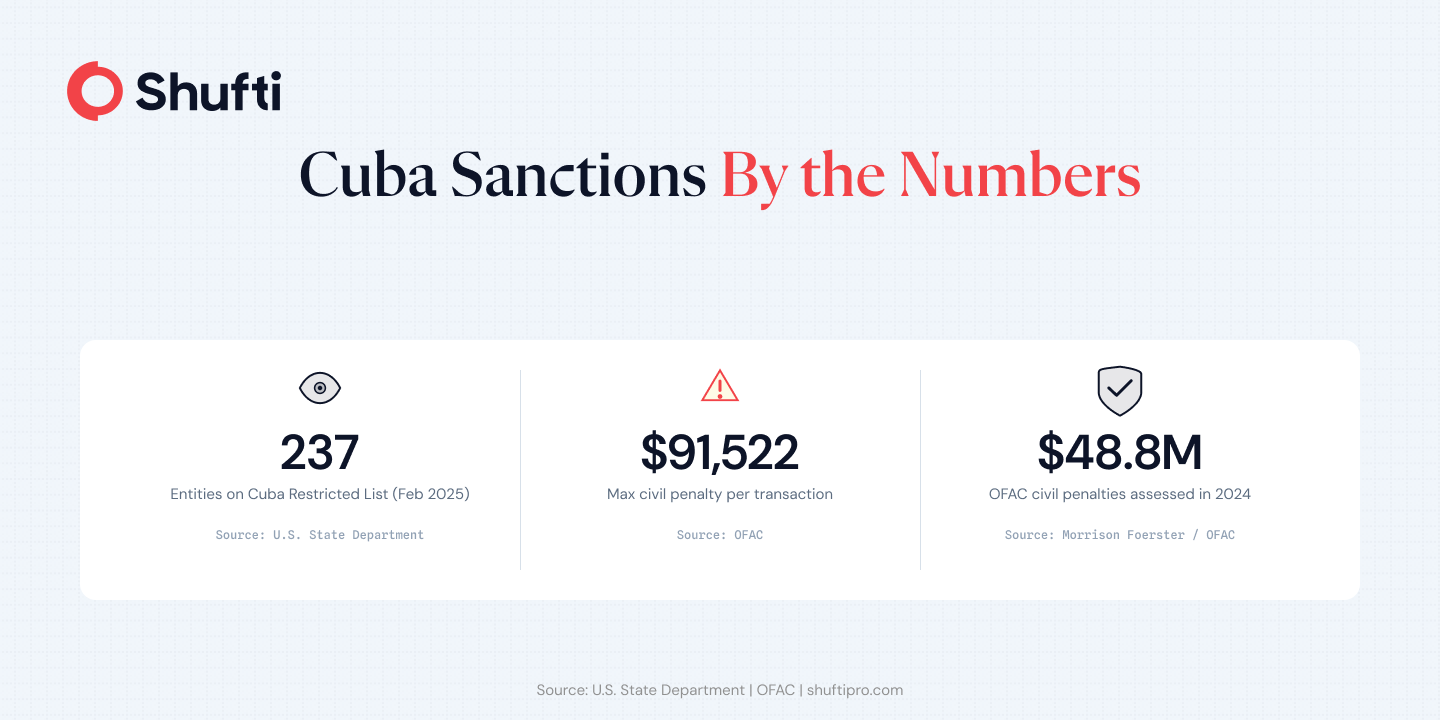
- The Cuba Restricted List, reinstated in February 2025, names 237 entities.
- The rules reach non-US firms through parent control, US nexus, and Helms-Burton claims.
- Civil penalties can reach $91,522 per transaction under OFAC’s framework.
In 2025, Key Holding, LLC received a $608,825 civil penalty from the Office of Foreign Assets Control (OFAC) after its Colombian subsidiary arranged 36 unlicensed freight shipments to Cuba worth approximately $3 million. The US parent company controlled the subsidiary’s operations, and that control was sufficient to make OFAC’s Cuban Assets Control Regulations (CACR) apply to a company incorporated in Colombia.
The Key Holding case is not unusual. The CACR, which has been in force since 1963, reaches further than most compliance teams assume. This guide sets out what activities the regulations prohibit, what cannot be shipped to Cuba, and which businesses outside the United States are caught by the rules.
What are Cuba Sanctions?
Cuba sanctions are one of the longest-standing US embargo programmes, and among the most broadly scoped. The CACR prohibits US persons, and in many cases their foreign-controlled subsidiaries, from engaging in virtually any transaction where Cuba or a Cuban national holds a direct or indirect interest.
The sanctions draw authority from several instruments, starting with the Trading with the Enemy Act of 1917. The Cuban Democracy Act of 1992 and the Helms-Burton Act of 1996 extended their reach, tightened restrictions on third-country trade, and limited the ability of future administrations to lift them without congressional approval. The Helms-Burton Act also opened the door to private civil claims against foreign nationals who traffic in property confiscated from US persons by Cuba.
Since January 2025, the United States has pursued a maximum-pressure posture toward Cuba. The Cuba Restricted List, reinstated in February 2025 with 237 named entities, targets companies controlled by or acting on behalf of Cuban military, intelligence, and security services. Direct financial transactions with these entities are generally prohibited under 31 CFR 515.209. Compliance teams tracking AML sanction lists across multiple regimes need both entity-level screening and payment-level controls for Cuba.
What business activities are banned under US sanctions on Cuba?
The CACR prohibits US persons from conducting most forms of commerce with Cuba, and the prohibited categories are broad. The regulations cover financial services, trade in goods, professional services, and travel-related payments, reaching domestic and international activity wherever a Cuban nexus exists.
Financial transactions and investment
US persons cannot open or maintain accounts with Cuban financial institutions, extend credit to Cuban nationals, or process dollar-denominated transactions involving a Cuban nexus. Wire transfers that pass through a US correspondent bank and involve Cuba require an OFAC licence even when neither party is American. US persons are also prohibited from investing in Cuban entities, acquiring Cuban real estate, and receiving dividends or profits from Cuban-controlled businesses.
Trade in goods and services
The CACR bars the import of Cuban-origin goods into the United States and the export of most US goods to Cuba without a specific or general OFAC licence. Services rendered to Cuban nationals inside Cuba are prohibited unless a licence exception applies. This prohibition covers consulting arrangements, software licensing, professional advisory services, and technical assistance, meaning firms that sell software-as-a-service or managed services globally need to screen their customer base against the Cuba Restricted List before onboarding.
Travel-related payments
US citizens may travel to Cuba under certain authorised categories, but paying for travel-related expenses is where the prohibition activates. US banks cannot process payments to Cuban hotels, airlines, or tour operators. Twelve categories of travel, including family visits, journalistic activity, educational exchanges, and professional research, are authorised under general licences, but the traveller must independently qualify for the applicable category. Cuba-related transactions in these sectors require upfront screening.
What items are prohibited for export to Cuba?
Most goods and technology subject to US jurisdiction require a licence before they can be shipped to Cuba, and most licence applications are denied. Two regulatory bodies control Cuba export restrictions, and both must be satisfied before any shipment clears.
Bureau of Industry and Security controls
The Bureau of Industry and Security (BIS) administers Cuba export controls under the Export Administration Regulations (EAR). As of April 2026, all items subject to US export jurisdiction require a licence exception or specific BIS authorisation to ship to Cuba. Items with higher Export Control Classification Numbers, including dual-use technology, semiconductors, encryption software, and defence-related equipment, face a near-total denial policy. BIS publishes its current guidance on the BIS Cuba export controls page.
Cuba Restricted List and prohibited recipients
Even categories with the widest licence exceptions face additional screening requirements when the intended recipient appears on the Cuba Restricted List. BIS will generally deny licence applications for goods destined for listed entities regardless of the item’s export classification. The State Department’s February 2025 Federal Register notice covering the 237-entity Cuba Restricted List covers military holding companies, hotels, tourist agencies, marina operators, and entities serving the defence and security sectors.
Foodstuffs and medicine carry the broadest licence exceptions under both BIS and OFAC rules, but they are not exempt from the Cuba Restricted List check. The Key Holding case makes this clear. The unlicensed shipments in that matter were largely foodstuffs, which demonstrates that even goods with favourable licence treatment require authorisation before they move. Any exporter relying on a food or medicine carve-out still needs to confirm the recipient is not on the restricted entity list.
Do Cuba sanctions apply to non-US companies?
Cuba sanctions reach non-US companies in three distinct circumstances, and each carries its own enforcement risk profile.
The first is parent-company control. A foreign company owned or controlled by a US person is treated as a US person under the CACR. The Key Holding case illustrates this directly. Its Colombian subsidiary was liable because the US parent controlled its operations, not because the entity had a US address or US employees.
The second is the US nexus rule. A non-US company that causes a US person to violate the CACR can face civil penalties even without any US incorporation. Processing a Cuba-related payment through a US correspondent bank, using US-origin software in a transaction with a Cuban entity, or routing communications through US infrastructure can each create the nexus OFAC needs to assert jurisdiction. Non-US financial institutions that process dollar-denominated payments are particularly exposed because dollar clearing passes through US correspondent accounts by default.
| Circumstance | How it applies |
| Parent-company control | Foreign firm controlled by a US person is treated as a US person |
| US nexus rule | Causing a US person to breach the CACR, e.g. USD payments via US banks |
| Helms-Burton Title III | US nationals sue foreign firms over confiscated Cuban property |
The third is the Helms-Burton Act’s Title III, which allows US nationals to bring civil claims in US courts against foreign persons who traffic in confiscated Cuban property. The European Union responded by enacting a blocking statute that makes compliance with Helms-Burton Title III unlawful for EU companies operating in Cuba. Foreign companies therefore face conflicting legal obligations from two directions. OFAC demands compliance on the US side, while EU and UK blocking statutes make that compliance unlawful for European firms operating in Cuba.
In 2024, OFAC issued 12 public enforcement actions and assessed approximately $48.8 million in civil monetary penalties across its sanctions programmes. Civil penalties for Cuba sanctions violations can reach $91,522 per transaction under OFAC’s penalty framework, with criminal penalties of up to $1 million and 10 years in prison for wilful violations. For non-US firms with any US nexus, sanctions screening against OFAC’s Cuba programme is not a US-only compliance obligation.
How Shufti helps compliance teams screen Cuba-related exposure
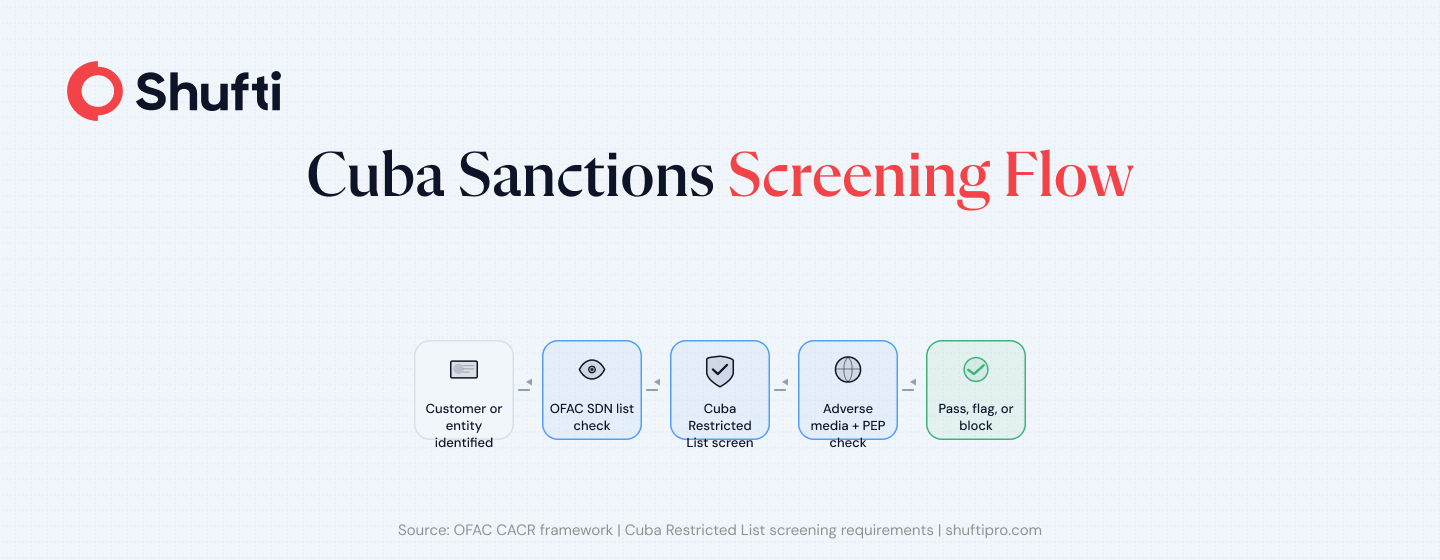
Cuba sanctions violations rarely start with a deliberate decision to circumvent the law. They begin with a gap in the screening workflow, where a counterparty name does not match the Cuba Restricted List as written but resolves to a military-controlled entity, or an onboarding check ran against last month’s watchlist rather than the version updated this week.
Shufti’s AML screening checks customers and counterparties against 3,500+ global watchlists and 215+ sanction regimes in real time, with data updated every 15 minutes. The Cuba Restricted List, OFAC’s Specially Designated Nationals (SDN) list, and secondary sanctions lists are part of the standard screening set. When a match occurs, the system surfaces contextual information for the analyst, enabling a reasoned decision rather than a bare pass or fail against a name string.
For firms screening at the transaction level as well, Shufti’s transaction screening applies the same dataset to payment instructions before a transfer clears, flagging Cuba-linked routing before they become enforcement liabilities.
Frequently Asked Questions
What business activities are banned under Cuba sanctions?
US persons cannot invest in Cuban entities, process most Cuba-related financial transactions, export most goods or services to Cuba, or pay for travel-related expenses in Cuba without an OFAC licence. The prohibitions cover virtually all commercial activity where Cuba or a Cuban national holds a direct or indirect interest in the transaction.
What items are prohibited for export to Cuba?
Most goods subject to the Export Administration Regulations require a BIS licence to export to Cuba, and most applications are denied. Items with higher export control classifications, including dual-use technology and defence-related equipment, face a near-total denial policy. Foodstuffs and medicine carry broader exceptions but still require authorisation, and goods destined for Cuba Restricted List entities face additional barriers regardless of the item type.
Do Cuba sanctions apply to non-US companies?
Yes, in three circumstances. A foreign company owned or controlled by a US person is treated as a US person under the CACR. Any non-US company that causes a US person to violate the CACR can face civil liability, including through dollar-denominated payments cleared via US correspondent banks. The Helms-Burton Act also enables US nationals to sue foreign companies in US courts over confiscated Cuban property, creating a conflict with EU and UK blocking statutes for European firms.
What is the Cuba Restricted List?
The Cuba Restricted List is a US State Department list of entities controlled by or acting on behalf of the Cuban military, intelligence, or security services. As of February 2025, the list names 237 entities. Direct financial transactions with listed entities are generally prohibited under 31 CFR 515.209, and BIS will typically deny export licence applications for goods destined for listed recipients.