AMLR Solutions
  AMLR Consultation
 EUDI Wallet
 Onboarding
 Ongoing Monitoring
 FRAML
FRAML KYC
KYC KYB
KYB KYI
KYI Age Assurance
 Workforce IAM
 Candidate Verification
 Account Takeover
 Bonus/ Promotion Abuse
 Chargeback Fraud
 Deepfake
 Document Fraud
 Fraud Networks
 Impersonation Fraud
 Money Mule Activity
 Multi-Accounting
 Party Fraud
 Regulatory & Compliance Risks
 Synthetic Identity Fraud
 Adult Content
 Banking
 Crypto
 Fintech
 Forex
Forex Compliance
 Fraud prevention
 Trust & safety
 Global expansion
 Compliance Officers
 Developers
 Fraud Analysts
 Product Managers
 Journey Builder
  Global Trust Platform
 Customer Profiles
 Vendor Comparison
 IDV Case Management
 AML Case Management
 Regulatory Reporting
 Agentic Rule Builder
  AI Compliance Co-Pilot
  Fraud Analytics
 Fraud Hub
  OCR
OCR Shufti AI
 Bank Account Verification
  Biometric Duplication
 Database Checks
 Document Intelligence
 Government ID
 Mobile Driver's License
 NFC
NFC Selfie Liveness
 Brand Personalisation
 Deployment Options
 Identity Methods
 IDV Modes
 Multi-tenancy
 On-Premise IDV
 Secure Capture
 Shufti MCP













TL;DR
- Positive sanctions reward conformity; negative sanctions attach a cost to deter behaviour.
- “Negative” describes the effect on behaviour, not a moral judgement.
- Sanctions split four ways across two axes: formality and direction.
- 2025 OFAC enforcement reached $265 million, a fivefold increase on 2024.
- High-stakes regulatory violations favour negative sanctions over incentive-based approaches.
In 2025, U.S. Office of Foreign Assets Control (OFAC) enforcement actions totaled $265 million in penalties against companies found in violation of formal sanctions programmes, a fivefold increase on 2024. That figure illustrates something the academic framing of the word often obscures. Whether a sanction appears in a sociology syllabus or a regulatory enforcement notice, the underlying logic is the same. Both apply a deliberate consequence to influence behaviour. Understanding the difference between positive and negative sanctions, and how each type operates in practice, matters well beyond the classroom.
A sanction is any deliberate response to behaviour, intended to reward conformity or discourage deviation from an established norm. Sanctions are split into two types by formality, formal (set by law or policy) or informal (enforced by social pressure), and by direction. The difference between positive and negative sanctions comes down to that direction. Positive sanctions reinforce desired behaviour. Negative sanctions apply an unwanted cost.
This article maps all four types across real-world settings, from workplace management to international regulatory enforcement, and examines where each type proves more effective.
What does a negative sanction mean, and how does it work?
The term “negative sanction” is often misread as a synonym for something harmful or extreme. What a negative sanction means in social science is more specific. It is any consequence that reduces the likelihood of a behaviour recurring by attaching a cost to it. The word “negative” refers to what the sanction does to the behaviour, not to a moral judgement about the measure itself.
Negative sanctions span a wide range in form and severity. A disapproving glance from a manager is a negative sanction. So is a criminal sentence. Both attach a cost to a behaviour, whether social, financial, or physical, to signal that the behaviour crossed a line and deter its repetition. The Financial Action Task Force (FATF) builds its Recommendations framework around this logic at the inter-governmental level. As of 2025, jurisdictions that fail to implement adequate anti-money laundering controls face FATF grey-listing, a formal negative sanction that restricts their access to global financial networks until deficiencies are corrected.
Positive sanctions work in the opposite direction. A pay raise, a public commendation, a tax incentive for regulatory compliance, or an employee award are all positive sanctions. They do not require a violation to trigger. They respond to behaviour that meets or exceeds an expected standard and make that behaviour more likely to continue.
Types of sanctions: the four-category framework
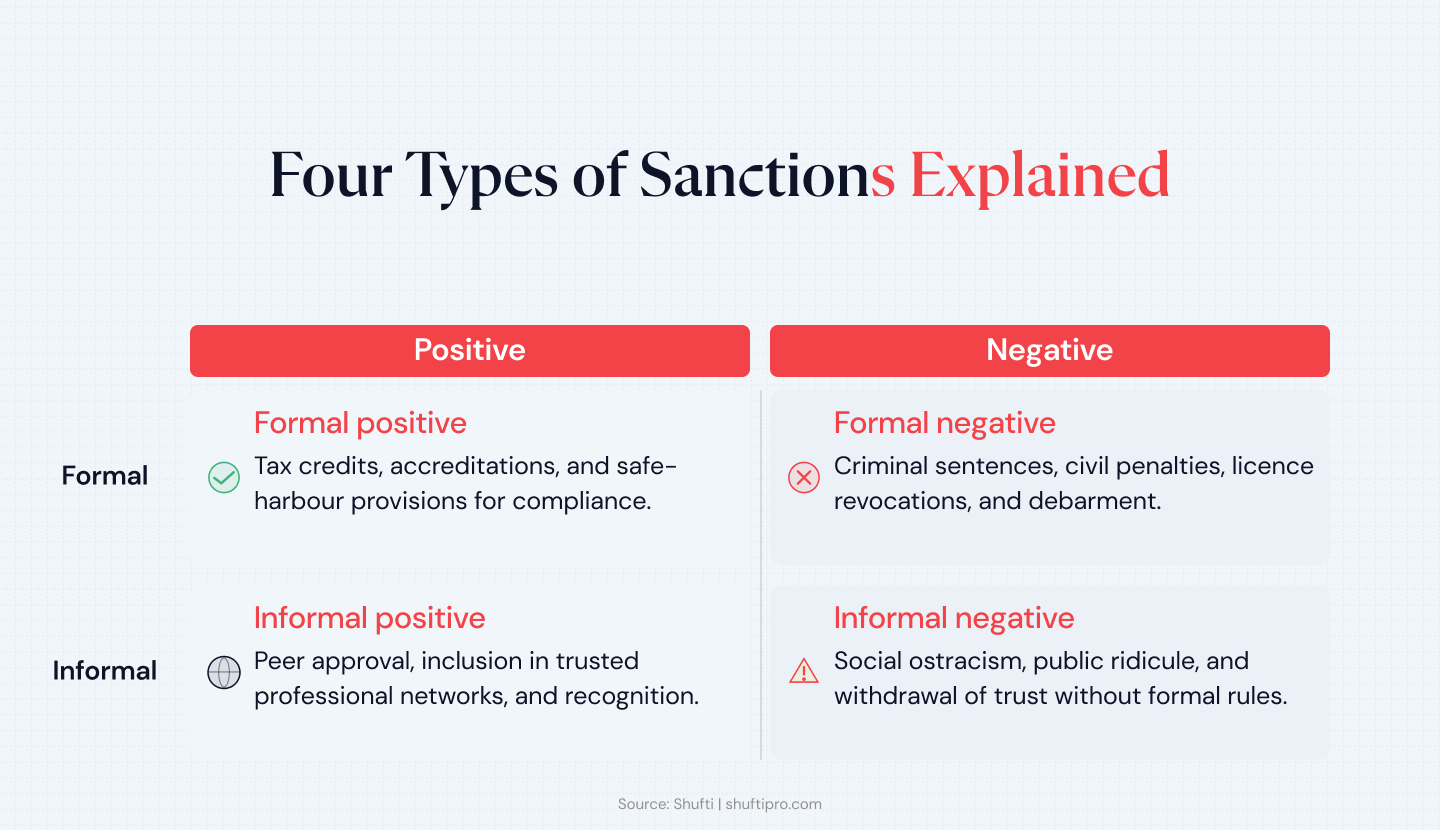
Sanctions are organised along two intersecting axes, formality and valence, giving four distinct types. Every sanction fits one of them, whether it is an international trade restriction, a workplace bonus, or a round of disapproval from a peer group.
| Type | Example |
| Formal positive | State honours, professional accreditations, tax incentives, safe-harbour provisions |
| Formal negative | Criminal sentences, civil penalties, licence revocations, debarment, censures |
| Informal positive | Approval, network inclusion, peer praise, public recognition |
| Informal negative | Gossip, exclusion, ridicule, withdrawal of trust, social ostracism |
Formal sanctions
Formal sanctions are applied through official channels with defined procedures and documented criteria. Formal positive sanctions include state honours, professional accreditations, tax incentives for compliant behaviour, and regulatory safe-harbour provisions that protect entities meeting a defined standard. Formal negative sanctions are those most readily associated with the word. These include criminal sentences, civil monetary penalties, licence revocations, debarment from public contracts, and regulatory censures.
Laws are not automatically formal negative sanctions. Many laws create entitlements, grant permissions, or mandate neutral procedural obligations. As of April 2026, OFAC administers over 30 distinct sanctions programmes covering specific countries, entities, and conduct types, each carrying formal negative consequences that range from asset freezing to criminal prosecution. For a breakdown of how AML sanction lists are structured across major global regimes, the specifics vary significantly by jurisdiction and programme type.
Informal sanctions
Informal sanctions operate through social dynamics, not institutional authority. Informal positive sanctions examples include approval, inclusion in trusted professional networks, praise from peers, and public recognition that carries no official weight but shapes behaviour reliably. Informal negative sanctions examples include gossip, exclusion, public ridicule, withdrawal of trust, and social ostracism.
Informal sanctions are enforced not by any designated authority but by collective group behaviour. A team that quietly stops including someone in decisions is applying an informal negative sanction. Its force often exceeds what a written warning achieves, particularly in professional settings where reputation is a functional asset. Informal sanctions do not require formal procedures to take effect, and they typically cannot be formally appealed.
Negative sanctions examples across real-world settings
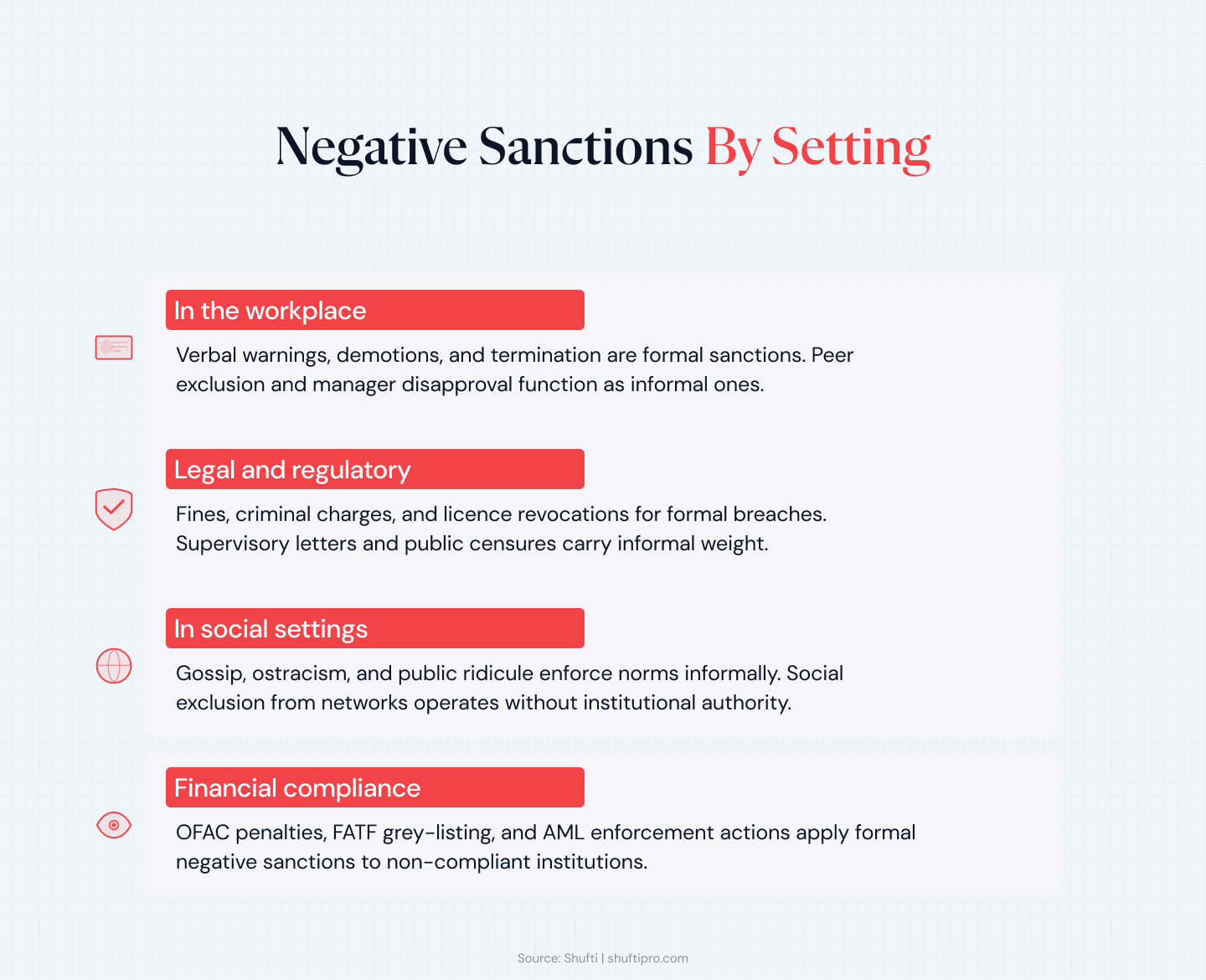
The form a negative sanction takes depends on the setting in which it operates. A regulatory fine, a verbal warning at work, and social exclusion from a peer group all serve the same underlying function. A cost is attached to a behaviour, applied deliberately, to reduce its frequency.
In the workplace
Formal negative sanctions in employment include verbal warnings, written reprimands, demotion, suspension, pay reductions, and termination. Each sits inside a defined HR procedure and creates a documented record. Informal workplace negative sanctions are less structured. A manager’s visible disappointment, a team’s collective withdrawal of engagement, or the loss of access to high-visibility projects all function as informal negative sanctions. Workplace rewards, including bonuses, promotions, and recognition programmes, are positive sanctions, formal or informal depending on whether they follow documented criteria or arise spontaneously from peer acknowledgement.
In legal and regulatory enforcement
In financial regulation, formal negative sanctions are the primary compliance enforcement tool. Per the UNODC’s current estimates, 2 to 5 percent of global GDP, between $800 billion and $2 trillion annually, flows through money laundering networks. The formal negative sanctions designed to deter this, including fines, criminal charges, and loss of banking licences, impose significant costs on violating institutions. Regulatory bodies also deploy informal negative sanctions. These include public statements identifying poor practice, supervisory letters, and skilled-persons reviews, all of which carry reputational consequences that extend well beyond their formal weight.
Can positive sanctions be as powerful as punishment?
Whether positive sanctions match negative ones in effectiveness depends on the behaviour being targeted, the timing of the response, and the stakes involved. The research does not give a single answer, but three conditions shift the balance toward positive reinforcement.
Timing makes a material difference. A positive sanction applied immediately after a desired behaviour reinforces it more reliably than a delayed negative sanction tied to a future audit or review cycle. Bonus structures linked directly to a specific compliance milestone work in this way. A vague threat of future consequences that may or may not materialise carries much less weight.
Perceived fairness also matters. Positive sanctions that recipients view as earned and consistently applied shape behaviour more durably than formal rewards that feel arbitrary. This is why recognition programmes succeed or fail based on the transparency of their criteria, not their financial value.
High-stakes violations, however, favour negative sanctions. As of June 2025, only 16 percent of countries assessed by FATF demonstrated high or substantial effectiveness in implementing targeted financial sanctions. At that scale of non-compliance, incentive-based approaches alone cannot close the gap. The consequences of undetected violations, including sanctions evasion, financial fraud, and systematic anti-money laundering failures, require deterrence at a level that positive reinforcement cannot replicate.
How Shufti helps compliance teams act on formal negative sanctions
Formal negative sanctions in financial regulation carry consequences that extend well beyond the headline penalty. Downstream costs, covering enhanced supervisory requirements, remediation programmes, and reputational damage with counterparties, often dwarf the fine itself. What compliance teams need is not just an understanding of how negative sanctions work conceptually, but the operational capability to keep their entities off the wrong side of a sanctions list before a breach occurs.
Shufti’s AML screening runs continuous checks against 215+ sanction regimes and 3,500+ global watchlists, covering OFAC, UN, EU, and HM Treasury lists, with data updated every 15 minutes. When a customer or beneficial owner appears on a sanctions list after initial onboarding, the system surfaces the match in real time rather than leaving it to the next scheduled screening cycle. Shufti also screens against Politically Exposed Person (PEP) profiles and adverse media across 50,000+ sources, so the signal extends beyond official list hits to the broader risk picture. For teams managing ongoing AML screening obligations across jurisdictions, that continuous coverage means compliance findings surface when they are still actionable.
Batch-based sanctions screening creates the kind of lag that OFAC enforcement actions punish. Shufti’s screening keeps watchlist checks current across 215+ sanctions regimes without manual overhead, so your compliance team works from a live view of sanctions status rather than last month’s batch run. Request a demo to see how the screening flow handles your onboarding volumes and ongoing monitoring requirements.
Frequently Asked Questions
Are workplace rewards considered positive sanctions?
Yes. Bonuses, promotions, public recognition, and employee award programmes are all positive sanctions. They reward behaviour that meets or exceeds an organisational standard and increase the likelihood that it continues. They qualify as formal positive sanctions when criteria are documented and applied consistently, or informal positive sanctions when they arise from spontaneous peer acknowledgement or managerial approval.
Why do societies rely more on negative sanctions?
Negative sanctions respond to violations that have already occurred, making them visible, attributable, and defensible under legal frameworks. Positive sanctions require identifying and rewarding compliant behaviour proactively, which is harder to operationalise consistently at scale. Behavioral research also shows that people weight potential losses more heavily than equivalent gains, which means the threat of a negative sanction carries more deterrent force than the promise of a reward of equal value.
How are informal sanctions actually enforced?
Informal sanctions are enforced through collective social behaviour rather than any institutional authority. Withdrawal of approval, exclusion from social or professional networks, gossip, and public criticism are applied by groups acting on shared norms, not by a designated body with formal powers. Because they carry no formal rules or due process, informal sanctions can operate faster than formal ones and cannot typically be appealed.
Can positive sanctions be as powerful as punishment?
Under the right conditions, yes. When a positive sanction is applied immediately after a desired behaviour, its criteria are transparent, and its value is proportionate to the behaviour, it can sustain compliance as effectively as the threat of punishment. For high-stakes regulatory violations, negative sanctions dominate. The detection rates needed to make incentive-based compliance work at scale exceed what most positive-reinforcement programmes can deliver.
Are laws always considered formal negative sanctions?
No. Laws create a range of formal consequences. Criminal statutes are typically formal negative sanctions, attaching defined penalties to defined conduct. Many laws also create formal positive sanctions, such as tax relief for compliant behaviour, regulatory safe-harbour provisions, and financial incentives for meeting reporting or environmental standards. Some statutes mandate neutral procedural obligations, such as disclosure requirements or record-keeping rules, without attaching a reward or a punishment to the outcome.