




 Face Verification
 Address Verification
 Document Verification
 Age Verification
 VideoIdent
 Fast ID
 Docless Verification
 Consent Verification
 NFC Verification
 Business Verification
 Due Diligence
 Investor Verification
 E-Signature

 QES
QES
 AML Screening
 Transaction Monitoring
 Adverse Media
 Business AML Screening
 PEP & RCA
 Sanctions
 Watchlist
 Behavioural Biometrics
 Device Fingerprinting
 Biometric Face Authentication
 MFA
MFA
 Fraud Hub
 Onboarding
 Ongoing Monitoring
 KYC
KYC
 KYB
KYB
 KYI
KYI
 Age Assurance
 Identity Verification
 Workforce IAM
 Candidate Verification
 Compliance
 Fraud prevention
 Trust & safety
 Global expansion
 Product Managers
 Compliance Officers
 Fraud Analysts
 Developers
 Deepfake Detection
 Bonus Abuse / Promotion Abuse
 Account Takeover
 Synthetic Identity Fraud
 Document Fraud
 Impersonation Fraud
 Multi-Accounting
 Fraud Networks
 Chargeback Fraud
 Money Mule Activity
 Party Fraud
 Regulatory & Compliance Risks
 Fintech
 Crypto
 iGaming
 Forex
Forex
 Social Network
 Marketplace
 Banking
 Gig Economy
 Payments
 Ride Hailing
 Adult Content
 Blind Spot Audit
 Deepfake Detector
 Liveness Spoofs
 Document Originality
 Document Deepfake
 Global Trust Platform
 Journey Builder
 Case Management
 Shufti AI
 Fraud Analytics
 Vendor Comparison
 Brand Personalisation
 AI Compliance Co-Pilot
 OCR
OCR
 Secure Capture
 Deployment Options
 Identity Methods
 API Documentation
 Mobile SDKs
 Service Status
 Help Center
 Contact Us
 Technical Support
 Supported Documents
 Supported Countries
 Content library
 Blogs
Blogs
 News
News
 Reports
 Insights
 Knowledgebase
 ROI calculator
 About
About
 Career
 Press Release
 Certifications
 Partnership
 Awards
 Events & Webinar
 Interactive Demo
 Podcast Studio
 Spotlight Studio
Identity Verification Platform: How It Works and What to Look For
-
Add us as a Preferred Source
- 01 What Is an Identity Verification Platform?
- 02 How Does an Identity Verification Platform Work?
- 03 Why Businesses Need an Identity Verification Platform
- 04 What Features Matter When Choosing a Platform
- 05 How Shufti Supports Identity Verification at Scale
- 06 Conclusion
TL;DR
- An identity verification platform confirms a customer’s identity before granting product access.
- It checks documents, matches faces, screens watchlists, and returns a decision in seconds.
- Identity theft reports through September 2025 already surpassed all of 2024.
- Six features separate a production-grade platform from a basic check.
- Document coverage, liveness, AML screening, workflows, deployment, and speed matter most.
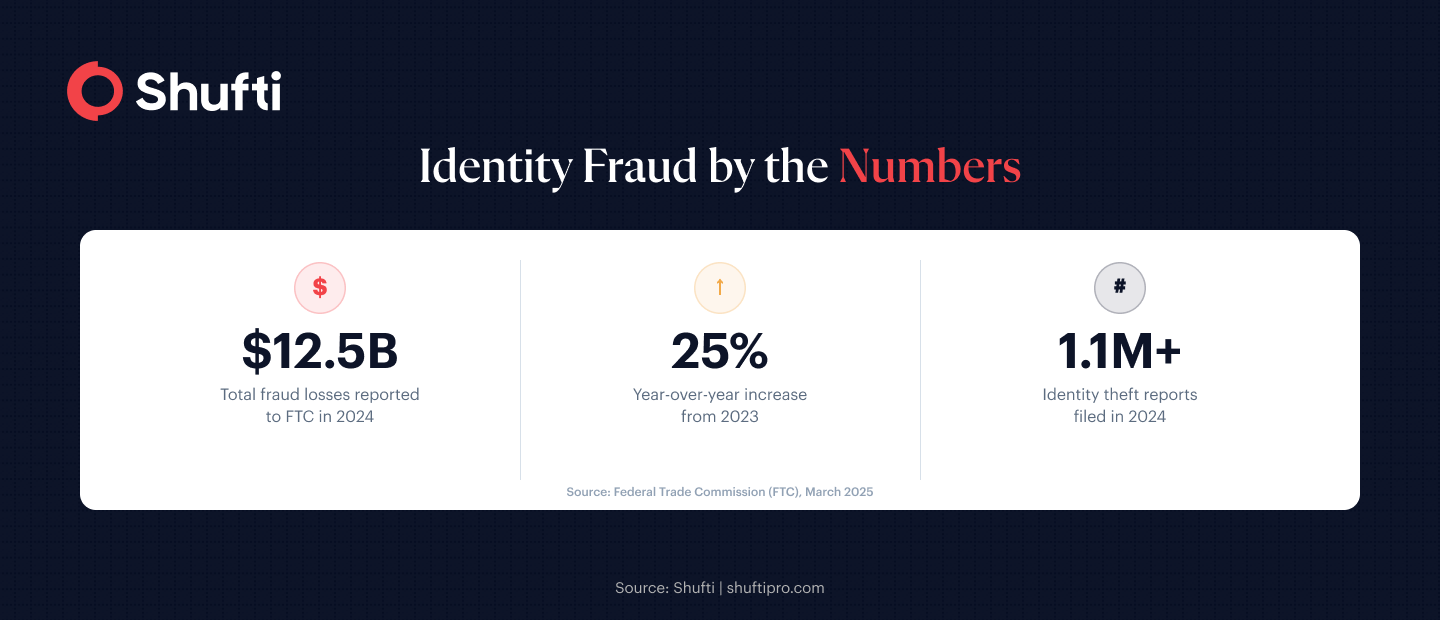
Identity theft reports filed between January and September 2025 already surpassed the total for all of 2024, according to the Federal Trade Commission. That same year, total fraud losses reported to the FTC crossed $12.5 billion. For businesses that onboard customers remotely, these numbers translate into a straightforward operational question: how do you confirm someone is who they claim to be before giving them access to your product?
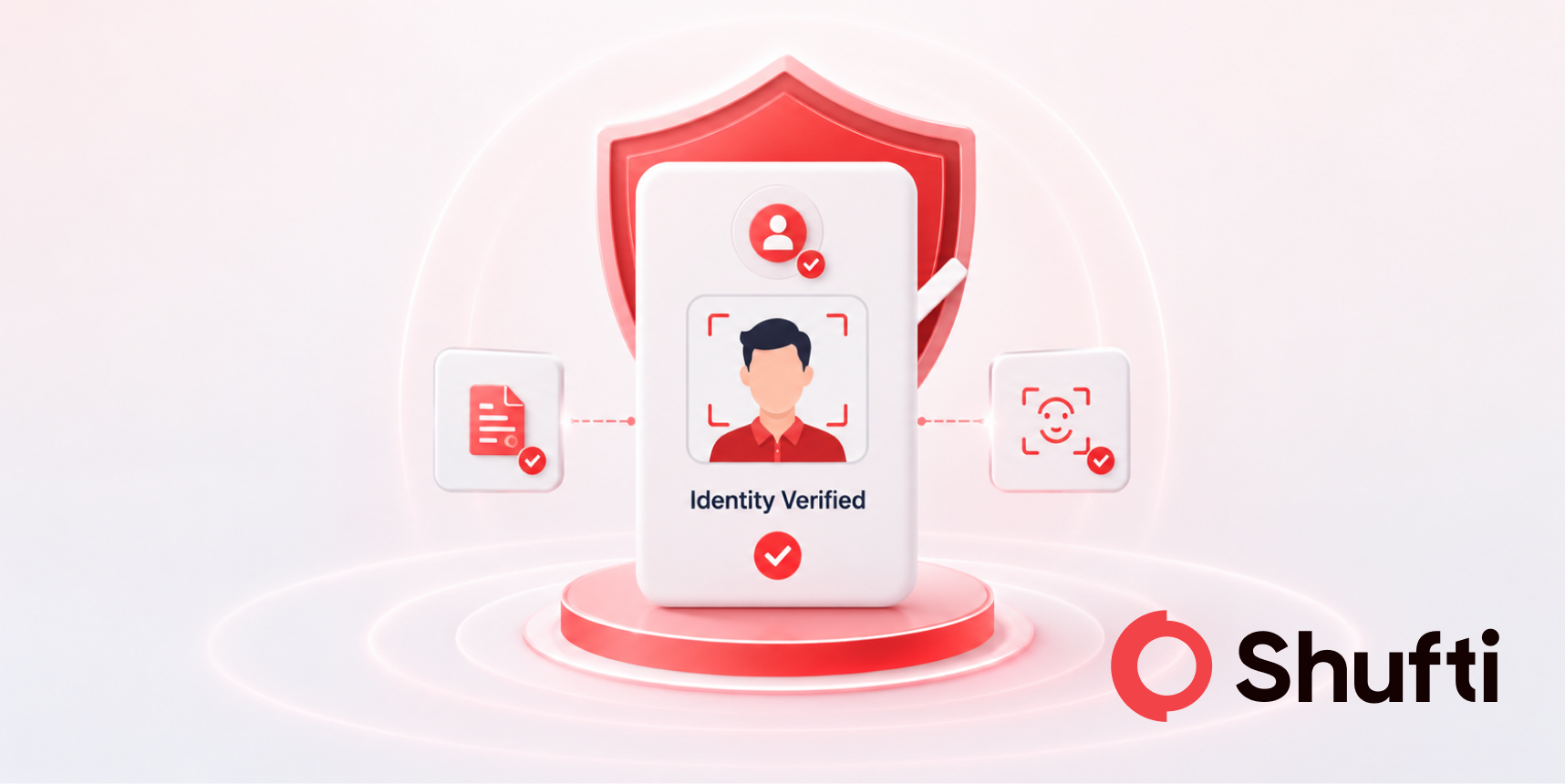
That is the job of an identity verification platform. It is the system that sits between a new customer and your onboarding workflow, checking documents, matching faces, screening watchlists, and returning a pass/fail decision, usually in seconds.
Below, we walk through what an identity verification platform actually does, how the process works from capture to decisioning, and what features separate a production-grade platform from a basic check.
What Is an Identity Verification Platform?
An identity verification platform is software that confirms a person’s claimed identity by cross-referencing multiple data points: government-issued documents, biometric data, and third-party databases. Unlike a single-point check (say, just confirming an email address), a full identity verification platform runs layered checks that together produce a high-confidence identity decision.
In practice, a user submits an ID document and a selfie. The platform extracts data from the document, compares the photo on the document to the selfie, checks the person against sanctions and PEP lists, and returns a result. What makes platforms different from one another is how accurately and quickly they handle each of those steps, and how many document types and countries they cover.
Businesses across banking, fintech, insurance, e-commerce, and crypto use these platforms to meet Know Your Customer (KYC) requirements, satisfy anti-money laundering regulations, and reduce fraud at the point of onboarding.
How Does an Identity Verification Platform Work?
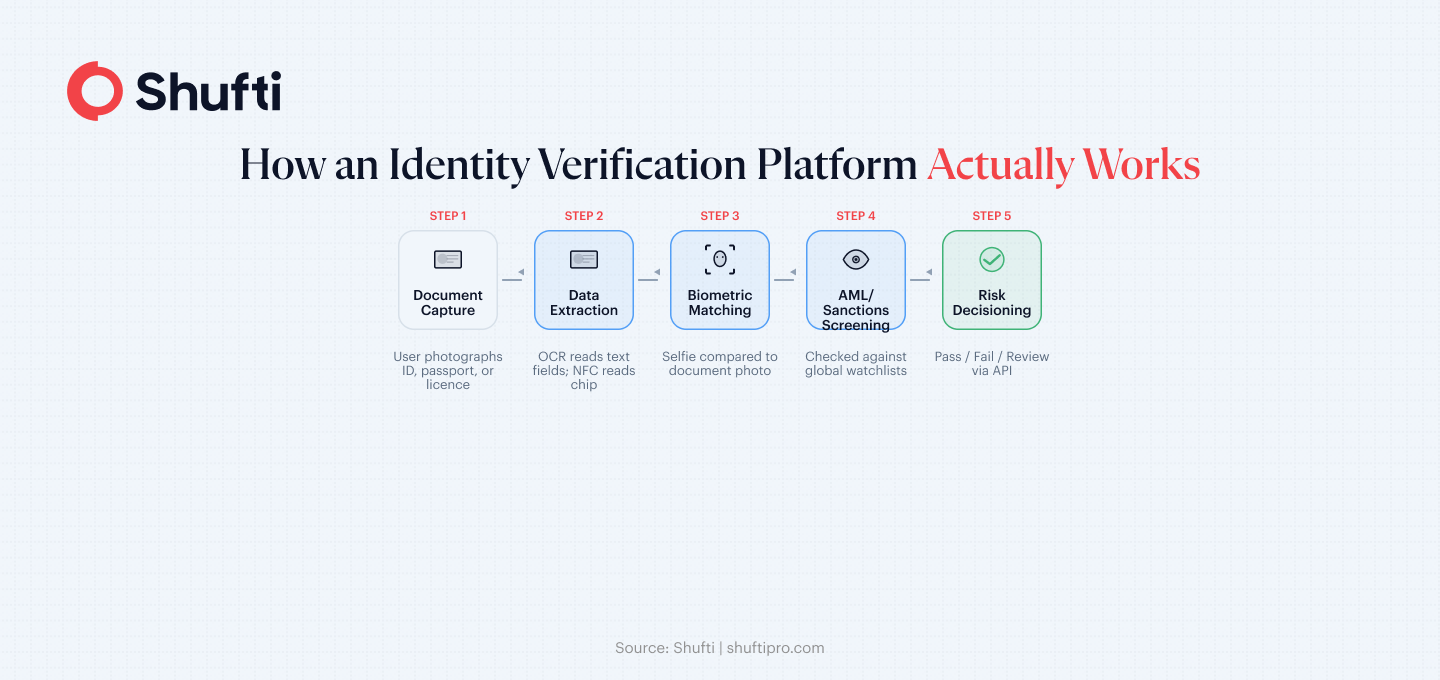
The verification process follows a predictable sequence. Here is what happens when a customer taps “Verify” in your app.
Document Capture and Data Extraction
The user photographs or uploads a government-issued ID, a passport, or a driver’s licence. The platform’s OCR engine reads the text fields (name, date of birth, document number, expiry date) and validates the document’s security features: holograms, MRZ codes, microprint patterns. NFC-enabled platforms can also read the chip in e-passports, which is significantly harder to forge than a printed document.
Biometric Matching
Next, the user takes a live selfie. The platform’s face verification engine compares this selfie against the photo extracted from the ID document. Modern platforms include liveness detection to block spoofing attempts, where someone holds up a printed photo or a deepfake video instead of their actual face.
Database and Watchlist Screening
Once the identity is established, the platform runs the individual against AML screening databases: global sanctions lists, politically exposed persons (PEP) registries, adverse media feeds, and law enforcement watchlists. This step is what separates identity verification from simple identity authentication. Authentication confirms a returning user is the same person who registered before. Verification confirms the person is real, their documents are genuine, and they are not on any restricted list.
| Step | What happens |
| Document capture and extraction | OCR reads fields and validates holograms, MRZ, microprint, NFC chips |
| Biometric matching | Live selfie compared to ID photo with liveness detection |
| Database and watchlist screening | Checks sanctions, PEP, adverse media, law enforcement lists |
| Risk decisioning | Risk engine returns pass, fail, or manual review via API |
Risk Decisioning
All of these signals feed into a risk engine that produces a pass, fail, or manual-review decision. The platform applies rules you configure: risk thresholds, country restrictions, document acceptance policies. The output integrates into your onboarding flow via API, so the customer either proceeds or gets flagged without leaving your app.
Why Businesses Need an Identity Verification Platform
Regulatory pressure is one obvious driver. The FATF sets the global standard for customer due diligence, and 85 of 117 assessed jurisdictions have now enacted Travel Rule legislation. The EU’s Anti-Money Laundering Authority (AMLA) became operational in July 2025, adding a supranational enforcement layer across member states. Businesses operating in regulated sectors, particularly financial services, cannot legally onboard customers without performing identity checks.
But compliance is only half the story. Fraud is the other half. The FTC reported $12.5 billion in fraud losses in 2024 alone, a 25% jump from the prior year. An identity verification platform catches fraudulent documents, synthetic identities, and sanctioned individuals before they enter your system. The cost of catching fraud at onboarding is a fraction of what it costs to unwind a fraudulent account after the fact.
There is also a conversion to consider. A well-built digital identity verification platform runs checks in seconds, not days. Customers who hit a fast, frictionless verification flow are far more likely to complete onboarding than those stuck uploading documents to a manual review queue.
What Features Matter When Choosing a Platform
Not every identity verification platform is built the same way. The difference between a platform that works in a demo and one that works in production usually comes down to six things.
Start with document coverage. If you onboard customers from multiple countries, the platform needs to handle thousands of document types across hundreds of countries, not just US passports and EU national IDs. A platform covering only 30 countries becomes a blocker the moment you expand.
Biometric accuracy matters, but only when paired with liveness detection. Face matching on its own is not enough. Deepfake and presentation attacks are improving every quarter, and your platform needs active or passive liveness checks to catch them. iBeta Level 1 and Level 2 certification is the independent benchmark worth asking about.
Then there is AML screening. Running identity checks and AML checks on two separate systems creates gaps. A platform that handles both (sanctions, PEPs, adverse media, and ongoing monitoring) reduces integration complexity and catches more risk at the same step.
Configurable workflows matter more than most buyers realise upfront. Different customer segments carry different risk profiles, and a good platform lets you build verification journeys that adjust: simplified checks for low-risk users, enhanced due diligence for high-risk ones.
Deployment flexibility is a dealbreaker for regulated industries. Banking and government clients often require on-premises or hybrid deployments to meet data residency rules. Cloud-only platforms cannot serve those use cases. And speed is the piece that affects your bottom line directly. Verification that takes minutes instead of seconds kills conversion rates. GPU-accelerated processing and optimized capture SDKs make a measurable difference at scale.
How Shufti Supports Identity Verification at Scale
Shufti covers the full verification chain described above through a single API: document verification across 10,000+ document types in 230+ countries, face verification with 98.72% biometric accuracy (iBeta Level 1 and 2 certified), and AML screening against 3,500+ global watchlists updated every 15 minutes.
Verification completes in under 15 seconds. The platform supports cloud, on-premises, and hybrid deployment, which matters for organisations bound by data sovereignty rules. Shufti’s Journey Builder lets compliance teams configure risk-based verification workflows without writing code.
The platform holds PCI DSS, SOC2, GDPR, and ISO 27001:2013 certifications and was recognised as a DHS RIVR 2025 Top Performer.
Conclusion
An identity verification platform is no longer optional for businesses that onboard customers remotely. Between rising fraud losses and tightening global regulations, the operational risk of not verifying identities far exceeds the cost of doing it properly. The platforms that deliver the most value combine document checks, biometric matching, and AML screening into one workflow that runs in seconds and adapts to your risk appetite.
Frequently Asked Questions
What is an identity verification platform?
It is software that confirms a person's real identity by checking their government-issued documents, matching their face against the document photo, and screening them against global watchlists, all through a single automated process.
How does an identity verification platform work?
The user submits an ID document and a live selfie. The platform extracts document data via OCR, compares the selfie to the document photo, runs AML and sanctions checks, and returns a pass or fail decision, typically in seconds.
Why do businesses need identity verification platforms?
Regulations like FATF customer due diligence standards and the EU's AMLA require businesses to verify customer identities. Beyond compliance, these platforms catch fraudulent documents and synthetic identities before they cause financial damage.
How secure are identity verification platforms?
Reputable platforms hold certifications like PCI DSS, SOC2, ISO 27001, and iBeta Level 1 and 2. They use encrypted data transmission, liveness detection to block spoofing, and can be deployed on-premises for organisations with strict data residency requirements.
What is the difference between identity verification and identity authentication?
Verification confirms a person's identity for the first time using documents, biometrics, and database checks. Authentication confirms a returning user is the same person who previously verified, typically using passwords, tokens, or biometric re-checks.