


 Face Verification
 Address Verification
 Document Verification
 Age Verification
 VideoIdent
 Fast ID
 Docless Verification
 Consent Verification
 NFC Verification
 Business Verification
 Due Diligence
 Investor Verification
 E-Signature

 QES
QES
 AML Screening
 Transaction Monitoring
 Adverse Media
 Business AML Screening
 PEP & RCA
 Sanctions
 Watchlist
 Behavioural Biometrics
 Device Fingerprinting
 Biometric Face Authentication
 MFA
MFA
 Fraud Hub
 Onboarding
 Ongoing Monitoring
 KYC
KYC
 KYB
KYB
 KYI
KYI
 Age Assurance
 Identity Verification
 Workforce IAM
 Candidate Verification
 Compliance
 Fraud prevention
 Trust & safety
 Global expansion
 Product Managers
 Compliance Officers
 Fraud Analysts
 Developers
 Deepfake Detection
 Bonus Abuse / Promotion Abuse
 Account Takeover
 Synthetic Identity Fraud
 Document Fraud
 Impersonation Fraud
 Multi-Accounting
 Fraud Networks
 Chargeback Fraud
 Money Mule Activity
 Party Fraud
 Regulatory & Compliance Risks
 Fintech
 Crypto
 iGaming
 Forex
Forex
 Social Network
 Marketplace
 Banking
 Gig Economy
 Payments
 Ride Hailing
 Adult Content
 Blind Spot Audit
 Deepfake Detector
 Liveness Spoofs
 Document Originality
 Document Deepfake
 Global Trust Platform
 Journey Builder
 Case Management
 Shufti AI
 Fraud Analytics
 Vendor Comparison
 Brand Personalisation
 AI Compliance Co-Pilot
 OCR
OCR
 Secure Capture
 Deployment Options
 Identity Methods
 API Documentation
 Mobile SDKs
 Service Status
 Help Center
 Contact Us
 Technical Support
 Supported Documents
 Supported Countries

 Content library
 Blogs
Blogs
 News
News
 Reports
 Insights
 Knowledgebase
 ROI calculator
 About
About
 Career
 Press Release
 Certifications
 Partnership
 Awards
 Events & Webinar
 Interactive Demo
 Podcast Studio
 Spotlight Studio
What was the Embargo Act of 1807, and what it teaches modern compliance teams.
TL;DR
- The Embargo Act of 1807 banned nearly all US ships from sailing to foreign ports.
- President Jefferson signed it on December 22, 1807, to pressure Britain and France without war.
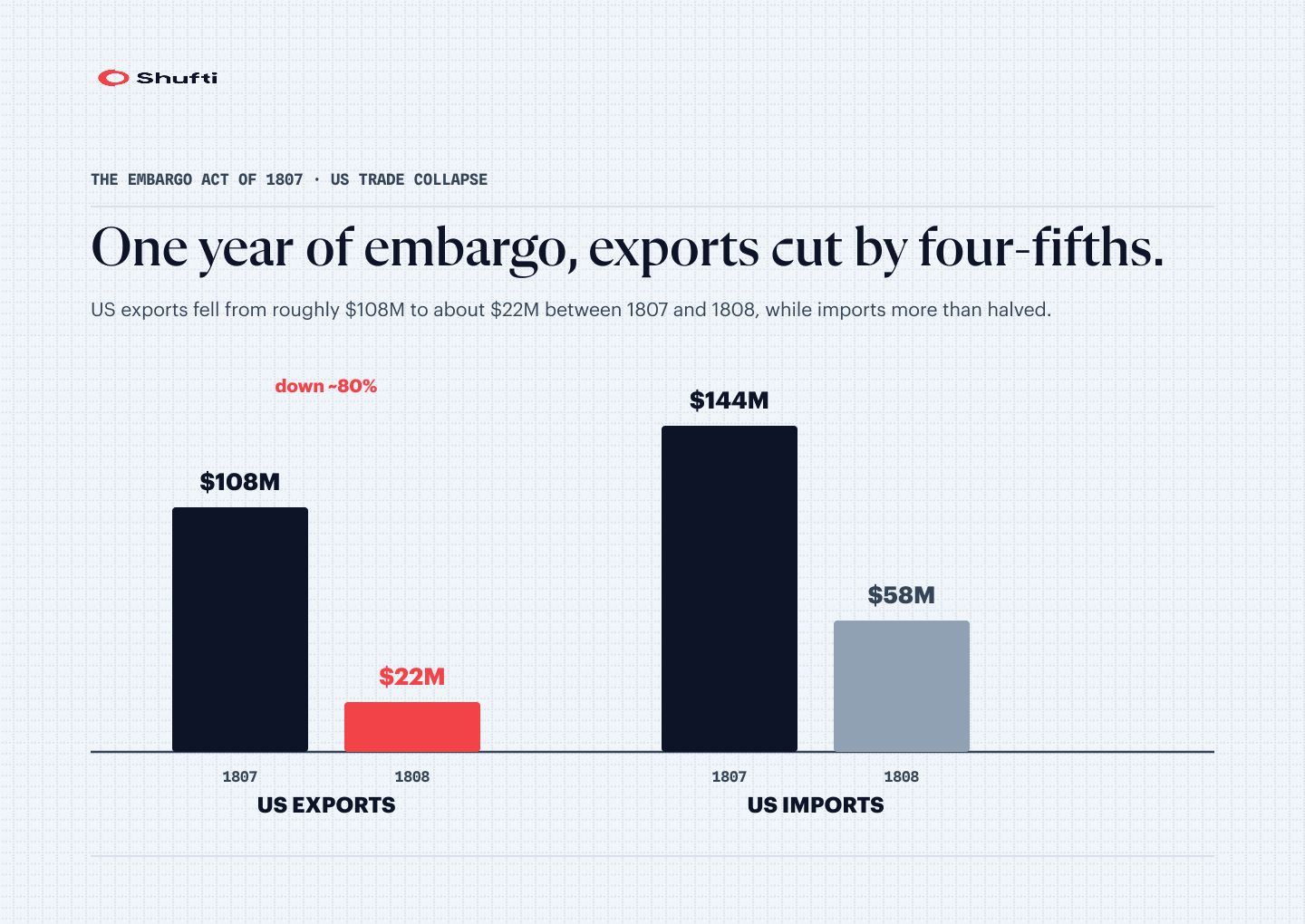
- US exports collapsed from roughly $108 million to about $22 million in a single year.
- Congress repealed it in March 1809 after it damaged America more than its targets.
- The same failure pattern, weak enforcement and easy evasion, still shapes modern sanctions compliance.
On June 22, 1807, the British warship Leopard fired on the American frigate Chesapeake off the Virginia coast, killing three sailors and dragging four more off the deck. According to the Thomas Jefferson Foundation, the attack pushed public anger to a level the country had not felt since the Battle of Lexington. President Thomas Jefferson had a choice. He could go to war with the most powerful navy on earth, or he could try to force Britain and France to respect American neutrality through economic pressure alone. He chose pressure. The result was one of the boldest and most self-damaging trade policies in early US history.
This article explains what the Embargo Act of 1807 was, what it did, why it failed, and why compliance and risk teams still study it two centuries later.
What was the Embargo Act of 1807 and why was it passed?
The Embargo Act of 1807 was a US federal law that prohibited American ships from departing for foreign ports, cutting off almost all overseas trade. In plain terms, the embargo act definition is a government-imposed halt on trade, and in this case the United States imposed it on itself. That is the twist most people miss. An embargo, in US history, usually means one country blocking commerce with another to apply pressure. This tool at that time turned inward, betting that American goods mattered so much to Europe that withholding them would change British and French behavior.
The road to the embargo: impressment and the Chesapeake affair
The pressure had been building for years. Britain and France were locked in the Napoleonic Wars, and both seized neutral American ships to choke each other’s supply lines. Britain went further with impressment, boarding American vessels and forcing sailors into the Royal Navy. The Jefferson Foundation records that of roughly 10,000 men taken from American ships, only about 1,000 were ever proven to hold British citizenship. The Chesapeake–Leopard affair turned a simmering grievance into a national crisis and forced Jefferson to act.
What did the Embargo Act of 1807 do to US trade?
The Embargo Act of 1807 shut down American export trade almost overnight and triggered a sharp domestic recession. This is the heart of what the embargo act did. By forbidding ships from clearing for foreign ports, it stranded cargo on docks, idled vessels in harbor, and cut off the income of everyone tied to maritime commerce.
What the law actually banned
So what did the embargo act do in practice? The law and its follow-on acts were far reaching. Ships could not sail to foreign ports. Later supplementary and enforcement acts required bonds from coastal, fishing, and whaling vessels, banned the export of goods by land as well as by sea, and let port authorities seize cargo on mere suspicion of an embargo violation. Jefferson was even empowered to use the Army and Navy to enforce the ban, according to the Thomas Jefferson Foundation. What began as a trade halt became a sweeping enforcement regime.
The trade collapse
The numbers tell the story of what the Embargo Act of 1807 did to the economy. American trade fell off a cliff in the first year alone.
| Trade flow | Before the embargo (1807) | After the embargo (1808) |
| US exports | $108 million | $22 million |
| US imports | $144 million | $58 million |
Figures reflect the widely cited historical trade record for 1807–1808. Treat the precise dollar amounts as approximate.
Ports like New York, Boston, and Charleston emptied. Prices for wheat, cotton, tobacco, and rice fell as demand vanished. Bankruptcies and foreclosures climbed, sailors and dockworkers lost their livelihoods, and the fishing and whaling fleets sat useless without foreign markets to serve.
What were the consequences, and when was it repealed?
The consequences of the Embargo Act of 1807 were severe at home and negligible abroad, which is precisely why it collapsed. The policy inflicted deep pain on the country that imposed it while barely denting the nations it targeted.
Smuggling, enforcement, and public backlash
Enforcement failed almost immediately. Merchants along the Canadian border and the New England coast smuggled goods out by land and sea, and each new enforcement act only pushed evasion into new channels. Britain, meanwhile, adjusted quickly. It replaced lost American trade with commerce from South America and absorbed the price shocks without much strain. France, under Napoleon’s Continental System, almost welcomed the embargo. The United States was squeezing itself while its targets barely noticed.
Repeal and the Non-Intercourse Act of 1809
Congress repealed the embargo in the final days of Jefferson’s presidency. As opposition mounted, especially from a New England economy built on shipping, lawmakers replaced it with the Non-Intercourse Act, which Jefferson signed. The new law reopened trade with every nation except Britain and France, an admission that a blanket self-embargo had been the wrong instrument.
Why the Embargo Act of 1807 still matters
The significance of the Embargo Act of 1807 is that it became the first large-scale test of trade restriction as a substitute for war, and it exposed the exact weaknesses that still undermine sanctions today. Its lessons run straight into modern policy.
The embargo act of 1807 significance sits in three enduring lessons. First, a trade restriction is only as strong as its enforcement, and smuggling defeated this one within months. Second, restrictions can hurt the imposing country more than the target when the target has alternative trading partners. Third, economic coercion needs precision, because a blunt, blanket ban created enormous collateral damage at home.
Modern trade sanctions descend directly from this idea, but the design has grown far more surgical. Rather than halting all trade, today’s programs target specific individuals, entities, vessels, and sectors.
In the United States, the Treasury’s Office of Foreign Assets Control (OFAC) administers embargoes and sanctions against designated countries, groups, and people. The core challenge Jefferson faced remains unchanged. A sanction only works if it can be enforced, and enforcement now depends on institutions being able to identify exactly who they are dealing with.
Where Shufti fits in modern sanctions compliance
Jefferson’s embargo failed partly because there was no reliable way to police who was trading with whom. Modern sanctions put that exact burden on banks, crypto exchanges, and marketplaces, which must screen every customer and counterparty against fast-changing watchlists or face penalties. That is a hard problem when a sanctioned party hides behind a shell company or a stolen identity. Shufti’s AML and sanctions screening checks individuals and businesses against major sanctions lists, including OFAC, EU, UK HMT, and UN, with continuous monitoring that re-screens as designations change. Paired with business verification that traces ownership to the real people behind an entity, it closes the enforcement gap that sank the 1807 embargo. One platform. Fully owned technology. Global coverage with real local depth.
See how Shufti screens customers and beneficial owners against live sanctions lists on your real data book a 20-minute demo.
Frequently Asked Questions
Why did Thomas Jefferson sign the Embargo Act of 1807?
Jefferson signed it to pressure Britain and France into respecting American neutrality without going to war. After the Chesapeake–Leopard attack and years of impressment, he bet that cutting off American exports would inflict enough economic pain on Europe to change its behavior.
When was the Embargo Act of 1807 repealed and why?
Congress repealed it in early 1809, replacing it with the Non-Intercourse Act that Jefferson signed on March 1, 1809. It was scrapped because it devastated the American economy, provoked widespread smuggling, and barely affected Britain or France.
What is the historical significance of the Embargo Act of 1807?
It was the first major attempt to use trade restriction as an alternative to war, and it demonstrated how restrictions fail without enforcement and hurt the imposing nation when targets have other trading partners. Those lessons still shape sanctions design today.
How does the Embargo Act of 1807 relate to modern trade sanctions?
It is an early ancestor of them. Modern sanctions apply the same logic of economic coercion but target specific people and entities rather than banning all trade, and they depend on rigorous screening and identity verification to enforce what the 1807 embargo could not.