


 Face Verification
 Address Verification
 Document Verification
 Age Verification
 VideoIdent
 Fast ID
 Docless Verification
 Consent Verification
 NFC Verification
 Business Verification
 Due Diligence
 Investor Verification
 E-Signature

 QES
QES
 AML Screening
 Transaction Monitoring
 Adverse Media
 Business AML Screening
 PEP & RCA
 Sanctions
 Watchlist
 Behavioural Biometrics
 Device Fingerprinting
 Biometric Face Authentication
 MFA
MFA
 Fraud Hub
 Onboarding
 Ongoing Monitoring
 KYC
KYC
 KYB
KYB
 KYI
KYI
 Age Assurance
 Identity Verification
 Workforce IAM
 Candidate Verification
 Compliance
 Fraud prevention
 Trust & safety
 Global expansion
 Product Managers
 Compliance Officers
 Fraud Analysts
 Developers
 Deepfake Detection
 Bonus Abuse / Promotion Abuse
 Account Takeover
 Synthetic Identity Fraud
 Document Fraud
 Impersonation Fraud
 Multi-Accounting
 Fraud Networks
 Chargeback Fraud
 Money Mule Activity
 Party Fraud
 Regulatory & Compliance Risks
 Fintech
 Crypto
 iGaming
 Forex
Forex
 Social Network
 Marketplace
 Banking
 Gig Economy
 Payments
 Ride Hailing
 Adult Content
 Blind Spot Audit
 Deepfake Detector
 Liveness Spoofs
 Document Originality
 Document Deepfake
 Global Trust Platform
 Journey Builder
 Case Management
 Shufti AI
 Fraud Analytics
 Vendor Comparison
 Brand Personalisation
 AI Compliance Co-Pilot
 OCR
OCR
 Secure Capture
 Deployment Options
 Identity Methods
 API Documentation
 Mobile SDKs
 Service Status
 Help Center
 Contact Us
 Technical Support
 Supported Documents
 Supported Countries
 Content library
 Blogs
Blogs
 News
News
 Reports
 Insights
 Knowledgebase
 ROI calculator
 About
About
 Career
 Press Release
 Certifications
 Partnership
 Awards
 Events & Webinar
 Interactive Demo
 Podcast Studio
 Spotlight Studio
VideoIdent for Non-Financial Businesses in Germany: New Rules for Lawyers, Real Estate Agents and Notaries
- 01 What Changed for Non-Financial Businesses Under GwG
- 02 Who Must Use VideoIdent in the Non-Financial Sector
- 03 What GwG Actually Requires for Video Identification
- 04 When Did VideoIdent Become Mandatory for Non-Financial Businesses?
- 05 What Documents and Steps a Compliant VideoIdent Session Covers
- 06 How Shufti helps non-financial Verpflichtete run compliant VideoIdent
TL;DR
- GwG now extends AML identity verification obligations to lawyers, notaries, real estate agents, tax advisors, and other non-financial businesses in Germany.
- Remote client onboarding requires a compliant VideoIdent process with document verification, liveness checks, biometric matching, and audit-ready evidence.
- Businesses must retain verification records and perform additional due diligence, including UBO, AML, PEP, and sanctions screening where applicable.
- Shufti provides a BaFin-aligned VideoIdent solution to help non-financial businesses meet GwG compliance requirements efficiently.
For years after the Federal Financial Supervisory Authority (BaFin) issued Circular 3/2017, video identification in Germany was treated as a banking concern. The circular set the rules, banks ran the processes, and most other regulated professions assumed the obligation stopped at the financial sector. That assumption has aged badly.
Successive amendments to the Geldwäschegesetz (GwG, the German Money Laundering Act) have pulled lawyers, notaries, real estate agents, tax advisors and other professional services firmly into the Anti-Money Laundering (AML) perimeter, with identification standards that look closer to a bank’s onboarding flow than to a traditional client meeting. VideoIdent for the non-financial sector Germany regulates is no longer a niche compliance topic. The practical question now is how to run a compliant flow without creating fresh compliance debt.
What Changed for Non-Financial Businesses Under GwG
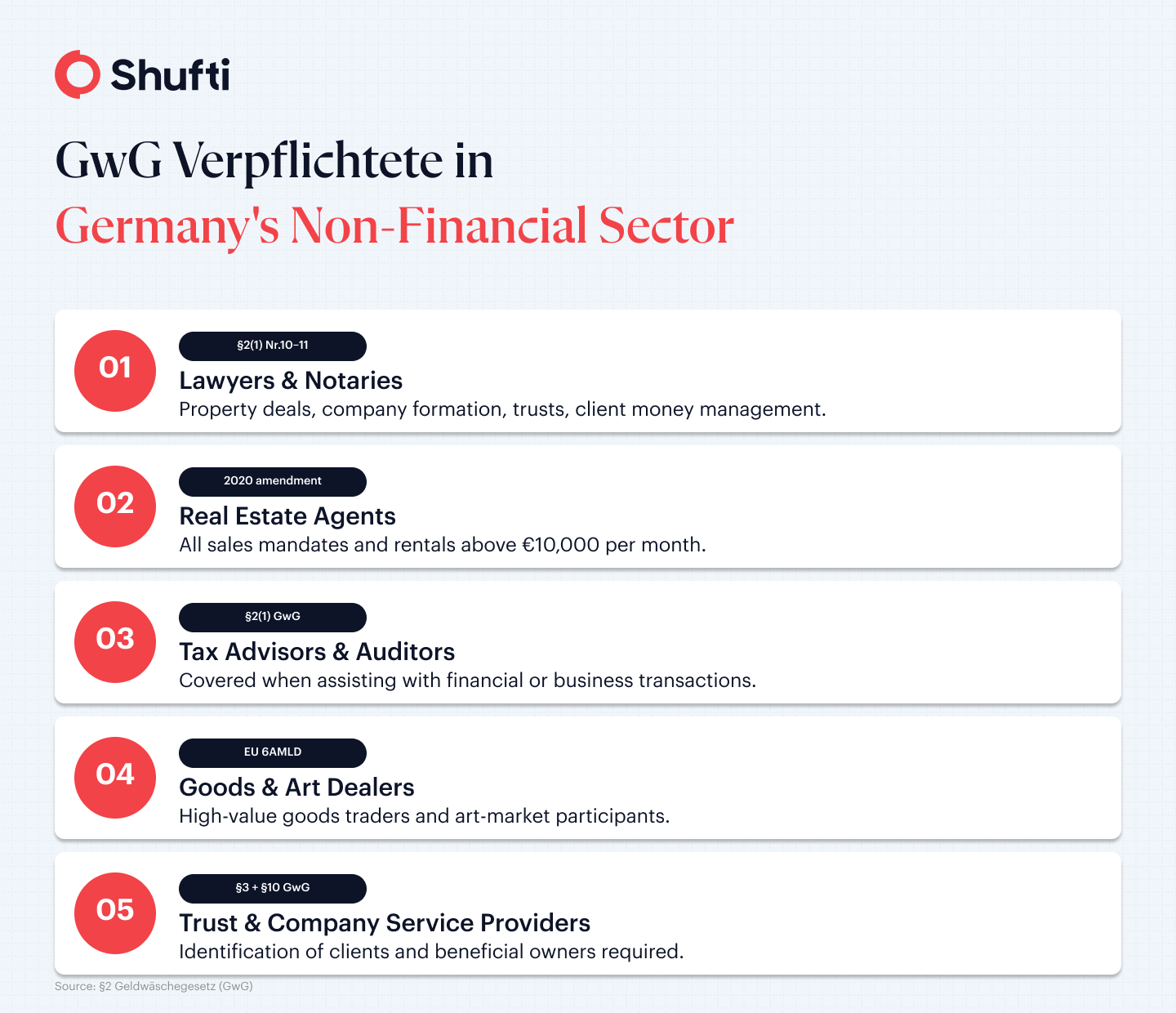
Germany’s transposition of the EU’s Fifth and Sixth Anti-Money Laundering Directives extended §2 GwG well beyond banks and payment institutions. The list of obliged entities (Verpflichtete) now covers lawyers and notaries acting in real estate, company formation and certain financial transactions, real estate agents (including those brokering rental contracts above €10,000 per month since the 2020 amendment), tax advisors, auditors, trust and company service providers, art and high-value goods dealers, and several adjacent categories. The Federal Ministry of Finance’s GwG guidance frames the shift in plain terms. Non-financial AML Germany enforcement is no longer a footnote.
The pressure has also moved from rule-writing to rule-enforcement. The Financial Action Task Force (FATF) 2022 Mutual Evaluation of Germany flagged supervisory gaps in the non-financial sector and pushed for stronger oversight of designated non-financial businesses and professions. State-level supervisors and the BMF have responded with more inspections and clearer expectations on identity proofing.
Bar associations and notarial chambers in several Bundesländer have also issued professional guidance reminding members that AML failures are now treated as a regulatory matter, not just an internal compliance issue, with personal liability attached to the responsible partner or office holder.
Who Must Use VideoIdent in the Non-Financial Sector
The professions in scope under §2(1) GwG that most often need a remote, attended identification path are notaries, lawyers, tax advisors and auditors, real estate agents, trust and company service providers, and dealers in high-value goods. Each is bound by the customer due diligence chain (Sorgfaltspflichten) in §10 GwG, which begins with verified identification of the client and any beneficial owners.
Lawyers and notaries are pulled in when they handle the transactions listed in §2(1) Nr. 10 and Nr. 11 GwG, which include property purchases and sales, the management of client money, the formation or sale of companies, and the operation of trust structures. Tax advisors and auditors are covered when they assist with comparable financial or business transactions. Real estate agents are obligated for any property sale they broker and for rental mandates above the €10,000 monthly threshold. An overview from the German Real Estate Association (IVD) sets out the practical implications for agency practice.
Whether a firm needs an attended video flow specifically, rather than an in-person meeting, depends on its operating model. Firms that onboard clients remotely or across regional offices typically pick video ident for real estate lawyers and similar mandates because the alternative, postal verification or in-person presence, adds days to every onboarding and quickly becomes uneconomic for any decent client volume.
What GwG Actually Requires for Video Identification
11 to §13 GwG govern how a Verpflichtete must verify identity. The Act recognises several methods, including in-person presentation of an ID, qualified electronic signatures, electronic identity (eID) schemes such as the German nPA online function, and video-based procedures that meet the security standards set by the supervisory authority.
For financial institutions, those standards are spelled out in BaFin Circular 3/2017. Non-financial businesses are not directly bound by that circular but are expected, in practice, to apply equivalent or higher safeguards if they choose a video route, because supervisors will benchmark any session against the BaFin reference.
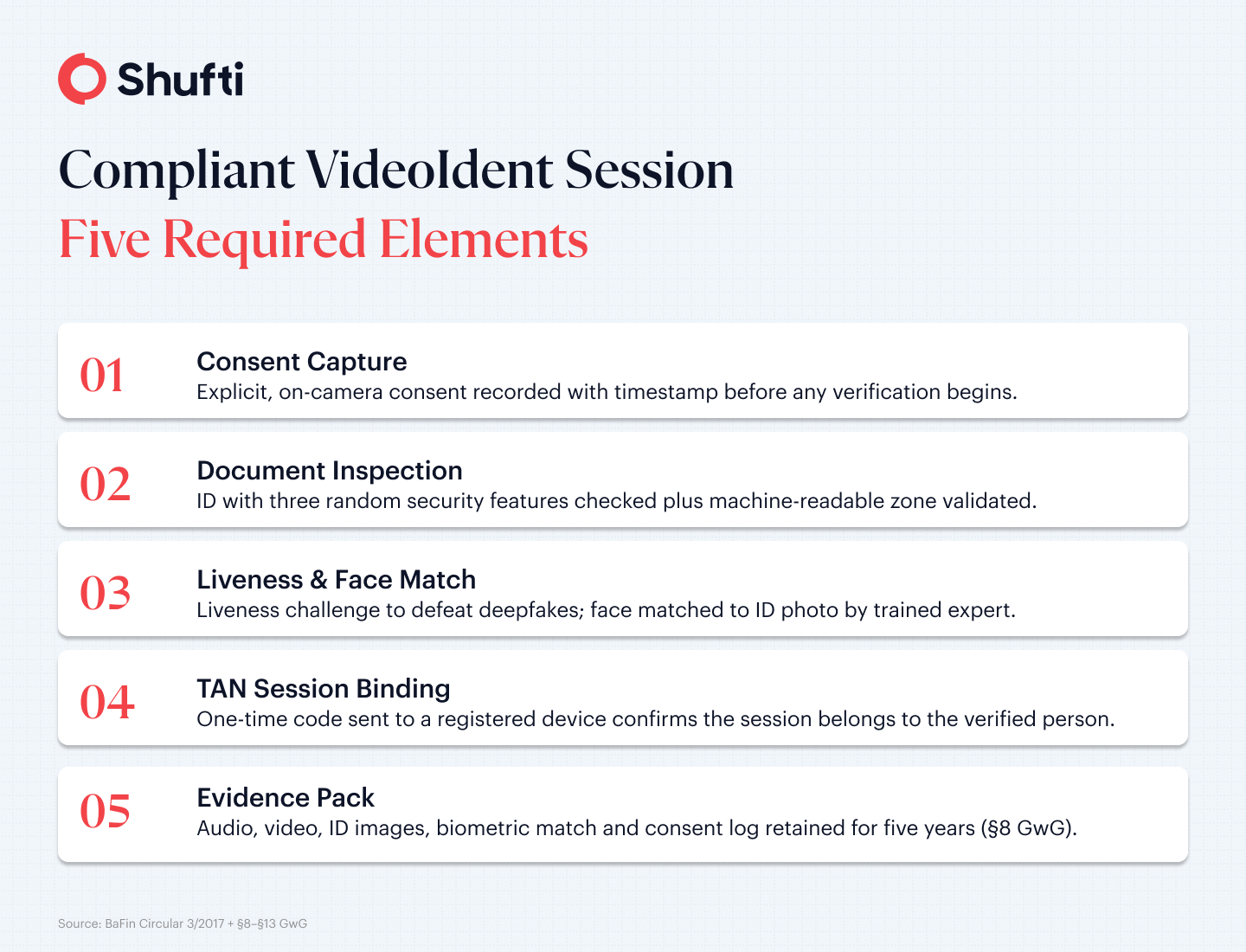
When a firm adopts GwG video identification, notaries and other regulated professions apply the same baseline. A compliant session captures a valid government-issued ID, performs a liveness challenge and a face-to-document match, records explicit consent, binds the session through a one-time code or comparable factor, and produces a complete evidence pack retained for five years under §8 GwG. Sloppy retention is one of the most cited weaknesses in supervisory reports, alongside missing audio recordings and unstructured screenshots.
When Did VideoIdent Become Mandatory for Non-Financial Businesses?
There is no single date on which VideoIdent itself became compulsory for the non-financial sector. The obligations evolved in layers. The 2017 GwG overhaul brought most professional services into AML scope. The 2020 amendment extending agent obligations to high-value rentals tightened the real estate perimeter.
Subsequent updates aligned German practice with the EU AML Package, including the establishment of the Anti-Money Laundering Authority (AMLA), the new EU regulator based in Frankfurt and due to begin direct supervision of selected obligated entities under the EU Single Rulebook from 2027.
What firms now face is a continuous tightening of acceptable identification methods, with paper-based or weakly evidenced flows looking less defensible each audit cycle. The direction of travel is clear, even if the deadline for any individual firm depends on its supervisor and risk profile.
What Documents and Steps a Compliant VideoIdent Session Covers
At a minimum, a GwG-aligned session walks through the following. The agent verifies that a valid identity document is present, checks at least three random security features and the machine-readable zone, performs a liveness detection so the person on screen cannot be a recording or deepfake, captures a face-to-document biometric match, and records an explicit consent statement. A second factor binds the session to the user, typically through a Transaction Authentication Number (TAN) or one-time password sent to a registered device. The full audio and video, document images, biometric comparison and consent timestamp are then packaged into a single evidence file.
For corporate clients, the session must also feed into beneficial-owner identification under §3 and §10 GwG, with cross-reference to the Transparenzregister where applicable. Address verification, AML screening against politically exposed persons (PEP) and sanctions lists, and adverse media checks complete the wider due diligence picture.
How Shufti helps non-financial Verpflichtete run compliant VideoIdent
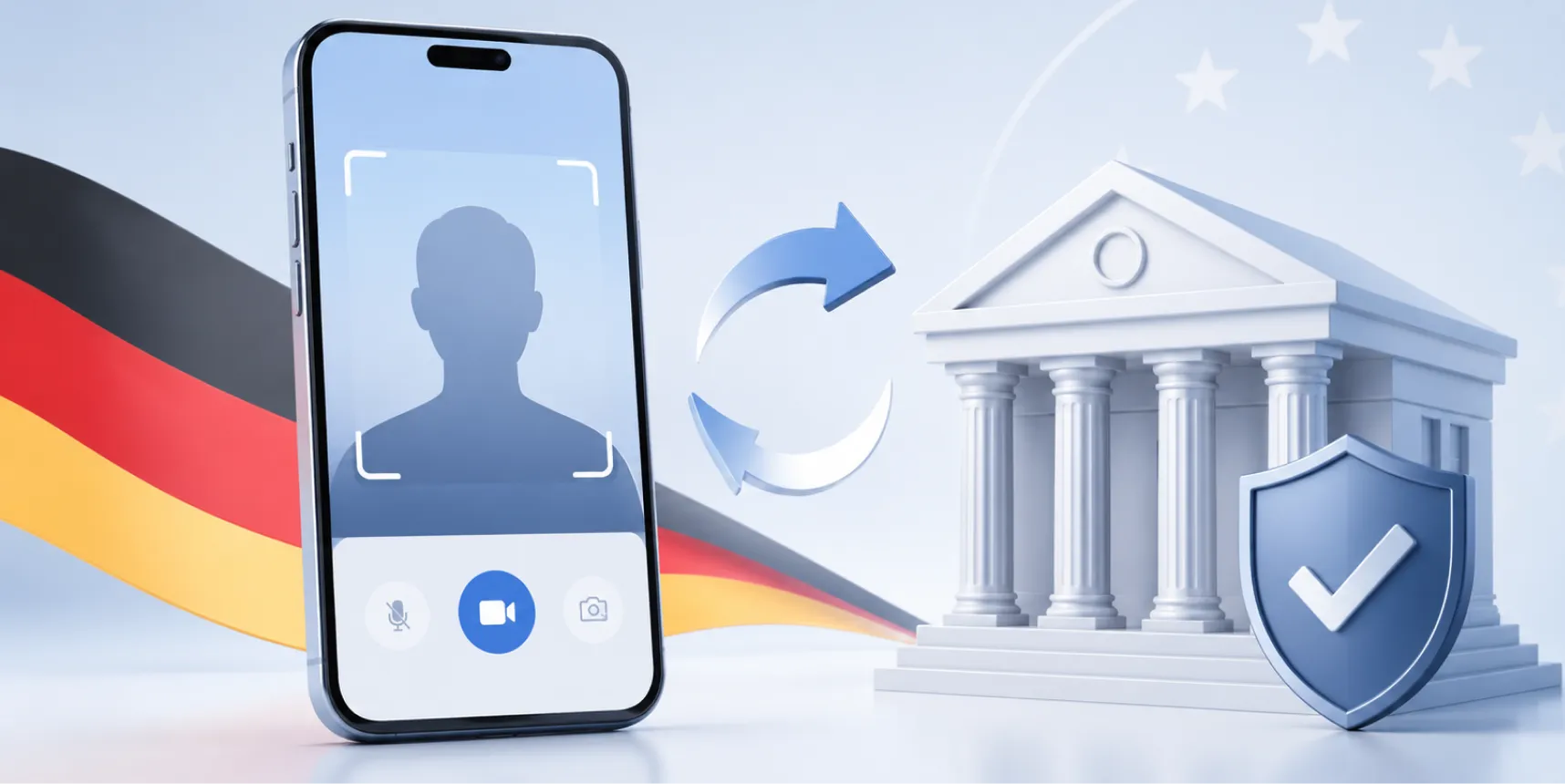
Shufti VideoIdent was designed around the BaFin reference flow and adapts cleanly to the non-financial sector. Trained Know Your Customer (KYC) experts run the session, inspect documents to the security-feature standard supervisors expect, capture consent on record, and produce an evidence pack ready for examiner review within 24 hours. For smaller firms, a dedicated agent pool is often impractical, so Shufti also offers a bring-your-own-agent model. A notary’s compliance team or a law firm’s KYC officer can run sessions on Shufti’s infrastructure while keeping verification decisions in-house.
The same platform extends to document verification, AML screening, address verification and beneficial-owner checks under one integration, which matters for firms that previously stitched identity proofing across two or three vendors. EU data residency, ISO 27001 and SOC 2 Type II certification round out the controls that supervisory examiners look for first. Risk-based step-up means an automated path can still handle low-risk client journeys, with the attended video session reserved for the moments where assurance actually matters.
GwG enforcement in the non-financial sector will only sharpen as AMLA stands up its supervisory regime and FATF follow-up reviews land, leaving law firms, notaries and real estate agencies on the hook for an identification flow that survives examiner scrutiny. Shufti’s VideoIdent gives non-financial Verpflichtete a BaFin-aligned attended video flow with audit-ready evidence packs and a flexible agent model that fits firms of any size. Request a demo to scope a deployment around your current process in a single call.
Frequently Asked Questions
Which non-financial professions must use VideoIdent under GwG?
Lawyers, notaries, tax advisors, auditors, real estate agents, trust and company service providers, art dealers, and high-value goods traders all fall under §2 GwG. Each must verify client identity to BaFin-equivalent standards when establishing business relationships covered by the Act.
Do German notaries need VideoIdent for property transactions?
Notaries handling property sales must verify all parties under §10 GwG before notarisation. While in-person attendance is the historical norm, BaFin-aligned VideoIdent is now accepted for preparatory client onboarding when physical presence is later required for the deed itself.
What documents must real estate agents collect during VideoIdent?
Agents must capture a government-issued photo ID (national ID card or passport), perform a face-to-document match, log explicit consent, and retain the full session record for five years. Beneficial-owner data is required for corporate clients under §3 GwG.
Are tax advisors subject to the same VideoIdent rules as lawyers?
Yes. Tax advisors and auditors fall under §2(1) GwG alongside lawyers and notaries. Identification standards under §11 to §13 GwG apply uniformly. The trigger is the type of service provided, not the profession itself, with similar evidence retention obligations.