AMLR Solutions
  AMLR Consultation
 EUDI Wallet
 Onboarding
 Ongoing Monitoring
 FRAML
FRAML KYC
KYC KYB
KYB KYI
KYI Age Assurance
 Workforce IAM
 Candidate Verification
 Account Takeover
 Bonus/ Promotion Abuse
 Chargeback Fraud
 Deepfake
 Document Fraud
 Fraud Networks
 Impersonation Fraud
 Money Mule Activity
 Multi-Accounting
 Party Fraud
 Regulatory & Compliance Risks
 Synthetic Identity Fraud
 Adult Content
 Banking
 Crypto
 Fintech
 Forex
Forex Compliance
 Fraud prevention
 Trust & safety
 Global expansion
 Compliance Officers
 Developers
 Fraud Analysts
 Product Managers
 Journey Builder
  Global Trust Platform
 Customer Profiles
 Vendor Comparison
 IDV Case Management
 AML Case Management
 Regulatory Reporting
 Agentic Rule Builder
  AI Compliance Co-Pilot
  Fraud Analytics
 Fraud Hub
  OCR
OCR Shufti AI
 Bank Account Verification
  Biometric Duplication
 Database Checks
 Document Intelligence
 Government ID
 Mobile Driver's License
 NFC
NFC Selfie Liveness
 Brand Personalisation
 Deployment Options
 Identity Methods
 IDV Modes
 Multi-tenancy
 On-Premise IDV
 Secure Capture
 Shufti MCP













APAC Child Safety Regulations: Six Laws, No Shared Standard
How Indonesia, Malaysia, Australia, and Singapore are mandating age verification, and why no single method can satisfy all four.
Shufti runs all four methods from one integration, routing each user through the path their market requires: a MyKad document check in Malaysia, AI facial age estimation in Australia, tiered consent flows in Indonesia, and method-neutral age assurance in Singapore.
Schedule a DemoKey Takeaways – What Compliance Teams Need To Know Now
Three markets, three incompatible methods
Four major APAC governments activated child safety laws in eighteen months. The deadlines are live, the investigations have started, and no two markets accept the same verification method.
World’s first under-16 ban, active since December 2025
Formal investigations are now open against multiple major social media platforms. Penalties reach AUD $49.5 million. Government ID may not be the sole verification method; a reasonable alternative must always be available.
Government ID mandatory since 1 June 2026
The Child Protection Code requires MyKad, passport, or MyDigital ID before registration, the most prescriptive method in the region, with no alternative pathway.
Five age tiers, eight platforms named
PP Tunas creates five developmental age bands. Under-16 accounts on eight named high-risk platforms were ordered disabled from 28 March 2026.
01 – Legislative Landscape
Which APAC markets have enacted child safety legislation?
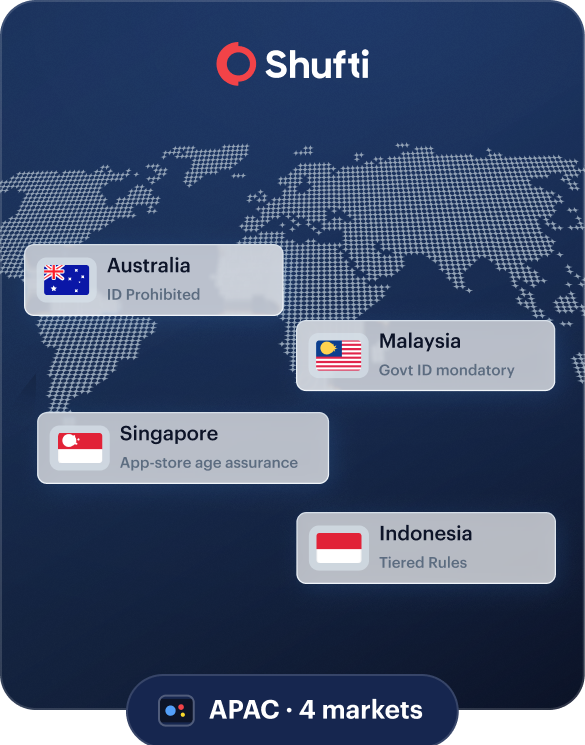
Four major APAC governments, Australia, Malaysia, Indonesia, and Singapore now have active or transitioning child safety laws that impose age verification or age assurance obligations on digital platforms. No two use the same method.
The table below is a working compliance reference across these markets as of June 2026.
| Country | Key law | Protected age | Verification method | Max penalty | Status |
|---|---|---|---|---|---|
| Australia | Online Safety Amendment Act 2024 | Under 16 | Waterfall / successive validation; govt ID permitted as one option only (alternative required) | AUD $49.5M | Active |
| Malaysia | Online Safety Act 2025 + Child Protection Code | Under 16 | Govt ID mandatory (MyKad / passport / MyDigital ID) | RM 10M (~USD $2.3M) | Active |
| Indonesia | PP Tunas (GR 17/2025) + MOCD Reg. 9/2026 | Under 16 (social); tiered 13/16/18 | Technology-neutral; parental consent mandatory under-17 | Criminal: IDR 200M; admin from Mar 2027 | Transition |
| Singapore | Online Safety ADS Code | Under 18 (app downloads) | “Reasonable accuracy” age assurance (method-neutral) | SGD $1M (~USD $750K) | Active |
02 – Australia
What does Australia’s social media ban actually require of platforms?
Australia requires designated social media platforms to take “reasonable steps” to stop under-16s from holding accounts, and it bars government ID from being the sole method of doing so. It has moved faster than any other APAC government, and the results are instructive for platforms preparing for similar laws elsewhere.
The Online Safety Amendment (Social Media Minimum Age) Act 2024 received Royal Assent in late November 2024 and came into legal force on 10 December 2025. The law bans under-16s from registering on designated social media platforms, with fines of up to AUD $49.5 million for systemic non-compliance. Multiple major social media platforms are currently designated in scope, with the eSafety Commissioner holding ongoing power to designate additional services.
What “successive validation” actually means
The law does not mandate a specific technology. The eSafety Commissioner’s Regulatory Guidance, published 16 September 2025, describes a “successive validation” or waterfall approach, which the Commissioner actively encourages: platforms layer multiple verification signals in sequence rather than relying on any single method. Self-declaration alone, without supporting validation mechanisms, is not considered sufficient for compliance.
Not as the sole method. Platforms cannot require government-issued identification as the sole method of age assurance. Per Section 63DB of the Act, if government ID is offered as one option, a reasonable alternative must always be available. The guidance encourages combinations of AI-powered facial age estimation, inference from behavioural signals, and app-store-level checks layered in sequence. On data retention, the eSafety Commissioner does not expect providers to retain personal information as a record of individual age checks.
03 · Malaysia
Why is Malaysia the regional outlier on age verification method?
Malaysia is the outlier because it mandates verification against government-issued records before registration the only APAC market to require document checks with no alternative pathway. That creates a direct architectural challenge for any platform also operating in Australia.
The Online Safety Act 2025 came into force in January 2026. The Child Protection Code (CPC), published 22 May 2026 and in force from 1 June 2026, operationalises the under-16 restriction for licensed social media providers with at least eight million registered Malaysian users. Five major social media platforms are currently in scope.
Malaysia requires
Government records, before registration
Verification against government-issued records before registration. Acceptable documents: MyKad, passport, or MyDigital ID credential. No alternative pathway exists under the current code.
Australia restricts
Government ID can’t be the sole method
The collection of “government identity materials” in the course of age verification. Platforms must use AI estimation, behavioural inference, or app-store signals instead.
The collision is architectural, not procedural. A platform that builds its verification system around document checks for Malaysia cannot use that same flow for Australian users. Any platform operating in both markets needs separate verification pathways by jurisdiction, separate data handling pipelines, separate consent flows, and separate audit documentation for what is ostensibly the same regulatory goal.
RM10 million, plus licence risk. Fines reach approximately USD $2.3 million, with licence suspension possible for persistent failures. The enforcement posture as of early June 2026 is outcomes-based, with an informal operationalisation period expected while platforms build compliance pipelines. A six-month progressive rollout applies to existing users.
04 – Indonesia
What are Indonesia’s five age tiers, and which platforms were named?
Indonesia’s framework is the most structurally complex in the region. It sorts all children into five developmental age bands, each requiring a differentiated product experience, and imposes obligations on nearly every consumer-facing digital service not just social media.
Government Regulation No. 17 of 2025 (PP Tunas), in force 1 April 2025, governs all Electronic System Operators whose services are designed for children or “likely to be used by children,” bringing e-commerce, gaming, streaming, and educational apps into scope.
The five developmental age bands (PP Tunas)
Rather than a single threshold, PP Tunas groups all children into five developmental age bands, each requiring a differentiated product experience. Assegaf Hamzah and Partners’ analysis of the regulation confirms the five bands explicitly:
Youngest tier. Services specifically designed for this age group, with age-appropriate content, interface design, and mandatory parental controls.
Elementary-age children. Enhanced parental consent and privacy-by-default settings required across all applicable services.
Pre-adolescent tier. Platforms must implement differentiated interfaces and restrict exposure to addictive design features.
Early adolescent. Access to low-risk platforms permitted with parental consent. High-risk platform access blocked entirely.
Older adolescent. Access to all platforms including high-risk permitted, with parental consent required.
Three access-rule brackets mapped onto the five bands
PP Tunas layers three access-rule brackets onto these developmental bands, governing which service categories each group can reach:
Under 13: Services specifically designed for children, or low-risk platforms with parental consent only.
13 to 16: All services on low-risk platforms, with parental consent.
16 to 18: All services including high-risk platforms, with parental consent.
The eight named platforms (MOCD Reg. 9/2026)
Minister of Communication and Digital Regulation No. 9 of 2026, issued 6 March 2026, named eight platforms as high-risk across social media, live streaming, and gaming. Under-16 accounts on all eight were ordered disabled from 28 March 2026:
A video streaming platform, classified high-risk due to content exposure, addictive recommendation algorithms, and potential for contact with strangers.
Major short-form video and social media platforms, named due to high-risk design features and documented child user bases.
Open social interaction and microblogging platforms, named for real-time public social interaction features.
A live streaming platform, named for real-time broadcast interaction with unknown audiences.
A social gaming platform, named for gaming with embedded social and communication features.
Wider than your child-facing products. PP Tunas applies to any Electronic System Operator whose product is “specifically designed for children or likely to be used by children.” Even if a platform’s terms of service do not reference child users, it may be in scope if evidence shows a large proportion of regular users are children, its advertising targets children, or its design appeals to children. Ministry guidance on what constitutes “strong evidence” has not yet been finalised.
05 – Singapore
How does Singapore’s app-store approach differ from social media bans elsewhere?
Singapore targets the distribution layer rather than social media platforms directly. Its rules put the age-assurance obligation on app stores, which must check age with “reasonable accuracy” before under-18 users can download age-restricted apps.
The Code of Practice for App Distribution Services (ADS Code), effective 31 March 2025, places obligations on major app distribution services: they must implement age assurance with “reasonable accuracy” before under-18 users can download age-restricted apps.
Pushing the obligation to the app-store level has a real logic: stores already control account creation and payment authentication, giving them more reliable identity signals than most social media platforms hold. However, social media platforms accessed via web browser fall entirely outside the ADS Code’s scope, and Singapore’s Code of Practice for Social Media Services imposes age-appropriate design obligations only, with no age gate at registration.
The “reasonable accuracy” standard also lacks a precise technical specification, leaving implementation plans subject to IMDA review case by case. At least one major app-store operator implemented automatic age-verification safeguards for Singapore users in February 2026. The framework is best understood as a first-layer intervention at the distribution point, with further social media obligations likely to follow.
06 – Operational Reality
What operational challenges do platforms face across all APAC markets at once?
Every market in this analysis shares operational headaches that do not appear in the text of any individual law but define the practical compliance experience: circumvention, the privacy-versus-accuracy conflict, compressed timelines, and the absence of any shared technical standard.
| Challenge | What it means in practice |
|---|---|
| Circumvention gap | Age gates are circumventable by any user with a VPN. No APAC government has proposed a technical solution. Regulators ask platforms to reduce underage access meaningfully, not eliminate it absolutely. |
| Privacy vs accuracy | Australia prohibits government ID from being the sole verification method; if offered, an alternative must always exist. Malaysia requires government ID as the only accepted method. A single global verification flow cannot satisfy both, making jurisdiction-aware routing essential. |
| Timeline compression | Malaysia’s Child Protection Code came into force ten days after publication. Indonesia ordered platform action before full guidance had issued. Australia launched investigations within months of the law taking effect. |
| No shared technical standard | No APAC regional body harmonises verification methods. Each jurisdiction defines requirements independently, using vague terms like “reasonable accuracy” that platforms must interpret without regulatory pre-clearance. |
07 – Method Comparison
How do age verification method requirements differ across APAC markets?
Method requirements diverge at exactly the level where cross-regional product architecture decisions get made: whether government ID is permitted, whether the rule is technology-neutral, and what each market expects in practice. The table below maps them.
| Country | Method required | Govt ID permitted? | Tech-neutral? | Key notes |
|---|---|---|---|---|
| Australia | Successive / waterfall validation | Yes (not as sole method; alternative required) | Yes (with constraints) | Govt ID may be one option but must be paired with an alternative; data not expected to be retained post-verification |
| Malaysia | Govt-issued records check | Yes (mandatory) | No (document check required) | MyKad / passport / MyDigital ID. Most prescriptive in region |
| Indonesia | Technology-neutral; parental consent mandatory | Not mandated | Yes | Consent within 24 hrs; 5-tier age system; high-risk platforms named |
| Singapore | “Reasonable accuracy” age assurance | Not specified | Yes | App stores only; web-based social media not covered by ADS Code |
08 – Architecture
What does APAC compliance fragmentation mean for platform architecture?
It means a single document-check vendor or AI estimation tool cannot cover the region. A platform operating across all four markets simultaneously faces four structurally different legal obligations, and the defensible answer is one modular platform that routes users through different flows by jurisdiction.
The core tension is between Australia (where government ID cannot be the sole method, so an alternative must always exist) and Malaysia (where only government ID is accepted). No single verification pathway satisfies both simultaneously. The more defensible architecture is modular: a single verification platform routing users through different flows by jurisdiction, maintaining consistent data minimisation, and deleting age data post-verification uniformly.
The seven-question platform compliance checklist
Seven questions to pressure-test any age verification architecture before you commit to an APAC rollout.
Does your verification system support both government-ID and ID-free (AI estimation) pathways, switchable by jurisdiction?
Can your system enforce different age thresholds (under-13, under-16, under-18) for different markets within the same product?
Does your age verification flow implement a waterfall approach layering facial age estimation, behavioural inference, and app-store account data in sequence?
Does your architecture delete age data post-determination, satisfying Australia’s and Indonesia’s data minimisation requirements?
Does your system cover the national ID documents of all four markets: MyKad (Malaysia), Indonesian KTP, and passports?
Can your verification vendor adapt to new regulatory requirements within weeks, or are you waiting on a third-party product roadmap?
Have you mapped which products may be in scope under Indonesia’s “likely to be used by children” standard beyond explicitly child-targeted services?
Certifications
Independently audited and certified for enterprise-grade security and data protection.






Frequently Asked Questions
The Online Safety Amendment Act 2024 applies only to designated “age-restricted social media platforms.” Seven major social media platforms are currently in scope. A number of messaging services, educational platforms, gaming services, and children-specific apps are explicitly excluded. The eSafety Commissioner has scope to designate additional services, so platforms not currently listed should self-assess whether they fall within the “sole or significant purpose” test.
The Child Protection Code requires verification against government-issued records, specifying MyKad, passport, or MyDigital ID as acceptable sources. It does not prescribe the technical mechanism, which means platforms can work with third-party identity verification providers that cross-reference government-issued data without the platform itself storing a document copy. MyDigital ID integration offers the most friction-free pathway for Malaysian users with digital identity credentials.
PP Tunas (Government Regulation No. 17 of 2025) applies to all Electronic System Operators whose products are specifically designed for children or likely to be used by children in Indonesia. This covers social media, e-commerce, gaming, streaming, and educational apps. Even if a platform’s terms of service do not reference child users, it may still be in scope if evidence shows a large proportion of regular users are children, its advertising targets children, or its design appeals to children.
The two-year transition period to March 2027 suspends administrative penalties under PP Tunas for platforms still building full compliance systems, but it does not suspend the substantive obligations. The order disabling under-16 accounts on eight named platforms from 28 March 2026 is active enforcement, not transition. Civil lawsuits have been possible since April 2025, and the full administrative penalty regime activates after March 2027.
Implement the baseline that aligns with your highest-obligation market and apply it consistently, while building jurisdiction-awareness into the verification flow so it can adapt as regulation evolves. For markets without a current mandate, age-appropriate design principles such as content restrictions and privacy defaults for younger users represent the minimum standard most regulators will eventually require. Building modular verification architecture now is substantially cheaper than retrofitting it when legislation activates.
Turn rejected Cypriot applicants into funded accounts
See how Shufti reads every Cyprus document, old and new, and moves your first-pass rate from 72.90% to 98.67%.