


 AMLR Solutions
  AMLR Consultation
 EUDI Wallet
 Onboarding
 Ongoing Monitoring
 FRAML
FRAML KYC
KYC KYB
KYB KYI
KYI Age Assurance
 Workforce IAM
 Candidate Verification
 Account Takeover
 Bonus/ Promotion Abuse
 Chargeback Fraud
 Deepfake
 Document Fraud
 Fraud Networks
 Impersonation Fraud
 Money Mule Activity
 Multi-Accounting
 Party Fraud
 Regulatory & Compliance Risks
 Synthetic Identity Fraud
 Adult Content
 Banking
 Crypto
 Fintech
 Forex
Forex Compliance
 Fraud prevention
 Trust & safety
 Global expansion
 Compliance Officers
 Developers
 Fraud Analysts
 Product Managers
 Journey Builder
  Global Trust Platform
 Customer Profiles
 Vendor Comparison
 IDV Case Management
 AML Case Management
 Regulatory Reporting
 Agentic Rule Builder
  AI Compliance Co-Pilot
  Fraud Analytics
 Fraud Hub
  OCR
OCR Shufti AI
 Bank Account Verification
  Biometric Duplication
 Database Checks
 Document Intelligence
 Government ID
 Mobile Driver's License
 NFC
NFC Selfie Liveness
 Brand Personalisation
 Deployment Options
 Identity Methods
 IDV Modes
 Multi-tenancy
 On-Premise IDV
 Secure Capture
 Shufti MCP












 Back
Back
Onboard already verified users with Docless Verification in Europe
eIDs, Digital Identity Wallets, and trusted data sources now enable regulated businesses to onboard users with less friction. This guide maps Europe’s Docless Verification landscape and shows how businesses can verify customers without identity documents while still maintaining a high level of assurance in onboarding.
Schedule a DemoWhy Docless, Why Now
Three pressures are converging on identity
Commercial
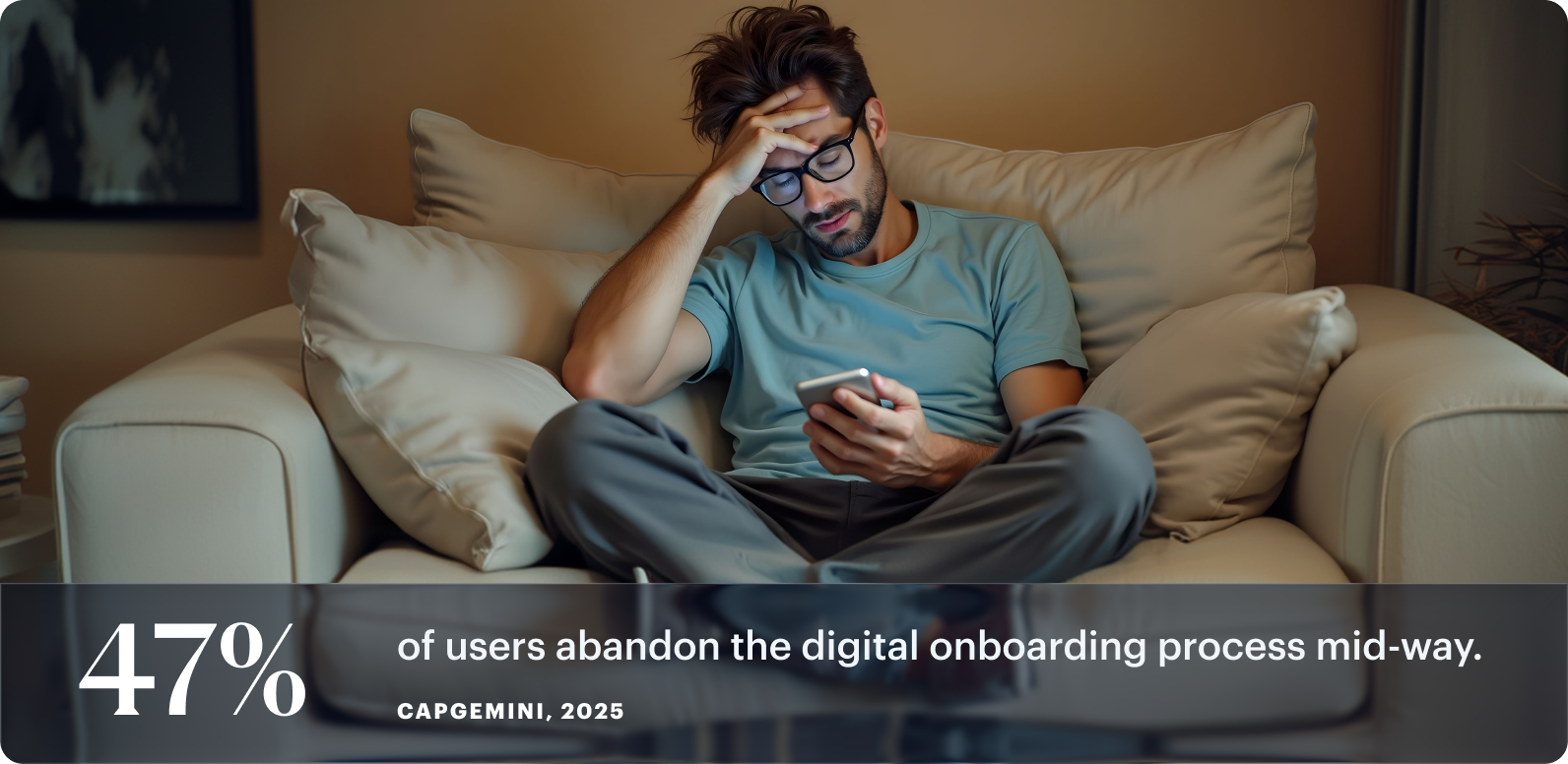
Digital-native users expect onboarding in minutes — nearly half abandon journeys that become too lengthy or cumbersome.
Regulatory
National eID schemes already serve millions, and eIDAS 2.0’s European Digital Identity Wallet is being rolled out across member states ahead of 2027.
Assurance
Beyond confirming the data is genuine, businesses need confidence that the person presenting it is its legitimate owner. Biometric binding that detects deepfakes and presentation attacks helps provide that assurance.
01 — The Conversion Challenge
Onboarding friction is a measurable revenue problem
Europe’s digital economy has reached a scale where remote onboarding friction translates immediately into lost revenue. With reportedly 94% of EU individuals online in 2025 and nearly nine in ten using mobile, regulated platforms onboard at volumes that demand an identity layer which never becomes a bottleneck in the way of customer acquisition.
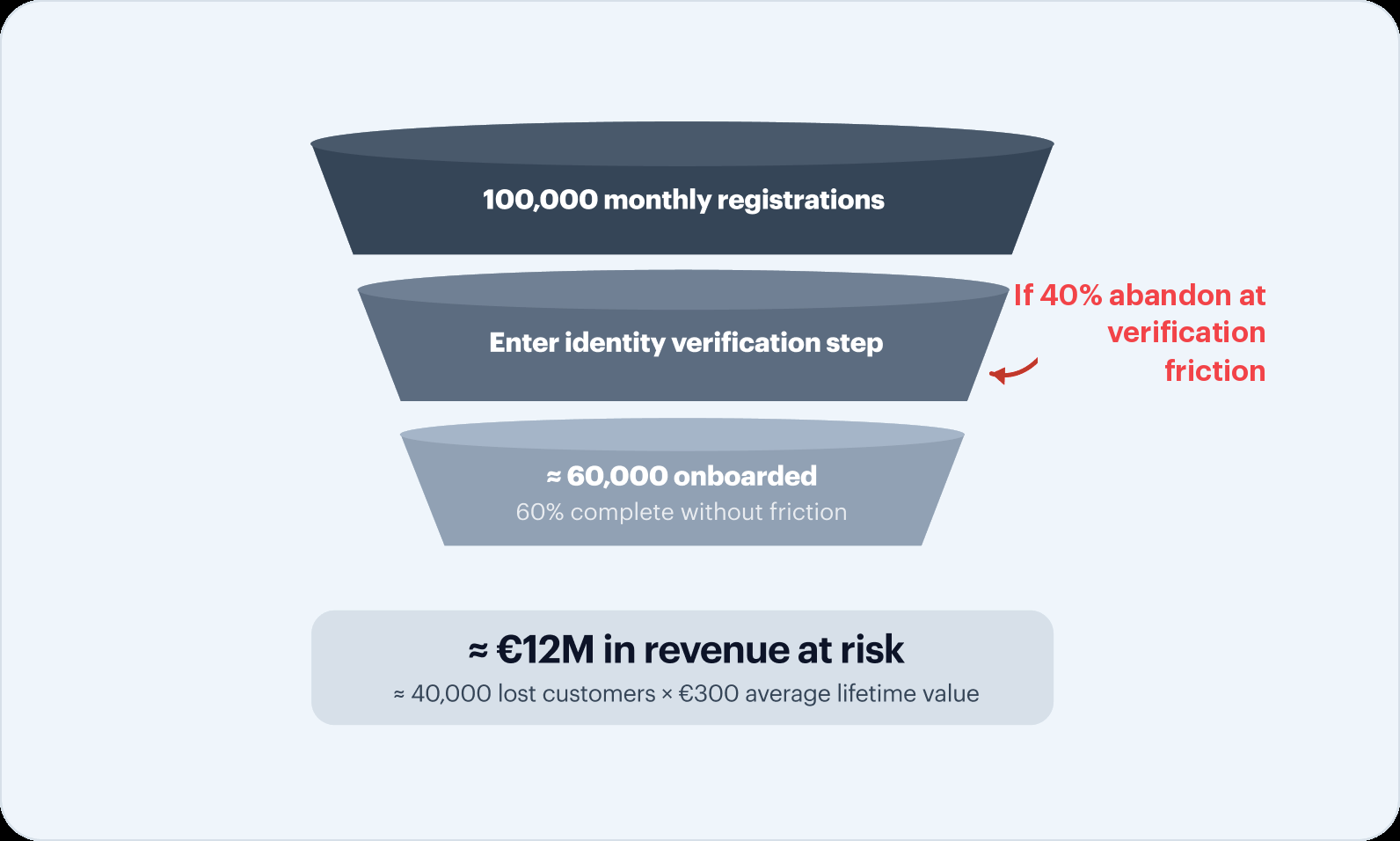
To illustrate the revenue scale
in monthly revenue forfeited by a platform processing 100,000 monthly registrations at €300 average lifetime value, if 40% of users abandon verification.
The Fraud Threat
Fraud is escalating specifically at the remote onboarding stage
While friction in customer onboarding drives revenue loss, the need for a higher level of assurance in onboarding is rising at the same time as fraud levels climb. Account creation is increasingly becoming the highest-risk stage of the customer lifecycle. European regulators continue to reinforce a risk-based approach to customer due diligence, requiring institutions to understand customer risk, apply proportionate verification measures, and maintain confidence in the identity established at onboarding.
projected surge in deepfake fraud by the end of 2026 — including document deepfakes and synthetic IDs.
Shufti internal verification dataRisk-sensitive due diligence
Verification depth must match each customer’s risk. Where digital identity schemes are used, their reliability and assurance level should be assessed as part of the overall remote customer onboarding controls, including notified eID schemes under the eIDAS framework.
Confirmed presence & identity binding
Liveness checks can strengthen assurance by helping confirm the presence of the individual presenting an identity credential and reducing risks associated with impersonation attempts.
02 — The European eID Ecosystem
Your users are already verifying with national and commercial eIDs
European countries have developed national and private digital identity ecosystems, with many schemes collectively serving hundreds of millions of users. Docless Verification through these schemes is not a future capability — it is the current reality for most of Europe’s digitally active population. The map below shows the government-issued and nationally recognised eID schemes across Europe, based on the schemes notified under eIDAS (Official Journal C/2026/4428), with non-EU markets such as Norway included for context.
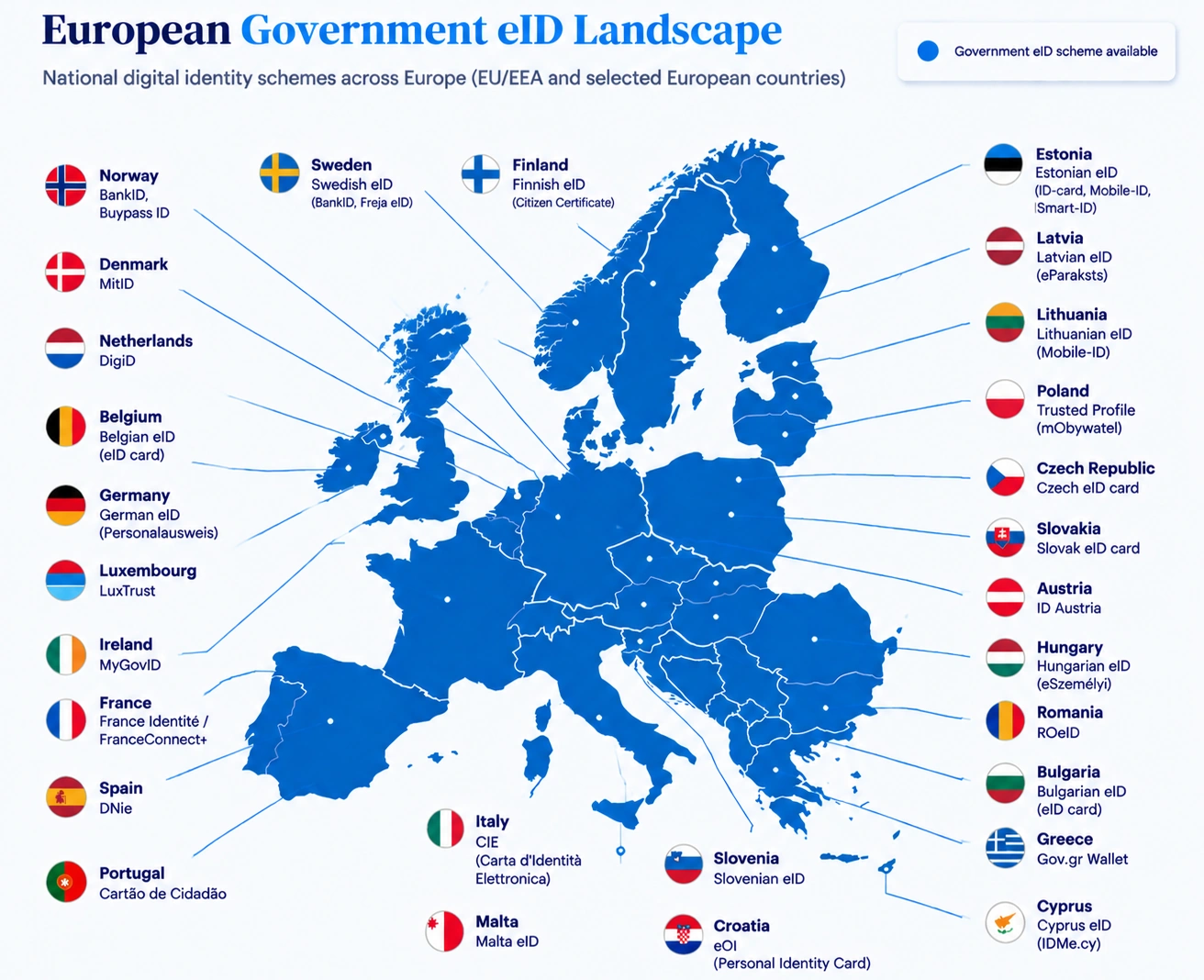
Note: this map shows government-issued or nationally recognised eID schemes across European countries. Some countries have more than one eID means under a single national scheme, and non-EU European countries (e.g. Norway) are included for context. Source: European Commission, Official Journal C/2026/4428 (12 August 2026).
The European Commission’s 2030 Digital Decade target — 80% of EU citizens using a digital ID by 2030 — is already ahead of schedule in several markets.
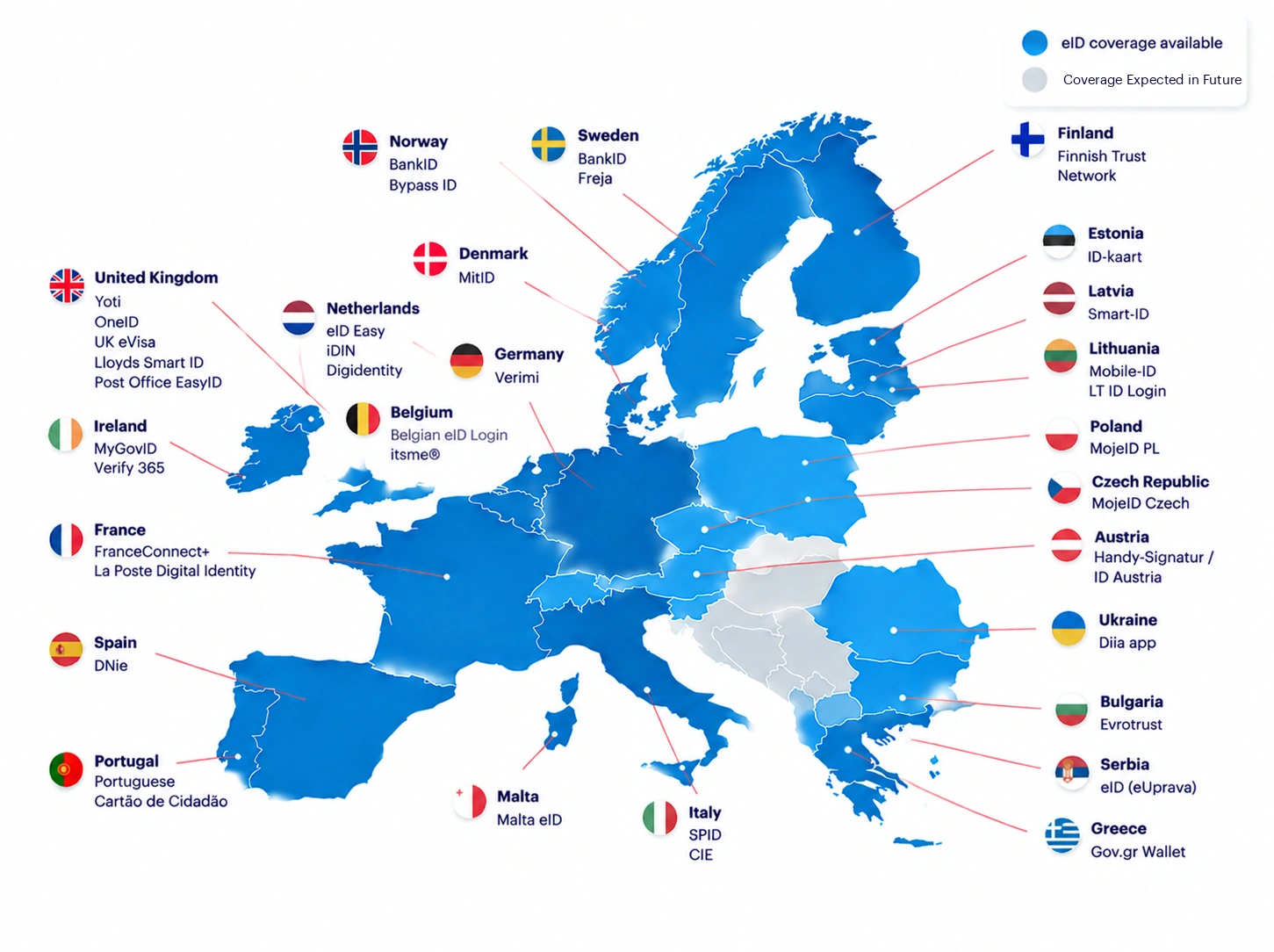
Shufti’s Active eID coverage across Europe
Alongside these government schemes, Shufti has partnered with private eID providers, extending Active eID coverage across Europe. Blue denotes markets with eID coverage; grey denotes markets where coverage is expected in future. New eID integrations are added as further national and private schemes come online, so coverage keeps growing.
03 — Docless Verification Coverage Across Europe
Passive Docless Verification coverage across Europe
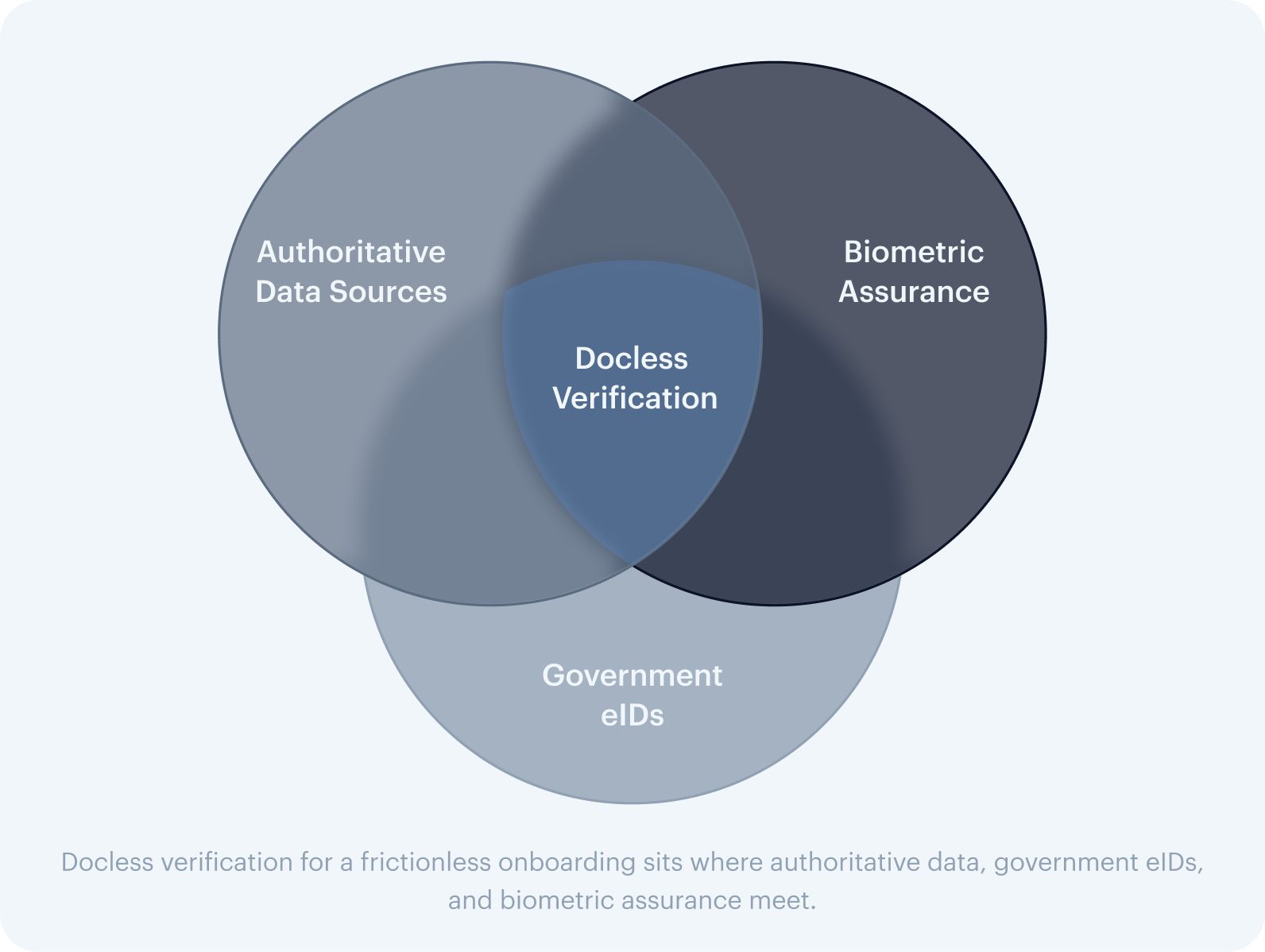
Passive Docless Verification validates identity using trusted government, telecom, credit, commercial, and consumer data sources without requiring document submission. By combining multiple authoritative data sources within a single verification flow, Shufti supports both one-to-one matching and two-plus-two verification methodologies, improving resolution rates across diverse markets. Bubble size reflects adult population, while colour represents the highest coverage available from an individual data source across key European economies.
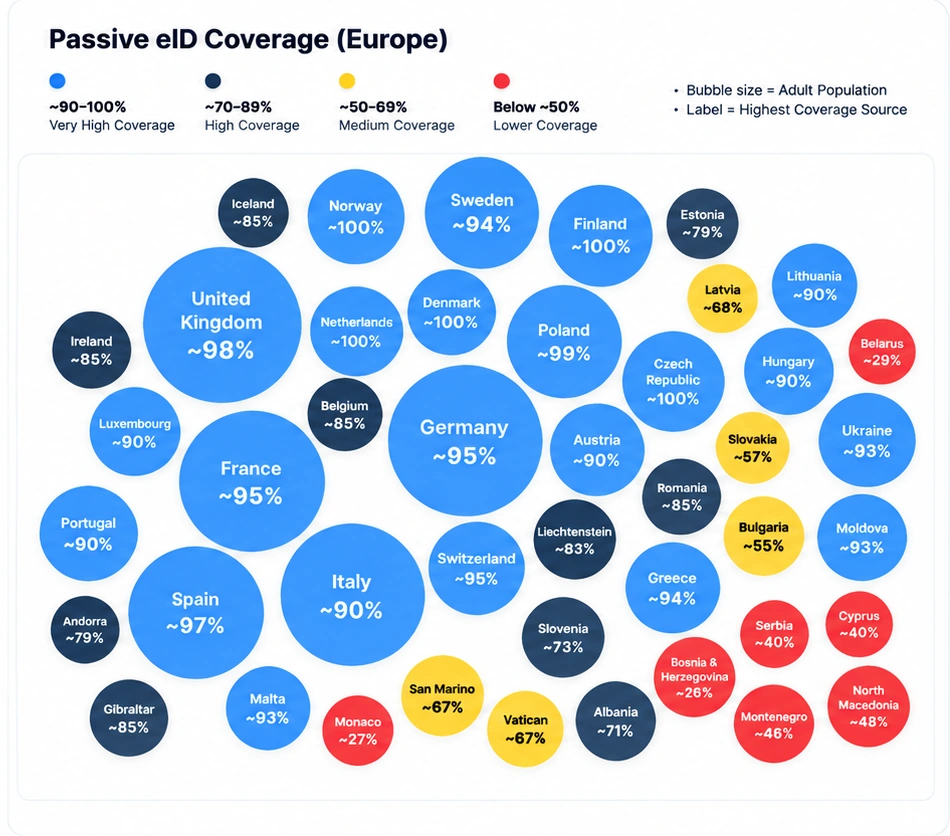
The chart highlights representative markets — coverage extends beyond the countries shown here.
04 — eIDAS 2.0 & The EUDI Wallet
Wider EUDI Wallet acceptance is arriving in 2027
Is your business ready to accept the EUDI Wallet?
Regulation (EU) 2024/1183 requires every member state to issue a European Digital Identity Wallet by December 2026. The EUDI Wallet framework is designed to enable wider acceptance of digital identity credentials across participating services from 2027, subject to applicable obligations and implementation requirements for relying parties such as banks, payment institutions, and regulated digital platforms.
Identity binding rules
Implementing Regulation (EU) 2026/798 establishes reference standards for remote onboarding to European Digital Identity Wallets, where electronic identification means at assurance level substantial are combined with additional remote onboarding procedures to meet high assurance requirements. These procedures support identity verification and the binding of personal identification data to the wallet and user device.
Wallet issuance
Every member state issues a government-backed portable identity container citizens use to share verified attributes selectively.
Wider acceptance
Acceptance obligations begin to apply for relying parties in scope. A programme built on document capture alone will need to be extended to accept wallet credentials.
05 — One Platform, Three Capabilities
Identity verification, assurance, and e-signing in one place
EU businesses may need a combination of identity verification, stronger authentication assurance, and electronic signing capabilities for use cases such as loan applications or transaction authorisation. Shufti brings these together on a single platform, applied in any combination a customer or transaction demands.
Three capabilities · apply the combination your workflow requires
 Identity Verification
Confirm identity using trusted digital identity schemes, authoritative sources, or government-backed credentials such as BankID, MitID, SPID, DigiD, itsme, FranceConnect+, or future European Digital Identity Wallet credentials.

Biometric liveness can strengthen assurance by helping verify that the person presenting the credential is the legitimate holder.
 Consent & Signing
Complete transactions with electronic signatures, including Qualified Electronic Signatures where a legally recognised qualified signature is required.
06 — Risk-Based Orchestration
Match verification depth to customer risk
The best Docless Verification flows don’t apply one process to everyone. They run a lighter check for low-risk users and escalate only when the risk profile warrants. This is the architecture that makes Docless Verification both commercially viable and compliance-grade.
Invisible background check against authoritative data — under 3 seconds, no redirect.
Authentication with a government-issued digital identity credential the user already holds.
Liveness capture at iBeta Level 3 — ISO/IEC 30107-3 presentation-attack detection.
Verification depth escalates with customer risk → higher assurance
Future ready for the EUDI Wallet
Infrastructure for the future of digital identity in Europe
Shufti is actively investing in the future of digital identity — expanding eID coverage across Europe and integrating with the evolving EUDI Wallet ecosystem. Businesses are positioned to accept digital credentials and support customer onboarding as regulatory adoption milestones approach, without building and maintaining complex digital identity infrastructure from scratch.
07 — Provider Evaluation
Use this checklist to choose a Docless Verification provider for Europe

A single integration that opens Docless Verification across the entire EU, so one provider and one contract cover every market you operate in, with no need to source, integrate, or maintain a separate vendor per country.
Active Docless Verification via national government credentials across all major EU markets.
Passive data-source verification across member states, drawing on both government and non-government authoritative sources, with a demonstrable per-market resolution rate.
iBeta Level 3 conformance under ISO/IEC 30107-3, with deepfake detection built and updated by the provider on its own timeline, running in-session without redirects.
Verification depth configurable by segment, with automatic in-session escalation when a risk signal appears mid-flow.
EUDI Wallet acceptance readiness ahead of late 2027, QES support under eIDAS 2.0, and in-region plus on-premises deployment for GDPR and data sovereignty.
Onboard more than 400 million already verified users across Europe through a single solution
The eID schemes are live, the regulatory framework is set, and the capability already exists. The only question is whether your provider can deliver it across the markets you operate in.


Certifications
Independently audited and certified for enterprise-grade security and data protection.


Frequently Asked Questions
Shufti’s eIDV coverage across Europe spans more than 30 countries through Passive eIDV, verifying identity against authoritative government and commercial data sources. Active eIDV supports a growing range of national and private eID schemes, including BankID, MitID, SPID and CIE, itsme, FranceConnect+, Gov.gr Wallet and the other schemes shown on the coverage map above. Coverage is continuously updated as new eID schemes and data sources are integrated, so the map reflects availability at the time of publication; contact Shufti for the current eIDV coverage in the markets you operate in.
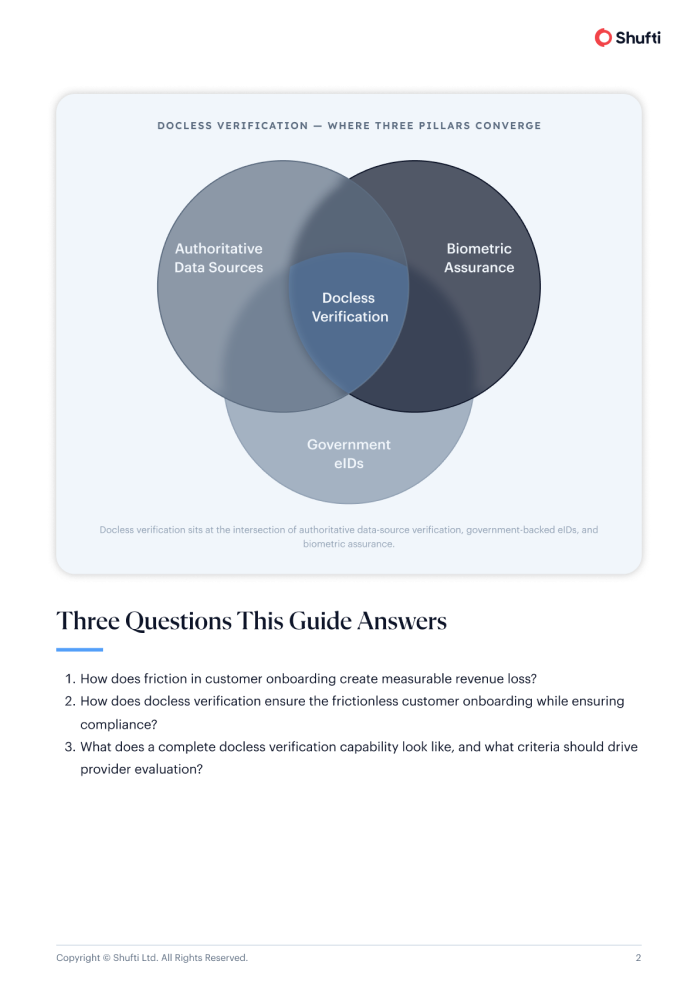
Docless Verification confirms identity against an authoritative source of truth — a government registry, financial database, or government-backed eID — rather than from a submitted document image. It removes the long forms, repeated requests, and upload failures that drive onboarding abandonment, while combining authoritative data with biometric assurance for high confidence.
Regulation (EU) 2024/1183 requires every member state to issue a European Digital Identity Wallet by December 2026. The framework is designed to enable wider acceptance of wallet credentials across participating services from 2027, subject to applicable obligations for relying parties. Implementing Regulation (EU) 2026/798 establishes reference standards for remote onboarding to the wallet, combining electronic identification at assurance level substantial with additional onboarding procedures to reach the high assurance level.
Even with authoritative data, you must confirm the person presenting the identity genuinely owns it — not someone using breached details or a synthetic identity. iBeta Level 3 conformance under ISO/IEC 30107-3 is the highest independently audited liveness standard, explicitly testing against AI-generated face attacks at the sophistication now in operational use.
Look for a provider that owns its core technology, returns a single consistent result schema across markets, holds iBeta Level 3 conformance, allows configurable risk-based escalation, and is positioned for EUDI Wallet acceptance ahead of late 2027 — with in-region and on-premises deployment for data residency.

Form submitted successfully!
Thank you for your interest — your report is loading now.
Verify Singapore customers before December 2026
With about eight months to the NRIC authentication deadline and MAS enforcement at its firmest since 2023, see Shufti configured for Singapore, with MyInfo routing, FIN-holder fallback, deepfake-resistant biometric authentication, AML screening, and MAS-calibrated audit records.