



 Face Verification
 Address Verification
 Document Verification
 Age Verification
 VideoIdent
 Fast ID
 Docless Verification
 Consent Verification
 NFC Verification
 Business Verification
 Due Diligence
 Investor Verification
 E-Signature

 QES
QES
 AML Screening
 Transaction Monitoring
 Adverse Media
 Business AML Screening
 PEP & RCA
 Sanctions
 Watchlist
 Behavioural Biometrics
 Device Fingerprinting
 Biometric Face Authentication
 MFA
MFA
 Fraud Hub
 Onboarding
 Ongoing Monitoring
 KYC
KYC
 KYB
KYB
 KYI
KYI
 Age Assurance
 Identity Verification
 Workforce IAM
 Candidate Verification
 Compliance
 Fraud prevention
 Trust & safety
 Global expansion
 Product Managers
 Compliance Officers
 Fraud Analysts
 Developers
 Deepfake Detection
 Bonus Abuse / Promotion Abuse
 Account Takeover
 Synthetic Identity Fraud
 Document Fraud
 Impersonation Fraud
 Multi-Accounting
 Fraud Networks
 Chargeback Fraud
 Money Mule Activity
 Party Fraud
 Regulatory & Compliance Risks
 Fintech
 Crypto
 iGaming
 Forex
Forex
 Social Network
 Marketplace
 Banking
 Gig Economy
 Payments
 Ride Hailing
 Adult Content
 Blind Spot Audit
 Deepfake Detector
 Liveness Spoofs
 Document Originality
 Document Deepfake
 Global Trust Platform
 Journey Builder
 Case Management
 Shufti AI
 Fraud Analytics
 Vendor Comparison
 Brand Personalisation
 AI Compliance Co-Pilot
 OCR
OCR
 Secure Capture
 Deployment Options
 Identity Methods
 API Documentation
 Mobile SDKs
 Service Status
 Help Center
 Contact Us
 Technical Support
 Supported Documents
 Supported Countries

 Content library
 Blogs
Blogs
 News
News
 Reports
 Insights
 Knowledgebase
 ROI calculator
 About
About
 Career
 Press Release
 Certifications
 Partnership
 Awards
 Events & Webinar
 Interactive Demo
 Podcast Studio
 Spotlight Studio
UK Fraud Is Surging in 2026: AI Scams, Synthetic Identity & Prevention Frameworks

- 01 What do UK fraud statistics reveal about 2024?
- 02 Why is fraud increasing in the UK?
- 03 How do AI scams work in UK financial crime?
- 04 What is synthetic identity fraud and why is it rising?
- 05 What are the main categories of fraud in UK finance?
- 06 How is the UK preventing fraud in 2026?
- 07 What do businesses need to do now?
- 08 How Shufti help businesses stay ahead of UK fraud?
- UK fraud losses hit £1.17bn in 2024 across 3.31M confirmed cases (up 12% YoY), with APP fraud alone accounting for £450.7M and Cifas logging a record 421,000 cases.
- Identity fraud is the fastest-growing category: false identity cases rose 60% year-on-year and now make up 29% of all identity fraud, driven largely by synthetic identities that blend real and fabricated data to slip past basic checks.
- Four forces are pushing losses up: generative AI has cut the cost and skill needed to run scams, digital-only onboarding removed in-person friction, real-time Faster Payments move money before detection catches up, and consumer/SME awareness lags the sophistication of the attacks.
- AI-enabled fraud runs mainly through three channels: voice cloning, deepfake video (both fuelling CEO and impersonation fraud), and LLM-written phishing that strips out the old spelling-error tells.
- Prevention now operates on three layers: identity verification at onboarding (reinforced by the Failure to Prevent Fraud Act), Confirmation of Payee V2 covering 99% of Faster Payments, and the PSR mandatory reimbursement scheme (£85k cap, live since 7 October 2024, with split liability across sending and receiving banks).
UK fraud losses reached £1.17 billion in 2024, with 3.31 million confirmed cases recorded across the year, a 12% rise on the previous year, according to UK Finance’s Annual Fraud Report 2025.
Prevention is catching up, from the Payment Systems Regulator’s mandatory reimbursement rules to Confirmation of Payee covering 99% of Faster Payments, but the attack surface is widening faster than defences can close it.
This article breaks down the current UK fraud trends 2026 landscape, what is driving losses, who is being targeted, and what the prevention architecture now looks like for banks and fintechs operating in Britain.
What do UK fraud statistics reveal about 2024?
UK fraud statistics for 2024 paint a clear picture: authorised push payment (APP) fraud alone accounted for £450.7 million of total losses, while unauthorised fraud made up the remainder. The Cifas Fraudscape 2025 report recorded 421,000 fraud cases in 2024, a record high, with identity fraud representing more than half of all filings.
False identity cases where criminals create or use fabricated credentials to open accounts or access credit rose 60% year-on-year according to Cifas, and now account for 29% of all identity fraud submitted to their National Fraud Database.
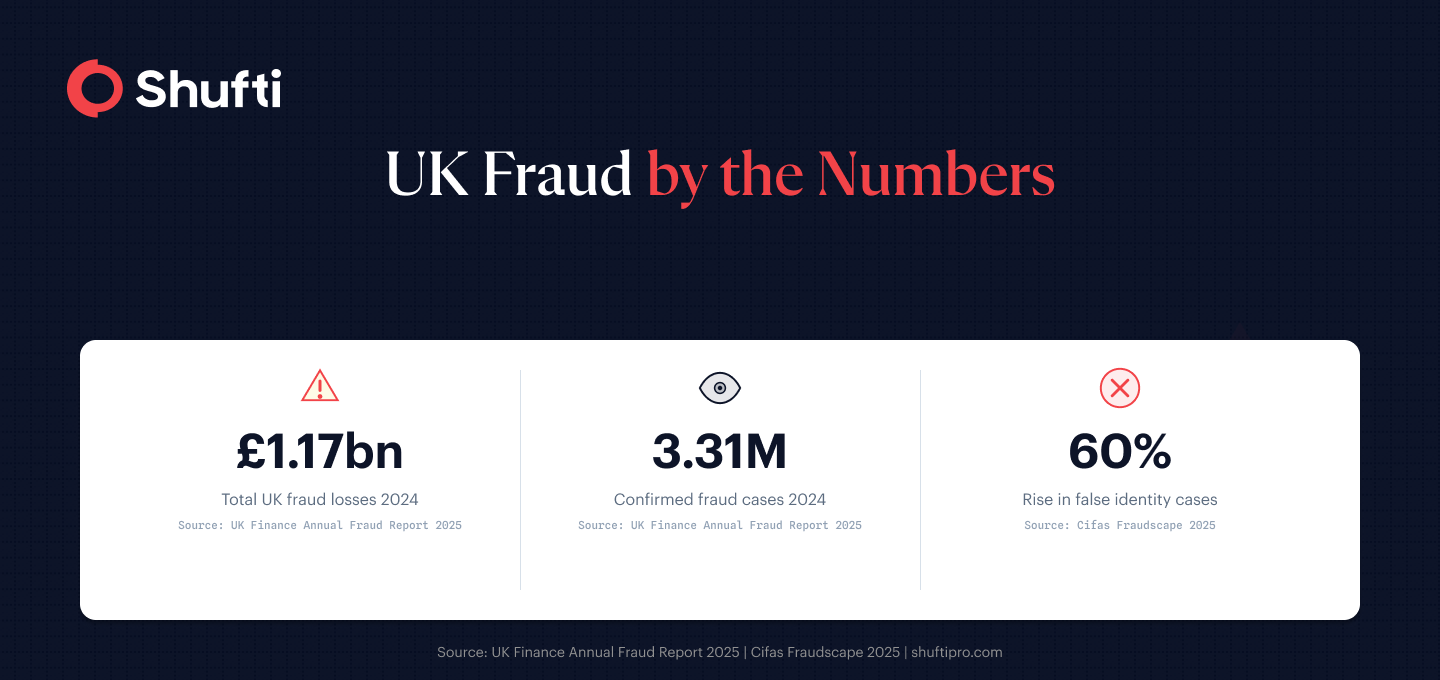
These figures confirm that UK financial crime trends are not driven by a single attack type. Fraud in UK financial services is simultaneously a payments problem, an identity problem, and an AI problem, each feeding into the others in ways that make point-solution defences inadequate.
Why is fraud increasing in the UK?
Several forces are converging to explain why fraud is increasing in the UK at its current pace.
Generative AI has lowered the barrier to entry. Criminals no longer need technical skill to produce convincing phishing emails, synthetic voices, or cloned faces. Tools available on darknet forums can generate believable impersonation content in minutes, allowing low-sophistication actors to run campaigns that previously required organised crime infrastructure.
Account openings have moved entirely online. The shift to digital-first banking removed in-person identity checks that once acted as a natural filter. Synthetic identities, constructed from a mix of real and fabricated data points, pass basic document checks more easily when there is no human to notice inconsistencies.
Payment rails move money faster than fraud detection. The Faster Payments scheme settles transactions in seconds. When APP fraud succeeds, funds are moved through layered accounts within minutes often before a victim or their bank has noticed anything is wrong.
Consumer and SME awareness has not kept pace. Invoice and mandate fraud, which involves criminals intercepting legitimate payment instructions and redirecting funds, exploits exactly the gap between rapid payments and slow verification habits.
In one documented case from the Government’s Economic Crime Survey 2024, a business transferred the equivalent of £20 million to a criminally-controlled account after receiving fraudulent wire transfer instructions that appeared to come from a trusted counterparty.
How do AI scams work in UK financial crime?
AI scams targeting UK bank customers typically work in one of three ways.
First, voice cloning: criminals capture audio of a known contact, a CEO, a bank manager, or a family member from social media or corporate websites, then use text-to-speech AI to generate a real-time conversation that instructs the victim to transfer funds.
Second, deepfake video: synthetic video is used in video calls to impersonate senior figures during business payment authorisations.
Third, AI-generated phishing: large language models write contextually accurate, grammatically correct fraud messages at scale, stripping away the tell-tale spelling errors that once helped consumers identify scams.
UK scam trends show all three methods accelerating in 2025 and into 2026, particularly in CEO fraud targeting mid-market companies and in retail banking scams targeting consumers through social media messaging.
What is synthetic identity fraud and why is it rising?
Synthetic identity fraud occurs when a criminal combines real identity data, typically a genuine National Insurance number, with fabricated name and address details to create a new, coherent identity. Because part of the identity is real, it passes basic matching checks and can build a credit history over months before the fraudster makes a large withdrawal or default.
Synthetic identities are harder to detect than stolen identities because there is no victim to report the fraud; the underlying person whose data element was used may not notice for years. Financial institutions relying on database lookups alone, without layering in credential verification and biometric liveness detection, will continue to onboard these accounts at scale.
What are the main categories of fraud in UK finance?
UK financial crime trends in 2024–2026 cluster into four main categories:
APP fraud covers all cases where a victim is tricked into authorising a payment to a criminal-controlled account. It includes romance scams, purchase scams, impersonation scams, and investment fraud. At £450.7 million in 2024, it remains the largest single loss category.
Identity fraud covers account takeover, application fraud, and synthetic identity fraud. Cifas data shows it is the fastest-growing category by case volume, driven by the synthetic identity pattern described above.
Invoice and mandate fraud targets businesses by intercepting payment instructions, often through business email compromise. Losses here are routinely under-reported because corporate victims face reputational risk in disclosing incidents.
Card and unauthorised fraud covers payment card fraud, cheque fraud, and remote banking fraud where the victim did not authorise the transaction. These categories have declined relative to APP fraud as chip-and-PIN and 3DS authentication have hardened the attack surface.
How is the UK preventing fraud in 2026?
The UK prevention framework in 2026 operates on three interlocking layers.
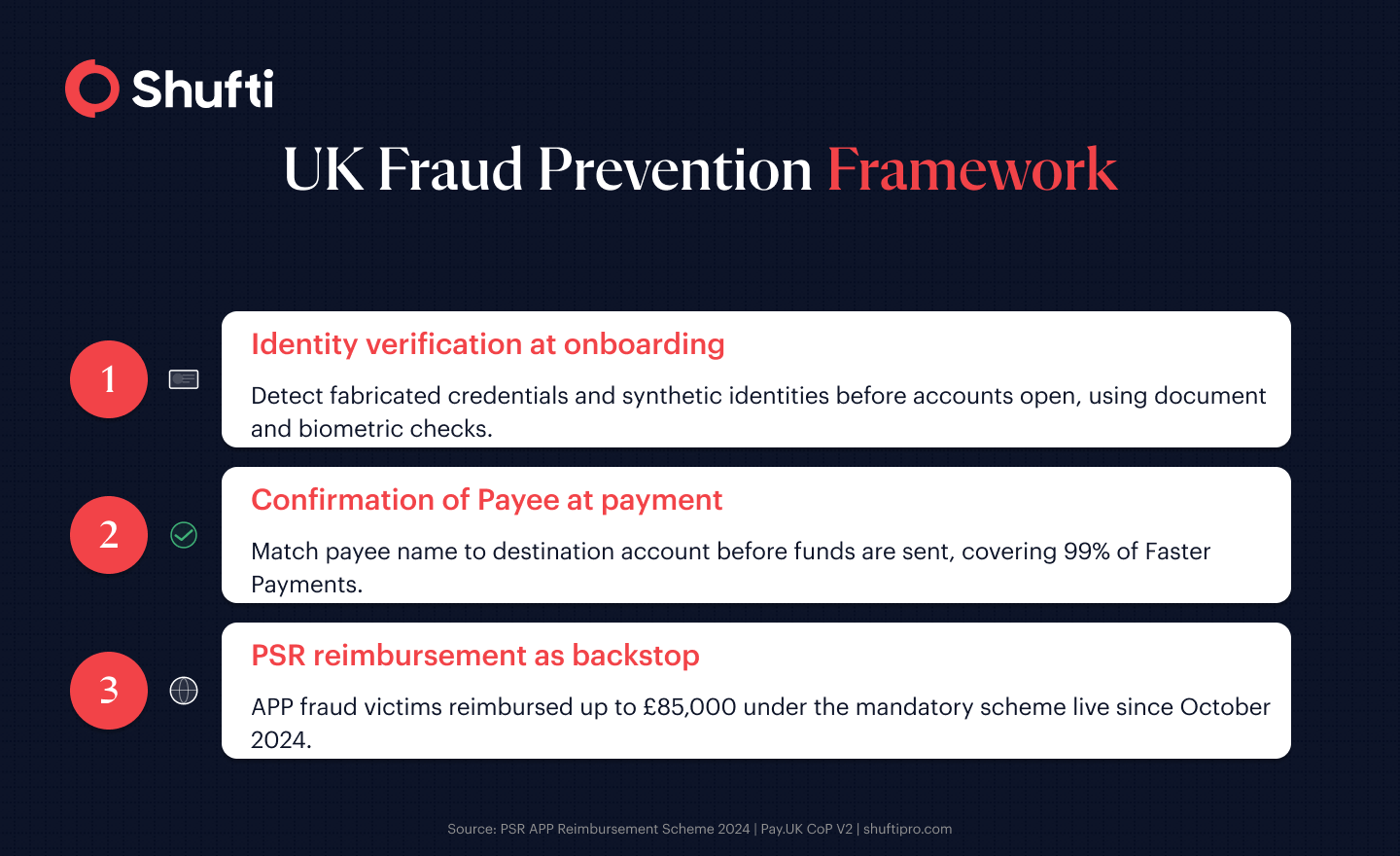
Layer one: Identity verification at onboarding: The Failure to Prevent Fraud Act, fully in force from 2025, creates corporate liability for large organisations whose employees facilitate fraud even without senior knowledge. This has pushed more firms to implement rigorous AML screening and identity checks at account opening, rather than relying on downstream monitoring.
Layer two: Confirmation of Payee at payment: Confirmation of Payee (CoP) V2, rolled out through Pay.UK. When a sender’s payee name does not match the destination account holder, the system flags a mismatch before funds are released, breaking the most common APP fraud chain. CoP V2 extended coverage to additional payment types and smaller payment service providers that were outside the original mandate.
Layer three: PSR mandatory reimbursement as backstop: The Payment Systems Regulator (PSR) mandatory APP reimbursement scheme came into force on 7 October 2024, requiring banks to reimburse victims of APP fraud up to a cap of £85,000 per claim. In the first quarter of operation, 86% of eligible claims were paid, according to PSR monitoring data. The scheme creates a financial incentive for sending and receiving banks to invest in prevention, because both sides share liability under the split-liability model.
What do businesses need to do now?
The fraud landscape UK businesses face in 2026 demands a layered response, not a single compliance checkbox. Firms that treat identity verification as a one-time onboarding exercise and deepfake detection as an optional enhancement are the ones generating the fraud statistics cited above.
Practically, that means treating every payment instruction that arrives by email or phone as unverified until confirmed through an independent channel, implementing biometric re-authentication for high-value transactions, and running ongoing monitoring rather than point-in-time checks. The PSR reimbursement liability model makes this a commercial imperative as well as a compliance one.
How Shufti help businesses stay ahead of UK fraud?
Shufti supports financial institutions, fintechs, and regulated businesses across the UK with an integrated fraud prevention platform that addresses the full attack surface described above. Document verification checks credential authenticity at onboarding. Biometric liveness detection catches deepfake and presentation attacks in real time. AML screening covers 100,000+ data sources, 3,500+ global watchlists, and 2.6 million PEP profiles across 215+ sanction regimes, with data refreshed every 15 minutes. Ongoing monitoring surfaces risk changes after onboarding, not just at the point of account opening. The platform is deployable via a single API across cloud, on-premises, or hybrid environments, and is certified to iBeta Level 1 and 2 for biometric PAD.
Frequently Asked Questions
What is the PSR reimbursement scheme and who does it cover?
The PSR mandatory APP reimbursement scheme, live since 7 October 2024, requires UK payment service providers to reimburse victims of authorised push payment fraud up to £85,000 per claim. It covers personal and most business customers using Faster Payments, with liability split between sending and receiving firms.
What is synthetic identity fraud and why is it rising?
Synthetic identity fraud combines real data elements with fabricated ones to create a new identity that passes basic checks. It is rising because generative AI makes it cheaper to construct consistent false personas, and digital-only onboarding removes the in-person friction that once caught mismatches.
How do AI scams work in the UK financial sector?
AI scams in the UK mainly use voice cloning, deepfake video, and AI-generated phishing messages to impersonate trusted contacts. Voice-cloning CEO fraud is growing fastest in the SME segment, where payment authorisation controls are typically less rigorous than in larger corporates.
What is Confirmation of Payee, and how does it prevent fraud?
Confirmation of Payee (CoP) checks whether the name a payer enters matches the account holder at the destination bank before a Faster Payment is released. When there is a mismatch, the payer receives a warning. CoP V2 has now processed over 2 billion checks covering 99% of Faster Payments, breaking the most common APP fraud chain.
What are the main categories of fraud in UK finance?
The four main categories are APP fraud (£450.7M in 2024), identity fraud including synthetic identities (fastest-growing by case volume), invoice and mandate fraud targeting businesses, and card and unauthorised fraud. APP fraud and identity fraud are the two largest by both case count and financial loss.
What is invoice and mandate fraud?
Invoice and mandate fraud involves criminals intercepting payment instructions, typically through business email compromise, and redirecting funds to criminal accounts before the legitimate payee notices. It predominantly targets SMEs and professional services firms because payment authorisation processes in those sectors are often manual.
Why is fraud increasing in the UK?
UK fraud is increasing because generative AI has lowered attack costs, digital-only account opening has removed physical identity friction, real-time payment rails move funds before detection, and consumer and SME awareness of AI-driven impersonation techniques remains lower than the sophistication of the attacks themselves.