







TL;DR
- US fraud losses hit $12.5 billion in 2024, up 25% year-on-year
- ID verification is legally required for most US sectors under the BSA, PATRIOT Act, and FinCEN’s CIP rule
- The process covers three stages: document validation, liveness detection, and AML screening
- Deepfakes and synthetic identities make liveness detection non-negotiable in 2025
- AI-powered platforms complete full verification in under 30 seconds
- The US verification market is growing from $4.34B in 2025 to $8.16B by 2030
Americans filed more than 1.1 million identity theft reports with the Federal Trade Commission (FTC) in 2024, and total fraud losses hit $12.5 billion, a 25% jump over the prior year. For US businesses, that number has a direct operational meaning. Customers arrive with stolen credentials, synthetic identities, and AI-generated documents. Onboarding processes that take those at face value absorb the loss.
ID verification in the USA is not optional for most sectors. Financial institutions, fintechs, and an expanding list of regulated industries must confirm who they are dealing with before opening accounts, processing transactions, or extending credit. Online identity verification USA-wide has become the default method. It is mobile-first, AI-powered, and expected to conclude in seconds. This guide explains how the process works, which federal laws drive it, and what it looks like across the industries that rely on it most.
What is ID verification in the USA?
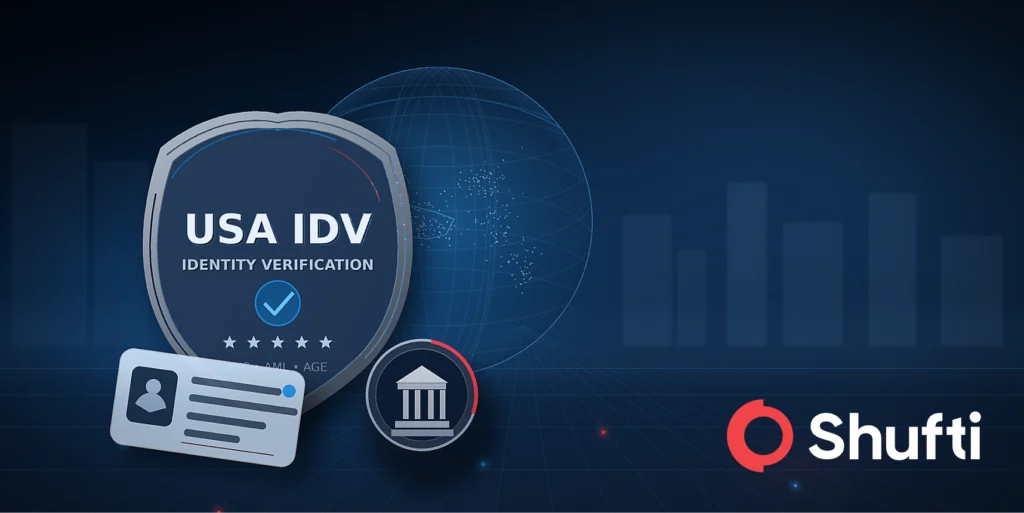
Digital identity verification in the USA is the process of confirming that a person’s claimed identity corresponds to a real, valid, and living individual. It uses a combination of document checks, biometric matching, and database lookups to establish that the person presenting credentials is actually who they claim to be.
The concept is not new. Banks have run identity checks for decades, and the practice predates digital channels. What has changed is the mechanism. Physical branch visits gave way to remote identity verification USA-wide, driven by the rise of neobanks, digital lending platforms, and mobile-first financial products. US digital ID verification is now expected to run entirely on a mobile device, across state lines, at any hour. The need to verify identity online USA-wide spans industries from banking to gaming.
Identity verification solutions handle the full process through a single API, covering document validation, selfie biometrics, and sanctions screening without a branch visit or mailed-in paperwork. The question for US businesses is no longer whether to verify identity, but how to do it fast enough to retain customers while staying compliant.
How does online identity verification work in the USA?
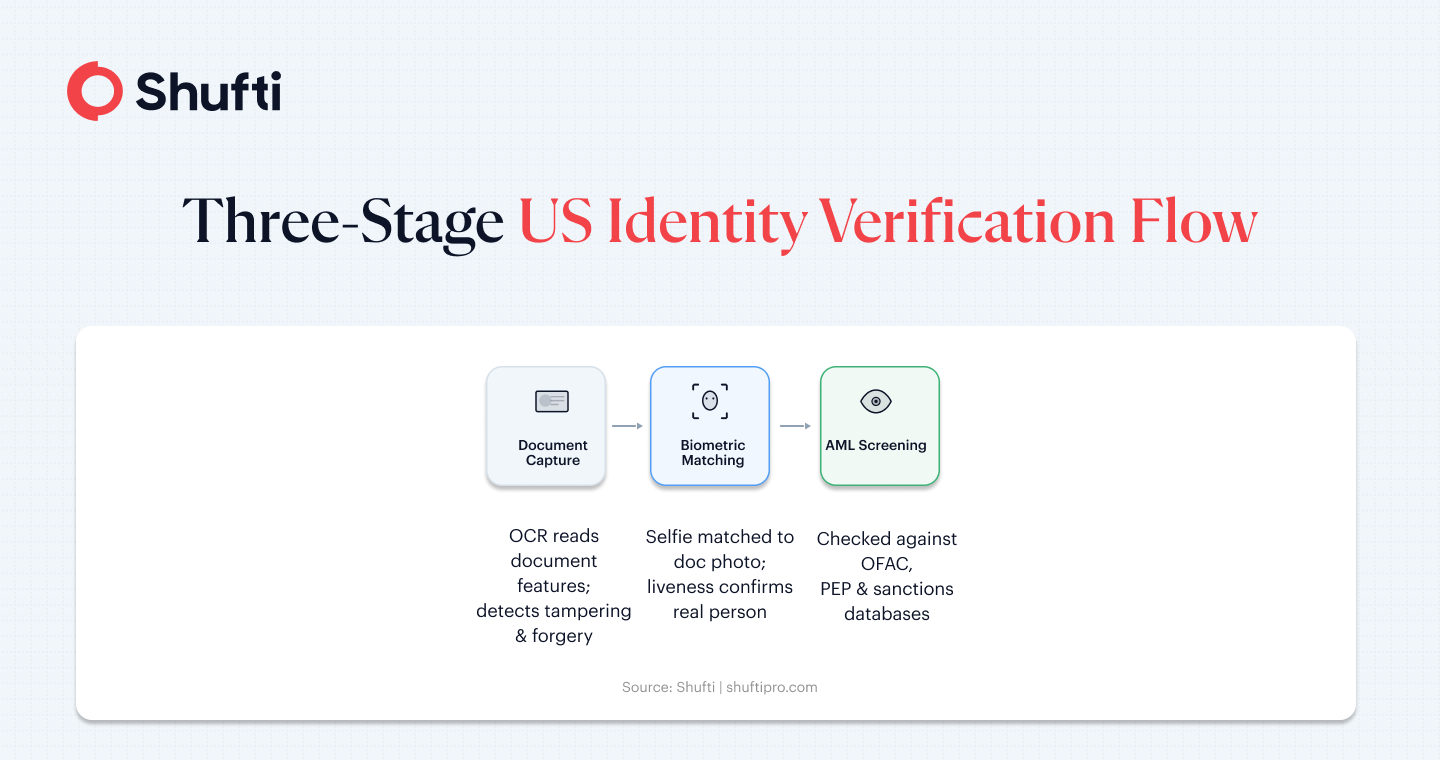
Online identity verification USA runs through three sequential stages. The first is document capture and validation, the second is biometric matching with liveness detection, and the third is database cross-check with risk screening. Most AI identity verification USA platforms complete all three in under 30 seconds. Each stage catches a different category of fraud. A system that skips one stage leaves a gap that sophisticated actors will find.
Document capture and validation
When a user submits an identification document, the system checks the document’s physical and digital security features, including holograms, microprint patterns, and MRZ (Machine Readable Zone) data. Document verification software reads name, date of birth, address, and ID number using optical character recognition (OCR) and cross-references the extracted data against the document’s encoded metadata to detect tampering or forgery.
Electronic ID verification USA platforms typically support over 10,000 document types globally. That range matters for US businesses onboarding international customers alongside domestic ones; a single document library covers driver’s licenses, US passports, passport cards, and permanent resident cards, plus the equivalent document set for 230+ other countries.
Biometric matching and liveness detection
Once the document clears, the user submits a selfie or short video. Facial recognition software matches the biometric capture against the document photo. Identity authentication USA platforms add a liveness layer, confirming through passive analysis or active prompts that the person is physically present and not submitting a printed photograph, a 3D mask, or an AI-generated video feed.
This step is the primary battleground for fraud in 2025. Generative AI has lowered the barrier for producing convincing deepfakes and synthetic face images, making liveness detection a non-negotiable component of any serious US digital identity verification solution.
Database cross-check and AML screening
The confirmed identity runs against AML screening databases, including sanctions lists, Politically Exposed Persons (PEP) registries, adverse media sources, and watchlists maintained by regulators including the Office of Foreign Assets Control (OFAC). For US businesses subject to the Bank Secrecy Act (BSA), this step is mandatory. A sanctioned individual must not pass through onboarding regardless of how clean their document appears.
What US laws require businesses to verify customer identities?
Three federal frameworks define the identity verification baseline for US businesses in 2025. The Bank Secrecy Act (BSA), section 326 of the USA PATRIOT Act, and the Financial Crimes Enforcement Network (FinCEN) Customer Identification Program (CIP) rule set the floor, and sector-specific regulators layer additional requirements on top. Understanding this stack is essential before selecting ID verification solutions USA businesses can rely on when a compliance examination arrives.
The BSA, USA PATRIOT Act, and the CIP rule
The BSA has required financial institutions to maintain anti-money-laundering programs since 1970. Section 326 of the USA PATRIOT Act, enacted in 2001, added a specific identity verification mandate. The resulting FinCEN Customer Identification Program rule requires banks, credit unions, and other covered institutions to collect each customer’s name, date of birth, address, and a government-issued identification number at account opening, and to verify that information through documentary or non-documentary means. The USA PATRIOT Act extended these obligations to broker-dealers, mutual funds, and futures commission merchants as well. Digital onboarding does not exempt businesses from the CIP requirement. It obligates them to adapt the method to the channel.
State-level and sector-specific requirements
Federal law sets the minimum. State-level requirements raise it further depending on industry and geography. California’s consumer privacy framework (CCPA), New York’s Department of Financial Services (NYDFS) cybersecurity regulation, and an expanding body of state-level age verification legislation mean that KYC verification USA obligations vary materially depending on where a business operates and what it offers. ID verification providers USA businesses work with must stay current on both federal and state requirements. A solution that satisfies FinCEN but fails a state regulator creates exposure on a different front.
Which industries use ID verification most in the USA?
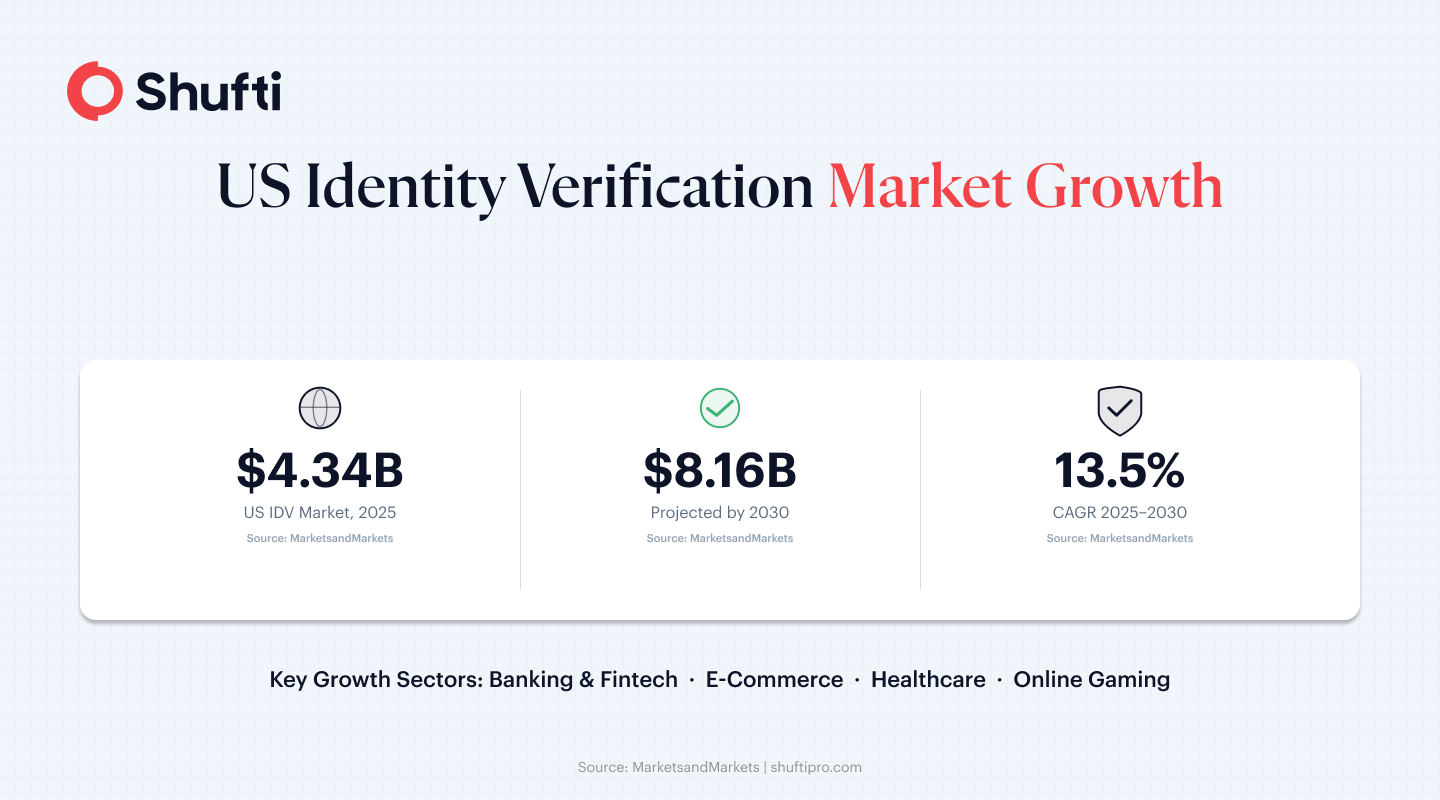
The US identity verification market stood at $4.34 billion in 2025 and is projected to reach $8.16 billion by 2030, at a compound annual growth rate of 13.5%. That growth is not evenly distributed. Four industries account for the majority of demand, each driven by a distinct combination of regulatory pressure and fraud exposure.
Banking and fintech
Financial institutions are the largest users of ID verification services USA-wide. Every new account opening, loan application, and digital wallet registration triggers a CIP-mandated identity check under the BSA. For fintechs handling cross-border transfers or digital assets, the obligation extends to ongoing transaction monitoring and periodic re-verification. The shift to fully digital onboarding has pushed banks and fintechs to adopt automated KYC workflows that can verify a customer in the time it takes to fill out a form.
E-commerce and marketplace platforms
Online marketplaces face identity risk on two sides. Fraudulent buyers use stolen payment credentials and trigger chargebacks. Fraudulent sellers list non-existent goods and disappear before disputes resolve. US digital ID verification at seller onboarding, and in high-risk buyer scenarios, has become standard for larger platform operators managing significant transaction volume.
Healthcare
Telehealth expansion moved identity verification into patient onboarding at scale. Healthcare providers verify patient identity to prevent insurance fraud, protect prescription records, and comply with state licensure requirements when treating patients across state lines. The stakes extend beyond compliance; a patient identity error in a medical context carries clinical risk alongside the financial one.
Gaming and online gambling
US states that have licensed online gaming, including New Jersey, Pennsylvania, and Michigan, require operators to verify both player age and identity before any wagered transaction proceeds. AI identity verification USA has become the standard method for this use case, given the volume and speed required during peak registration periods.
How Shufti helps US businesses run compliant identity checks
US businesses operating under FinCEN’s CIP rule face a specific tension. The regulation requires thorough identity verification, but digital users abandon onboarding the moment it feels slow. Manual review creates delays that cost conversions. Fragmented vendor stacks create handoff gaps that sophisticated fraud exploits.
Shufti’s identity verification platform combines document validation with biometric liveness matching in a single API, completing a full identity check in under 15 seconds. The platform covers 10,000+ document types across 230+ countries, which directly addresses the reality that US businesses onboard international customers alongside domestic ones. Synthetic identity fraud, linked to over $35 billion in annual US losses by the Federal Reserve Bank of Boston, is screened at the document level using forensic AI trained on real manipulation patterns, catching forgeries that optical checks alone miss.
See how Shufti handles compliant identity verification for US businesses request a demo.
Frequently Asked Questions
Q: What are the benefits of ID verification for US businesses?
Automated ID verification reduces fraud losses, satisfies FinCEN's Customer Identification Program requirements, and cuts the manual review overhead that slows onboarding. Verified customers generate fewer chargebacks, lower dispute rates, and create an auditable identity record that supports regulatory examinations and internal compliance reporting.
Q: What types of ID are accepted for verification in the USA?
Most US identity verification solutions accept driver's licenses, state-issued identification cards, US passports, and passport cards as primary documents. Permanent resident cards and military IDs are accepted by many platforms. Document acceptance depends on the verification provider's supported document library and the risk tier the business needs to satisfy.
Q: How long does ID verification take in the US?
AI-powered digital identity verification USA typically completes document and biometric checks in under 30 seconds. More complex scenarios, including enhanced due diligence (EDD) triggers, manual review flags on edge-case documents, or multi-factor identity authentication USA workflows, extend that timeline depending on the platform's automation depth.
Q: Can ID verification prevent fraud in American businesses?
Automated verification catches stolen credentials, forged documents, and synthetic identities at onboarding, before a fraudulent account is created. The Federal Reserve Bank of Boston reported in April 2025 that generative AI is accelerating synthetic identity fraud, making AI-powered multi-stage verification more effective than document checks alone.