




 Face Verification
 Address Verification
 Document Verification
 Age Verification
 VideoIdent
 Fast ID
 Docless Verification
 Consent Verification
 NFC Verification
 Business Verification
 Due Diligence
 Investor Verification
 E-Signature

 QES
QES
 AML Screening
 Transaction Monitoring
 Adverse Media
 Business AML Screening
 PEP & RCA
 Sanctions
 Watchlist
 Behavioural Biometrics
 Device Fingerprinting
 Biometric Face Authentication
 MFA
MFA
 Fraud Hub
 Onboarding
 Ongoing Monitoring
 KYC
KYC
 KYB
KYB
 KYI
KYI
 Age Assurance
 Identity Verification
 Workforce IAM
 Candidate Verification
 Compliance
 Fraud prevention
 Trust & safety
 Global expansion
 Product Managers
 Compliance Officers
 Fraud Analysts
 Developers
 Deepfake Detection
 Bonus Abuse / Promotion Abuse
 Account Takeover
 Synthetic Identity Fraud
 Document Fraud
 Impersonation Fraud
 Multi-Accounting
 Fraud Networks
 Chargeback Fraud
 Money Mule Activity
 Party Fraud
 Regulatory & Compliance Risks
 Fintech
 Crypto
 iGaming
 Forex
Forex
 Social Network
 Marketplace
 Banking
 Gig Economy
 Payments
 Ride Hailing
 Adult Content
 Blind Spot Audit
 Deepfake Detector
 Liveness Spoofs
 Document Originality
 Document Deepfake
 Global Trust Platform
 Journey Builder
 Case Management
 Shufti AI
 Fraud Analytics
 Vendor Comparison
 Brand Personalisation
 AI Compliance Co-Pilot
 OCR
OCR
 Secure Capture
 Deployment Options
 Identity Methods
 API Documentation
 Mobile SDKs
 Service Status
 Help Center
 Contact Us
 Technical Support
 Supported Documents
 Supported Countries
 Content library
 Blogs
Blogs
 News
News
 Reports
 Insights
 Knowledgebase
 ROI calculator
 About
About
 Career
 Press Release
 Certifications
 Partnership
 Awards
 Events & Webinar
 Interactive Demo
 Podcast Studio
 Spotlight Studio
Identity Verification for Wealth Management Companies: A 2026 Compliance Guide

-
Add us as a Preferred Source
- 01 Why do wealth management firms need identity verification?
- 02 What AML regulations apply to wealth management firms?
- 03 How do wealth managers verify high-net-worth client identities?
- 04 PEP screening and continuous KYC monitoring in wealth management
- 05 How Shufti helps wealth managers verify and monitor clients
TL;DR
- Wealth managers must verify client identity, establish the source of wealth, and screen for PEPs and sanctions at onboarding before accepting assets under management.
- Regulatory obligations span multiple frameworks: FATF Recommendations, EU 6AMLD, US FATCA, and the OECD Common Reporting Standard (CRS), which expands to cover digital assets from 2026.
- Standard customer due diligence (CDD) applies to all clients; enhanced due diligence (EDD) is required for high-risk clients, PEPs, and those from high-risk jurisdictions and requires senior management sign-off.
- PEP screening is not a one-time onboarding check; it must run continuously because political exposure and sanctions status change after the client relationship begins.
- Continuous KYC monitoring re-screens existing clients against updated watchlists, PEP databases, and adverse media on a rolling basis, not only at annual review.
- Digital identity verification now runs entirely remotely for most firms, combining document authentication, biometric liveness, and risk screening in a single workflow.
“We’re performing compliance checks manually, with uncertainty around accuracy and regulatory coverage.” That sentence came out of discovery calls with investment management firms across the Asia-Pacific and the Americas, in the same period that UK AML enforcement gave a stark warning to regulated firms in 2025, imposing fines for more than 124 million pounds by year-end, with the majority linked to financial crime control failures. For wealth management companies, where client portfolios are large and regulatory scrutiny runs deep, the gap between a documented compliance policy and the manual processes carrying the actual load is where regulatory risk lives.
This guide covers what identity verification for wealth management firms requires in 2026: the statutory obligations, how the verification process works for high-net-worth clients, and what effective ongoing monitoring looks like in practice.
Identity verification in wealth management refers to confirming that a client is who they claim to be, establishing the origin of their wealth, and screening them against global sanctions lists and politically exposed person (PEP) databases before or during onboarding.
Why do wealth management firms need identity verification?
Wealth managers sit at a structurally high-risk point in the financial system. They handle large asset concentrations from clients across multiple jurisdictions, and they work regularly with individuals whose source of wealth is complex to trace. The United Nations Office on Drugs and Crime (UNODC) estimates that 2–5% of global GDP is laundered annually, and wealth management channels are among the documented routes for those flows. Regulators applying Financial Action Task Force (FATF) standards have made the sector a named enforcement priority, and recent fine levels in the UK and Europe reflect that directly.
The statutory baseline for client onboarding identity checks
Customer due diligence (CDD) applies to every client at onboarding. Wealth management client onboarding identity checks go well beyond capturing a name and a passport scan. The firm must verify the client’s identity against a live biometric, understand the nature of the intended business relationship, and establish the source of funds before accepting assets under management. KYC identity verification for wealth management companies is the entry point for that process, not the full extent of it.
AML identity verification for asset managers: the risk-based approach
FATF Recommendation 10 requires financial institutions to calibrate their due diligence to each client’s risk profile. For asset managers, this means verification depth varies by client. A straightforward domestic retail investor may clear CDD with document verification and a database check. A high-net-worth individual from a higher-risk jurisdiction triggers a more intensive process, including AML identity verification and, depending on the client’s profile, a full enhanced due diligence review.
What AML regulations apply to wealth management firms?
Wealth managers operate at the intersection of several overlapping regulatory frameworks, each imposing identity verification obligations that interact across cross-border client relationships. Understanding which rules apply and how they connect is the starting point for building a defensible program.
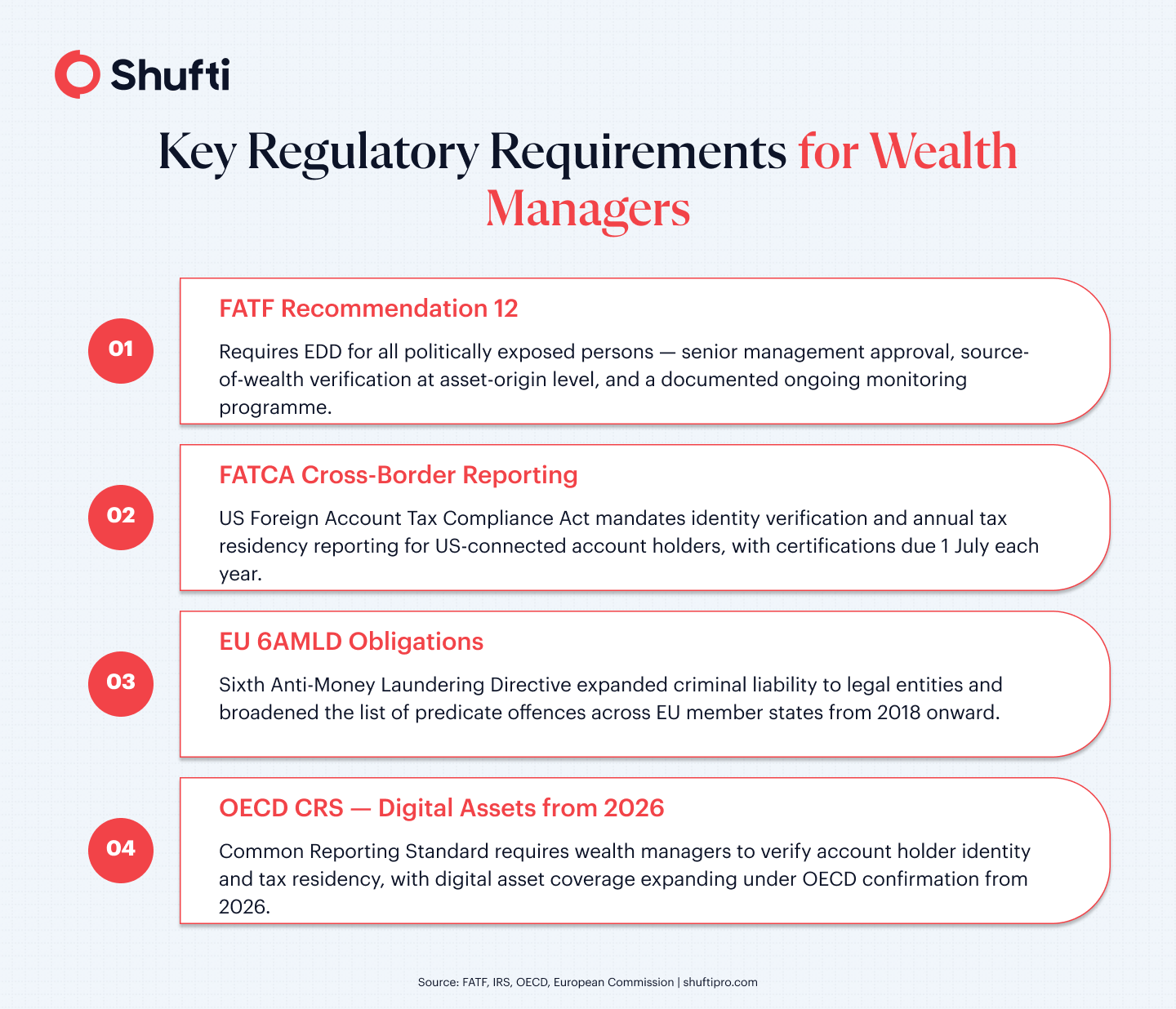
FATF Recommendations and 6AMLD obligations
The FATF Recommendations set the international standard for anti-money laundering (AML) compliance. In the European Union, those recommendations are transposed into national law through the Sixth Anti-Money Laundering Directive (6AMLD), which, as of 2018, expanded criminal liability to legal entities and broadened the list of predicate offenses. Wealth managers operating in EU member states must comply with 6AMLD requirements alongside any national-level transpositions and FATF mutual evaluation findings that apply to their jurisdiction.
FATCA and CRS: the cross-border identity layer
The U.S. Foreign Account Tax Compliance Act (FATCA) and the OECD’s Common Reporting Standard (CRS) add a cross-border identity layer that goes beyond standard AML checks. Both frameworks require wealth managers to verify the tax residency and national identity of account holders and report those findings annually to the relevant tax authority. As of 2025, FATCA certifications covering the prior calendar year were due by July 1. The OECD has confirmed that CRS will expand to cover digital assets from 2026. For asset managers serving internationally mobile clients, this makes identity data accuracy a board-level concern, not a back-office task.
How do wealth managers verify high-net-worth client identities?
Verifying a high-net-worth individual differs structurally from verifying a standard retail client. The asset values are larger, the client’s expectation of a private and frictionless onboarding experience is higher, and the regulatory scrutiny is correspondingly deeper. Selecting the best identity verification platform for wealth management means choosing a system that handles document authentication, biometric liveness, and risk screening inside a unified workflow, rather than connecting point solutions that break the audit trail between steps.
Document verification and biometric liveness
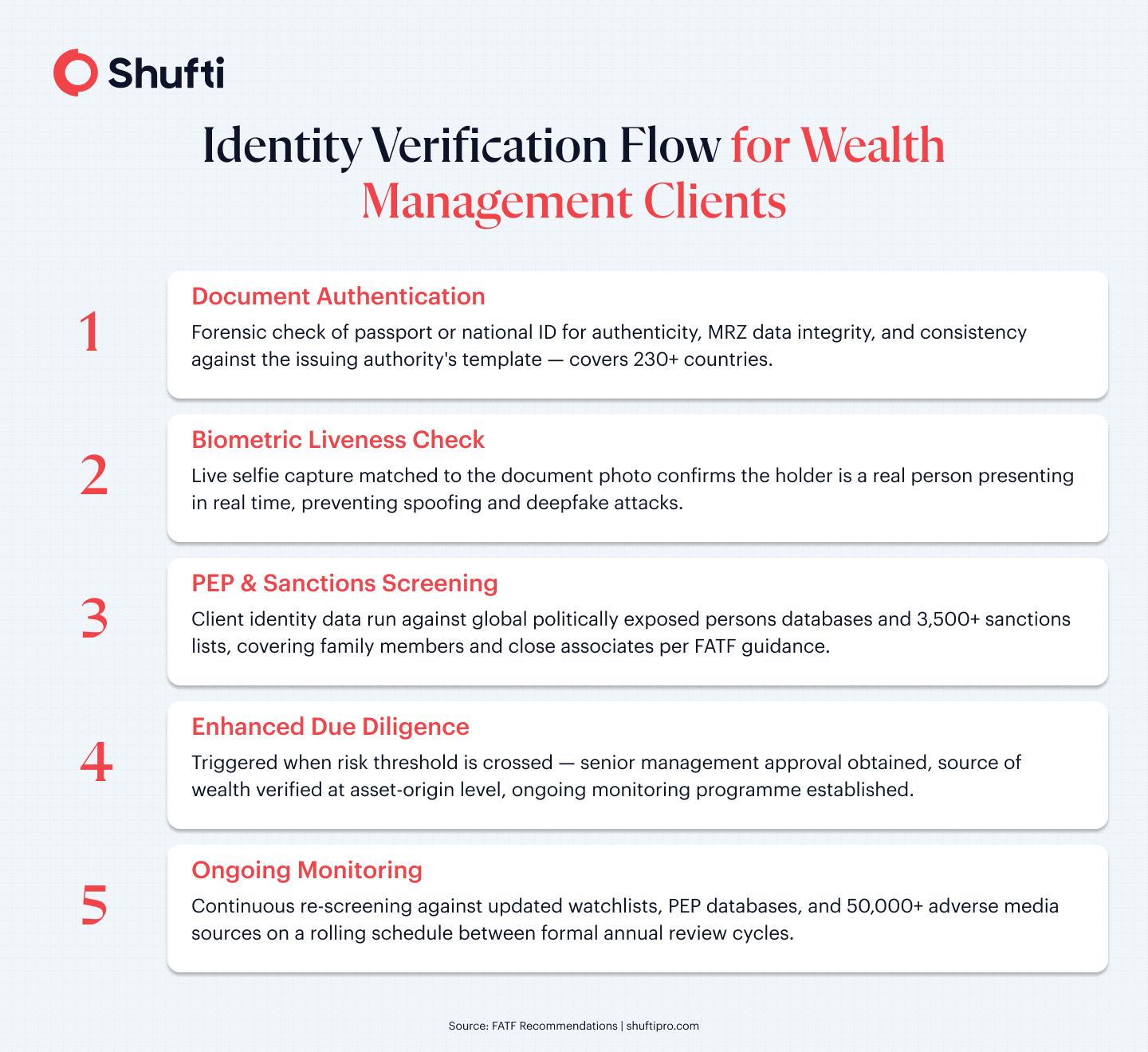
The process begins with document verification: a forensic check of the client’s identity document (passport, national ID, or driving licence) for authenticity, machine-readable zone (MRZ) data integrity, and consistency against the issuing authority’s template. This is followed by biometric identity verification for private wealth clients, a liveness check that matches the document photo to a live selfie capture and confirms the document holder is a real person presenting themselves in real time.
Digital identity verification for private banking now runs entirely remotely for most firms. Wealth management remote client onboarding IDV allows a compliance team in London or Frankfurt to onboard a client in Singapore, Dubai, or New York without requiring a branch visit. The identity verification API for asset managers supporting this flow needs to cover the document formats and issuing standards of 240+ countries to be operationally realistic across a globally diversified client base.
Enhanced due diligence for high-risk client profiles
Enhanced due diligence (EDD) applies when a client’s risk profile crosses a defined threshold, whether from their jurisdiction, source of wealth, political exposure, or asset volume. Enhanced due diligence in identity verification for wealth management goes significantly beyond standard CDD. The firm must obtain senior management approval for the relationship, verify the source of wealth at the asset-origin level rather than only the source of the funds being deposited, and establish a documented ongoing monitoring program.
FATF Recommendation 12 specifies these requirements in the context of politically exposed persons. High net worth individual KYC verification that stops at a document scan does not satisfy EDD for a client flagged as a PEP or from a jurisdiction with elevated money laundering risk.
PEP screening and continuous KYC monitoring in wealth management
PEP screening in wealth management identity verification is not a one-time check at onboarding. A client’s political exposure changes over time: a government official may leave public service, a family member’s risk profile may shift following an election, or a new sanctions designation may apply to a person the firm already manages assets for. The screening program must run continuously to stay current with those changes.
How PEP screening works in practice
PEP screening runs a client’s identity data against databases of politically exposed persons and their close associates. A confirmed match triggers enhanced due diligence. The firm then obtains senior management approval, verifies the source of wealth, and conducts ongoing monitoring at a higher intensity than its standard program. Screening must extend to family members and known close associates under FATF guidance because those relationships carry the same elevated exposure as the PEPs themselves.
Continuous KYC monitoring for existing clients
Continuous KYC monitoring means re-screening existing clients against updated watchlists, PEP databases, and adverse media sources on a rolling schedule, not only at onboarding or annual review. For a wealth manager whose client base includes international investors, business owners, and individuals in public life, this keeps the risk picture current as circumstances change between formal review cycles. Adverse media screening adds a signal layer that structured databases alone cannot provide, monitoring tens of thousands of global news sources for negative coverage tied to a client’s identity and catching changes that have not yet produced a formal regulatory sanction.
How Shufti helps wealth managers verify and monitor clients
The compliance gap most wealth management teams carry is not a policy problem. Firms know what EDD requires. The difficulty is that manual processes cannot run PEP screens at the frequency regulators now expect, cannot keep adverse media monitoring current across a large and diverse client base, and cannot produce a clean audit trail when an examination arrives.
Shufti’s identity verification and AML screening services address this at the process level. Document authentication, biometric liveness, and PEP and sanctions screening run inside a single workflow, drawing on 2.6 million PEP profiles across 215 sanction regimes with data updated every 15 minutes. For firms looking to replace fragmented manual processes, Shufti functions as a wealth management KYC solution provider that delivers these checks through a single API, deployable in the cloud, on-premises, or hybrid environments to fit inside existing case management infrastructure.
Frequently Asked Questions
Q: Why is identity verification important for wealth management companies?
Wealth managers handle large asset concentrations from multi-jurisdiction clients, making the sector a documented enforcement priority. Identity verification confirms who the client is, where their wealth originates, and whether the relationship is legitimate before assets are accepted, satisfying FATF, 6AMLD, and FATCA obligations from the first interaction.
Q: What is enhanced due diligence in wealth management?
Enhanced due diligence applies to high-risk clients, including politically exposed persons and those from high-risk jurisdictions. It requires senior management approval, verification of the source of wealth at the asset-origin level, and a documented ongoing monitoring programme, going significantly further than standard customer due diligence.
Q: How does PEP screening work in wealth management identity verification?
PEP screening runs client identity data against global databases of politically exposed persons and their associates. A confirmed match triggers enhanced due diligence. Screening must cover family members and close associates, and it must run continuously because political exposure and sanctions status can change after the initial onboarding check.
Q: What is continuous KYC monitoring in wealth management?
Continuous KYC monitoring means re-screening existing clients against updated watchlists, PEP databases, and adverse media sources on a rolling schedule rather than only at onboarding. It keeps the firm's risk picture current as client circumstances, geopolitical situations, and sanctions regimes change between formal annual review cycles.
Q: What AML regulations apply to wealth management firms?
Wealth managers are subject to FATF Recommendations, 6AMLD in EU jurisdictions, FATCA for US person account holders, and the OECD's Common Reporting Standard. Each framework imposes specific identity verification, screening, and reporting obligations that interact across cross-border client relationships.