





 Face Verification
 Address Verification
 Document Verification
 Age Verification
 VideoIdent
 Fast ID
 Docless Verification
 Consent Verification
 NFC Verification
 Business Verification
 Due Diligence
 Investor Verification
 E-Signature

 QES
QES
 AML Screening
 Transaction Monitoring
 Adverse Media
 Business AML Screening
 PEP & RCA
 Sanctions
 Watchlist
 Behavioural Biometrics
 Device Fingerprinting
 Biometric Face Authentication
 MFA
MFA
 Fraud Hub
 Onboarding
 Ongoing Monitoring
 KYC
KYC
 KYB
KYB
 KYI
KYI
 Age Assurance
 Identity Verification
 Workforce IAM
 Candidate Verification
 Compliance
 Fraud prevention
 Trust & safety
 Global expansion
 Product Managers
 Compliance Officers
 Fraud Analysts
 Developers
 Deepfake Detection
 Bonus Abuse / Promotion Abuse
 Account Takeover
 Synthetic Identity Fraud
 Document Fraud
 Impersonation Fraud
 Multi-Accounting
 Fraud Networks
 Chargeback Fraud
 Money Mule Activity
 Party Fraud
 Regulatory & Compliance Risks
 Fintech
 Crypto
 iGaming
 Forex
Forex
 Social Network
 Marketplace
 Banking
 Gig Economy
 Payments
 Ride Hailing
 Adult Content
 Blind Spot Audit
 Deepfake Detector
 Liveness Spoofs
 Document Originality
 Document Deepfake
 Global Trust Platform
 Journey Builder
 Case Management
 Shufti AI
 Fraud Analytics
 Vendor Comparison
 Brand Personalisation
 AI Compliance Co-Pilot
 OCR
OCR
 Secure Capture
 Deployment Options
 Identity Methods
 API Documentation
 Mobile SDKs
 Service Status
 Help Center
 Contact Us
 Technical Support
 Supported Documents
 Supported Countries
 Content library
 Blogs
Blogs
 News
News
 Reports
 Insights
 Knowledgebase
 ROI calculator
 About
About
 Career
 Press Release
 Certifications
 Partnership
 Awards
 Events & Webinar
 Interactive Demo
 Podcast Studio
 Spotlight Studio
KYB Compliance UAE Guidelines

-
Add us as a Preferred Source
- 01 What Is KYB Compliance in the UAE?
- 02 The Regulatory Framework Governing KYB in the UAE
- 03 UAE UBO Verification Requirements
- 04 What Documents Are Required for KYB in the UAE?
- 05 Penalties for KYB Non-Compliance in the UAE
- 06 KYB for Fintech and Crypto Companies in the UAE
- 07 How Shufti Supports KYB Compliance in the UAE
TL;DR
- The UAE’s AML framework has become significantly stricter following its removal from the FATF grey list in 2024, making KYB compliance a critical requirement for regulated businesses.
- KYB in the UAE involves verifying a company’s identity, ownership structure, beneficial owners, and risk profile before and during the business relationship.
- The framework is governed by Federal Decree-Law No. 10 of 2025, with oversight provided by CBUAE, DFSA, ADGM FSRA, and VARA depending on the sector and jurisdiction.
- Businesses must identify and verify Ultimate Beneficial Owners (UBOs) holding 25% or more ownership, voting rights, or effective control, and maintain updated ownership records.
- Required KYB documents include trade licenses, incorporation certificates, shareholder registers, director and UBO identification, proof of address, and financial information for higher-risk entities.
- Non-compliance can result in substantial fines, licence revocations, personal sanctions, and criminal penalties, particularly for fintech, crypto, and other regulated businesses.
When the Financial Action Task Force (FATF) removed the UAE from its grey list in February 2024, the move signalled the end of a two-year sprint of regulatory reform. It did not signal the end of scrutiny. Regulators issued over AED 380 million in AML fines in the first half of 2025 alone, including licence revocations and personal sanctions against senior compliance officers.
For banks, fintechs, payment platforms, crypto exchanges, and designated non-financial businesses and professions (DNFBPs) operating in or entering the UAE, Know Your Business (KYB) compliance now sits at the centre of this environment. Getting it right is not optional, and the cost of falling short is no longer theoretical. This guide covers the current framework, the obligations it creates, and what regulated businesses should have in place.
What Is KYB Compliance in the UAE?
Know Your Business UAE compliance is the process by which regulated entities verify the identity, ownership structure, and risk profile of their corporate clients and business counterparties before entering a relationship, and on an ongoing basis thereafter.
KYB is the business-facing counterpart of Know Your Customer (KYC) for individuals. Where KYC confirms who a person is, KYB establishes whether a business is legitimate, who ultimately controls it, and whether any associated persons or entities carry AML or sanctions risk. In the UAE, it is a mandatory element of Customer Due Diligence (CDD) obligations under federal AML law. UAE AML business verification applies across mainland financial institutions, DIFC-regulated firms, ADGM-licensed entities, and virtual asset service providers (VASPs) licensed under the Virtual Assets Regulatory Authority (VARA). For context on how individual identity verification requirements sit alongside corporate checks, our KYC UAE regulations guide covers the parallel framework.
The Regulatory Framework Governing KYB in the UAE
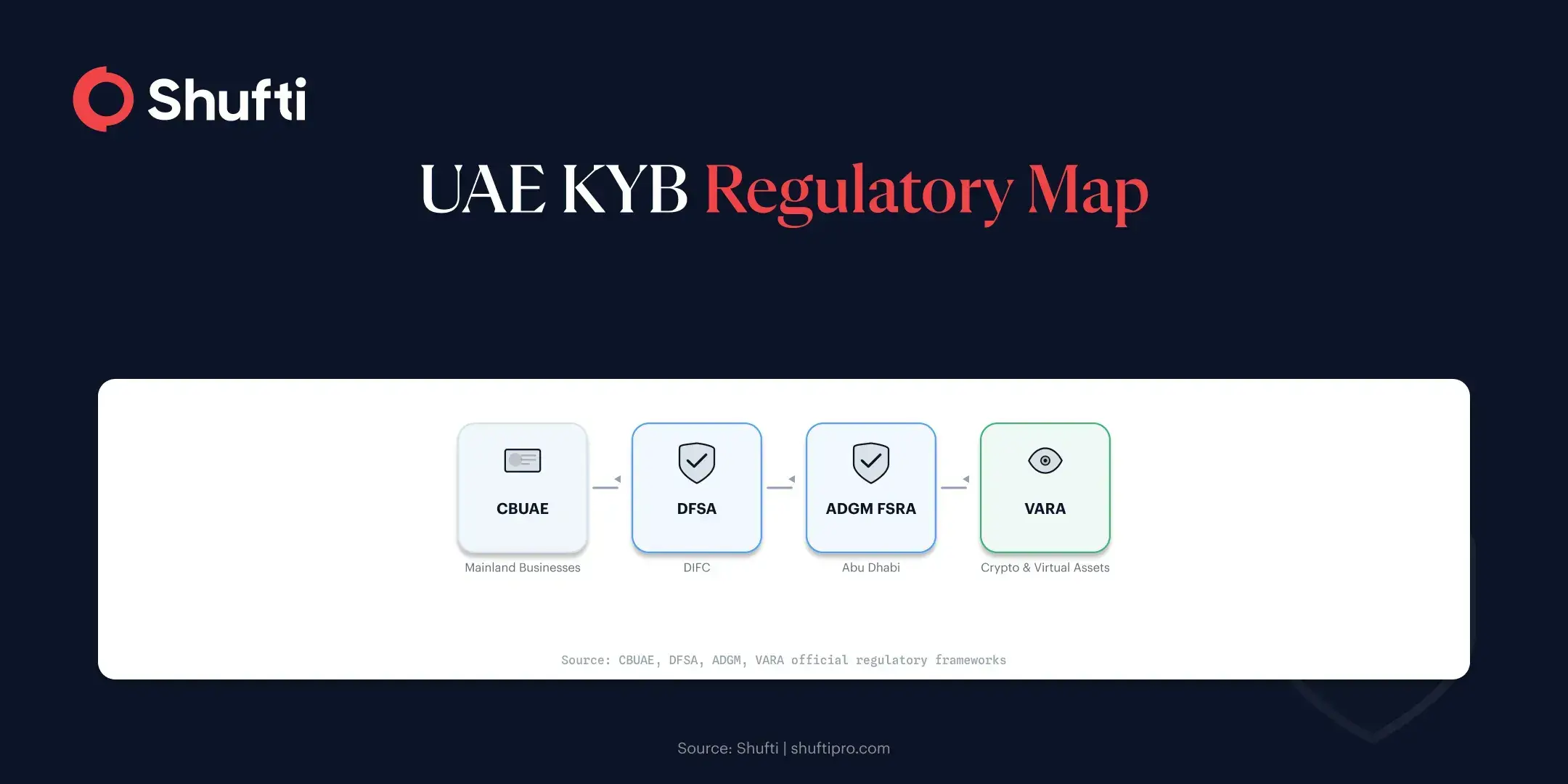
The UAE does not operate a single unified KYB regulator. Different regulators oversee different jurisdictions and sectors, though all of them derive authority from the same federal AML legislative base. A business operating in the Dubai International Financial Centre (DIFC) faces different supervisory oversight than a mainland payment firm or an Abu Dhabi-licensed wealth manager. Understanding which regulator applies, and what each one expects, is the starting point for building a compliant KYB programme.
UAE Federal Decree-Law No. 20 of 2018 established the foundational UAE Federal Decree-Law 20 AML framework that made business verification mandatory across sectors. That law was repealed and replaced by Federal Decree-Law No. 10 of 2025, in force from 14 October 2025. Key additions include proliferation financing as a distinct criminal offence, explicit AML obligations for VASPs, and strengthened risk-based due diligence requirements. The implementing regulations are contained in Cabinet Resolution No. 134 of 2025, effective from 14 December 2025.
CBUAE Mainland Businesses
The Central Bank of the UAE (CBUAE) supervises licensed financial institutions on the mainland. Its AML and CFT (Counter-Financing of Terrorism) standards require full CDD, including KYB, for all business relationships. The enforcement tone has been unambiguous: the CBUAE imposed AED 339 million in fines on a single day in June 2025, alongside licence revocations for exchange houses with repeated compliance failures.
DFSA – DIFC
The Dubai Financial Services Authority (DFSA) governs firms operating within the DIFC, which has its own legal system and independent courts. DFSA-regulated firms must meet KYB standards aligned with FATF recommendations, with enhanced due diligence required for higher-risk business relationships.
ADGM FSRA – Abu Dhabi
The Financial Services Regulatory Authority (FSRA) of Abu Dhabi Global Market (ADGM) applies rigorous beneficial ownership and control requirements for entities registered within ADGM. These sit independently of the mainland UBO register, with their own documentation and disclosure standards.
VARA — Virtual Assets
The Virtual Assets Regulatory Authority (VARA) licenses and oversees crypto and virtual asset businesses in Dubai, covering the mainland and most free zones outside DIFC. KYB for fintech and crypto businesses under a VARA licence is mandatory and must include full corporate verification, UBO identification, and AML screening against global watchlists.
UAE UBO Verification Requirements
Beneficial ownership is the most operationally demanding element of UAE corporate due diligence. The threshold established under Cabinet Resolution No. 58 of 2020 sits at 25%. Any natural person holding 25% or more of ownership, voting rights, or effective control of a company must be identified and verified as a UBO.
Beneficial ownership UAE regulations require that UBO records be maintained in a dedicated register, updated whenever the ownership structure changes, and made available to the UAE Financial Intelligence Unit (FIU) within 30 days of a request.
The obligation extends down the ownership chain. When a corporate shareholder holds 25% or more, the regulated entity must trace through to the natural person at the top. Layered holding structures do not dissolve the obligation. They extend it.
Free zone entities in DIFC and ADGM are exempt from mainland UBO register requirements but must follow the dedicated UBO frameworks set by DFSA and FSRA respectively.
What Documents Are Required for KYB in the UAE?
A standard UAE corporate due diligence check draws on the following:
- Corporate registration: Trade licence, certificate of incorporation, and memorandum and articles of association
- Ownership structure: Shareholder register confirming ownership percentages down to the 25% UBO threshold
- Directors and signatories: Government-issued identification and proof of authority for all authorised signatories and directors
- Business address: Ejari tenancy contract for Dubai-registered entities; Tawtheeq contract for Abu Dhabi entities
- UBO documentation: Government-issued identification and proof of address for each natural person identified as a UBO
- Financial information: Bank statements or audited accounts, particularly for higher-risk or high-value relationships
Enhanced due diligence applies when a business client comes from a higher-risk jurisdiction, has a complex or opaque ownership structure, or operates in a sector flagged in the 2024 UAE National ML/TF Risk Assessment. All KYB records must be retained for a minimum of five years and made available to the FIU within 30 days on request. Our AML regulations in the UAE guide covers the full legislative history behind these retention and reporting obligations.
Penalties for KYB Non-Compliance in the UAE
Enforcement has grown sharper since the FATF grey list exit, and the trajectory is not reversing. The CBUAE imposes non-compliance charges of between AED 50,000 and AED 500,000 per violation, calibrated by severity, duration, and compliance history.
Beyond monetary penalties, regulators have revoked licences. In 2024, 32 gold refineries had their licences suspended after inspectors found 256 AML violations, including failures to identify business counterparties and report suspicious activity. The CBUAE has also imposed personal sanctions on individual compliance officers, extending accountability beyond the institution itself.
Under Federal Decree-Law No. 10 of 2025, providing false beneficial ownership information carries imprisonment plus fines starting at AED 20,000. The introduction of proliferation financing as a distinct criminal category adds further exposure for any business that fails to screen corporate clients against the full universe of designated entities and sanctioned parties.
KYB for Fintech and Crypto Companies in the UAE
KYB fintech and crypto requirements in the UAE carry additional obligations that go beyond standard corporate onboarding. Every VARA-licensed entity must implement AML and KYC policies, appoint a Money Laundering Reporting Officer (MLRO), and complete full KYB verification on any corporate client before activating the relationship.
The FATF Travel Rule applies to all UAE-licensed VASPs: any transfer exceeding AED 3,500 requires the collection, verification, and transmission of originator and beneficiary information. KYB is therefore not a one-time onboarding check for virtual asset businesses. It feeds into transaction-level compliance for every qualifying transfer.
DIFC-regulated virtual asset firms follow the DFSA Digital Assets regime and must meet enhanced due diligence standards equivalent to those applied to traditional financial services firms. ADGM-licensed virtual asset entities must apply full UBO verification under the FSRA’s dedicated framework.
How Shufti Supports KYB Compliance in the UAE
Compliance teams handling UAE corporate onboarding work across a framework that spans federal law, free zone regulations, and sector-specific regimes simultaneously. Manual processes cannot keep pace with that complexity, and the CBUAE’s enforcement record makes the cost of falling short concrete.
Shufti’s KYB solution checks company registries, ownership records, and UBO chains across 250+ jurisdictions, including the UAE mainland and all major free zones. Business AML screening runs corporate entities and their UBOs against 3,500+ global watchlists updated every 15 minutes, keeping risk profiles current well beyond the point of onboarding. For businesses managing compliance across mainland UAE and international markets, Shufti’s UAE solutions page covers the full verification stack in one place.
Frequently Asked Questions
What is KYB compliance in the UAE?
KYB (Know Your Business) compliance in the UAE is the mandatory process of verifying a corporate client's identity, ownership structure, and risk profile before entering a business relationship. It applies across all regulated entities under Federal Decree-Law No. 10 of 2025, covering mainland, DIFC, ADGM, and VARA frameworks.
What documents are required for KYB in the UAE?
Core documents include a trade licence, certificate of incorporation, memorandum and articles of association, shareholder register, director and UBO identification, business address proof, and financial statements for higher-risk relationships. All records must be retained for at least five years.
What is the penalty for KYB non-compliance in the UAE?
CBUAE non-compliance charges range from AED 50,000 to AED 500,000 per violation. Regulators have also revoked licences and imposed personal sanctions on compliance officers. Under Federal Decree-Law No. 10 of 2025, false UBO declarations carry imprisonment plus fines from AED 20,000.
Is KYB mandatory for crypto companies in the UAE?
Yes. All VARA-licensed entities, plus DFSA and FSRA-licensed virtual asset firms, must perform full KYB on corporate clients. The FATF Travel Rule also applies, requiring verified originator and beneficiary data for transfers exceeding AED 3,500.
What are UAE UBO disclosure requirements?
Any natural person holding 25% or more of ownership, voting rights, or effective control must be identified as a UBO, verified, and recorded in a register. Businesses must update this register on ownership changes and provide it to the UAE FIU within 30 days on request.