




 Face Verification
 Address Verification
 Document Verification
 Age Verification
 VideoIdent
 Fast ID
 Docless Verification
 Consent Verification
 NFC Verification
 Business Verification
 Due Diligence
 Investor Verification
 E-Signature

 QES
QES
 AML Screening
 Transaction Monitoring
 Adverse Media
 Business AML Screening
 PEP & RCA
 Sanctions
 Watchlist
 Behavioural Biometrics
 Device Fingerprinting
 Biometric Face Authentication
 MFA
MFA
 Fraud Hub
 Onboarding
 Ongoing Monitoring
 KYC
KYC
 KYB
KYB
 KYI
KYI
 Age Assurance
 Identity Verification
 Workforce IAM
 Candidate Verification
 Compliance
 Fraud prevention
 Trust & safety
 Global expansion
 Product Managers
 Compliance Officers
 Fraud Analysts
 Developers
 Deepfake Detection
 Bonus Abuse / Promotion Abuse
 Account Takeover
 Synthetic Identity Fraud
 Document Fraud
 Impersonation Fraud
 Multi-Accounting
 Fraud Networks
 Chargeback Fraud
 Money Mule Activity
 Party Fraud
 Regulatory & Compliance Risks
 Fintech
 Crypto
 iGaming
 Forex
Forex
 Social Network
 Marketplace
 Banking
 Gig Economy
 Payments
 Ride Hailing
 Adult Content
 Blind Spot Audit
 Deepfake Detector
 Liveness Spoofs
 Document Originality
 Document Deepfake
 Global Trust Platform
 Journey Builder
 Case Management
 Shufti AI
 Fraud Analytics
 Vendor Comparison
 Brand Personalisation
 AI Compliance Co-Pilot
 OCR
OCR
 Secure Capture
 Deployment Options
 Identity Methods
 API Documentation
 Mobile SDKs
 Service Status
 Help Center
 Contact Us
 Technical Support
 Supported Documents
 Supported Countries
 Content library
 Blogs
Blogs
 News
News
 Reports
 Insights
 Knowledgebase
 ROI calculator
 About
About
 Career
 Press Release
 Certifications
 Partnership
 Awards
 Events & Webinar
 Interactive Demo
 Podcast Studio
 Spotlight Studio
KYC and AML for Investment Advisers: What Wealth Managers Need to Know

-
Add us as a Preferred Source
- 01 Key Takeaways
- 02 What is KYC for investment advisers and wealth managers?
- 03 What AML rules apply to investment firms under the FinCEN mandate?
- 04 How do wealth managers perform AML checks and verify clients?
- 05 What is perpetual KYC and why does it matter for wealth management?
- 06 How Shufti helps investment advisers meet AML compliance requirements
Key Takeaways
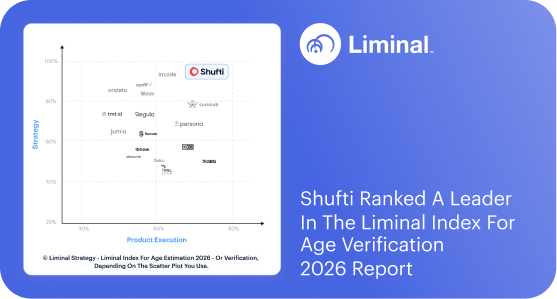
- FinCEN’s finalized AML rule places ~14,000 RIAs and ~6,000 ERAs under Bank Secrecy Act obligations for the first time, covering $119 trillion in assets.
- The full compliance deadline is January 1, 2028. Firms building programs in 2026 will be operationally ready before enforcement opens.
- Investment advisers must implement three core obligations: a Customer Identification Program (CIP), risk-based Client Due Diligence (CDD), and ongoing Suspicious Activity Report (SAR) filing.
- Enhanced due diligence applies to high-risk clients, including PEPs, complex ownership structures, and cross-border accounts, and requires senior management sign-off.
- Perpetual KYC replaces fixed annual review cycles with continuous, event-driven monitoring, catching risk profile changes as they happen rather than a year later.
When the Financial Crimes Enforcement Network (FinCEN) finalized its AML rule for investment advisers in September 2024, it ended decades of near-total exemption from Bank Secrecy Act (BSA) obligations. The final rule filed in the U.S. Federal Register puts approximately 14,000 Registered Investment Advisers (RIAs) and 6,000 Exempt Reporting Advisers (ERAs), collectively managing $119 trillion in assets, inside formal AML compliance requirements for the first time. The full program compliance deadline has since been moved to January 1, 2028, but the underlying rule is final. Investment advisory firms that begin building in 2026 will have a working compliance program before the enforcement window opens. The sections below cover what the Customer Identification Program (CIP), client due diligence, enhanced screening, and perpetual monitoring requirements demand from investment advisory firms in practice.
What is KYC for investment advisers and wealth managers?
The KYC program investment advisers must implement has three core components. Firms must confirm client identity at onboarding, assess the source and origin of client assets, and maintain an accurate risk profile throughout the relationship. RIA KYC requirements go beyond a single onboarding event. The program forms part of a written AML mandate the FinCEN rule requires each firm to calibrate to its specific client base, business model, and risk exposure. For many RIAs and wealth managers who operated outside formal AML frameworks until now, this shift is fundamental.
Customer Identification Program requirements
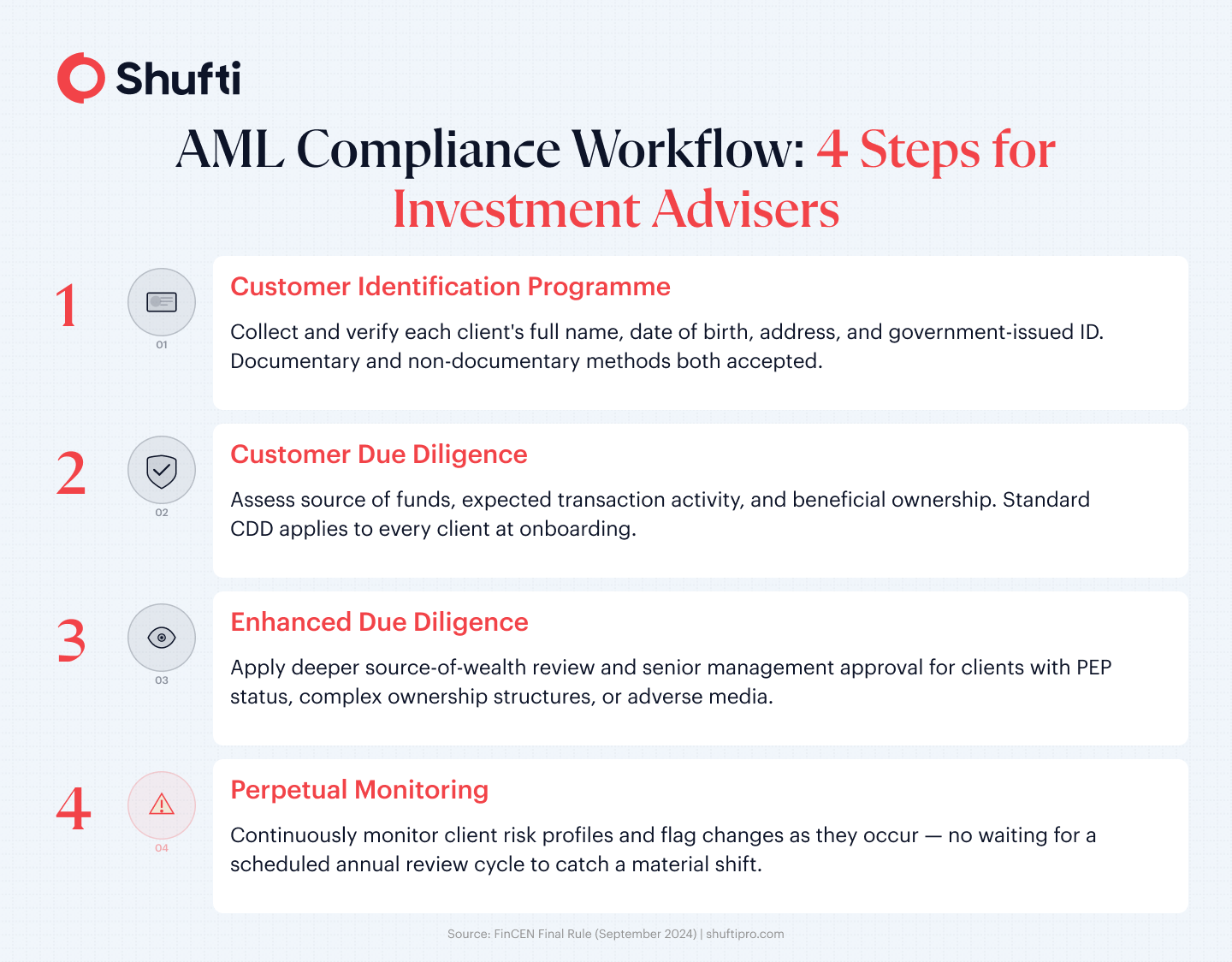
A Customer Identification Program (CIP) is the first formal step in wealth management compliance at the onboarding stage. Covered firms must collect and verify each client’s full name, date of birth, address, and a government-issued identification number. KYC verification for financial advisors may use documentary methods, non-documentary database checks, or a combination, provided the procedures are documented in writing and applied consistently across all client types.
Client due diligence in finance
Client due diligence (CDD) in finance goes beyond confirming identity. Wealth management AML compliance requires firms to understand the nature of each client relationship, expected transaction activity, and the source of funds. For high-value accounts and complex ownership structures, this means beneficial ownership mapping, source-of-wealth documentation, and a defined protocol for escalating standard CDD to enhanced review when risk indicators are present. Many wealth management firms integrate this stage with investor onboarding workflows that handle identity verification for investors across multiple account structures and jurisdictions.
What AML rules apply to investment firms under the FinCEN mandate?
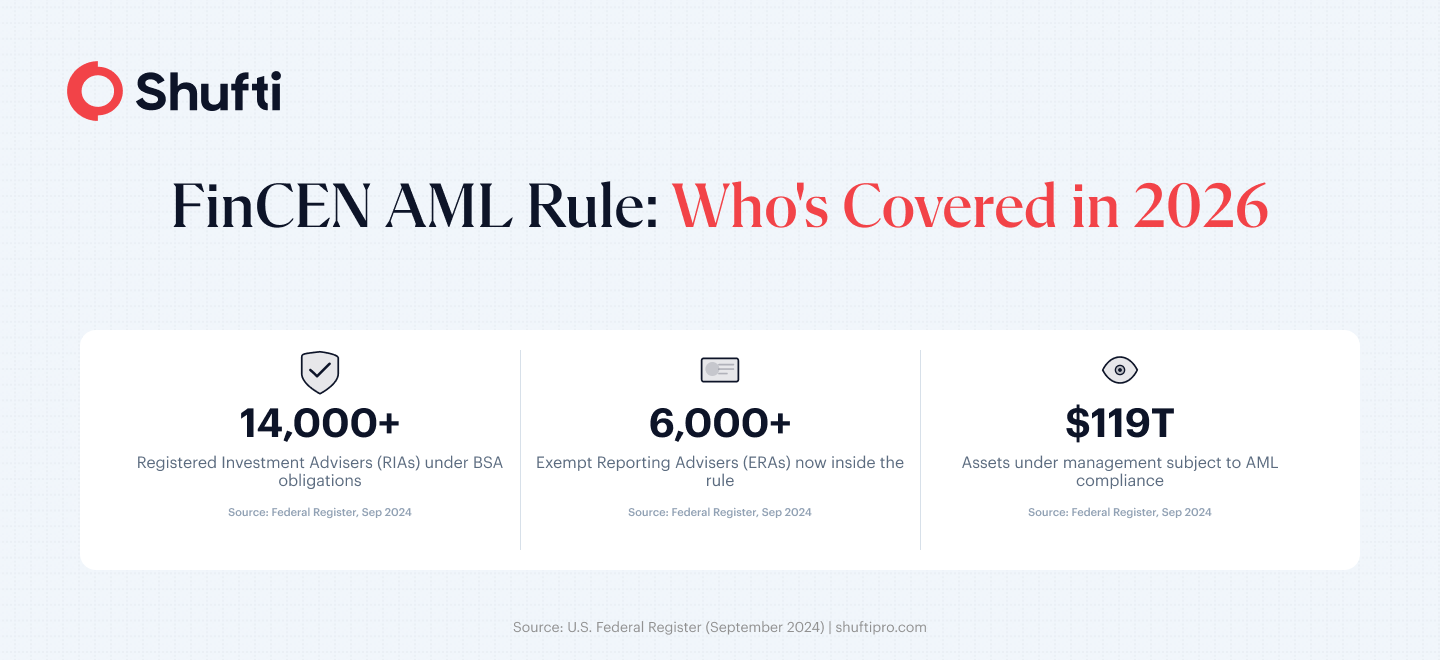
The U.S. Treasury’s December 2025 postponement notice moved the compliance deadline for covered advisers to January 1, 2028. The underlying rule is final, and the program requirements are not in dispute. Registered investment adviser AML obligations require each firm to maintain a written controls program, appoint a compliance officer with decision-making authority, run ongoing employee training, and submit the program to independent testing at defined intervals. Covered advisers will also be required to file Suspicious Activity Reports (SARs) with FinCEN when they detect transactions or activity that may indicate financial crime.
Registered investment adviser AML scope
As of the September 2024 final rule, the regulation applies to RIAs registered with the Securities and Exchange Commission (SEC), with limited exclusions for mid-sized advisers, multi-state advisers, pension consultants, and RIAs reporting zero assets under management on Form ADV. Registered investment adviser AML requirements extend to ERAs, which include most private equity funds, hedge funds, and venture capital managers. The U.S. Treasury’s 2026 National Money Laundering Risk Assessment, published March 2026, identifies the private investment sector as a material vulnerability given its historically weak AML oversight and the scale of assets flowing through it.
Risk-based approach and AML rules for investment firms
Wealth management compliance under the FinCEN framework uses a risk-based approach rather than a uniform checklist. The Financial Action Task Force (FATF) has published dedicated risk-based guidance for the securities sector, noting that the sector’s speed, global reach, and adaptability make it attractive for money laundering and terrorist financing. AML rules for investment firms must therefore reflect each firm’s actual client risk profile, product mix, and geographic exposure. Generic controls applied uniformly across every account type will not meet the risk-calibration standard the rule requires.
How do wealth managers perform AML checks and verify clients?
AML checks in wealth management follow a layered sequence tied to the client’s risk profile. Identity verification for investors happens first, at onboarding. Risk scoring then determines whether standard client due diligence applies or whether the account warrants enhanced scrutiny. Client onboarding in wealth management does not end with a passed identity check. It closes with a documented risk rating and a monitoring plan attached to the client account from day one.
Standard CDD and sanctions screening
Every client goes through standard CDD at onboarding, covering identity verification, source-of-funds review, and screening against global sanctions lists, Politically Exposed Persons (PEP) registries, and adverse media databases. These baseline checks confirm that the client is who they say they are and does not appear on watchlists maintained as part of the firm’s AML compliance tools and controls framework. For wealth management firms handling cross-border clients, the screening scope must extend to secondary sanctions regimes and foreign PEP lists, not only the primary sanctions lists enforced by the firm’s home jurisdiction.
Enhanced due diligence for high-risk clients
Enhanced due diligence (EDD) applies when a client presents elevated risk indicators. PEP status, complex ownership structures, cross-border account activity, and adverse media all trigger EDD consideration. EDD for investment advisers requires senior management approval at onboarding, deeper source-of-wealth investigation, and more frequent profile reviews. Clients investing through offshore trusts or special-purpose vehicles typically require EDD as standard practice under any risk-based wealth management compliance framework.
What is client risk assessment?
Client risk assessment assigns and maintains a risk score for each client based on identity data, transaction behaviour, and screening outputs. The score determines how often the client’s profile is reviewed and the level of scrutiny applied at each touchpoint. For investment firms managing large discretionary mandates, firms can integrate risk scoring tools that combine identity, screening, and behavioural signals into a single client score, capturing the transition from onboarding paperwork to active, ongoing risk management.
What is perpetual KYC and why does it matter for wealth management?
Perpetual KYC (pKYC) in wealth management replaces scheduled review cycles with continuous, event-driven profile updates. Rather than reviewing all clients on a fixed annual or triennial schedule, perpetual KYC wealth management systems monitor client profiles in real time and flag changes as they occur. When a trigger fires, the compliance team receives an alert for the specific changed element rather than a full re-verification request.
Continuous KYC monitoring for investment firms matters because wealth management clients often hold multi-jurisdictional portfolios, invest through layered entity structures, and experience life events that change their risk profile between periodic reviews. A political appointment, a change of domicile, or a significant inheritance can move a client from standard CDD to EDD territory in a matter of weeks. Periodic annual reviews miss those changes. Perpetual KYC catches them as they happen.
The pKYC audit trail also simplifies regulatory examinations. When an examiner requests evidence of continuous oversight, a firm running pKYC produces a timestamped audit trail of every trigger event and each corresponding compliance response. That is a substantially stronger posture than a set of annual review certificates that only reflect a point-in-time snapshot.
How Shufti helps investment advisers meet AML compliance requirements
Investment advisory firms preparing for the FinCEN mandate need for wealth managers and AML compliance tools that cover the full program lifecycle, from initial CIP-level identity checks through CDD, PEP and sanctions screening, and perpetual monitoring. Point solutions that handle only one part of the workflow create gaps in the audit trail and additional reconciliation overhead when systems do not share a common data model.
Shufti’s AML Screening draws on 100,000+ AML data sources, 3,500+ global watchlists, and 2.6 million PEP profiles across 215+ sanction regimes. The continuous monitoring capability surfaces changes to a client’s risk profile as they occur, covering the ongoing monitoring element the FinCEN rule requires. The adverse media module scans 50,000+ news sources in real time, so a client’s media profile reflects current reporting rather than last year’s snapshot.
For firms evaluating the best KYC software for finance-sector AML programs, a practical consideration is whether the identity and AML layers connect natively. Shufti’s KYC product integrates directly with the AML screening module, so document verification, biometric liveness detection, and continuous monitoring share a single client record from onboarding through the lifetime of the relationship.
Wealth managers running client onboarding and ongoing monitoring on manual processes carry real compliance exposure in a sector that regulators have now formally placed inside AML obligations. Shufti covers the full program lifecycle, from initial client identity checks and CDD through continuous PEP, sanctions, and adverse media monitoring, in a single platform built for investment adviser workflows. Book a demo to see how the platform handles the CIP, CDD, and perpetual monitoring steps on live adviser volumes.
Frequently Asked Questions
Do investment advisers need KYC?
Yes. FinCEN's finalized AML rule brings approximately 14,000 RIAs and 6,000 ERAs under Bank Secrecy Act obligations for the first time. Covered firms must implement a customer identification program, conduct client due diligence, and file suspicious activity reports. The full compliance deadline is January 1, 2028.
What is AML compliance in wealth management?
AML compliance in wealth management means maintaining a written program covering client identity verification, risk-based CDD, PEP and sanctions screening, adverse media monitoring, and ongoing transaction review. FinCEN requires covered firms to appoint a compliance officer, train employees, and submit the program to independent testing.
What is enhanced due diligence?
Enhanced due diligence applies to high-risk clients, including those with PEP status, complex ownership structures, or adverse media exposure. It requires senior management approval, deeper source-of-wealth investigation, and more frequent profile reviews. The trigger threshold is determined by each firm's risk-based client risk assessment process.
How do investment advisers automate KYC compliance?
Automated KYC for investment advisers uses integrated software to handle identity document verification, biometric checks, sanctions screening, and ongoing monitoring within a single platform. Automation replaces manual document review, reduces onboarding time, and produces the audit trail required under a written AML program.
What are the penalties for AML non-compliance?
Investment advisers that fail BSA obligations face FinCEN civil penalties and potential criminal referral. The SEC can bring enforcement actions for material AML programme deficiencies. Non-compliance also carries reputational risk, client attrition, and regulatory examination findings that may restrict business operations.