


 Face Verification
 Address Verification
 Document Verification
 Age Verification
 VideoIdent
 Fast ID
 eIDV
eIDV
 Consent Verification
 NFC Verification
 Business Verification
 Due Diligence
 Investor Verification
 E-Signature

 QES
QES
 AML Screening
 Transaction Monitoring
 Adverse Media
 Business AML Screening
 PEP & RCA
 Sanctions
 Watchlist
 Behavioural Biometrics
 Device Fingerprinting
 Biometric Face Authentication
 MFA
MFA
 Fraud Hub
 Onboarding
 Ongoing Monitoring
 KYC
KYC
 KYB
KYB
 KYI
KYI
 Age Assurance
 Identity Verification
 Workforce IAM
 Candidate Verification
 Compliance
 Fraud prevention
 Trust & safety
 Global expansion
 Product Managers
 Compliance Officers
 Fraud Analysts
 Developers
 Deepfake
 Bonus Abuse / Promotion Abuse
 Account Takeover
 Synthetic Identity Fraud
 Document Fraud
 Impersonation Fraud
 Multi-Accounting
 Fraud Networks
 Chargeback Fraud
 Money Mule Activity
 Party Fraud
 Regulatory & Compliance Risks
 Fintech
 Crypto
 iGaming
 Forex
Forex
 Social Network
 Marketplace
 Banking
 Gig Economy
 Blind Spot Audit
 Deepfake Detector
 Liveness Spoofs
 Document Originality
 Document Deepfake
 Global Trust Platform
 Journey Builder
 Case Management
 Shufti AI
 Fraud Analytics
 Vendor Comparison
 Brand Personalisation
 IDV Modes
 AI Compliance Co-Pilot
 OCR
OCR
 Secure Capture
 Deployment Options
 Identity Methods
 API Documentation
 Mobile SDKs
 Service Status
 Help Center
 Contact Us
 Technical Support
 Supported Documents
 Content library
 Blogs
Blogs
 News
News
 Reports
 Insights
 Knowledgebase
 ROI calculator
 About
About
 Career
 Press Release
 Certifications
 Partnership
 Awards
 Events & Webinar
 Interactive Demo
 Podcast Studio
 Spotlight Studio
Online eIDV Solutions: How Businesses Verify Customers Without Physical Documents
- 01 Why document-based onboarding is breaking under its own weight
- 02 How online eIDV actually works
- 03 Regulatory standing of database-level verification
- 04 Preventing identity spoofing in document-free verification
- 05 Coverage in markets with poor document infrastructure
- 06 What happens when a customer won't engage with verification
Every friction point in your onboarding flow has a cost. A document upload prompt that times out, a photo capture that fails in poor lighting, an address form that rejects international postcodes, each one chips away at the conversion rate you worked hard to build.
Online eIDV solutions, electronic identity verification systems that check identity against authoritative data sources rather than requiring document uploads, are one of the most direct answers to this problem. They’re also fast becoming a regulatory expectation. Under eIDAS 2.0 (EU Regulation 2024/1183), every EU member state must provide citizens with a digital identity wallet by December 2026, and regulated private-sector entities must accept them from 2027. Businesses that aren’t thinking about document-free verification now will be reacting under pressure in twelve months.
This article explains how online eIDV works, what verification approaches are available, how to match the right tier to your risk level, and which compliance frameworks give database-level verification a green light. It also addresses the questions compliance teams most frequently raise when considering a move away from document-centric onboarding.
Why document-based onboarding is breaking under its own weight
The standard onboarding flow, photograph a document, submit a selfie, wait for a match, made sense when identity fraud was relatively unsophisticated. It no longer maps well to the threat and user-expectation environments of 2026.
A workflow that relies on inspecting document photos is not more secure than one that cross-references government-held identity records; it’s often less secure, because the attack surface is a JPEG rather than a live database query.
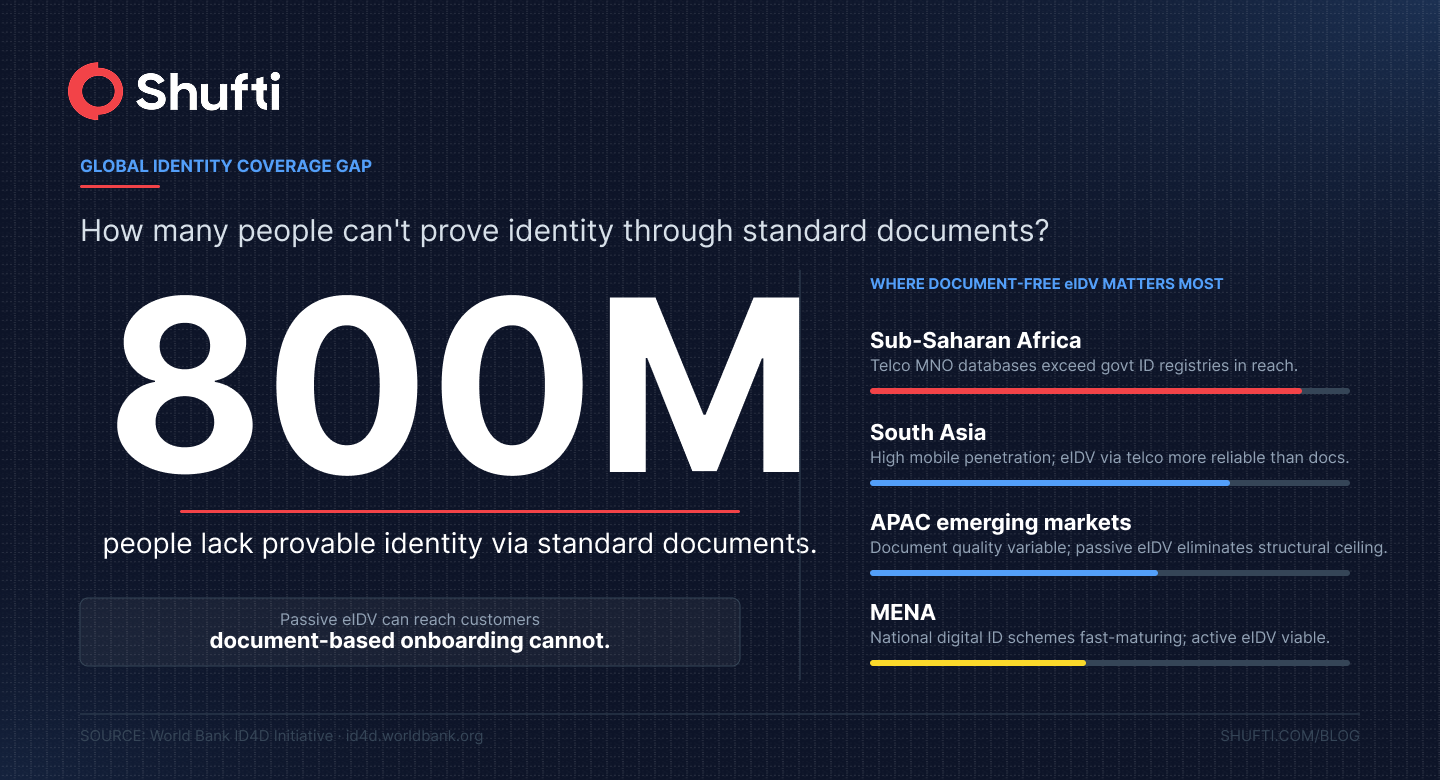
On the user side, the World Bank’s ID4D dataset estimates that more than 800 million people worldwide cannot prove their identity through standard documents, with the majority in Sub-Saharan Africa and South Asia. For platforms operating in APAC, MENA, or Africa, document upload isn’t just friction; it actively excludes a significant portion of the addressable market.
How online eIDV actually works
Electronic identity verification works by querying structured, authoritative data sources, telco records, credit bureau files, government identity registers, electoral rolls, and matching the attributes a user supplies at sign-up against what those sources hold. No document upload required. The check typically completes in under three seconds.
The logic isn’t binary. Most production eIDV deployments layer two or more independent data sources simultaneously, a cross-referencing technique designed to catch synthetic identities (fabricated credentials that no single source will flag as fraudulent because they were never issued as fraudulent). FATF Recommendation 10 explicitly supports a risk-based approach to customer due diligence, which means database-level verification can satisfy the CDD obligation where the risk tier is appropriate; it doesn’t require a physical document if the data cross-reference is sufficiently robust.
The three verification tiers
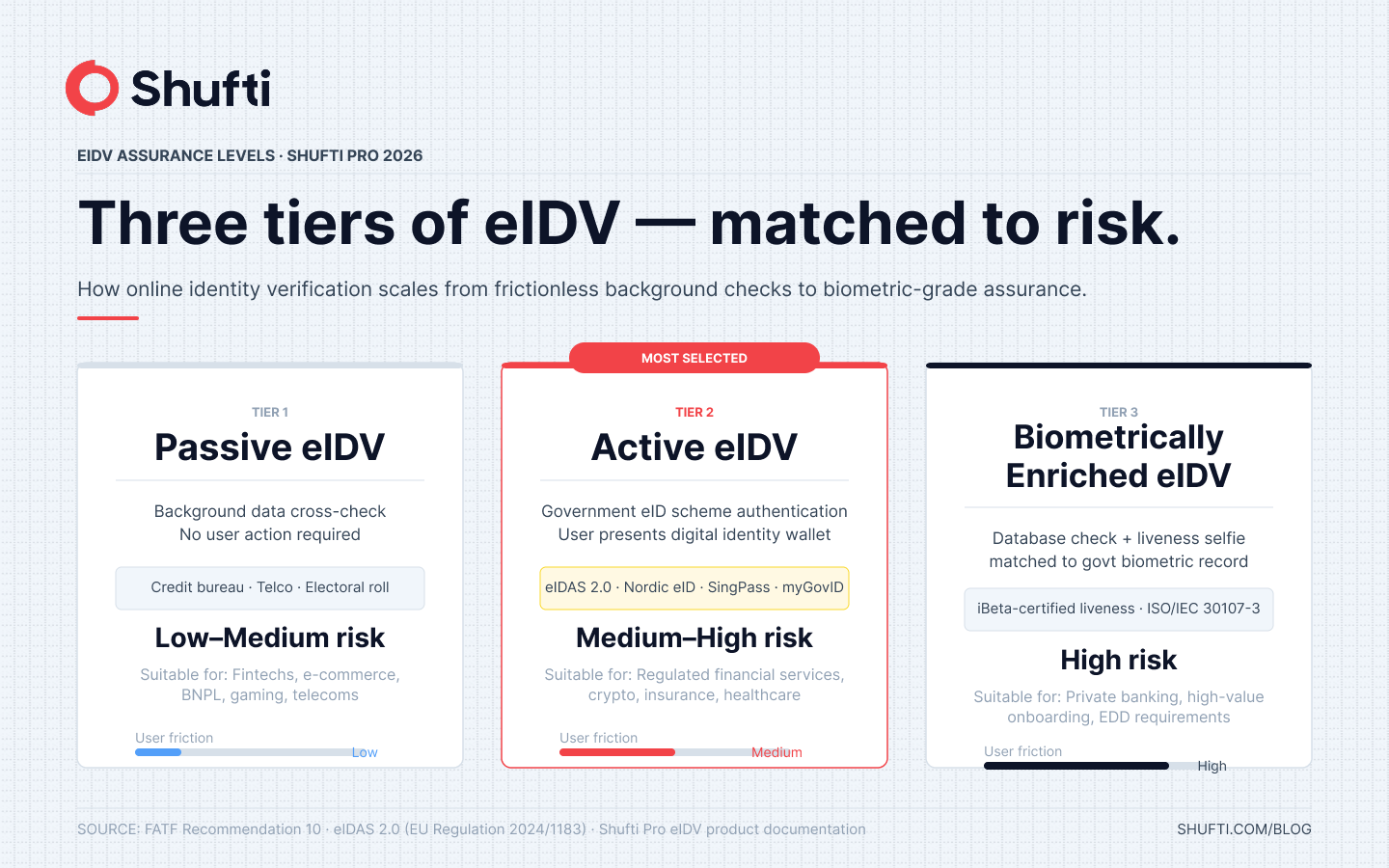
Not every customer or every transaction carries the same risk. Online eIDV solutions that calibrate to risk typically offer three assurance levels:
Passive eIDV
A frictionless background check against commercial and government data sources — credit bureau records, telco subscriber files, electoral rolls, national registries. The user supplies only basic personal data; the system verifies it in the background without any user action. Suited to low-to-medium risk onboarding where the applicant pool is predominantly legitimate. Regulatory audit trails are generated automatically.
Active eIDV
Direct authentication against a national eID scheme — a government-issued digital identity that the user actively presents, typically through a mobile app or a chip-read. These schemes (such as those operating under eIDAS 2.0 in Europe, or established national frameworks in Nordic countries, Australia, and Singapore) carry higher assurance because the government has already identity-proofed the credential holder.
Biometrically Enriched eIDV
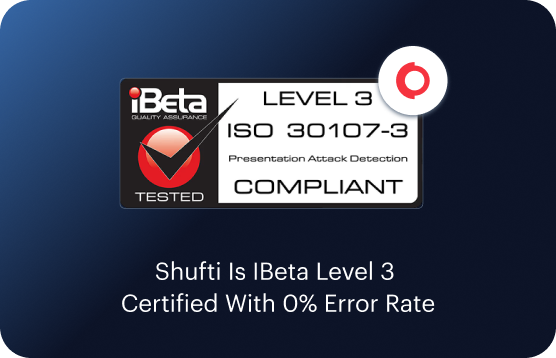
A database check combined with a liveness-verified selfie match against the government-held photo on file. This tier is appropriate where regulations demand a high assurance level, regulated financial institutions onboarding high-value customers, for instance, and require iBeta-certified liveness technology to resist deepfake and injection attacks. It produces the same audit trail as a document-based biometric check but without the document upload friction.
Regulatory standing of database-level verification
The admissibility question, whether eIDV outputs are accepted as proof of due diligence in a regulatory audit, depends on jurisdiction and risk classification. Still, the regulatory direction of travel is clearly supportive. FATF Recommendation 10 establishes the risk-based approach as the global standard for CDD: obligated entities must apply measures proportionate to identified risk, and those measures may include electronic verification of identity where appropriate. FATF guidance does not require a physical document check as a universal baseline.
In Europe, eIDAS 2.0 goes further: it creates a legal framework for digital identity wallets that, once issued by a member state, carry the same legal weight as a physical document for any regulated transaction. From 2027, regulated businesses must accept these wallets. Businesses with no eIDV infrastructure in place will face both a compliance gap and a conversion gap when that deadline arrives.
For compliance officers concerned about audit admissibility: the answer is that properly implemented eIDV, with documented data sources, cross-reference logic, and a full audit trail, is defensible and increasingly expected. The risk of a failed audit comes not from choosing eIDV over document checks, but from choosing eIDV without adequate documentation of the sources used, the match thresholds applied, and the risk classification underpinning the decision.
Preventing identity spoofing in document-free verification
The most common objection to document-free verification is spoofing: if there’s no document to inspect, what stops someone from supplying stolen credentials and passing a database check? The answer lies in the combination of data sources and the cross-reference logic applied to them.
A single-source check is relatively easy to spoof: if a fraudster has a victim’s name, date of birth, and address, they might pass a check against a single credit bureau. A dual-source check, cross-referencing a credit bureau against a government electoral roll simultaneously, narrows that attack significantly, because the data sets are maintained independently and updated on different schedules. Synthetic identities that have fabricated a credit profile often haven’t been registered to vote; stolen identities that show on the electoral roll often don’t show consistent address histories on credit files.
Coverage in markets with poor document infrastructure
For platforms operating in markets where document quality is variable, faded text, folded creases, non-machine-readable formats, or where a significant share of the addressable market simply doesn’t carry a national ID, document-centric verification creates a structural conversion ceiling.
The World Bank ID4D data quantifies the scale of this problem: more than 800 million people lack a provable identity through standard documents. In many markets in APAC and Africa, telco subscriber databases and national mobile identity registries are actually more comprehensive than government-issued document registries, which means that passive eIDV against telco sources can reach customers that document-based onboarding cannot.
For teams evaluating coverage, the relevant metric isn’t “how many countries support document verification” (nearly all do), it’s “how many countries have mature, queryable identity data sources at the passive tier, and how many have live national eID schemes at the active tier.” Those two numbers tell you where document-free onboarding is viable and where a document fallback is still necessary.
What happens when a customer won’t engage with verification
If a customer actively refuses to submit to verification, whether document-based or database-based, the obligation under most regulatory frameworks is straightforward: you cannot onboard them for a regulated service. FATF Recommendation 10 is explicit that if a customer fails or refuses CDD, the institution must not open the account, must consider filing a suspicious activity report if circumstances warrant, and must terminate any existing relationship if it cannot be remediated.
The more common scenario isn’t outright refusal; it’s passive abandonment, where a customer simply doesn’t complete the flow. That’s where eIDV addresses a real product problem: by removing the document upload step entirely and completing the background check on data the customer has already supplied (name, date of birth, address, phone number), the passive tier eliminates the most common drop-off trigger. The customer doesn’t experience a verification step at all.
Conclusion
Shufti’s eIDV Pro covers 85+ countries for passive verification and connects to 30+ national eID schemes for active verification, all through a single API with sub-3-second response times and a 99% pass rate. Businesses using it have reported 30%+ reductions in onboarding drop-off. It supports cloud, on-premises, and hybrid deployment, and includes a full audit trail for regulatory reporting.
If you’re evaluating document-free verification options, request a demo to see how the three-tier framework maps to your specific onboarding flows and risk profile. Or explore the eIDV product page for a full breakdown of country coverage, data sources, and integration options.
Frequently Asked Questions
How do online eIDV solutions handle customers without standard identity documents?
At the passive tier, eIDV works without any document at all, it queries telco records, credit bureau files, electoral rolls, and national registries using basic personal data the customer supplies during sign-up. For markets where document coverage is thin but telco subscriber bases are large (common in parts of APAC and Africa), passive eIDV against mobile network operator data can reach customers that document-based onboarding cannot.
How secure is online identity verification compared to in-person checks?
At the passive and active tiers, online eIDV is comparable to in-person verification for most regulated use cases. At the biometrically enriched tier, live selfie match against a government-held photo using iBeta-certified liveness detection, it can exceed the assurance level of a standard in-person branch check, because a branch staff member cannot access the government biometric database directly and relies on visual inspection of a physical document.
Are online eIDV solutions admissible as proof of due diligence during regulatory audits?
Yes, where properly implemented. FATF Recommendation 10 permits a risk-based approach that allows electronic verification where appropriate. The audit defensibility depends on documentation: which data sources were queried, what match thresholds were applied, how the risk classification was determined, and what the audit trail shows. A well-configured eIDV deployment with a complete audit log is defensible; an eIDV check with no documented methodology is not, regardless of whether it involved a document or not.
How do online eIDV solutions prevent identity spoofing?
Through cross-referencing. Querying two independent authoritative sources simultaneously, credit bureau and electoral roll, or telco and government registry, dramatically narrows the attack surface compared to a single-source check. Synthetic identities that pass one source typically fail against an independent source with a different data provenance. At the biometrically enriched tier, iBeta-certified liveness detection closes the remaining spoofing vector.