AMLR Solutions
 AMLR Consultation
 Onboarding
 Ongoing Monitoring
 FRAML
FRAML KYC
KYC KYB
KYB KYI
KYI Age Assurance
 Workforce IAM
 Candidate Verification
 Account Takeover
 Bonus/ Promotion Abuse
 Chargeback Fraud
 Deepfake
 Document Fraud
 Fraud Networks
 Impersonation Fraud
 Money Mule Activity
 Multi-Accounting
 Party Fraud
 Regulatory & Compliance Risks
 Synthetic Identity Fraud
 Adult Content
 Banking
 Crypto
 Fintech
 Forex
Forex Compliance
 Fraud prevention
 Trust & safety
 Global expansion
 Compliance Officers
 Developers
 Fraud Analysts
 Product Managers
 Advanced Journey Builder (AJB)
 Global Trust Platform
 Customer Profiles
 Vendor Comparison
 IDV Case Management
 AML Case Management
 Regulatory Reporting
 Travel Rule Protocols
 Agentic Rule Builder
 AI Compliance Co-Pilot
 Fraud Analytics
 Fraud Hub
 OCR
OCR Shufti AI
 Bank Account Verification
 Biometric Duplication
 Database Checks
 Document Intelligence
 Government ID
 Mobile Driver's License
 NFC
NFC Selfie Liveness
 Brand Personalisation
 Deployment Options
 Identity Methods
 IDV Modes
 Multi-tenancy
 On-Premise IDV
 Secure Capture












TL;DR
- Identity verification confirms a person is who they claim using documents, biometrics, and database checks.
- Regulated sectors must implement it under AML and KYC frameworks like FATF Recommendation 10.
- Deepfake fraud rose 495% year over year in 2026, breaking single-step checks.
- Weak verification exposes a business to fines, account takeover, and synthetic identity losses.
- The strongest setups combine document, biometric, and electronic checks in one auditable flow.
In 2026, Shufti’s Deepfake Fraud Index recorded a 495% year-over-year jump in deepfake fraud, with attacks using deepfaked identity documents forecast to rise 39-fold over the year (Biometric Update, June 2026). That shift is why a selfie check run in isolation no longer proves anything. Identity verification is the control that sits between a stranger and your platform, and it is now both a fraud problem and a regulatory one. This guide explains what identity verification is, how it works, the methods available, the compliance frameworks that mandate it, and the risks of getting it wrong. It is written for the compliance, fraud, and operations teams who have to implement it, not just read about it.
What is identity verification?
Identity verification is the process of confirming that a person is who they claim to be, by checking the identity evidence they present against authoritative, independent sources. In practice that means validating a government-issued document, matching a live biometric to that document, and cross-referencing the claimed identity against trusted databases. The output is a decision: accept, reject, or refer for review.
The concept maps directly onto regulatory language. Under most anti-money-laundering regimes, a business has to both identify a customer (collect who they say they are) and verify that identity (prove it independently). Collecting a name and date of birth is identification. Proving that the name belongs to a real, living person who is actually present is verification. The gap between those two steps is where most fraud and most compliance failures live. When the subject is an end user at onboarding, this is often called customer identity verification, the first step in any KYC programme.
Identity verification vs authentication
Verification and authentication are not the same control, and treating them as interchangeable is a common and costly mistake. Verification happens once, usually at onboarding, and answers the question “is this a real person, and are they who they claim to be?” Authentication happens repeatedly, every time that person returns, and answers a narrower question: “is this the same person who was verified before?”
A password, a one-time code, or a fingerprint unlock is authentication. It confirms access to a previously established account. None of those steps prove the original identity was genuine. If a synthetic identity passes weak verification at onboarding, every authentication after that point simply confirms the fraudster is the same fraudster. This is why regulators anchor their requirements at the verification stage. For a deeper breakdown, see the distinction between identity proofing and verification.
The three core identity verification methods
Most verification rests on three method families, usually layered together. Document-based verification authenticates a passport, national ID, or driver’s licence by reading its security features and machine-readable zone. Biometric verification matches a live face to the document photo and runs liveness detection to confirm a real person is present. Database or electronic checks compare the claimed identity against civil registries, voter rolls, and other authoritative records. Each method closes a gap the others leave open, which is why a single method rarely satisfies a serious regulator or stops a determined attacker.
How does identity verification work, step by step?
The identity verification process works as a five-stage pipeline that moves from raw data capture to a final decision, with each stage feeding the next. A well-built flow runs in seconds and produces an auditable record at every step. The process below is the standard sequence regulated businesses use for remote, online identity verification.
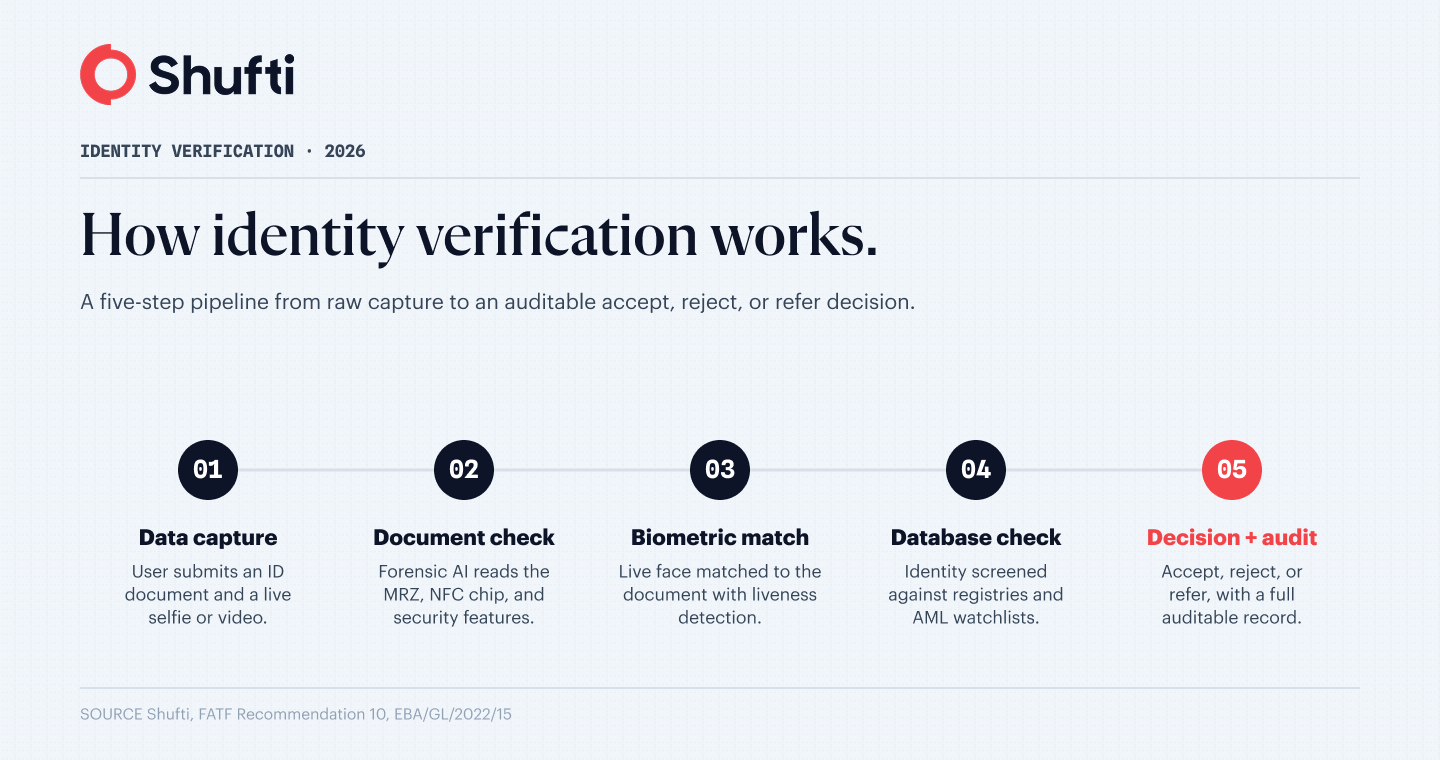
Step 1: Data and document capture
The user submits their identity evidence, typically a photo or scan of a government-issued document plus a live selfie or short video. Capture quality matters here. Blurry images, glare, and partial frames are the leading cause of avoidable rejections, so good capture tooling guides the user in real time rather than failing them after submission.
Step 2: Document authentication
Forensic checks confirm the document is genuine. Optical character recognition (OCR) first reads and extracts the data from the document, converting the printed fields, the machine-readable zone, and the NFC chip data where present into structured text the system can validate. The forensic layer then inspects security features such as holograms, microprint, and UV patterns to catch manipulated or wholly fake documents that would pass a casual photo glance. OCR accuracy matters most in markets with non-Latin scripts, where a system that cannot read the document natively fails before the forensic check even begins.
Step 3: Biometric match and liveness
The system matches the live face to the photo on the document and runs liveness detection to confirm the person is physically present, not a photo, a replay, or a deepfake. With AI-generated face swaps now mainstream, liveness has become the step that does the heaviest fraud-prevention work, which also makes it the step attackers target hardest. This is closely tied to biometric identification techniques.
Step 4: Database cross-check
The verified identity is checked against authoritative databases and, where AML rules apply, against sanctions, politically exposed persons, and watchlist sources. This stage confirms the identity exists in the real world and flags any regulatory exposure before the account opens.
Step 5: Decision and audit trail
The system returns a result: accept, reject, or refer to a human reviewer. Every check, score, and source is logged into an audit pack the business can produce on demand. For regulated firms, that audit trail is not a nice-to-have. It is the evidence that proves the verification actually happened the way the rules require.
Types of identity verification
There is no single method that fits every business, risk level, or jurisdiction. The five methods below are the building blocks, and most real-world flows combine two or more. The table compares how each works, where it fits, and where it falls short, which is the fastest way to see why layering matters.
| Method | How it works | Best for | Limitation |
| Document verification | Authenticates a government ID by reading security features, MRZ, and NFC chip | Onboarding where a physical document is available | Depends on document quality and coverage of document types |
| Face / biometric verification | Matches a live selfie to the document photo and runs liveness detection | Remote onboarding and high-fraud channels | Requires a camera and strong liveness to resist deepfakes |
| Electronic IDV (eIDV) | Checks identity data against authoritative databases and digital ID schemes | Markets with strong civil registries or national digital IDs | Coverage and data freshness vary by country |
| KYC database check | Screens the identity against sanctions, PEP, and watchlist sources | AML compliance and risk screening | Screening alone does not prove the person is present |
| Knowledge-based authentication (KBA) | Asks questions only the genuine person should be able to answer | Low-risk step-up or legacy fallback | Weak against data-breach exposure and social engineering |
The pattern across the table is consistent. Document checks prove the credential, biometrics prove the person, electronic checks prove the identity exists, and screening proves they are not a sanctioned or high-risk actor. Strong identity verification methods stack these so no single point of failure decides the outcome.
Why does identity verification matter for compliance?
Identity verification matters for compliance because it is a legal requirement, not a best practice, across regulated sectors. Anti-money-laundering law, electronic identity regulation, and sector-specific rules all start from the same premise: a business must know who its customer is before it provides a regulated service. Skipping or weakening that step is not a commercial risk. It is a breach.
FATF Recommendation 10
The global baseline is set by the Financial Action Task Force. FATF Recommendation 10 requires regulated entities to identify the customer and verify that identity using reliable, independent source documents, data, or information (FATF Recommendations, updated October 2025). It mandates customer due diligence when a business relationship begins, when an occasional transaction crosses the USD/EUR 15,000 threshold, or when money laundering is suspected. Almost every national AML regime, including those in the EU, UK, and US, builds on this standard, so it is the reference point compliance teams design against.
eIDAS 2.0 and the EBA remote onboarding guidelines
In Europe, two instruments shape how digital identity verification must be done. The revised electronic identity regulation, eIDAS 2.0, requires every EU member state to offer citizens a certified European Digital Identity Wallet by November 2026, with obliged entities required to accept it by December 2027 (European Commission). Alongside it, the European Banking Authority’s guidelines on remote customer onboarding, EBA/GL/2022/15, took effect on 2 October 2023 and make liveness detection mandatory for unattended remote onboarding (EBA Guidelines). Together they raise the bar from “collect a document” to “prove a real, present person matched that document, and keep the evidence.” For the AML angle specifically, see how AML identity verification ties verification to ongoing compliance.
Identity verification rules around the world
Identity verification is mandated well beyond the EU, and the specific regulator changes with the jurisdiction even though the underlying obligation is the same. A business operating across borders has to satisfy each regime where it onboards customers, not just its home one. The table below names the core frameworks in several major markets.
| Region | Regulation and regulator | What it requires |
| Global baseline | FATF Recommendation 10 | Identify and verify customers from reliable, independent sources |
| United States | Bank Secrecy Act, administered by FinCEN, via the Customer Identification Program | Verify customer identity at account opening |
| United Kingdom | Money Laundering Regulations 2017 (MLR 2017) | Customer due diligence including identity verification |
| European Union | AML package under AMLA, plus eIDAS 2.0 | Harmonised due diligence and acceptance of digital identity |
| Singapore | MAS AML/CFT Notices, such as Notice 626 for banks | Identity verification for regulated financial institutions |
The pattern holds across every market. Whatever the regulator is called, the requirement is to identify the customer and then verify that identity to a defined standard. For a business expanding internationally, the practical task is meeting the strictest applicable standard once, rather than rebuilding verification for each new jurisdiction.
What are the risks of not verifying identity?
The risks of skipping or weakening identity verification fall into four categories, and they compound. A weak control does not just let one bad actor through. It creates exposure across regulatory, financial, operational, and reputational lines at the same time.
Regulatory fines and enforcement
AML enforcement has grown sharply, and identity verification failures sit at the centre of most major penalties. When a regulator finds that a firm onboarded customers it could not properly identify, the fine is rarely the end of it. Remediation orders, business restrictions, and personal liability for compliance officers often follow. The cost of a verification gap is almost always larger than the cost of closing it.
Account takeover and synthetic identity fraud
Generative AI has changed the threat model. The Federal Reserve Bank of Boston warned in April 2025 that generative AI tools now produce convincing fake documents, realistic profile photos, and synthetic behavioural data, making synthetic identity fraud significantly easier to commit (Federal Reserve Bank of Boston). Shufti’s own figures show the scale: synthetic identity attacks now make up more than 42% of total AI fraud, outnumbering live video deepfakes, while account takeover and identity fraud incidents rose 244% in 2025 (Biometric Update, June 2026). A verification flow built before this shift will not catch what is coming through now.
Reputational damage
A fraud event or a public enforcement action does lasting damage to customer trust, partner confidence, and valuation. In regulated markets, a reputation for weak controls also invites closer supervisory attention, which raises the cost of every future onboarding decision. Reputational harm is the slowest risk to recover from and the hardest to quantify in advance.
Which industries must verify identity?
Identity verification is mandatory across every sector that touches money, age-restricted goods, or sensitive data, with the specific rule varying by vertical. The verticals below carry explicit legal obligations, and the relevant regulation is named for each. For a fuller treatment, see the industries that require identity verification.
- Banking and lending operate under national AML laws built on FATF standards, requiring customer due diligence at account opening and on a risk-triggered basis thereafter.
- Fintech and neobanks face the same AML obligations plus, in the EU, the EBA remote onboarding guidelines that govern how digital verification must be performed.
- iGaming and online gambling must verify both identity and age under licensing regimes such as the UK Gambling Commission’s rules and Germany’s interstate gambling treaty.
- Crypto exchanges and virtual asset service providers are bound by FATF’s travel rule and national VASP registration regimes that require identity verification before transactions.
- Healthcare verifies identity to protect patient data and prevent medical fraud under privacy regimes like HIPAA and GDPR.
- The sharing economy and online marketplaces increasingly verify users to meet platform-liability and trust-and-safety obligations.
The common thread is that verification is the precondition for operating legally, not an optional layer of assurance.
Document verification vs electronic identity verification (eIDV)
Document verification and electronic identity verification solve the same problem through different evidence, and the right choice depends on the market and the available infrastructure. Document verification proves identity from a physical credential. Electronic IDV proves it from authoritative data. Many businesses run both, falling back to one when the other has thin coverage. The table sets them side by side.
| Document verification | Electronic IDV (eIDV) | |
| Definition | Authenticates a government-issued ID document | Confirms identity against authoritative databases and digital ID schemes |
| How it works | Reads security features, MRZ, and NFC chip, then matches a biometric | Queries civil registries, voter rolls, and national digital identity records |
| Speed | Seconds, dependent on capture quality | Near-instant where database coverage is strong |
| Regulatory acceptance | Widely accepted globally as primary evidence | Accepted where national eID infrastructure exists, expanding under eIDAS 2.0 |
| When to use | Markets without strong digital ID, or where a document is the norm | Markets with mature civil registries or national digital ID schemes |
Neither approach is strictly better. Document verification gives global reach because almost everyone holds a physical ID, while electronic identity verification gives speed and low friction where the data infrastructure supports it. The strongest solutions cover both through one integration, so coverage gaps in either method do not become onboarding failures.
How to choose the right identity verification solution
Choosing an identity verification solution comes down to five criteria that separate a tool that demos well from one that performs in production across real markets. The selection mistake most teams make is optimising for the easy markets in the pilot, then discovering the pass rate collapses in the regions that actually matter. Evaluate against all five, weighted to where your users are. For the platform-level view, see what defines a complete identity verification solution.
- The first criterion is global document coverage. A solution is only as strong as the document types and countries it reads natively, so confirm coverage in your hardest markets, not just the headline number.
- The second is accuracy benchmarks, specifically independent validation. iBeta Level 3 conformance under ISO/IEC 30107-3 is the highest published standard for liveness attack detection, and very few vendors hold it.
- The third is compliance certifications such as SOC 2, ISO 27001, GDPR, and PCI DSS, which determine whether you can deploy the solution at all in regulated environments.
- The fourth is integration method, since a clean single API reduces the dependency risk that fragmented multi-vendor stacks introduce.
- The fifth is false rejection rate, because a solution that blocks genuine customers costs you conversion every day it runs.
- The sixth is availability of deployment options like on-premise or cloud. If the laws mandate localization or you choose to avoid legal complexities of data privacy laws can the vendor meet these requirements?
Weigh these against your own risk profile, and compare shortlisted tools the way you would any other identity verification software decision.
When should a business upgrade or layer its verification?
A business should upgrade or layer its verification the moment its current setup stops matching its risk, its markets, or its regulators, rather than waiting for a fraud loss or an audit finding to force the change. Verification is not a one-time build. The threat landscape and the rulebook both move, and a stack that was adequate at launch quietly falls behind.
Five triggers signal it is time to act:
- Rising false rejections. Genuine customers are failing checks and abandoning onboarding, which means the controls are now costing more in lost revenue than they save in blocked fraud.
- Expansion into new markets. Entering regions with non-Latin documents or different ID formats exposes coverage gaps a single-method or Western-trained stack cannot close.
- A new regulatory deadline. Obligations such as mandatory liveness for remote onboarding or EUDI Wallet acceptance require capabilities a basic document check does not have.
- A new attack vector. Deepfakes, injection attacks, and synthetic identities defeat verification flows built before generative AI was cheap and convincing.
- A single point of failure. If one check decides every outcome, layering document, biometric, and database verification removes the gap a determined attacker will find.
The pattern across all five is the same. Verification should be reviewed on a schedule, not just after something breaks.
How Shufti handles identity verification across regulated markets
If your users are in Vietnam, Indonesia, Brazil, South Asia, or the Gulf, you have likely seen the gap. Most verification vendors trained their models on Western documents and retrofitted everything else, which surfaces as failed reads and abandoned sessions in exactly the markets where you are trying to grow.
Shufti built and owns its entire stack, with document intelligence trained on 10,000+ document types across 240+ countries and proprietary OCR reading 150+ languages natively. Shufti has one of the highest first attempt pass rates of nearly 90%. Its liveness engine holds iBeta Level 3 conformance under ISO/IEC 30107-3, the standard introduced in response to AI-driven deepfakes, so document, biometric, and database checks run in one auditable flow rather than a stitched-together chain.
Shufti’s fully owned technology provides all IDV solutions in one platform with global coverage while maintaining real local depth, earning it the label of best identity verification software for 2026 from credible independent sources like G2.
See how Shufti verifies identities across document, biometric, and database checks in one integration so request a demo.
Frequently Asked Questions
What is identity verification?
Identity verification is the process of confirming a person is who they claim to be by checking their identity evidence against authoritative, independent sources. It typically combines document authentication, a biometric match with liveness, and a database cross-check, ending in an accept, reject, or refer decision.
What is the difference between identity verification and authentication?
Verification proves a real person's identity at onboarding, usually once. Authentication confirms a returning user is the same person who was verified, repeatedly, using passwords, codes, or biometrics. Authentication does not prove the original identity was genuine, which is why regulators anchor requirements at the verification stage.
Is identity verification required by law?
Yes, across regulated sectors. FATF Recommendation 10 requires regulated firms to identify and verify customers using reliable, independent sources, and national AML laws in the EU, UK, and US enforce it. Sector rules in banking, fintech, crypto, iGaming, and healthcare add further verification obligations.
What documents are accepted for identity verification?
Passports, national identity cards, driver's licences, and residence permits are the most widely accepted documents. Acceptance depends on the verification provider's coverage, since document types and security features vary by country. Solutions with broad native coverage read far more document types reliably than those built around a few Western formats.
How long does identity verification take?
Automated identity verification typically completes in seconds. Document capture, biometric matching, and database checks run in real time, returning an accept, reject, or refer result almost immediately. Cases routed to a human reviewer take longer, which is why strong capture quality and accurate automation matter for both speed and conversion.
What is electronic identity verification (eIDV)?
Electronic identity verification confirms a person's identity by checking their data against authoritative databases such as civil registries, voter rolls, and national digital identity schemes, rather than authenticating a physical document. It is fast and low-friction where the data infrastructure exists, and its regulatory acceptance is expanding under eIDAS 2.0 in Europe.
What is the difference between KYC and identity verification?
Identity verification is one step within Know Your Customer (KYC). Verification proves who the customer is, while KYC is the wider compliance process that adds risk assessment, AML screening, and ongoing monitoring. Verification is where KYC starts, but KYC continues throughout the customer relationship.
What happens if a business fails to verify customer identities?
A business that fails to verify identities properly faces regulatory fines, remediation orders, and potential personal liability for compliance officers, alongside direct fraud losses from account takeover and synthetic identities. Reputational damage and closer supervisory scrutiny usually follow, making the cost of a verification gap far higher than the cost of closing it.