












TL;DR
- Shufti offers six integration methods, all connecting to one verification engine.
- Methods span RESTful API, mobile SDKs, Journey Builder, hosted page, on-prem, and AWS Marketplace.
- Mobile SDKs cover iOS, Android, Flutter, React Native, and Cordova natively.
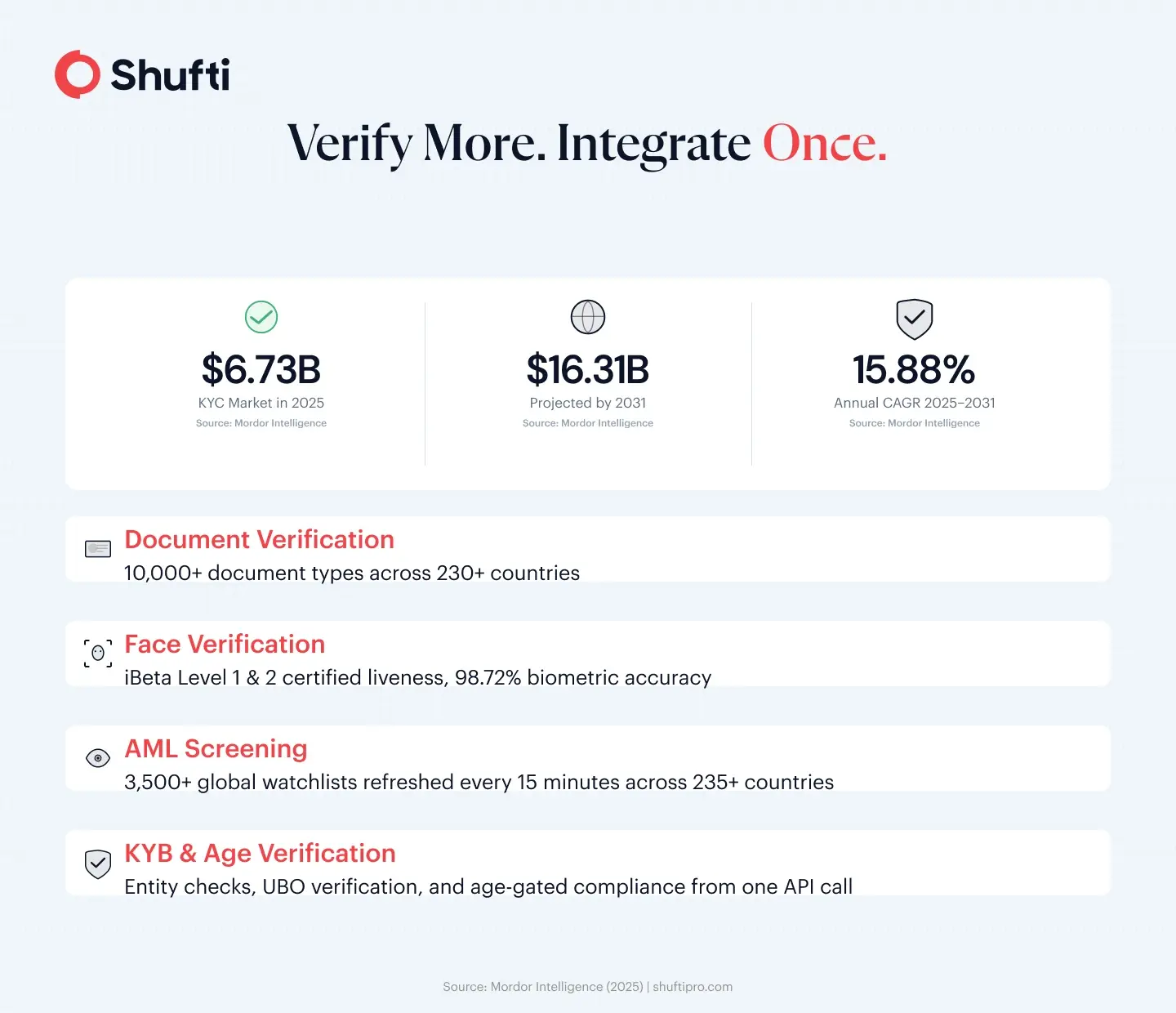
- One API verifies documents, faces, AML, KYB, and age across 230+ countries.
- Adding a service later is an API parameter update, not a new integration.
Building identity verification into a product used to mean picking a vendor, hoping their SDK matched your stack, and spending weeks on edge cases the documentation did not cover. For mobile-first teams, the choice between native SDKs and web fallbacks often came with the implicit understanding that one path would underperform.
The global KYC market is projected to grow from USD 6.73 billion in 2025 to USD 16.31 billion by 2031, compounding at 15.88% annually. That pace puts pressure on how quickly teams can ship verification. With 64.85% of identity verification workloads already running in the cloud, the baseline expectation for developer tooling is more demanding than it was three years ago.
Shufti’s developer toolkit is built around one principle: the right integration method for every platform and team, through a single API.
Why developer experience determines your verification timeline
When identity verification projects fall behind schedule, the problem is rarely the verification logic. It is usually the integration layer. Legacy system integration complexity regularly overruns initial estimates by 50 to 100%, and teams that expected a two-week effort often find themselves at month two with the core flow still in testing.
Three failure patterns appear repeatedly. First, vendor SDKs built for one platform often need adapting for another, and edge-case documentation is sparse. Second, compliance requirements shift by market: what satisfies KYC in one jurisdiction adds different document types or liveness checks in another, so the integration must accommodate logic that changes after launch. Third, verification services built as standalone components create maintenance overhead that expands every time the product adds a feature.
Developers working within Shufti’s integration portal sidestep much of this because the SDK layer and compliance logic are bundled together. Adding AML screening to a flow that already handles document verification is a configuration change, not a separate integration. For teams that have shipped KYC, the path to KYB or ongoing compliance monitoring runs through the same API credentials and endpoint structure.
The practical result is a shorter path from integration completion to the first verified user, with a smaller surface area for failures to appear six months later.
Shufti’s integration toolkit: six paths to verified users
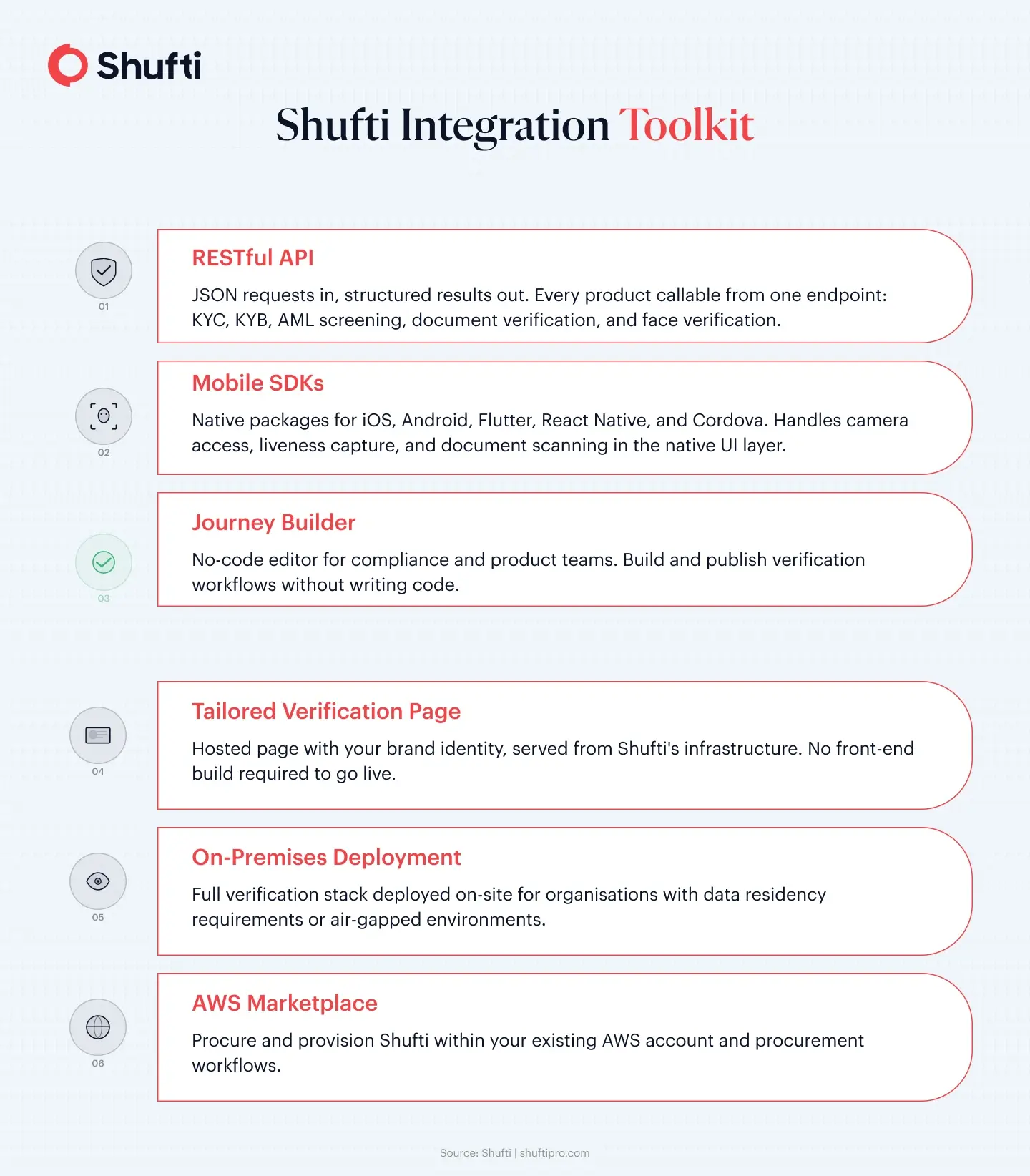
Shufti provides six integration methods. All six connect to the same underlying verification engine, so coverage, compliance rules, and reporting remain consistent regardless of the path chosen.
| Integration method | Best fit |
| RESTful API | Web apps, back-end microservices, custom front-ends |
| Mobile SDKs | iOS, Android, Flutter, React Native, Cordova apps |
| Journey Builder | No-code teams without engineering bandwidth |
| Tailored Verification Page | Hosted page for teams without front-end resources |
| On-Premises | Data residency or air-gapped environments |
| AWS Marketplace | Teams procuring within existing AWS accounts |
RESTful API. The core API accepts JSON requests and returns structured responses. Teams building web applications, back-end microservices, or custom front-ends typically start here. Every product in Shufti’s catalogue is callable through this endpoint, including KYC, KYB, AML screening, document verification, and face verification.
Mobile SDKs. Native packages are available for iOS, Android, Flutter, React Native, and Cordova. Each handles camera access, liveness capture, and document scanning within the native UI layer. Flutter and React Native teams build on a single codebase that runs on both platforms without maintaining separate build pipelines.
Journey Builder. Product and compliance teams without dedicated engineering bandwidth deploy verification flows through Journey Builder, a no-code editor that builds and publishes verification workflows without writing a line of code.
Tailored Verification Page. A hosted page served from Shufti’s infrastructure that carries the client’s visual identity. Teams without front-end resources can go live quickly without a custom UI build.
On-Premises. For organisations with data residency requirements or air-gapped environments, the complete verification stack deploys on-site. Full product parity is maintained across cloud and on-prem deployments.
AWS Marketplace. Teams operating within AWS infrastructure can procure and provision Shufti through the AWS Marketplace, within existing cloud accounts and procurement workflows.
How Shufti solves the integration complexity problem
The most consistent feedback from teams that have deployed Shufti’s toolkit is a reduction in what developers need to own directly. Shufti’s unified KYC API keeps the compliance logic inside the engine rather than in the customer’s codebase. That includes which document types apply in which market, which watchlists are active for a given region, and what liveness standard meets a given regulator’s threshold.
For teams operating across multiple markets, this separation matters in practice. A fintech expanding from Europe to the Middle East or APAC does not rewrite its KYC flow. It adjusts configuration parameters, and Shufti’s identity verification engine applies the market-specific rules. Document types, language support across nearly 100 OCR languages, including Arabic, Mandarin, and Cyrillic, and regional compliance requirements are updated in Shufti’s platform without changes pushed to the customer’s code.
All six integration methods described in this article share the same core engine, the same 280 million annual identity checks, and the same 99.3% fraud detection accuracy. The integration path chosen changes how the SDK connects to the product. It does not change what the SDK can do.
Verification complexity should not determine how quickly your product ships. Shufti’s developer toolkit covers every platform, every compliance requirement, and every integration method your team prefers, through a single verified connection. Book a demo to see how the SDK fits your stack.
Frequently Asked Questions
What platforms does Shufti's SDK support?
Shufti provides native SDKs for iOS and Android, cross-platform packages for Flutter and React Native, a Cordova plugin for hybrid applications, a RESTful API for web and back-end services, a no-code Journey Builder for teams without engineering resources, and a hosted Tailored Verification Page. Organisations with data residency requirements can deploy the full stack on-premises, and the platform is also available through the AWS Marketplace.
How quickly can a developer integrate Shufti's KYC API?
Integration time varies by method and stack. Most developers using the RESTful API complete an initial integration within a few days using the sandbox environment and sample code in the documentation. Mobile SDK integrations take longer due to device-specific permissions handling, though the Flutter and React Native packages reduce that timeline for cross-platform teams.
Can I add AML screening to an existing document verification integration?
Yes. Shufti's API is designed for multi-service requests. Adding AML screening to an existing document verification flow is an API parameter update, not a new integration. Credentials, endpoint structure, and response format remain unchanged. The same applies to adding face verification, KYB, or age verification to any live Shufti integration.