AMLR Solutions
 AMLR Consultation
 Onboarding
 Ongoing Monitoring
 FRAML
FRAML KYC
KYC KYB
KYB KYI
KYI Age Assurance
 Workforce IAM
 Candidate Verification
 Account Takeover
 Bonus/ Promotion Abuse
 Chargeback Fraud
 Deepfake
 Document Fraud
 Fraud Networks
 Impersonation Fraud
 Money Mule Activity
 Multi-Accounting
 Party Fraud
 Regulatory & Compliance Risks
 Synthetic Identity Fraud
 Adult Content
 Banking
 Crypto
 Fintech
 Forex
Forex Compliance
 Fraud prevention
 Trust & safety
 Global expansion
 Compliance Officers
 Developers
 Fraud Analysts
 Product Managers
 Advanced Journey Builder (AJB)
 Global Trust Platform
 Customer Profiles
 Vendor Comparison
 IDV Case Management
 AML Case Management
 Regulatory Reporting
 Travel Rule Protocols
 Agentic Rule Builder
 AI Compliance Co-Pilot
 Fraud Analytics
 Fraud Hub
 OCR
OCR Shufti AI
 Bank Account Verification
 Biometric Duplication
 Database Checks
 Document Intelligence
 Government ID
 Mobile Driver's License
 NFC
NFC Selfie Liveness
 Brand Personalisation
 Deployment Options
 Identity Methods
 IDV Modes
 Multi-tenancy
 On-Premise IDV
 Secure Capture











TL;DR
- FTC recorded 1.1M identity theft reports and $12.5B in fraud losses in 2024, often starting with fake addresses
- FinCEN CIP (31 CFR § 1020.220) requires collecting and verifying name, DOB, ID number, and address at account opening, with 5-year record retention
- Accepted proof of address: utility bills, bank statements, government letters (IRS/SSA/USCIS/DMV), signed lease agreements dated within 60–90 days
- Two verification paths: documentary (document upload) or non-documentary (real-time database cross-reference) both are CIP-compliant
- Fake addresses fail because they can’t simultaneously beat forensic document analysis, multi-source database checks, and geolocation signals
- Fintechs use a two-tier cascade: doc-less database check first document upload only if needed, reducing onboarding friction
- California platforms face CCPA data minimization requirements and must document all downstream processors receiving address data
- Shufti’s suite covers 240+ countries, 10,000+ document types, processes 1M+ verifications/day at 99.5% fraud detection accuracy
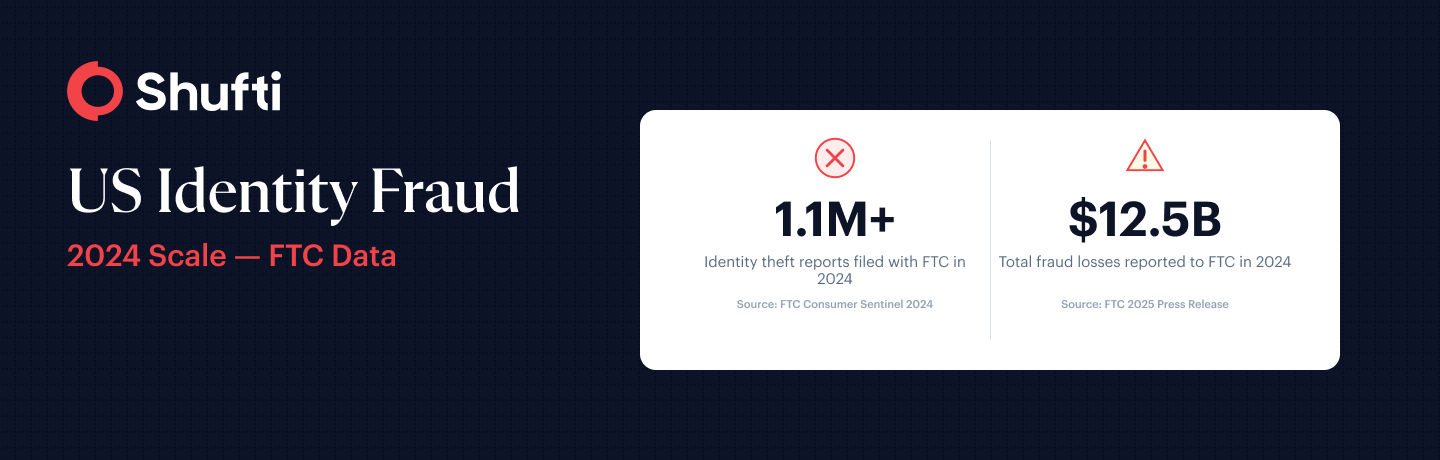
The Federal Trade Commission received more than 1.1 million identity theft reports in 2024, with total fraud losses reaching $12.5 billion. A significant share of those cases started with a manipulated or synthetic address, the kind that passes a basic form-fill check but collapses under forensic document review. For any business operating within the US financial system, address verification USA no longer remains a checkbox. It is a compliance control with regulatory teeth, an enforceable record-keeping requirement, and a measurable fraud-prevention layer.
This guide covers what FinCEN CIP requirements mandate at account opening, which documents meet proof of address USA standards, how fake address attempts fail modern verification controls, and what a compliant address verification workflow looks like for fintech platforms operating under federal and state law.
What is address verification in the US?
Address verification in the US is the process of confirming that a person’s stated residential or business address is real, attributable to them, and substantiated by either documentary evidence or authoritative database records. It sits within the broader identity verification USA fintech compliance framework governed by the Bank Secrecy Act, the USA PATRIOT Act, and, for California-resident users, the California Consumer Privacy Act (CCPA).
Verification takes two paths. The documentary path requires the customer to produce a utility bill, bank statement, or government letter that shows their name and address. The database path cross-references the submitted address against government registries, telecom records, and credit bureau data, all in real time, with no document upload, resulting in seconds. Modern compliance stacks combine both, routing each customer to the appropriate method based on their risk tier, the institution’s written CIP policy, and the jurisdiction in which the account is opened.
Shufti covers address checks, 520+ USA ID types, and AML screening in one CIP-ready workflow.Close the CIP gap with Shufti
What does FinCEN CIP require for address verification?
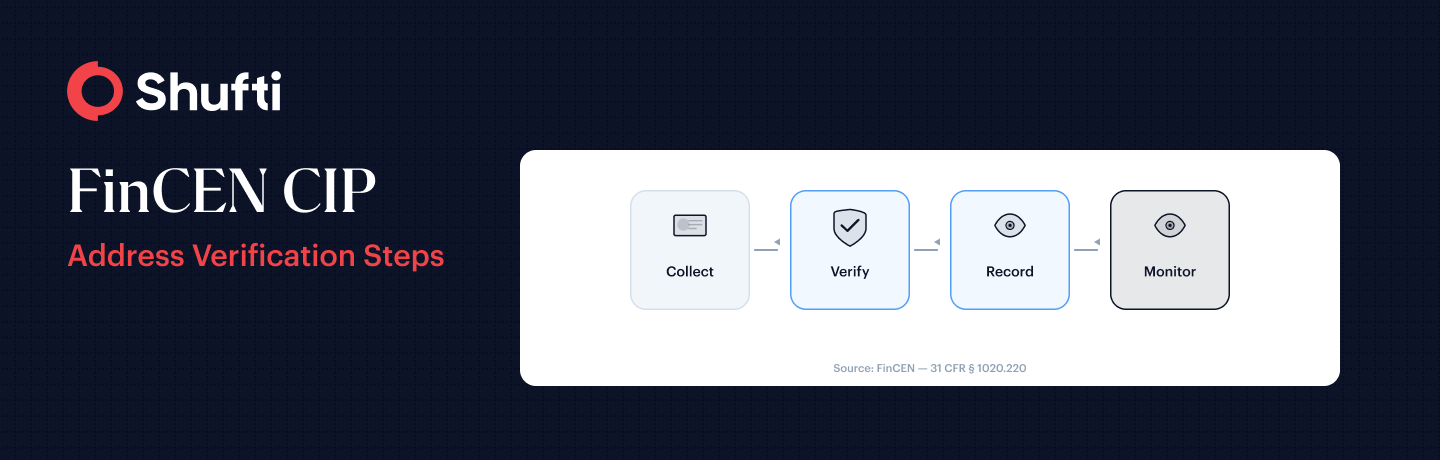
Under 31 CFR § 1020.220, every US financial institution must collect and verify four identity elements at account opening: name, date of birth, identification number, and address. The FinCEN CIP requirements specify that the customer identification program address standard applies to all US residents, with the residential street address as the baseline requirement. For non-US persons without a residential address, a business address or Army Post Office (APO) address may substitute.
CIP does not prescribe a single verification method. Institutions may use documentary verification, non-documentary verification (database checks), or a combination. What the regulation does require is that the chosen method is documented in the institution’s written CIP policy, applied consistently across similarly situated customers, and that records of the verification are retained for five years after the account is closed. Failure to maintain this documentation has been the basis for FinCEN enforcement actions carrying civil money penalties into the millions.
What documents count as proof of address in the USA?
For document-based proof of address USA verification, the document must display the customer’s full name and physical address, be issued by a recognizable third party, and fall within the institution’s acceptable recency window, most commonly 60 to 90 days from the issue date. The following document types meet that bar in the overwhelming majority of US institutional CIP policies.
Utility bills
A utility bill for electricity, gas, water, or broadband internet is the most widely accepted document for proof of address verification service purposes in the US. Online billing statements qualify provided they carry a visible issue date and account number. Utility bill verification online has become the norm for fintech onboarding: the customer uploads a photo or PDF, and the verification engine extracts name, address, and date via OCR before running a forensic integrity check.
Bank Statements
A bank statement dated within the preceding 60 days satisfies documentary CIP standards at most institutions and typically carries higher evidential weight than a utility bill because the issuing party is itself a regulated financial institution.
Government-issued correspondence
Letters from the IRS, Social Security Administration, USCIS, or state DMVs are accepted as proof of address. Their evidential weight in document-scoring models is high: the issuing body has conducted its own prior identity verification before sending correspondence to that address.
Lease agreements
A current, signed lease agreement bearing the customer’s name, address, and landlord signature is accepted at many institutions, particularly useful for customers who do not receive utility bills in their own name. Acceptable recency windows vary by institutional CIP policy.
Why do fake addresses fail modern verification?
A fake address generator produces plausible-looking strings, real zip codes, matching city names, and correctly formatted street numbers that pass a format-validation check. A fake ID address verification attempt escalates this: pairing a fabricated or stolen identity document with an address manipulated to match the forged ID. Both approaches fail under multi-layer verification for the same structural reason: they cannot produce a coherent, cross-sourceable footprint.
Modern address verification service USA platforms apply three controls simultaneously. Documentary forensics EXIF (Exchangeable Image File Format) and PDF metadata analysis, AI-manipulation detection, layout consistency scoring, and identify digitally altered utility bills and bank statements that a human reviewer would pass on visual inspection alone. Database cross-reference then checks the submitted address against government, telecom, and credit bureau sources: a synthetic address with no data footprint across multiple independent sources fails this cross-reference even when the document looks pristine. Geolocation signals layer in a third dimension: an IP address placing a user in one country while they claim a residential address in another feeds directly into the risk score, flagging the session for review before a document is even submitted.
The result is that manipulation has to succeed simultaneously on forensic, database, and geolocation controls. That combination is what makes modern address verification materially harder to circumvent than the form-fill checks of the prior decade.
How fintech companies verify addresses in the USA?
Identity verification USA fintech platforms face a constraint that traditional banks do not: mobile-first users abandon onboarding at high rates when asked to upload documents. Addressing that abandonment without sacrificing CIP compliance is the core design problem of address verification in the fintech context.
The practical solution is an address verification API built on a two-tier cascade. The cascade begins with a doc-less database check: the user’s name, address, and date of birth are submitted to the API and cross-referenced against authoritative government, telecom, and financial registry sources. If the data matches across sources, verification completes in seconds, no upload required, no friction added to the onboarding funnel. If the database check cannot confirm the address because the user is new to credit, recently relocated, or the jurisdiction has thin bureau coverage, the API escalates to a document request.
KYC address verification USA integrations also carry CCPA obligations for California-resident users. The regulation imposes data minimization requirements: the address data collected for verification must be limited to what is necessary for the stated compliance purpose. Platforms must provide a mechanism for users to request deletion of verification data after the applicable retention period expires, and must document every downstream processor that receives address verification data in their CCPA records of processing activities. An address verification API that routes data through multiple third-party enrichment services needs explicit processor mapping to stay within CCPA obligations.
How Shufti helps US fintechs meet CIP address requirements?
For fintech platforms trying to satisfy FinCEN CIP address requirements without adding document-upload friction to mobile onboarding, Shufti’s Address Verification Suite provides a practical path forward. The suite routes each user to the fastest viable verification method automatically. In markets with sufficient authoritative data coverage, doc-less verification cross-references the submitted address against 235+ trusted data sources, government registries, telecom records, and credit bureau databases, returning a confirmed result in under 3 seconds with no upload required.
Where institutional CIP policy or risk tier demands documentary evidence, the suite escalates to Document Proof of Address. Uploaded utility bills and bank statements pass through Document Intelligence forensic analysis, EXIF and PDF metadata inspection, AI-manipulation detection, and layout forgery scoring to catch the digitally altered documents that standard OCR cannot identify. Every verification result, whether doc-less or document-based, feeds a unified audit trail formatted to FinCEN CIP record-retention standards. Shufti’s address verification platform covers 240+ countries, supports 10,000+ document types in 95+ languages, and processes over 1 million verifications per day with a 99.5% fraud detection accuracy rate.
Frequently Asked Questions
What is the FinCEN CIP address requirement?
Under 31 CFR § 1020.220, US financial institutions must collect and verify a customer's residential street address at account opening. CIP does not mandate a specific verification method; documentary or non-documentary checks both qualify, but the chosen method must be documented in the institution's written CIP policy and records must be retained for five years after account closure.
What documents are accepted as proof of address in the USA?
Utility bills, bank statements, government correspondence (IRS, SSA, USCIS, state DMV), and signed current lease agreements are the standard accepted documents. The document must show your name and physical address and be dated within the institution's acceptable recency window, typically 60 to 90 days.
Can a fintech verify an address without a document upload?
Yes. Non-documentary verification cross-referencing submitted address data against government, telecom, and credit bureau databases is explicitly permitted under FinCEN CIP. Document upload is required only when the non-documentary check cannot confirm the address or when the institution's CIP policy mandates documentary evidence for a given customer risk tier.
Why do fake address generators fail modern identity verification?
A fake address generator can produce a correctly formatted address that passes a format-validation check. It fails the database cross-reference, which checks whether the address can be matched to a real person across multiple independent authoritative sources. Forensic document analysis separately detects digitally altered supporting documents, catching the manipulation at a second independent layer.
What does CCPA require for address verification data in California?
CCPA requires data minimization: the address data collected for verification must be limited to what the stated compliance purpose requires. California residents may request deletion of their verification data after applicable retention periods expire. Fintech platforms must document all downstream processors that receive address verification data in their CCPA records of processing activities.