AMLR Solutions
  AMLR Consultation
 EUDI Wallet
 Onboarding
 Ongoing Monitoring
 FRAML
FRAML KYC
KYC KYB
KYB KYI
KYI Age Assurance
 Workforce IAM
 Candidate Verification
 Account Takeover
 Bonus/ Promotion Abuse
 Chargeback Fraud
 Deepfake
 Document Fraud
 Fraud Networks
 Impersonation Fraud
 Money Mule Activity
 Multi-Accounting
 Party Fraud
 Regulatory & Compliance Risks
 Synthetic Identity Fraud
 Adult Content
 Banking
 Crypto
 Fintech
 Forex
Forex Compliance
 Fraud prevention
 Trust & safety
 Global expansion
 Compliance Officers
 Developers
 Fraud Analysts
 Product Managers
 Journey Builder
  Global Trust Platform
 Customer Profiles
 Vendor Comparison
 IDV Case Management
 AML Case Management
 Regulatory Reporting
 Agentic Rule Builder
  AI Compliance Co-Pilot
  Fraud Analytics
 Fraud Hub
  OCR
OCR Shufti AI
 Bank Account Verification
  Biometric Duplication
 Database Checks
 Document Intelligence
 Government ID
 Mobile Driver's License
 NFC
NFC Selfie Liveness
 Brand Personalisation
 Deployment Options
 Identity Methods
 IDV Modes
 Multi-tenancy
 On-Premise IDV
 Secure Capture
 Shufti MCP















TL;DR
- Vendor 99% accuracy claims come from clean lab media, not real user uploads.
- No single model catches every deepfake, so one-classifier tools underperform in production.
- Shufti runs seven independent forensic checks plus frequency-domain (DCT) analysis on degraded media.
- Injection attacks enter through virtual cameras, so tools must check how media arrived.
- Shufti’s 2026 index projects a 495% rise in deepfake identity fraud.
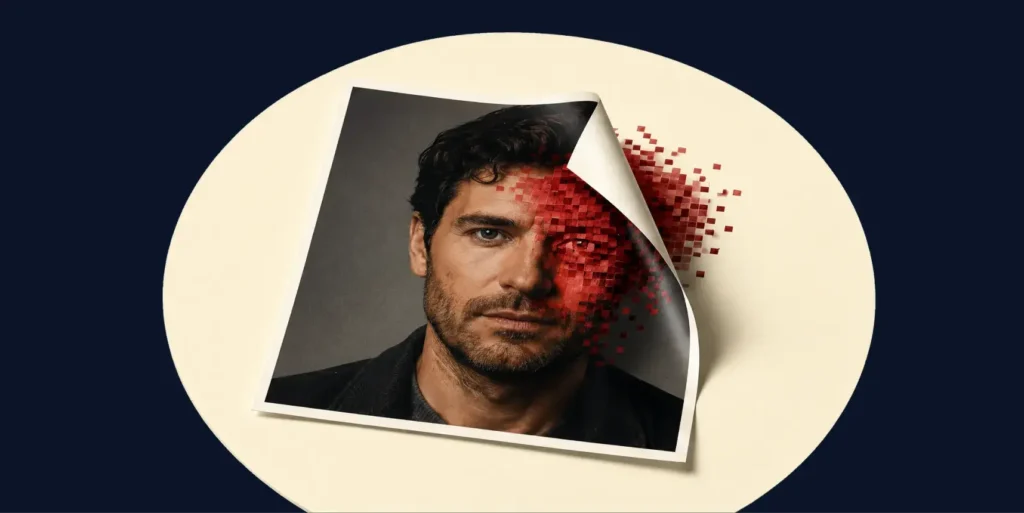
Most deepfake detection tools advertise their products with 99 percent accuracy claims, but the actual accuracy rates are drastically different.
Here are two reasons why:
- These accuracy numbers are measured on clean images and videos under controlled lab conditions. In real life, however, images and videos don’t arrive in perfect condition (they are compressed by the browser, re-encoded by the network, captured on whatever device and lighting the user happened to have, etc). Since these solutions aren’t designed to handle such degraded media, they fail to hold to their accuracy claims.
- These solutions treat deepfake detection as a problem that can be solved with a single-model tool, which is insufficient because no single model catches every kind of deepfake, thus resulting in lower accuracy rates.
Shufti closes both gaps with its production-grade detection that holds accuracy on degraded, real-world media, and the Seven Gates approach that performs checks across seven independent signals, ensuring no deepfake goes undetected.
In this guide, we will break down how Shufti closes these two gaps and cover five other tools that may be the better fit depending on your situation.
Best Deepfake Detection Tools:
As the publisher of this guide, we list Shufti first for transparency. The remaining five tools are described on the same factual basis. Product details are drawn from each vendor’s own public documentation, alongside G2 and Trustpilot profiles where a listing exists, all checked in August 2026.
| Tool | Primary category | Deepfake detection approach | Injection-attack coverage | Media types | Best for |
| Shufti | Full-stack identity verification (KYC, AML, document, biometric, age) | Seven independent forensic checks plus frequency-domain (DCT) analysis, built for degraded real-world media | Yes, capture-integrity checks that flag virtual cameras and emulators | Image, video | Teams that want deepfake defence inside onboarding, authentication, and account recovery, on media that arrives compressed and imperfect |
| Sumsub | Full-cycle verification (KYC, KYB, AML, transaction monitoring) | Detection embedded inside in-house liveness, with facial geometry and depth analysis | Yes, injected deepfakes covered within liveness | Image, video | Regulated onboarding teams already running a broad KYC and AML stack |
| iProov | Biometric face verification | Flashmark controlled-illumination liveness proving genuine presence in real time | Yes, independently certified focus on injection resistance | Video (face capture) | High-assurance authentication and account recovery where accredited proof matters |
| Facia | Face recognition and liveness | DeepLiveness layer on top of standard liveness, with sub-second decisions | Yes, blocks injection attacks alongside masks and replays | Image, video | Low-friction liveness across onboarding and remote meetings |
| Reality Defender | Communication-channel deepfake detection | Ensemble of models across modalities, in real time | Not an onboarding tool, protects calls and meetings | Audio, video, image | Enterprise and government teams fighting executive impersonation and voice-clone fraud |
| Sensity AI | Forensic deepfake detection with optional KYC SDK | Multilayer forensic analysis with explainable, court-ready output | Yes, via the optional KYC SDK and API | Image, video, audio | Forensics, law enforcement, defence, and media-integrity work needing defensible results |
Source: Table compiled from vendor-published documentation, current as of August 2026.
Shufti runs seven independent forensic checks on every image and video, and holds accuracy on the compressed, re-encoded uploads your customers actually submit.
Compare Shufti on your criteria
1) Shufti
Shufti is an AI-powered identity verification platform offering KYC, AML, document, biometric, and age verification on a single in-house stack. Its deepfake defence is built into that verification layer, catching manipulated faces, injected video, and synthetic identities at the moment of onboarding, authentication, and account recovery.
Here are its capabilities:
Multi-Stream Frequency-Domain Detection
Most tools only read the picture, whereas Shufti reads the picture and the frequency-domain (DCT) signal underneath it, at the same time. Generator artefacts live in that signal, and they survive compression, screenshots, and re-uploads long after the visible clues are gone.
Shufti at this hidden mathematical layer and capture the clues that survive to catch fakes on the imperfect images your customers upload.
Capture-integrity checks for injection defence
Injection fraud is the process where someone feeds AI video straight into the verification flow through a virtual camera, which makes a system believe that there’s a live person performing the verification.
Where most solutions just analyze the person in the video, Shufti checks how the video/image got in and flags the traces that are left behind by virtual cameras or emulators.
Metadata-Independent Analysis
Shufti does not rely on a file’s metadata alone, such as EXIF, device details, or timestamps. All of it is trivial to rewrite, and it vanishes the second a file is sent through WhatsApp or reposted. By ignoring metadata and judging the media itself, Shufti keeps a fake from getting past your system.
The Seven Gates – Shufti’s Seven-Part Forensic Model
Shufti runs each image/video through seven independent checks, each looking for a different signal to identify synthetic media. Here is what each gate checks:
- Biometric structure: Checks whether the face is built and moves like a real human face, catching the subtle geometry that drifts when a synthetic face tries to stay consistent across expressions and motion.
- Generator traces: Looks for the statistical fingerprints that are left behind by AI. This flags media that behaves more like model output rather than a real image captured by a customer using a camera.
- Compression history: Examines how the file was saved and re-saved to spot the mismatched processing that shows up when one region of an image has been edited and cleaned up.
- Frequency behaviour: Reads the frequency-domain signal beneath the image, where a real sensor leaves a natural pattern that generators tend to smooth over or reproduce incorrectly.
- Texture realism: Studies fine detail like skin, hairlines, and edges, catching the over-smooth, too-uniform texture that synthetic media usually produces.
- Resilience under degradation: Tests what still holds up when quality drops, so attacks hidden inside blurry, low-resolution, or badly lit media do not slip through.
- Pixel-level coherence: Inspects fine pixel continuity in high-detail captures, exposing the tiny discontinuities left behind by how a fake was assembled.
Ratings:
- Shufti G2 Reviews: 4.5/5 (151 reviews)
- Shufti Trustpilot Reviews: 4.8/5 (3953 reviews)
2) Sumsub
Sumsub is a full-cycle verification platform covering KYC, KYB, AML, transaction monitoring, and fraud prevention. Its deepfake detection is not a standalone product but sits inside its in-house liveness, so synthetic faces and injected video are caught during the same biometric check used for onboarding. Teams already running Sumsub get deepfake defence inside the existing flow rather than bolting on a separate scanner.
- Liveness-embedded detection: Targets AI-generated faces, injected deepfakes, screen replays, and printed or masked attempts, analysing facial geometry and depth cues for anomalies.
- Continuously learning models: Detection updates as soon as new deepfake tools and injection methods emerge.
- Real-time pixel analysis: In-house pixel analysis and pattern recognition identifies fakes in real time, with liveness tested by iBeta in accordance with ISO/IEC 30107-3.
Best for: Regulated onboarding teams that want deepfake defence inside a broader KYC and AML stack.
Reviews:
- G2: 4.6/5 (125 reviews)
- Trustpilot: 1.3 /5 (273 reviews)
3) iProov
iProov is a biometric identity verification provider focused on face verification for onboarding, authentication, and account recovery, used widely in government and financial services. Its deepfake defence is built around proving genuine presence in real time rather than spotting artefacts after the fact. It is one of the most heavily certified liveness providers, with particular emphasis on injection attack resistance.
- Flashmark Dynamic Liveness: A patented controlled illumination sequence during face capture confirms the user is genuinely present at that moment, not a replay, deepfake, or injected recording.
- Injection-attack focus: Independently certified under ISO/IEC 30107-3 and tested by Five Eyes governments for both presentation and injection attacks.
- iSOC threat intelligence: Continuous threat intelligence that tracks over 120 face-swap tools and deploys evolving countermeasures.
Best for: High-assurance authentication and account recovery where accredited proof of injection resistance matters most.
Ratings:
- G2: N/A
- Trustpilot: N/A
4) Facia
Facia is a face recognition and liveness platform founded in 2022, built for onboarding, authentication, and step-up verification. It positions deepfake detection as a layer on top of liveness, so a system confirms not only that a face is present but that it is real. It covers both offsite media checks and real-time detection during live video, and markets speed and low friction as core selling points.
- DeepLiveness layer: Adds a frictionless deepfake detection layer on top of standard liveness that confirms the face is real, not just present.
- Sub-second blocking: Its liveness API blocks deepfakes, masks, and injection attacks in under one second, certified to iBeta Level 2.
- Reported accuracy: Facia reports 89.91% real-world deepfake detection accuracy and single-image liveness up to 98.8%, vendor-reported.
Best for: Teams wanting fast, low-friction liveness with an embedded deepfake layer across onboarding and remote meetings.
Ratings
- G2: N/A
- Trustpilot: Limited Profile
5) Reality Defender
Reality Defender is an enterprise deepfake detection platform built to protect communication channels rather than run identity onboarding. It focuses on catching AI-generated impersonation across calls, meetings, and executive communications, covering audio, video, and images. Rather than a KYC tool, it is aimed at fraud, security, and investigative teams who need to verify whether media or a person on a call is genuine, through both a web app and a developer API.
- Multimodal real-time detection: Detects synthetic audio, video, and images in real time to protect critical communication channels from AI-generated fraud and impersonation.
- Ensemble-of-models approach: Uses a comprehensive ensemble-of-models approach that integrates with existing security infrastructure to stop AI-generated impersonations in real time.
- RealScan and RealAPI: RealScan, a drag-and-drop web app for images, video, audio, and documents, alongside RealAPI for developer integration.
Best for: Enterprise and government teams fighting executive impersonation and voice-clone fraud across calls and meetings, not onboarding.
Ratings
- G2: 3.8 /5 (2 reviews)
- Trustpilot: N/A
6) Sensity AI
Sensity AI is a forensic-grade deepfake detection platform operating since 2018, used across government, defence, judicial, and cybersecurity work, with an optional KYC integration. Its emphasis is on explainable, court-ready forensic output rather than a simple pass or fail, covering image, video, and audio. It suits investigations and evidence work where a decision must be defensible, though it can also plug into biometric onboarding via SDK or API.
- Multilayer forensic analysis: Analyses visual artefacts, acoustic patterns, metadata, behavioural cues, and cross-modal inconsistencies across image, video, and audio.
- Explainable, court-ready output: Processes content frame-by-frame with a verdict, confidence score, bounding boxes, and heat-map explainability, backed by court-ready reporting.
- KYC integration: A KYC deepfake detection SDK and API that blocks AI-generated faces and injection attacks on biometric checks, deployable via cloud or on-premises.
Best for: Forensics, law enforcement, defence, and media-integrity teams needing explainable, defensible results.
Ratings
- G2: N/A
- Trustpilot: N/A
How We Reviewed These Tools
We did not run these six tools through a shared lab test, and any guide that claims to has usually tested under conditions that favour whoever commissioned it.
Four things shaped our assessment:
- First, detection approach, meaning whether a tool leans on a single model or combines several independent signals.
- Second, real-world resilience, meaning whether detection is designed for degraded, compressed, real-world media rather than clean samples.
- Third, injection coverage, meaning whether a tool checks how media entered the flow, not just what the media shows.
- Fourth, deployment and certification, meaning where it runs and which independent standards it has been tested against.
Shufti reads the frequency-domain (DCT) signal beneath the image, where generator artefacts survive compression, screenshots, and re-uploads long after the visible clues are gone.
Explore the Shufti platform
Why Deepfake Attacks Are Increasing Rapidly
Three forces are driving the surge:
- Accessibility: Generative AI has stripped out the cost and skill fakes once needed. Anyone can create a fake identity now with one image or a text prompt.
- Scale: Generation runs as consumer apps and open-source models, so attacks are produced like software. Real-time face-swap and voice-cloning on ordinary hardware is what makes live-call and injection attacks practical.
- Layering: Fraudsters combine techniques in one attempt, pairing a synthetic face with a forged document to beat systems that check only one thing.
Shufti Deepfake Identity Fraud Index Report 2026 projects a 495% rise in deepfake identity fraud in 2026, close to a sixfold jump over 2025. Synthetic identities are the largest share today at over 42%, followed by face swaps at 17.6% and document deepfakes at 11.9%. Document deepfakes are the fastest-growing type, projected to grow nearly 3,900% year on year.
How to Choose the Best Deepfake Detection Tool
Most evaluations go wrong in the same place: comparing accuracy numbers that were never measured on comparable media. Do this instead.
- Ask for accuracy on degraded media, not lab benchmarks. Request figures measured on compressed, re-encoded, low-resolution uploads from mid-range devices.
- Send the vendor a sample of your own traffic. Browser-compressed selfies, low-light photos on older phones, documents captured at an angle.
- Map every point in your flow where a face or document decides an outcome. Onboarding, step-up authentication, high-value transactions, and account recovery, which is usually the weakest link.
- Confirm the tool inspects how media arrived, not just what it shows. Ask specifically about virtual camera and emulator traces.
- Check whether injection and capture-integrity checks are bundled or an add-on. These sit outside standard liveness and are often priced separately.
- Ask how many independent signals it runs and how often models update. Prefer several unrelated checks over one classifier that has to recognise every new generator.
- Ask to see the actual review screen a flagged case produces. Confirm the reasoning is auditable and that a genuine customer can retry without restarting verification.
- Run the shortlist on your own media before signing. Include known-good submissions so you measure the false-positive rate alongside the catch rate.
Shufti checks how the media entered your flow, flagging the traces virtual cameras and emulators leave behind, not only what the person on screen appears to be doing.
Book a live walkthrough with Shufti
Frequently Asked Questions
Is deepfake detection the same as liveness detection?
No, though they're often sold together. Liveness answers whether a real person is physically present in front of the camera, which catches printed photos, masks, and screen replays. Deepfake detection answers whether the media itself is synthetic. A high-quality AI-generated video played through a virtual camera can satisfy some liveness checks while still being entirely fake, which is why the two need to work together.
Can deepfake detection work on documents, or only faces?
Both, and document deepfakes are the part most teams underestimate. A manipulated ID or a fully synthetic document goes through the same forensic questions as a face: whether compression history is consistent across the image, whether the texture behaves like a photographed surface, and whether the frequency signal matches a real capture. Any tool you evaluate should state clearly whether document media is covered or whether it only inspects faces.
Do free or open-source deepfake detectors work?
They're useful for research and for building intuition, but they carry the exact weakness this guide describes. Open detectors are typically trained on public benchmark datasets of clean media and are rarely maintained against new generators. For a production flow where a wrong decision means a fraudulent account or a rejected customer, treat them as a learning tool, not a control.
How often do detection models need updating?
Continuously, because new generation tools appear faster than any fixed model can anticipate. This is the practical reason to prefer several independent signals over one classifier: an approach that looks at compression history, frequency behaviour, and texture realism doesn't depend entirely on having seen a specific generator before. When evaluating vendors, ask how often models are updated and what triggers an update.
What happens when a real customer gets flagged as a deepfake?
This is the question most buyers forget to ask, and it decides how the tool feels in production. Find out whether flagged media goes to a manual review queue, what evidence a reviewer sees, how long resolution takes, and whether the customer can retry without starting over. A high catch rate paired with a clumsy recovery path shows up later as onboarding drop-off.
Does deepfake detection cover audio?
Some tools do, some don't, and the distinction maps to what they're built for. Identity verification platforms focus on image and video, because that's what onboarding produces. Tools built to protect calls and meetings cover audio because voice cloning is the attack there. If your risk is a cloned voice authorising a transfer over the phone, that's a different product category from your KYC stack.
Where should deepfake detection sit besides onboarding?
Account recovery, step-up authentication for high-value actions, and any manual process where a human accepts a face or document as proof. Fraudsters go where verification is weakest, and recovery flows are frequently built for convenience rather than assurance.