



 Face Verification
 Address Verification
 Document Verification
 Age Verification
 VideoIdent
 Fast ID
 Docless Verification
 Consent Verification
 NFC Verification
 Business Verification
 Due Diligence
 Investor Verification
 E-Signature

 QES
QES
 AML Screening
 Transaction Monitoring
 Adverse Media
 Business AML Screening
 PEP & RCA
 Sanctions
 Watchlist
 Behavioural Biometrics
 Device Fingerprinting
 Biometric Face Authentication
 MFA
MFA
 Fraud Hub
 Onboarding
 Ongoing Monitoring
 KYC
KYC
 KYB
KYB
 KYI
KYI
 Age Assurance
 Identity Verification
 Workforce IAM
 Candidate Verification
 Compliance
 Fraud prevention
 Trust & safety
 Global expansion
 Product Managers
 Compliance Officers
 Fraud Analysts
 Developers
 Deepfake Detection
 Bonus Abuse / Promotion Abuse
 Account Takeover
 Synthetic Identity Fraud
 Document Fraud
 Impersonation Fraud
 Multi-Accounting
 Fraud Networks
 Chargeback Fraud
 Money Mule Activity
 Party Fraud
 Regulatory & Compliance Risks
 Fintech
 Crypto
 iGaming
 Forex
Forex
 Social Network
 Marketplace
 Banking
 Gig Economy
 Payments
 Ride Hailing
 Adult Content
 Blind Spot Audit
 Deepfake Detector
 Liveness Spoofs
 Document Originality
 Document Deepfake
 Global Trust Platform
 Journey Builder
 Case Management
 Shufti AI
 Fraud Analytics
 Vendor Comparison
 Brand Personalisation
 AI Compliance Co-Pilot
 OCR
OCR
 Secure Capture
 Deployment Options
 Identity Methods
 API Documentation
 Mobile SDKs
 Service Status
 Help Center
 Contact Us
 Technical Support
 Supported Documents
 Supported Countries
 Content library
 Blogs
Blogs
 News
News
 Reports
 Insights
 Knowledgebase
 ROI calculator
 About
About
 Career
 Press Release
 Certifications
 Partnership
 Awards
 Events & Webinar
 Interactive Demo
 Podcast Studio
 Spotlight Studio
Best Fraud Prevention Practices in Australia’s Banking Sector

- 01 What Fraud Risks Are Australian Banks Facing in 2026?
- 02 The Scams Prevention Framework Act 2025: What Banks Must Do Now
- 03 What Does AUSTRAC's AML/CTF Reform Require from Banks?
- 04 ABA Scam-Safe Accord: What Australian Banks Have Already Committed To
- 05 PayID, the NPP, and the Real-Time Fraud Risks Banks Must Address
- 06 How Shufti helps Australian banks meet fraud compliance requirements
- Australian banks lost $2.18 billion to scams in 2025, up 7.8% year-on-year, with AI deepfakes involved in most high-impact fraud attempts.
- Three regulations now apply together: the Scams Prevention Framework (SPF) Act 2025, AUSTRAC’s AML/CTF reform (effective 31 March 2026), and the ABA Scam-Safe Accord.
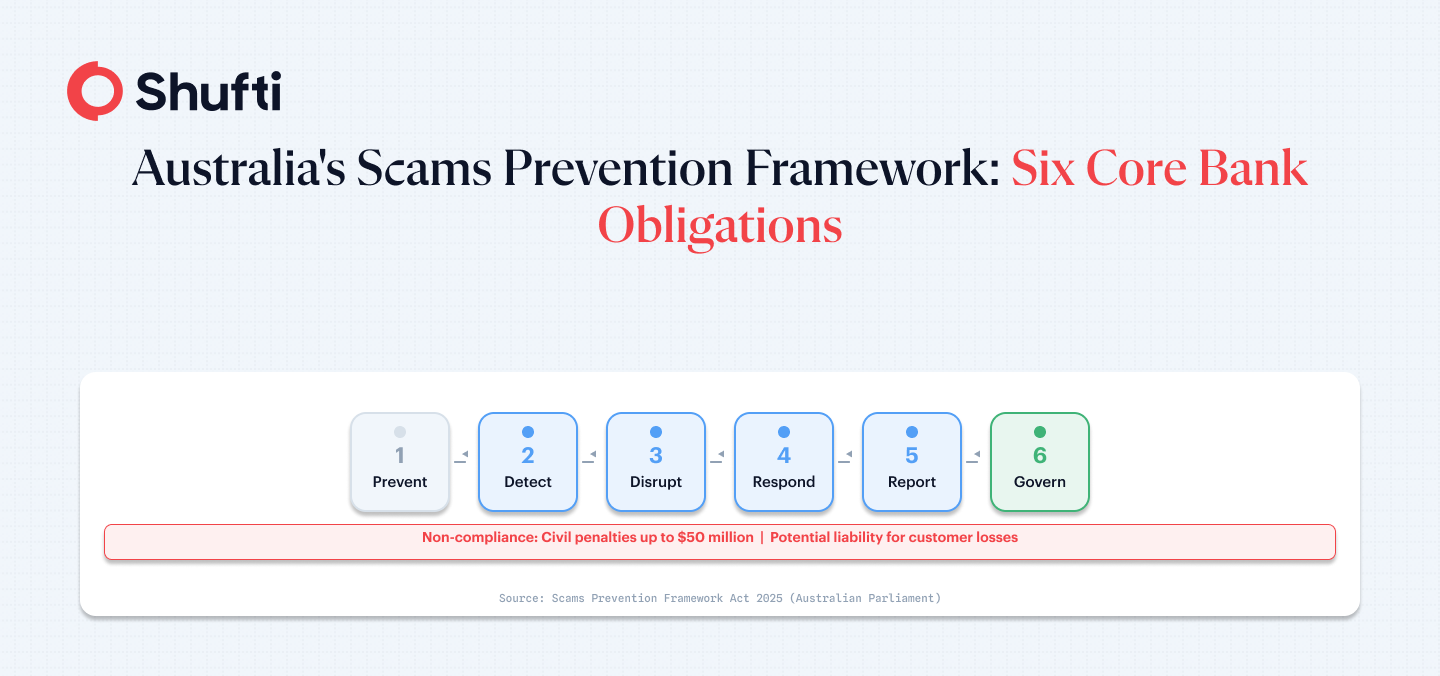
- The SPF requires banks to Prevent, Detect, Disrupt, Respond, Report, and Govern against scams, or face civil penalties up to $50 million.
- AUSTRAC requires Suspicious Matter Reports within 3 business days (24 hours for terrorism financing) and real-time, not batch, monitoring.
- The Scam-Safe Accord mandates biometric checks on new accounts and Confirmation of Payee verification, contributing to a 25.9% drop in scam losses in 2024.
- Real-time payments (PayID, NPP) and Consumer Data Right data-sharing remove the time window banks previously had to catch fraud before funds move.
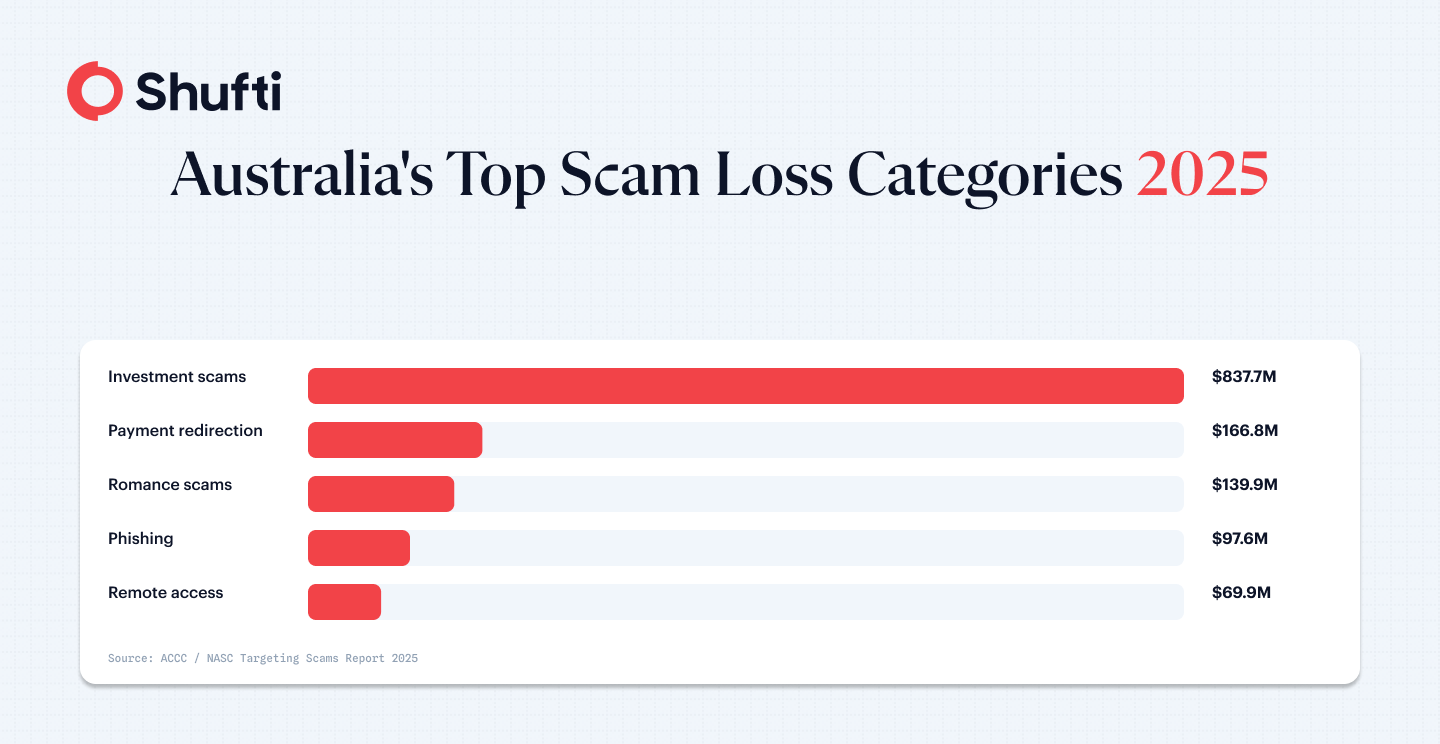
Australians lost $2.18 billion to scams in 2025, a 7.8% rise on the year before despite growing industry investment in controls across the banking sector. Investment fraud led to $837.7 million. Payment redirection scams added $166.8 million. AI-powered deepfakes now appear in the majority of high-impact fraud attempts targeting financial services customers.
Three regulatory frameworks are converging simultaneously. The Scams Prevention Framework (SPF) Act 2025 came into effect in February. AUSTRAC’s reformed Anti-Money Laundering and Counter-Terrorism Financing (AML/CTF) regime phased in from March 2026. The ABA Scam-Safe Accord established industry commitments that now define the market baseline for responsible banking fraud prevention in Australia.
Compliance teams are also managing real-time payment fraud from PayID and the New Payments Platform (NPP), plus new data-sharing fraud surfaces from the Consumer Data Right (CDR). This article maps each obligation to its fraud prevention implications and identifies where fraud prevention best practices in Australia tend to break down under operational pressure.
What Fraud Risks Are Australian Banks Facing in 2026?
The National Anti-Scam Centre recorded 481,523 scam reports across all channels in 2025. Older Australians (65 and above) absorbed 26.5% of total losses despite representing 17.1% of the population, a pattern regulators attribute to systemic control failures rather than individual lapses.
About 27% of Australians reported witnessing a deepfake scam in the past 12 months, which makes up around one in four Australians. AI-generated voices are now used to mimic relationship managers. Deepfake video calls impersonate senior executives. Payment redirection emails arrive with near-perfect brand replication. Financial fraud prevention in Australia is no longer addressable through rule-based batch processing designed for multi-day settlement. For compliance teams, the challenge has shifted from detecting catalogued fraud types to building systems that can catch attack patterns that have not been seen before. Fraud prevention in Australian institutions now requires continuous, adaptive controls rather than periodic policy reviews.
The Scams Prevention Framework Act 2025: What Banks Must Do Now
The SPF passed the Federal Parliament on 13 February 2025 and took legal effect on 21 February. Banks are the first sector formally designated under the framework, reflecting where regulators assess harm to be most concentrated.
The legislation names six obligations. On prevention and detection, banks must deploy technology controls that block scam transactions before settlement and run real-time monitoring rather than end-of-day batch review. The disruption obligation goes further. Banks must take active steps to interrupt a suspected scam transaction even when the customer has authorized the payment, reversing the long-held assumption that authorized transfers rest solely with the customer.
On the consumer side, response obligations require a 24/7 scam reporting channel with acknowledgement within 24 hours. Banks must also report actionable scam intelligence to regulators and industry networks and maintain a documented governance framework that covers anti-scam strategy and board-level oversight.
Banks that fail to demonstrate Australian fraud compliance with these obligations face civil penalties of up to $50 million.
On consumer liability, Australia’s approach differs from the UK’s Payment Systems Regulator, which mandates reimbursement for authorized push payment fraud victims up to £85,000 regardless of fault. Under Australia’s SPF, a bank that can evidence it met all six obligations has a strong defense against consumer loss claims. One that cannot be directly exposed.
What Does AUSTRAC’s AML/CTF Reform Require from Banks?
The Australian Transaction Reports and Analysis Centre (AUSTRAC) administers Australia’s AML/CTF regime. Its role in fraud risk management across Australia extends beyond financial crime specifically. The suspicious matter report (SMR) infrastructure it operates to surface patterns that connect individual fraud incidents to organized crime networks spanning multiple institutions.
Banks must submit an SMR within three business days of forming a reasonable suspicion, or within 24 hours when terrorism financing is implicated. AUSTRAC processes over 200 million transaction reports annually and has recorded a 258% increase in SMRs since 2017.
It has also separately flagged that the proportion of banks actively submitting suspicious matter reports remains too low, meaning a material share of detectable fraud activity goes unreported.
The reformed AML/CTF regime commenced on 31 March 2026 for existing reporting entities. The new Customer Due Diligence framework replaces the prior Applicable Customer Identification Procedures (ACIP), with a three-year transition running to 30 March 2029. From 1 July 2026, tranche 2 entities, including legal, accounting, and real estate firms, come under mandatory AML/CTF obligations for the first time.
AUSTRAC’s published regulatory priorities for 2025-26 explicitly name data quality and real-time monitoring as active supervisory focus areas. Australia fraud detection solutions built on legacy batch identification procedures will not satisfy what AUSTRAC expects from institutions under active supervision.
ABA Scam-Safe Accord: What Australian Banks Have Already Committed To
The Scam-Safe Accord, signed by all Australian Banking Association (ABA) and Customer Owned Banking Association (COBA) member institutions, combines financial investment, technical controls, and sector-wide intelligence sharing into a single industry commitment.
At its center is a $100 million investment in a national Confirmation of Payee system that verifies payment recipients against account holders before funds move, targeting payment redirection fraud at the moment it most commonly succeeds.
The biometric mandate adds a direct line of defense against synthetic identity fraud. From 2024, every new online account opening requires at least one biometric check. Fraudsters constructing fake personas to open mule accounts cannot pass biometric verification against genuine identity documents, which removes the path they rely on to enter the banking system undetected.
All members must also join the Australian Financial Crimes Exchange (AFCX) and the Automated Fraud Reporting Exchange (FRX), enabling real-time intelligence sharing across the sector. Mule accounts that migrate between institutions as each bank identifies and closes them no longer have that escape route.
During 2024, the first full year under the Accord, Australia recorded a 25.9% reduction in scam losses. Banking fraud prevention in Australia grounded in these commitments is producing measurable results.
PayID, the NPP, and the Real-Time Fraud Risks Banks Must Address
The New Payments Platform (NPP) delivers 24/7 real-time settlement across the Australian banking system. Traditional multi-day transfers gave risk teams up to 48 hours to identify suspicious activity and intervene before funds cleared. Real-time payments remove that window entirely, making fraud detection and disruption requirements simultaneous rather than sequential.
PayID enumeration and social engineering
PayID allows account lookup by mobile number or email address. Fraudsters exploit this through bulk enumeration attacks, systematically querying the system to collect account holder names for targeted social engineering campaigns. AUSTRAC expects NPP participants to implement real-time monitoring and SMR practices specifically calibrated to the speed and finality of NPP transactions, rather than adapting controls built for batch settlement.
Consumer Data Right as a fraud attack surface
The CDR’s action initiation capabilities, extended to non-bank lenders in March 2025, allow accredited third parties to initiate payments on behalf of customers. When a CDR intermediary initiates an action, the data-holding bank loses visibility of the device metadata, IP address, and transaction timing signals it normally uses for fraud scoring. Fraud prevention strategies for Australian CDR participants need compensating controls that preserve risk signal continuity across the data-sharing boundary so that the bank’s fraud detection posture does not degrade when a third party acts on the customer’s behalf.
How Shufti helps Australian banks meet fraud compliance requirements
Australian compliance teams face a coordination challenge that single-point tools cannot resolve. Three frameworks with overlapping requirements and different enforcement timelines demand a unified approach. Shufti’s fraud prevention and AML screening capabilities are built for exactly this architecture.
Shufti’s AML Screening draws on 100,000+ data sources, 3,500+ global watchlists, 2.6 million PEP profiles, and 215+ sanction regimes, with data refreshed every 15 minutes. A 15-minute data refresh cycle gives AUSTRAC-regulated institutions the real-time monitoring posture the 2026 reform demands.
Document verification and face verification with iBeta-certified liveness detection address the Scam-Safe Accord’s biometric requirement for every new account opening.
Shufti’s fraud prevention solutions are configurable by channel and customer risk segment, letting compliance teams tune controls without engineering intervention.
If your institution is managing SPF, AUSTRAC, and Scam-Safe Accord obligations at the same time, book a demo to see how Shufti fits your compliance stack.
Frequently Asked Questions
What are the key fraud trends for Australian financial institutions in 2026?
AI-powered deepfakes, authorised push payment fraud, and real-time account takeover attacks dominate the 2026 threat picture. Australians lost $2.18 billion to scams in 2025, with investment fraud ($837.7 million) and payment redirection ($166.8 million) among the costliest categories.
How does Australia's scams prevention framework work?
The SPF, passed 13 February 2025, imposes six obligations on designated banks: Prevent, Detect, Disrupt, Respond, Report, and Govern. Banks that cannot demonstrate compliance face penalties up to $50 million and potential liability for customer losses.
What is AUSTRAC's role in fraud and AML compliance?
AUSTRAC administers Australia's AML/CTF regime and processes over 200 million transaction reports annually. Banks must file Suspicious Matter Reports within three business days of forming a suspicion, or within 24 hours when terrorism financing is involved.
How does PayID affect fraud risk in Australia?
PayID's real-time payment capability eliminates the 48-hour window banks previously used to intercept suspicious transfers. Bulk enumeration attacks using PayID lookups also enable fraudsters to harvest account holder names for targeted social engineering campaigns.
What are Australian banks required to do under the ABA Scam-Safe Accord?
Banks must invest in a Confirmation of Payee system, require biometric checks for new online account openings, join AFCX and FRX intelligence networks, apply warnings on high-risk transactions, limit payments to high-risk channels, and maintain a documented anti-scam strategy.