AMLR Solutions
  AMLR Consultation
 EUDI Wallet
 Onboarding
 Ongoing Monitoring
 FRAML
FRAML KYC
KYC KYB
KYB KYI
KYI Age Assurance
 Workforce IAM
 Candidate Verification
 Account Takeover
 Bonus/ Promotion Abuse
 Chargeback Fraud
 Deepfake
 Document Fraud
 Fraud Networks
 Impersonation Fraud
 Money Mule Activity
 Multi-Accounting
 Party Fraud
 Regulatory & Compliance Risks
 Synthetic Identity Fraud
 Adult Content
 Banking
 Crypto
 Fintech
 Forex
Forex Compliance
 Fraud prevention
 Trust & safety
 Global expansion
 Compliance Officers
 Developers
 Fraud Analysts
 Product Managers
 Journey Builder
  Global Trust Platform
 Customer Profiles
 Vendor Comparison
 IDV Case Management
 AML Case Management
 Regulatory Reporting
 Agentic Rule Builder
  AI Compliance Co-Pilot
  Fraud Analytics
 Fraud Hub
  OCR
OCR Shufti AI
 Bank Account Verification
  Biometric Duplication
 Database Checks
 Document Intelligence
 Government ID
 Mobile Driver's License
 NFC
NFC Selfie Liveness
 Brand Personalisation
 Deployment Options
 Identity Methods
 IDV Modes
 Multi-tenancy
 On-Premise IDV
 Secure Capture
 Shufti MCP

















TL;DR
- Payment fraud in fintech includes account takeovers, synthetic identities, authorized push payment scams, card-not-present fraud, and chargeback abuse.
- 79% of businesses faced payment fraud attempts in 2024, and losses are projected to keep rising through 2029.
- Real-time transaction scoring, AI/ML pattern detection, and API-native fraud screening catch fraud that static rules miss.
- Effective prevention layers identity verification at onboarding with continuous behavioral monitoring and AML screening.
- PSD3/PSR and Visa’s VAMP thresholds are making fraud prevention a regulatory requirement, not just a best practice.
- Shufti connects identity verification and transaction risk scoring into one API, cutting manual reviews without increasing fraud exposure.
The 2025 AFP Payments Fraud and Control Survey found that 79% of businesses experienced attempted or actual payment fraud attacks in 2024. That figure has held at historically high levels for three consecutive years, and for fintechs specifically, the exposure is structural. As digital payment volumes grow and onboarding moves fully remote, every link in the transaction chain becomes a potential attack surface. This guide covers the fraud types hitting fintech hardest, the detection methods that work across high transaction volumes, and the compliance frameworks that make prevention a regulatory requirement, not just a risk preference.
Payment fraud in fintech refers to any unauthorized or deceptive attempt to initiate, manipulate, or reverse digital financial transactions, covering account takeovers, synthetic identity schemes, authorized push payment scams, card-not-present attacks, and chargeback abuse.
What are the most common types of payment fraud in fintech?
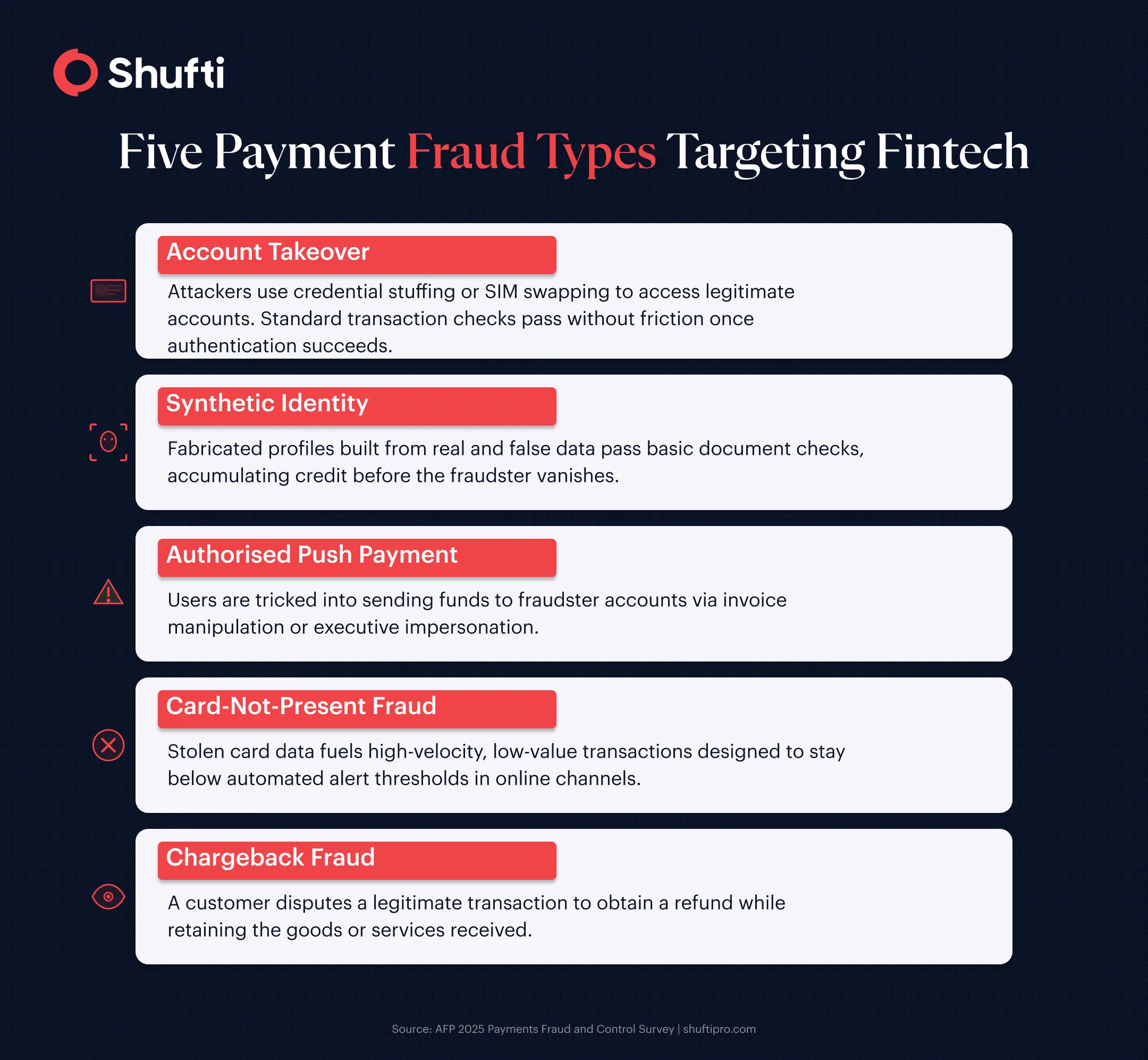
Fintech platforms process transactions at speeds and volumes that make manual fraud review impractical. Understanding the specific fraud types that target digital payment environments is the foundation for building detection controls that address real attack vectors rather than generic threats. The five types below account for the majority of fraud exposure across digital payment providers, and each demands a distinct detection and response approach.
Account takeover fraud
Account takeover (ATO) fraud occurs when an attacker gains access to a legitimate customer account through credential stuffing, phishing, or SIM swapping. Transactions initiated from the compromised account appear fully authorised, so standard transaction checks pass without friction. Velocity rules and behavioural anomaly detection are the primary controls that catch ATO after initial authentication has already succeeded.
Synthetic identity fraud
Synthetic identity fraud involves constructing a fictitious identity from a mix of real and fabricated personal data, such as a legitimate tax identifier paired with a false name, address, and date of birth. The resulting profile passes basic document checks and accumulates a balance or credit before the fraudster disappears. Detection requires cross-referencing identity signals that go beyond document validity alone, including device fingerprint, behavioural history, and biometric liveness. The deepfake detection in financial services guide covers this challenge in depth.
Authorised push payment fraud
Authorised push payment (APP) fraud tricks users into voluntarily transferring funds to accounts controlled by fraudsters, typically through invoice manipulation or executive impersonation. The Payment Services Directive 3 (PSD3), on which the European Parliament reached provisional agreement in November 2025, specifically mandates payee name verification controls to counter APP fraud, recognising it as a systemic risk rather than user error.
Card-not-present fraud
Card-not-present (CNP) fraud targets online transactions where the physical card is absent. Attackers use stolen card data to run high-velocity, low-value transactions designed to stay below automated alert thresholds. As contactless and digital wallet adoption expands, CNP attack patterns have become more sophisticated, requiring machine learning models to distinguish genuine low-value transactions from probing behaviour.
Chargeback fraud
Chargeback fraud occurs when a customer disputes a legitimate transaction to obtain a refund while retaining the goods or services received. Visa’s updated Acquirer Monitoring Programme (VAMP), effective April 2025, tightened enforcement thresholds from 1.5% to 0.9% by January 2026
How do fintech companies detect fraudulent transactions?
Effective detection rests on evaluating transaction context in real time, identifying behavioural anomalies at the account level, and using machine learning to surface patterns that rule-based systems miss. The right payment fraud detection software integrates all three into a single risk-scoring pipeline, so fintech companies that prevent payment fraud online work from a unified data picture rather than disconnected vendor outputs.
Real-time payment fraud detection
Real-time payment fraud detection evaluates each transaction in milliseconds before authorisation, scoring risk across signals including device fingerprint, IP geolocation, transaction velocity, amount relative to account history, and payee risk profile. Static rule-based systems can block obvious outliers but generate false positives in high-volume environments, adding friction for legitimate customers. A system that scores risk continuously rather than applying binary pass-fail rules reduces both fraud losses and customer abandonment at checkout.
AI fraud detection in fintech
Machine learning models trained on historical transaction data identify fraud patterns that evolve faster than manual rules can track. J.P. Morgan’s analysis of AI-enabled fraud detection shows AI integration improving detection accuracy and cutting false-positive rates across payment workflows. For fintechs processing millions of transactions monthly, deploying AI fraud detection in fintech environments enables risk scoring at a granularity and speed that rule engines alone cannot match, particularly for emerging attack patterns like APP fraud and synthetic identity clusters.
Fraud detection API for payments
A fraud detection API for payments integrates directly into the transaction authorisation flow, assessing each payment before it clears. API-native architectures allow fintechs to embed transaction screening and identity risk signals at the point of payment rather than in a post-authorisation batch review. For mobile payment applications and embedded finance platforms, API-first fraud prevention also means faster deployment and cleaner data pipelines compared to on-premises systems that require custom integration work.
Payment fraud prevention strategies every fintech needs
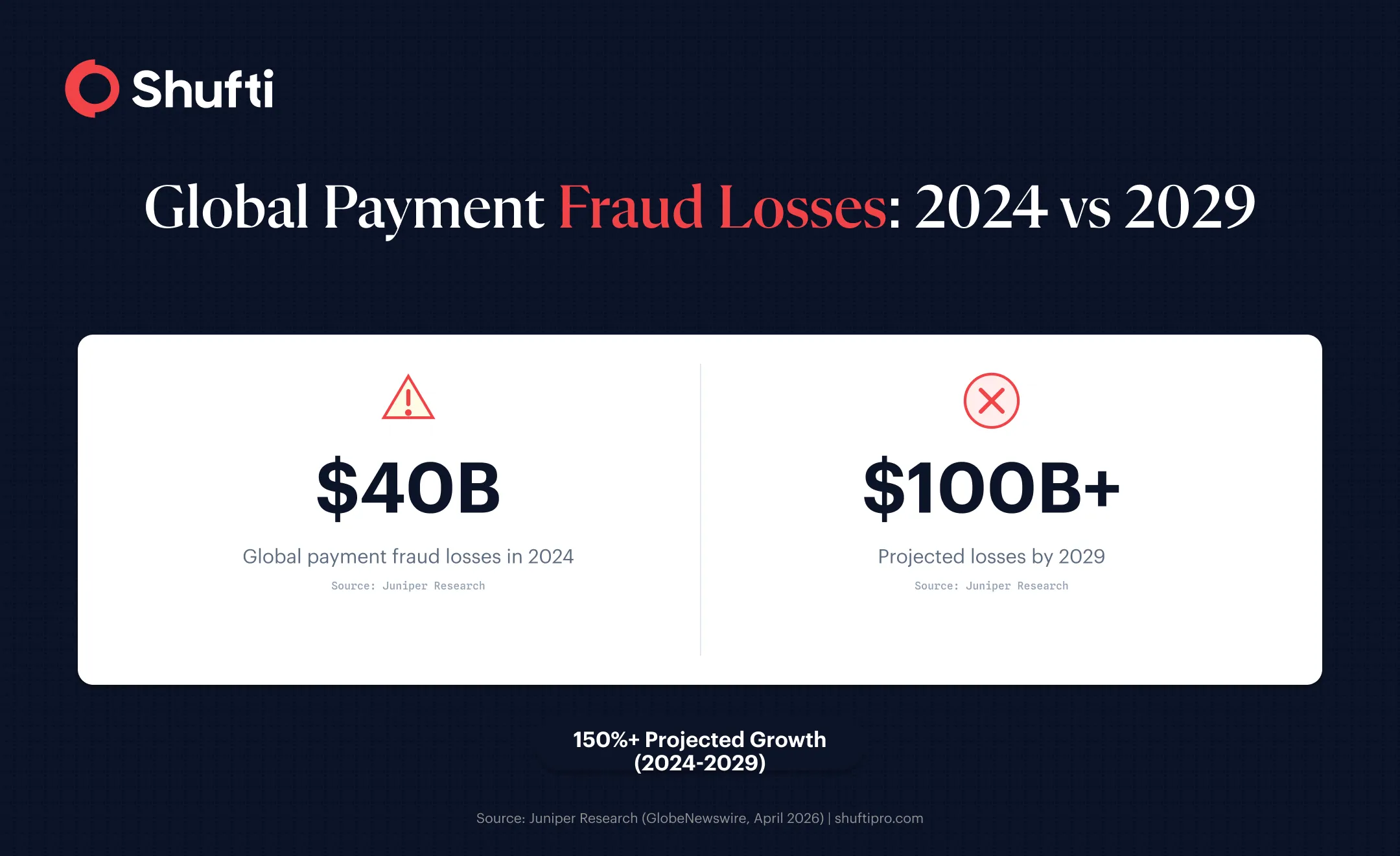
Prevention requires a layered approach, stopping fraud at onboarding, screening transactions in real time, and maintaining continuous monitoring after authorisation. Payment fraud prevention tools that deliver consistent results are designed to work together across the full customer lifecycle, not in isolation at individual touchpoints. Juniper Research projects global online payment fraud losses will exceed $362 billion over the next five years, reinforcing why a fragmented stack creates unacceptable exposure.
Identity verification at onboarding
Most payment fraud begins with a compromised or fabricated identity. Identity verification and user risk assessment at account opening, including biometric liveness checks and document validation, eliminate a large share of synthetic identity accounts before they can reach the transaction layer. Financial Action Task Force (FATF) Recommendations require customer due diligence (CDD) as a prerequisite to enabling payment functionality, and PSD3 extends that obligation to all payment service providers operating in the EU. For a deeper view of how identity controls connect to AML obligations across fintech, see the KYC and AML for fintech guide.
Behavioral analytics and ongoing monitoring
Transaction monitoring in fintech works best when it models account-level behaviour over time rather than evaluating individual transactions in isolation. Behavioural analytics tracks spending patterns, login frequency, device changes, and payee relationships, surfacing account anomalies that single-transaction rules miss. AML screening integrated alongside transaction monitoring adds a compliance dimension, flagging politically exposed persons (PEPs) and sanctioned counterparties that appear in the payment flow after onboarding.
Building on fintech fraud prevention solutions
Effective fintech fraud prevention solutions are modular by design. They connect onboarding identity checks, transaction risk scoring, AML watchlist screening, and chargeback management into a coherent risk architecture. Payment fraud prevention tools that operate in silos create blind spots. An attacker who passes onboarding can exploit weak post-approval transaction monitoring fintech controls. A stack audit that spans the full customer lifecycle, from account creation through ongoing transaction monitoring, is how risk teams find the gaps before fraudsters do.
How Shufti helps fintechs prevent payment fraud
Fintechs typically discover a fraud problem in one of two places. It shows up in excess chargebacks, or it shows up in AML flags firing on accounts that passed onboarding cleanly. Both signal the same structural gap. Identity verification and transaction risk are running as separate systems with no shared context between them.
Shufti’s fraud prevention platform connects identity signals from account opening directly into transaction-level risk scoring through a single API. When a returning user initiates a high-value transfer, the system cross-references their verified identity profile, device history, and behavioural baseline simultaneously rather than running each check in sequence. Fintechs moving from fragmented point solutions to this unified architecture consistently report fewer manual reviews per thousand transactions without increasing fraud exposure. Shufti processes over 280 million identity checks annually, giving risk models a data foundation that improves detection accuracy across varied geographies and document types.
See how your onboarding and transaction risk controls connect in practice. Book a walkthrough with the Shufti team.
Frequently Asked Questions
What is payment fraud in fintech?
Payment fraud in fintech refers to any unauthorised or deceptive manipulation of digital financial transactions, including account takeovers, synthetic identity creation, and APP scams, aimed at gaining funds or evading repayment. Attack sophistication rises alongside transaction volume, making automated detection essential for scale.
How does AI help in payment fraud detection?
AI models trained on historical transaction data identify evolving fraud patterns faster than static rules. They score risk in real time across multiple signals, including velocity, device fingerprint, and behavioural baseline, reducing both fraud losses and false positives that block legitimate customers.
What is real-time payment fraud prevention?
Real-time payment fraud prevention evaluates each transaction in milliseconds before authorisation, using risk scoring models to flag anomalies without blocking legitimate payments. It differs from batch review by acting before a transaction completes, not after funds have already moved.
How do you prevent chargeback fraud in fintech?
Preventing chargeback fraud requires identity verification at account opening, transaction-level evidence capture, and dispute management aligned with card scheme thresholds. Visa VAMP sets the current standard at a 1.5% dispute ratio, dropping to 0.9% by January 2026.
What compliance is required for payment fraud prevention?
PSD3 and the Payment Services Regulation require fraud screening, payee verification, and AML controls from payment service providers. FATF Recommendations require customer due diligence and ongoing transaction monitoring for all financial institutions processing digital payments.