AMLR Solutions
  AMLR Consultation
 EUDI Wallet
 Onboarding
 Ongoing Monitoring
 FRAML
FRAML KYC
KYC KYB
KYB KYI
KYI Age Assurance
 Workforce IAM
 Candidate Verification
 Account Takeover
 Bonus/ Promotion Abuse
 Chargeback Fraud
 Deepfake
 Document Fraud
 Fraud Networks
 Impersonation Fraud
 Money Mule Activity
 Multi-Accounting
 Party Fraud
 Regulatory & Compliance Risks
 Synthetic Identity Fraud
 Adult Content
 Banking
 Crypto
 Fintech
 Forex
Forex Compliance
 Fraud prevention
 Trust & safety
 Global expansion
 Compliance Officers
 Developers
 Fraud Analysts
 Product Managers
 Journey Builder
  Global Trust Platform
 Customer Profiles
 Vendor Comparison
 IDV Case Management
 AML Case Management
 Regulatory Reporting
 Agentic Rule Builder
  AI Compliance Co-Pilot
  Fraud Analytics
 Fraud Hub
  OCR
OCR Shufti AI
 Bank Account Verification
  Biometric Duplication
 Database Checks
 Document Intelligence
 Government ID
 Mobile Driver's License
 NFC
NFC Selfie Liveness
 Brand Personalisation
 Deployment Options
 Identity Methods
 IDV Modes
 Multi-tenancy
 On-Premise IDV
 Secure Capture
 Shufti MCP












TL;DR
- A shelf company is a pre-registered, dormant entity sold later for its aged history.
- Shelf companies are legal, but that aged history is exactly what launderers pay for.
- The risk sits in inherited legitimacy, not in the company’s paperwork.
- Good KYB traces the real beneficial owner, not the registration date.
- FATF, the US CTA, UK ECCTA, and the EU AML package are all tightening ownership transparency through 2027.
In March 2022, the Financial Action Task Force (FATF) rewrote its global rules on company ownership for one reason. Criminals kept hiding behind entities that looked older, cleaner, and more established than they actually were. A shelf company is one of the cleanest ways to buy that appearance. It arrives with a registration date years in the past, a spotless filing record, and no trading history to explain away.
For a compliance analyst, this combination is a trap. An aged entity with a five-year history reads as the safe counterparty, so it often gets a lighter touch at onboarding. That instinct is exactly what a launderer is counting on. This guide explains what a shelf company is, where these entities come from, how they differ from shell companies, how they show up in money laundering, and the KYB checks that catch the risk the registration date is designed to hide.
What is a Shelf Company?
A shelf company is a business entity that was legally registered and then left dormant, sitting on a shelf, until someone buys it ready-made. The seller incorporates the company, files nothing of substance, and holds it. The buyer acquires an entity that already carries an incorporation date, a registration number, and a clean compliance record from day one. The transaction transfers the whole history along with the shares.
How is a Shelf Company Created and Sold?
Formation agents and company service providers create shelf companies in volume. They register entities with a generic name, a nominal share structure, and a registered address, then let them age on a list. When a buyer wants one, the agent transfers the shares, swaps in new directors, and updates the registered details. The buyer walks away with an entity whose paperwork suggests years of quiet existence. Nothing about that process is hidden from the registry, which is part of why it works so well as a cover.
When Shelf Companies Are Legitimate
Shelf companies are legal in most jurisdictions, and plenty of buyers use them for ordinary reasons. A founder who needs to sign a contract this week rather than wait out an incorporation queue might buy one. Some tenders, lending products, and supplier agreements require a minimum company age, and an aged entity clears that bar immediately. A business expanding into a slow-registration market may acquire a local shelf company to start operating faster.
Legality ends where intent changes. The entity itself is neutral. The formation, the sale, and the transfer of ownership are all lawful. The problem is that the same aged history a legitimate founder values is the exact asset a bad actor buys to disguise who they are and where their money came from. The document trail looks identical in both cases, which is why age alone tells a compliance team almost nothing.
Where Shelf Companies Come From and Which Markets Sell Them
Shelf companies cluster in jurisdictions where formation is cheap, fast, and light on beneficial ownership checks. The United Kingdom and several US states are established sources because incorporation is inexpensive and, until recently, required little verification of who stood behind the company. Offshore and low-transparency jurisdictions add another layer by combining ready-made entities with corporate secrecy.
The appeal for a criminal buyer is the same everywhere. A company that looks old and is registered in a well-respected country seems more trustworthy than one set up in a place known for secrecy.
A company that appears to have been quietly trading in London or a US state for four years reads very differently from one registered last month in an offshore territory, even when the underlying substance is identical. That respectability gap is the product being sold.
This is also why the registration date is such a weak signal on its own. Two entities with the same five-year history can sit at opposite ends of the risk spectrum. One belongs to a founder who bought it to move fast. The other was purchased to give illicit funds a believable home. The paperwork does not separate them. Only the ownership behind them does.
What is the Difference Between a Shelf and a Shell Company?
A shelf company and a shell company are often confused because both can lack real operations, but they are not the same thing. The core difference is age and purpose. A shelf company is bought for the history it already carries. A shell company is used for what it can move or hold now.
| Attribute | Shelf company | Shell company |
| Definition | Pre-registered entity kept dormant, then sold | Entity with little or no active operations |
| Key asset | Aged incorporation date and clean record | Anonymity and the ability to hold or route funds |
| Primary purpose | Instant company history and legitimacy | Holding assets, routing payments, layering funds |
| Age at use | Deliberately old | Any age, often newly formed |
| Main AML signal | New owner inherits an unexplained old history | No genuine business activity behind the entity |
A shell company is not automatically illegitimate, and neither is a shelf company. Many holding structures and special purpose vehicles are lawful shells. The two categories also overlap in practice. A shelf company that gets activated and used to route funds becomes a shell company in function, now carrying an aged history on top. That combination, real operational emptiness dressed in a long registration record, is the version compliance teams should worry about most. The risk in both cases reduces to the same underlying question. Who actually controls this entity, and can that be proven.
How Are Shelf Companies Used in Money Laundering?
Shelf company money laundering works by borrowing credibility. A launderer buys an aged entity, opens a corporate bank account, and presents a company that appears to have existed for years. That apparent longevity is used to justify large or sudden transfers that would draw scrutiny from a brand-new company. The dirty money is layered through a business that looks legitimate on paper.
The Aged-Legitimacy Mechanic
The aged history does three things for the criminal at once. It lowers the risk score an onboarding system assigns to the entity. It provides a cover story for account activity. It buys time before anyone questions why a long-dormant company suddenly moves significant funds. Each of those advantages comes from the registration date alone, which is why a control that leans on company age is so easy to defeat.
Activation into a Front Company
A dormant shelf company becomes dangerous the moment it is activated. Once it has a bank account and a plausible business description, it can act as a front, issuing invoices, receiving payments, and mixing illicit proceeds with what looks like ordinary revenue. Real estate is a frequent destination. FinCEN has warned that criminals use companies to buy high-value property, often with cash and no financing, then switch ownership of that property multiple times to obscure the true owner, per its advisory on real estate and money laundering. An aged entity makes that cash buyer look more established, and less like a first-time anomaly.
|
SUGGESTED READ Once activated, a shelf company often becomes a front company, trading legitimately while it launders illicit funds. What Is a Front Company? How Criminals Hide Behind Real Businesses breaks down how they operate and the KYB checks that expose them. |
Red Flags on an Aged Entity
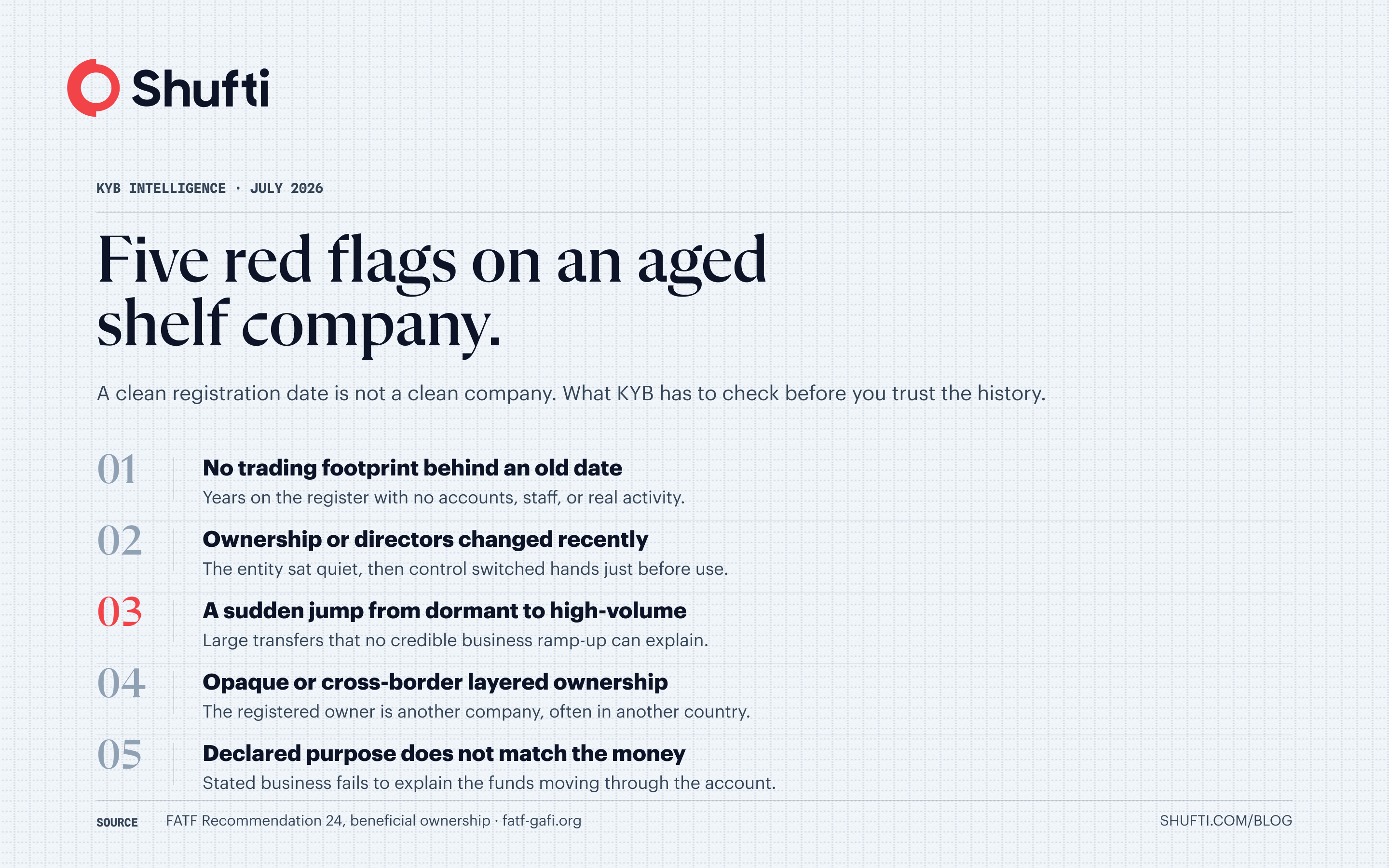
The AML risks of doing business with a shelf company cluster around a short list of red flags worth checking on any aged entity:
- A long incorporation history with no trading footprint, years on the register but no accounts, employees, or web presence.
- A recent change of ownership or directors of the entity was quiet, then control changed hands just before activity began.
- A sudden jump from dormant to high-volume, large transfers that do not match any credible business ramp-up.
- Opaque or layered ownership, the registered owner is another company, often in a different jurisdiction.
- A mismatch between stated business and actual activity, the declared purpose does not explain the money moving through the account.
None of these red flags is conclusive on its own. A genuine business can change directors or scale quickly. The signal is in the combination, an aged shell with new control and unexplained volume is the pattern enhanced due diligence exists to catch.
Which Industries Are Most Exposed to Shelf Company Risk?
Any regulated business that onboards corporate customers carries some exposure, but a few sectors sit closer to the fire. Banks and payment providers are the first stop, because a shelf company needs an account before it can move anything. Crypto exchanges face the same pressure with faster settlement and cross-border reach. Real estate, as FinCEN has documented, is a preferred laundering destination because property absorbs large sums and changes hands quietly.
Professional services firms, corporate service providers, and fintech platforms that offer business accounts also carry the risk, often without the mature compliance teams that banks maintain. For all of them, the exposure is the same in shape. A corporate customer arrives looking established, and the onboarding decision rests on whether the business can see past the paperwork to the person in control. That is a know your business (KYB) problem, not a document problem.
What KYB Checks Should be Done on a Shelf Company?
Effective shelf company verification ignores the registration date and focuses on who controls the entity today. The age of a company is not a risk signal on its own. The gap between that age and everything else about the entity is where the risk lives. Solid KYB checks close that gap across four moves.
Trace Beneficial Ownership to a Real Person
Corporate records name a director and a registered owner, but neither is necessarily the beneficial owner. A proper KYB check traces ownership through every layer of the structure until it lands on the natural persons who ultimately control the company, then screens each of them. If the trail stops at another company in another jurisdiction, that is a finding, not a dead end. Ownership that dissolves into cross-border layers is one of the strongest signals that an entity was structured to hide someone.
Check the Dormancy-to-Activity Gap
Pull the entity’s filing history and compare it against current activity. A company that filed nothing for four years and then took on a new director and a corporate bank account in the same month deserves enhanced due diligence. The pattern, not the age, is the trigger. A long quiet period followed by sudden activation is the operational fingerprint of a shelf company coming off the shelf.
Screen the Entity and Its Owners Against Watchlists
Run the company and every beneficial owner through sanctions, politically exposed person (PEP), and adverse media screening. No single shelf company checker or public registry lookup replaces this. A registry confirms the company exists. Layered AML screening confirms whether it, and the people behind it, should be trusted. Adverse media in particular often surfaces the history that a clean registration record hides.
Monitor After Onboarding, Not Just At The Gate
Verification at onboarding is a snapshot. A shelf company that passes an initial check can be activated weeks later, and ownership can change again after the account is open. Ongoing monitoring watches for the dormant-to-active jump, new directors, and transaction patterns that break from the declared business. Treating KYB as a one-time event is how activated shelf companies slip through after the fact.
How Can You Verify The Legitimacy Of A Shelf Company?
Verifying the legitimacy of a shelf company means confirming three things at once. First, that the entity is real and registered where it claims to be. Second, that the natural persons behind it can be identified and cleared against watchlists. Third, that the entity’s declared purpose matches its actual and intended activity. A registry check answers only the first. The other two require ownership tracing and screening layered on top.
There is no shortcut that a single lookup provides. Marketing for a shelf company checker can imply that one search settles the question of legitimacy, but a search that returns a registration number and an incorporation date has confirmed existence, not trustworthiness. Legitimacy is a judgment built from several data sources, the registry record, the ownership trace, watchlist and adverse media results, and the consistency of the business story. When those sources agree, you have a defensible decision. When they conflict, you have your answer about where to apply enhanced due diligence.
How Regulators Identify Fraudulent Shelf Company Activity
Regulators have moved the burden of transparency onto the point of registration and onboarding. The common thread across the frameworks below is beneficial ownership. Each one is designed to make the person behind an entity visible, which is the exact thing a shelf company is used to obscure.
| Framework | Region | What changed | Status |
| FATF Recommendation 24 | Global standard | Tougher beneficial-ownership rules for legal persons | Revised March 2022 |
| US Corporate Transparency Act | United States | BOI reporting, later narrowed to foreign entities only | Effective 2024, scope cut March 2025 |
| UK ECCTA identity verification | United Kingdom | Mandatory ID checks for directors and PSCs | Live from 18 Nov 2025 |
| EU AML package (6AMLD, AMLR, AMLA) | European Union | Interconnected UBO registers, lower ownership threshold | Adopted 2024, applies from 2027 |
FATF Sets the Global Baseline
The FATF revised Recommendation 24 in March 2022, requiring countries to hold adequate, accurate, and up-to-date beneficial ownership information on legal persons, per the FATF. That standard pushes the world toward central registers and away from the anonymity that shelf companies rely on.
The US Pulled Back in 2025
The United States moved the opposite way. The Corporate Transparency Act took effect in January 2024, but a March 2025 interim final rule removed almost all domestic entities from beneficial ownership reporting, leaving only foreign-registered companies in scope, according to the US Government Accountability Office. For compliance teams, that reversal widens the gap a US-registered shelf company can slip through, and it puts more of the detection burden back on private onboarding.
The UK and EU Tightened
The United Kingdom made identity verification for directors and persons of significant control mandatory from 18 November 2025 under the Economic Crime and Corporate Transparency Act, with fines up to £5,000. The European Union adopted its AML package in 2024, introducing interconnected beneficial ownership registers and lowering the ownership identification threshold to 25 percent or more, with the Anti-Money Laundering Regulation applying from 2027, per DLA Piper. The takeaway for compliance teams is that rules now differ sharply by region, so your own KYB has to be the backstop that holds regardless of where an entity was formed.
How Shufti Helps Compliance Teams Verify Shelf Companies
The aged shelf company is a hard case because the surface record is clean by design. The registration date checks out, the filings are in order, and the real question, who controls this entity, sits several layers down where a standard registry lookup never reaches.
Shufti’s business verification traces corporate structure through those layers to the natural persons behind the company, then runs each beneficial owner through sanctions, PEP, and adverse media screening in one flow. Registry coverage spans 220+ jurisdictions, so the trace holds up even when ownership crosses borders, which is where shelf company structures usually try to disappear. The check that takes an analyst hours per high-risk file lands in minutes, with the same fraud prevention signals watching for the dormant-to-active jump after onboarding.
See how Shufti maps beneficial ownership on your real onboarding files, not a demo dataset book a 20-minute walkthrough.
Frequently Asked Questions
Are Shelf Companies Legal?
Yes. Registering a company, holding it dormant, and selling it are all lawful in most jurisdictions. The legality breaks down only when the aged entity is used to disguise ownership, launder funds, or misrepresent a business. The structure is neutral. The intent is what matters.
What is the Difference Between a Shelf Company and a Shell Company?
A shelf company is bought for its aged registration history and clean record. A shell company is used for what it holds or moves now, regardless of age. Both can be lawful. Both raise the same core KYB question of who ultimately controls the entity, and an activated shelf company can become a shell company in function.
Is There a Shelf Company Checker that Confirms Legitimacy?
No single tool settles it. A public registry confirms the company exists and shows its filing history, but it does not reveal the true beneficial owner or screen for risk. Real shelf company verification layers ownership tracing, watchlist screening, and activity analysis on top of the registry record.
What Are the AML Risks of Doing Business With a Shelf Company?
The main risk is inherited legitimacy. An aged entity with a recent change of ownership and a sudden jump in activity can be used to layer illicit funds through what looks like an established business. Enhanced due diligence on beneficial ownership and account activity is the control that manages that risk.
How do Regulators Detect Fraudulent Shelf Company Activity?
Regulators rely on beneficial ownership transparency. FATF Recommendation 24, the UK ECCTA identity verification regime, and the EU AML package all push entities to disclose the natural persons behind them. Where registration rules are weak, as they became in the US in 2025, detection shifts onto the KYB checks that banks and other obligated entities run at onboarding.