AMLR Solutions
  AMLR Consultation
 EUDI Wallet
 Onboarding
 Ongoing Monitoring
 FRAML
FRAML KYC
KYC KYB
KYB KYI
KYI Age Assurance
 Workforce IAM
 Candidate Verification
 Account Takeover
 Bonus/ Promotion Abuse
 Chargeback Fraud
 Deepfake
 Document Fraud
 Fraud Networks
 Impersonation Fraud
 Money Mule Activity
 Multi-Accounting
 Party Fraud
 Regulatory & Compliance Risks
 Synthetic Identity Fraud
 Adult Content
 Banking
 Crypto
 Fintech
 Forex
Forex Compliance
 Fraud prevention
 Trust & safety
 Global expansion
 Compliance Officers
 Developers
 Fraud Analysts
 Product Managers
 Journey Builder
  Global Trust Platform
 Customer Profiles
 Vendor Comparison
 IDV Case Management
 AML Case Management
 Regulatory Reporting
 Agentic Rule Builder
  AI Compliance Co-Pilot
  Fraud Analytics
 Fraud Hub
  OCR
OCR Shufti AI
 Bank Account Verification
  Biometric Duplication
 Database Checks
 Document Intelligence
 Government ID
 Mobile Driver's License
 NFC
NFC Selfie Liveness
 Brand Personalisation
 Deployment Options
 Identity Methods
 IDV Modes
 Multi-tenancy
 On-Premise IDV
 Secure Capture
 Shufti MCP














TL;DR
- Detection accuracy alone can’t carry deepfake defence through onboarding anymore.
- Generative AI deepfakes have no “original” to forensically compare against, so the tell moved from visible tampering to frequency-domain signals.
- The attack surface moved from the face itself to the injection path (virtual cameras, stream substitution) and to documents.
- A detection score alone decays fast and isn’t evidence: five separate instruments (EU AI Act Art. 50, the voluntary AI-content transparency Code, GDPR Art. 22, BaFin Circular 3/2017, FinCEN alerts) now dictate what a compliant detection stack must produce beyond a probability score.
- The fix is three layers working together: capture integrity, media forensics, an evidence layer that logs signals, thresholds, and reviewer decisions so a block is defensible under audit.
- Onboarding risk shows up three ways: industrial-scale origination fraud (up to 20%+ at some firms vs. ~1% historical benchmark), remediation costs that dwarf the fraud loss itself (case example: $500K+ cleanup on $250K in fraudulent salaries), and GDPR Art. 22 exposure from over-aggressive automated rejection.
- Six controls are recommended, ordered by ROI: test injection resistance first, require independent liveness certification (iBeta Level 3/ISO 30107-3), extend detection to documents, log full decisions not just outcomes, design deliberate human review, and periodically rescreen high-risk cohorts.
Detection accuracy alone will not hold onboarding against generative AI deepfakes. See how EU AI Act duties, evidence rules and layered technical controls have to work as one.
The FBI’s 2025 Internet Crime Report published in April 2026, carries a section on artificial intelligence for the first time in the report’s roughly 25-year history. That section holds 22,364 complaints and almost $893 million in losses. The Bureau’s summary of what criminals actually deployed names fake social profiles, voice clones, identification documents, and believable videos of public figures and loved ones. Three of those four are things a person looks at and doubts. The fourth is a thing your onboarding flow reads and accepts, which is where a generative AI deepfake stops being a media story and becomes a control failure with a paper trail attached.
How do generative AI deepfakes differ from other types of deepfake content?
A generative AI deepfake is synthesised rather than edited, which removes the source recording that older forensic methods treated as ground truth. Earlier fakes were manipulations of something real, so an analyst could hunt for the seams where the original ended and the edit began. A diffusion or transformer model produces every pixel and every audio frame from a prompt, and there is no untouched original underneath for comparison.
Older fakes edited a real recording, generative models build one
The practical consequence is that just finding the tampering had stopped being a viable strategy. Compression artefacts, mismatched noise floors, and cloning residue all assume an edit boundary exists. Generative output has no boundary, so the tells move somewhere else entirely, which is the frequency-domain behaviour and statistical regularities that a human reviewer cannot see. Shufti’s product team has been openly talking about the human limit here. In an internal-facing session, the VP of Product Tom Gadsden noted that people score roughly 50/50 on “AI or not” tests, and that detection models therefore look at how the frequency spectra break down and at signals outside the visible spectrum, because that is where a generative model stopped trying.
The attack moved from the face to the feed
The second difference is where the attack lands. A convincing synthetic face is worthless until it reaches the verification session, and it has to get there somehow. Gadsden describes the step plainly, which is that the attacker has to take the digital asset and ship it into the physical world, either by holding a phone up to the camera or by injecting the stream through a virtual camera. That second path is the one that scales, and it is the reason a face-quality check can be excellent and still be irrelevant.
Regulators have started describing this in their own language also. The Financial Crimes Enforcement Network (FinCEN) lists, among its red flags, a customer using a third-party webcam plugin during a live verification check. That is a compliance-desk description of an injection attack, and it tells you the supervisory expectation has already moved past face analysis.
Documents are the fastest-growing surface
Most teams still treat deepfake generative AI as a video problem, and the data says otherwise. The Identity Fraud Index Report 2026 puts document deepfakes at 11.9% of the 2025 AI-fraud mix but projects them to grow nearly 3,892% year on year in 2026, the fastest-moving category in the set. A stack tuned entirely to the selfie will therefore be tested hardest at the document verification, where a synthetic passport page carries no face to analyse at all.
The tooling is not exotic, either. A search for deepfake generative AI online returns hosted face-swap and video-generation services that run in a browser on a consumer subscription, which is why attack volume tracks the price of the tools rather than the skill of the attacker.
Why “buy a better detector” is the wrong answer?
Buying accuracy solves a temporary problem, but the durable one remains the same, untouched. The detection quality matters, and a weak model is indefensible, but a detector improves your odds on a single frame while the obligations that are attached to that frame keep expanding. Two things break when the detector is treated as the whole answer.
A detection score decays between model releases
Every detector is trained against the generators that existed when it was built, so its measured accuracy has a shelf life set by someone else’s release schedule. Gartner’s analyst note alongside the 2026 prediction made the same point structurally, observing that presentation attacks were the most common vector but that injection attacks rose 200% in 2023, and that existing testing standards did not cover digital injection attacks using AI-generated deepfakes. A number that was true at procurement is not a number you can quote to an examiner three generator releases later.
There is a sharper version of this from the compliance side. Thees Buschmann, a DACH lawyer and money laundering reporting officer speaking on a Shufti panel, argued that current solutions are suitable mainly for catching petty fraudsters, because sophisticated actors have patience, develop new methods, and can simply buy the same detection tools to rehearse their attacks in private. His conclusion is the one that should worry a risk committee, which is that you often only clear this up in the rear view.
A score is not a decision, and a decision is not evidence
This is an important aspect to understand. When a model returns a probability, a policy turns that probability into an accept, reject, or review, and a regulator later asks you to justify the outcome for one specific customer on one specific date. Those are three different artefacts, and most deepfake tooling produces only the first. The Financial Action Task Force (FATF) reached the same place in its Horizon Scan on AI and Deepfakes, which was published in December 2025, which warns that deepfakes can circumvent anti-money laundering controls and customer due diligence measures in particular, and which recommends human validation alongside the technology plus documentation prepared for examination scrutiny. FATF is not asking for a better score. It is asking for a file.
What legal obligations now shape generative AI deepfake detection?
Five instruments now decide what your detection stack has to produce, and none of them is a detection standard. They constrain disclosure, automation, human involvement, and record-keeping, which means a technically excellent control can still be non-compliant, and a compliant process can still be technically weak.
| Obligation | What it requires | What it forces in your detection stack |
| EU AI Act, Article 50 (applies from 2 August 2026) | Providers must apply machine–readable markings for certain AI- generated content, and deployers must disclose certain AI-generated/manipulated content. | Provenance signals become an input you are expected to read, not just an artefact you might find |
| Code of Practice on Transparency of AI-generated Content (published 10 June 2026, voluntary) | Voluntary Guidance on effective, interoperable marking and labelling methods supporting AI Act transparency obligations. | Marking approaches need documented justification where alternative methods are used. |
| GDPR, Article 22 | Limits solely automated decisions producing legal or similarly significant effects. | Automated deepfake rejection may require lawful basis, safeguards and human review mechanisms |
| BaFin Circular 3/2017 (GW) (in force 15 June 2017) | Requires compliant video identification procedures performed by trained personnel under controlled outsourcing arrangements | AI can support detection, but regulated human identification responsibility remains |
| FinCEN Alert FIN-2024-Alert004 (13 November 2024) | Highlights identity verification red flags including suspicious technology use and inconsistent device/location signals | Session telemetry becomes a fraud-risk indicator contributing to investigation and SAR assessment |
The German rule is the clearest illustration of the tension, and it is worth stating without spin. Buschmann’s reading is that regulation requires a human being on the other side of the video to make the ultimate decision, that technology detects fraud in ways humans cannot and cannot be talked around by a plausible story, and that regulation nonetheless limits itself here. Both halves of that are true at once. Your model may be the better detector, and you are still not permitted to let it decide alone.
The law is also visibly behind the threat in places. Buschmann’s other observation is that the risk logic applied to politically exposed persons, which is that public data makes a person easier to target, now applies just as well to influencers and media personalities who publish hours of high-quality voice, movement, and facial footage, and that those people sit outside the frameworks entirely. Denmark has moved to close part of that gap through a proposed amendment to its Copyright Act covering realistic AI imitations of personal characteristics, which was still a draft open for comment when the European Parliament Research Service briefed on it in early 2026. Treat it as a signal of direction rather than a rule you can rely on today.
How can generative AI deepfakes be detected?
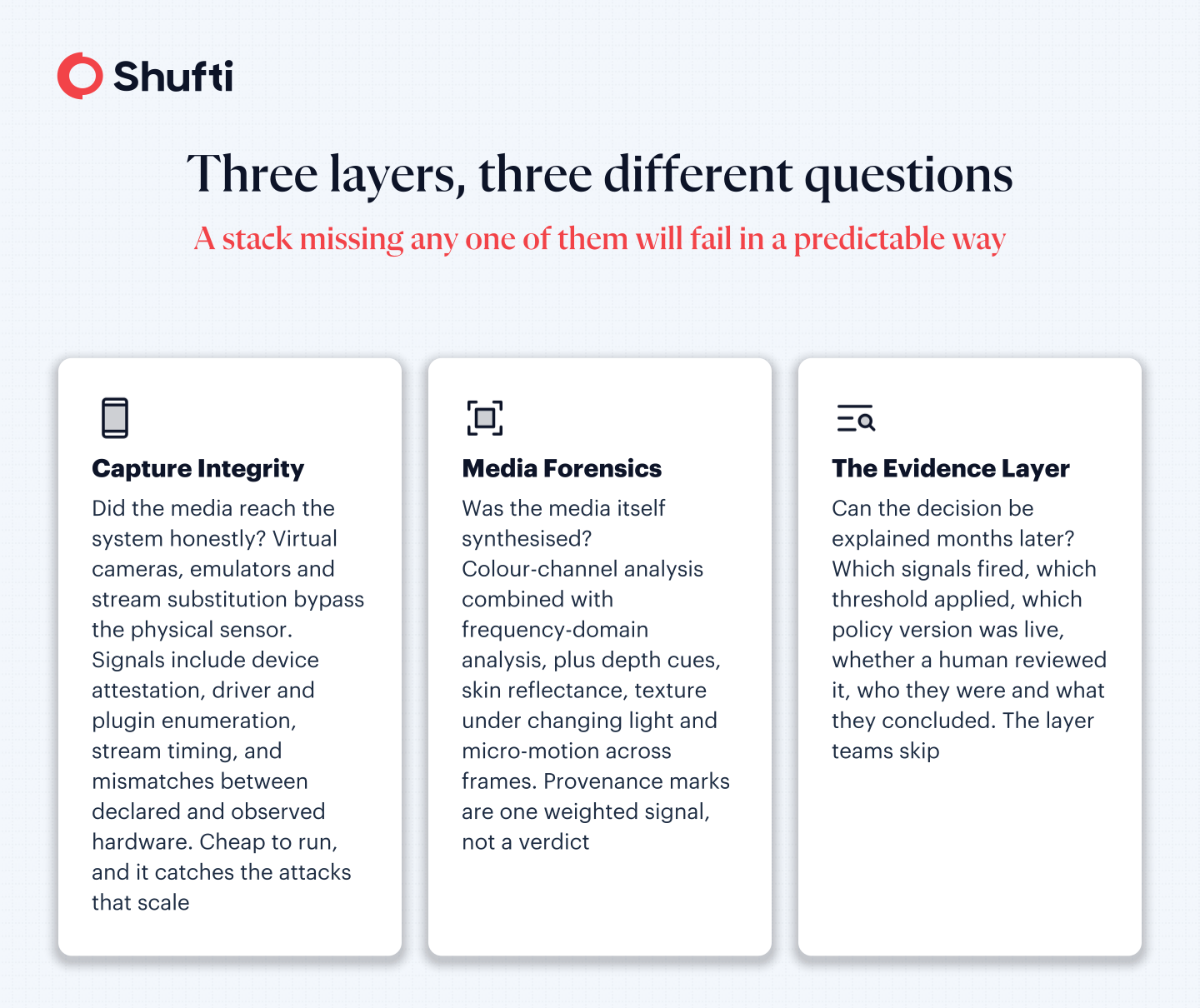
Generative AI deepfakes are detected in three layers that answer three different questions, and a stack missing any one of them will fail in a predictable way. Layer one asks whether the media reached the system honestly. Layer two asks whether the media itself was synthesised. Layer three asks whether the resulting decision can be explained months later.
Layer one, capture integrity
Capture integrity checks the path, not the picture. Virtual cameras, emulators, and stream substitution feed pre-recorded or generated media directly into the flow and bypass the physical sensor, so the question is whether the frames came from a real lens on a real device in a real session. Signals here include device and platform attestation, driver and plugin enumeration, stream timing behaviour, and inconsistencies between declared and observed hardware. This layer is cheap to run and catches the attacks that scale, which is why FinCEN’s webcam-plugin red flag maps onto it directly.
Layer two, media forensics
Media forensics interrogates the content once you trust the path. Effective approaches read the image in more than one representation at once, combining conventional colour-channel analysis with frequency-domain analysis, because generative artefacts that are invisible in the first are often obvious in the second. Depth cues, skin reflectance, texture behaviour under changing light, and micro-motion consistency across frames all contribute. Provenance marking becomes a genuine input at this layer from August 2026, since Article 50 obliges providers to embed machine-readable marks that detection systems are meant to read. Absent provenance is not proof of a fake, and present provenance is not proof of identity, so the marks are one weighted signal rather than a verdict.
Layer three, the evidence layer
The evidence layer converts a score into something defensible. This is the layer teams skip, and it is the one FATF, BaFin, and GDPR Article 22 all reach for in different words. It means capturing which signals fired, which threshold applied, which policy version was live, whether a human reviewed the case, who that reviewer was, and what they concluded. Without it, you can stop a fraud and still fail the audit, because the file cannot show why a specific genuine customer was refused, or how a specific synthetic one got past the check.
What risks do generative AI deepfakes pose during digital onboarding?
Onboarding is the highest-value target because a verified account is a durable asset, unlike a single fraudulent transaction that gets reversed once someone notices. A synthetic applicant who clears verification inherits your institution’s own assurance, which is what makes the account sellable, reusable, and hard to unwind later. The risk takes three forms, and only the first appears in most budgets.
Origination fraud at industrial scale
Account origination fraud has stopped being a rare event at some firms. Shufti’s Gadsden has described the shift from the old retail banking benchmark of roughly 1% fraudulent originations to figures around 20% and above for some customers, industrialised even against low-value incentives, because the account itself carries resale value as a mule. Volume at that level changes the economics of review, since a manual queue sized for exceptions collapses when the exception becomes one applicant in five.
The remediation bill, not the fraud loss
The direct loss is rarely the expensive part. Two cases sentenced in May 2026 put numbers on the gap. Overseas workers had used false and stolen identities to get hired at American companies, and in the first case the victim firms paid more than $250,000 in salaries, then spent more than $500,000 auditing and remediating the devices, systems, and networks those workers had touched. In the second, salaries came to $943,069, and the clean-up passed $1 million. Remediation outran the fraud in both.
Where the Legal layer Plays a Role
The third risk runs in the opposite direction. An aggressive automated rejection is a decision about a real person, and under GDPR Article 22, a solely automated decision with significant effects needs a lawful basis and a path to human intervention. False positives concentrate in exactly the populations where a model has seen the least training data, which turns a fraud control into a fairness exposure. Teams that treat deepfake and generative AI risk as purely a fraud metric tend to discover this through a complaint rather than a dashboard.
How can businesses protect themselves from generative AI deepfakes?
Protection is an architecture decision before it is a purchasing decision, because the question is not which model you run but what your system can prove afterwards. Most teams already own some version of the first two controls below and none of the last two, which is where the exposure concentrates. Six controls carry most of the weight, ordered here by how much protection they add per unit of effort:
- Test injection resistance before accuracy: Ask a prospective or incumbent provider to demonstrate detection of a virtual camera and an emulated stream, not just a held-up phone. Presentation attack results say nothing about the injection path, and the injection path is the one that scales.
- Insist on independent liveness validation: iBeta Level 3 Conformance to ISO/IEC 30107-3 is the highest published independent bar for liveness detection, and it was introduced specifically in response to AI-driven fraud. Ask which level was tested, and on which platforms.
- Extend detection to documents: With document deepfakes the fastest-growing category in the 2026 index cited above, a face-only defence leaves the growth vector open. Forensic document checks and chip reads where available close it.
- Log the decision, not just the outcome: Record signals fired, thresholds applied, policy version, reviewer identity, and reasoning. This is what turns a block into a defensible file under FATF’s examination expectation.
- Design the human step deliberately: Where regulation requires human judgment, as BaFin does for German video identification, build the review queue as a first-class product surface with the model output attached, rather than as an overflow tray.
- Rescreen against your own current models: Accounts approved eighteen months ago were cleared by a detector that no longer reflects the generator landscape, so periodic reassessment of high-risk cohorts is cheaper than a look-back ordered by someone else.
When detection alone is still enough?
The layered argument can be overplayed, and it is worth naming where it does not apply. If you are operating a low-risk, low-value service with no regulated identification duty, no adverse-action consequence for the applicant, and no supervisory examination in your future, a strong single-model check is a reasonable control and the evidence layer is overhead. The threshold moves the moment a rejection carries a legal or similarly significant effect for the person, or the moment an examiner can ask you to justify one file. Most regulated onboarding crossed that line some time ago.
How does Shufti handle generative AI deepfake detection?
If your fraud team has ever won an argument with a model and then lost it with an auditor, you have met the gap this article names. A confident block is worth very little when the file behind it holds a score and nothing else.
Shufti’s deepfake defence produces a reviewable decision rather than a bare verdict. Clear passes are automated, while high-risk attempts are blocked or routed to expert review with evidence outputs built for audit and investigation workflows, so the technical layer hands the legal layer something it can use. The underlying liveness holds iBeta Level 3 Conformance to ISO/IEC 30107-3, tested against expert attackers given weeks to attempt a breach, across 240+ countries and territories.
One global platform. The full compliance lifecycle, from sign-up to remediation. Every industry, every region, every use case.
Frequently Asked Questions
How can generative AI deepfakes be detected?
Through three layers working together. Capture integrity checks whether the media reached the system through a real camera or an injected stream. Media forensics reads colour and frequency-domain signals for generative artefacts. The evidence layer records which signals fired and who decided, so the outcome holds up under review.
How can businesses protect themselves from generative AI deepfakes?
Test injection resistance before headline accuracy, require independent liveness validation such as iBeta Level 3 Conformance to ISO/IEC 30107-3, extend detection to documents as well as faces, log the full decision rather than the outcome, design the human review step deliberately, and rescreen high-risk cohorts against current models.
What risks do generative AI deepfakes pose during digital onboarding?
Three. Synthetic applicants pass verification and become durable mule accounts. The larger cost lands as investigation, remediation, and look-back reviews rather than the direct loss. Over-aggressive automated rejection creates its own exposure under GDPR Article 22, which limits solely automated decisions with significant effects.
How do generative AI deepfakes differ from other types of deepfake content?
Earlier fakes edited a real recording, so forensics hunted for the seams. Generative models synthesise every frame, so no original sits underneath, and no edit boundary exists. The tells move into frequency-domain behaviour, and the attack shifts from the face to how the stream reaches the camera.