AMLR Solutions
  AMLR Consultation
 EUDI Wallet
 Onboarding
 Ongoing Monitoring
 FRAML
FRAML KYC
KYC KYB
KYB KYI
KYI Age Assurance
 Workforce IAM
 Candidate Verification
 Account Takeover
 Bonus/ Promotion Abuse
 Chargeback Fraud
 Deepfake
 Document Fraud
 Fraud Networks
 Impersonation Fraud
 Money Mule Activity
 Multi-Accounting
 Party Fraud
 Regulatory & Compliance Risks
 Synthetic Identity Fraud
 Adult Content
 Banking
 Crypto
 Fintech
 Forex
Forex Compliance
 Fraud prevention
 Trust & safety
 Global expansion
 Compliance Officers
 Developers
 Fraud Analysts
 Product Managers
 Journey Builder
  Global Trust Platform
 Customer Profiles
 Vendor Comparison
 IDV Case Management
 AML Case Management
 Regulatory Reporting
 Agentic Rule Builder
  AI Compliance Co-Pilot
  Fraud Analytics
 Fraud Hub
  OCR
OCR Shufti AI
 Bank Account Verification
  Biometric Duplication
 Database Checks
 Document Intelligence
 Government ID
 Mobile Driver's License
 NFC
NFC Selfie Liveness
 Brand Personalisation
 Deployment Options
 Identity Methods
 IDV Modes
 Multi-tenancy
 On-Premise IDV
 Secure Capture
 Shufti MCP











A front company is a real, trading business used to hide criminal money. Its paperwork is genuine, so checks that look for an empty company find nothing wrong. Ownership and activity checks are what work.
On 11 May 2026, the US Financial Crimes Enforcement Network warned banks that Iran’s Islamic Revolutionary Guard Corps was using front companies in other countries to open bank accounts and reach the international banking system. What made those companies hard to find was not secrecy; it was that they were real, authentic businesses.
Most checks that are conducted to detect suspicious companies usually look for things like missing staff, no premises, no filed accounts, no real customers, etc. A front company, on the other hand, has all of them, which is the reason why it’s hard to identify one.
This guide covers what a front company is, how it differs from a shell company, how criminals use one to launder money and evade sanctions, and the checks that find one.
What is a Front Company?
A front company is a real, working business that criminals use to hide the source of their money, who controls it, or where it is going. It sells actual goods or services, pays actual staff, files tax returns, and banks its takings.
They allow fraudsters to deposit criminal money alongside genuine takings, along with an explanation attached to it. Nothing on the company record shows a problem, because the company record is accurate. Whether a business is a front depends on what it is used for, and ‘use’ is impossible to identify with registry records.
What are Some Front Company Examples?
Cash businesses come up most often in enforcement cases. Examples include restaurants, car washes, laundromats, convenience stores, taxi firms, and small import or export traders, all of which appear regularly.
How is a Front Company Different from a Shell Company?
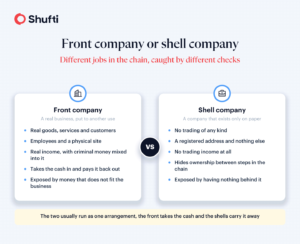
A shell company exists only on paper and does no business at all. A front company does real business. That difference matters because each one is caught by a different check.
| # | Front company | Shell company |
| Trading | Real goods, services, customers | None |
| Staff and premises | Employees and a physical site | Registered address only |
| Revenue | Real income mixed with criminal money | No trading income |
| Job in the laundering chain | Takes the cash in, pays it back out | Hides ownership between steps |
| What exposes it | Money that does not fit the business | Having nothing behind it |
Why Criminals Use Both Together
Front companies and shell companies usually work as one arrangement. The front business is the entity that’s usually used to take in the cash. The money then passes through a chain of shell companies, often in several countries, until tracing the ownership becomes impractical.
How do Criminals use Front Companies to Launder Money?
Front company money laundering follows the three standard stages:
Stage One: The Cash goes into the Business
The business reports higher takings than it had, and mixes the criminal cash alongside the real money. A bank sees a cash business depositing cash, which is totally normal, so the deposit triggers no alert by itself.
Stage Two: Invoices Move the Money Out
Banked money then leaves as supplier payments, management fees, and trade invoices. A common method is over-invoicing, where a company is billed far more than the goods are worth so the extra payment can be sent abroad and look like trade. Each invoice looks reasonable on its own because a real trading history supports it. Only analyzing the overall pattern can show the scheme.
Stage three: The Money Returns as Income
The people behind the company take the money out as wages, dividends, loan repayments, or property bought in the company name. By then, it has been declared and taxed, which makes it far harder for investigators to recover and makes early detection worth much more than late detection.
How do Front Companies Help Evade Sanctions?
Sanctions cut a person or company off from the banking system, and a front company can restore that access. In an alert dated 11 May 2026, the US Financial Crimes Enforcement Network described how Iran’s Islamic Revolutionary Guard Corps uses front companies in other countries to open bank accounts abroad, giving sanctioned parties a route back into international banking.
The same alert notes that these companies can act for sanctioned parties even when they are not themselves formally identified as owned by the IRGC. That has a direct effect on screening. Checking the company name against sanctions lists returns no match, because the company is not the party that was sanctioned. That is why it was chosen.
Why the Usual KYB Checks Miss a Front Company
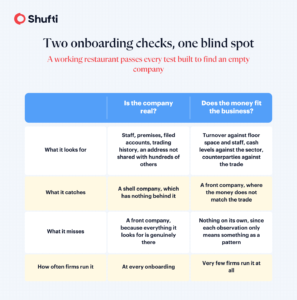
Two checks do most of the work when a business is onboarded. A front company usually gets past both.
The First Check Asks Whether the Company is Real
This check looks for things that should be there and are not. No staff, no premises, no filed accounts, no trading history, a registered address shared with hundreds of other companies. These signs are sound, and the FATF and Egmont Group study shows how often they turn up in real cases.
They also describe a shell company. Run the same tests on a working restaurant, and it passes all of them. The check proves a business exists. It does not show what the business is used for.
The Second Check Asks Whether The Money Fits the Business
This is the check that finds a front business, but the problem is that very few firms run it. The question is whether the money moving through the account matches the trade the company says it does. These would be turnover that doesn’t make sense for the premises and staff, and cash levels that are well above what similar businesses deposit, and customers and suppliers in countries that are irrelevant to the business.
None of those observations proves anything alone, but the pattern is what can help identify these companies.
How Do You Spot a Front Company?
To identify a front company, you’ll have to collect evidence that the money a business earns does not match the business size and type.
Front Company Red Flags
- When profits do not match the size of the business. A cafe with twelve seats banking the turnover of a fifty-seat restaurant is taking money from somewhere other than customers. Floor space and staff numbers set a ceiling on what a business can earn, and revenue above that ceiling has to come from another source.
- Where cash arrives in volumes the trade does not need. Compare the business against others in its sector. Similar firms take most payments by card and invoice, so a company banking large cash sums every week is behaving differently from its own industry. Cash is the one form of payment that carries no record of who paid it.
- A business whose suppliers and customers share its owners. Payments move in a circle between firms controlled by the same people, each one supported by an invoice. Trade that only ever happens inside one connected group is usually moving money rather than goods.
- Trade documents that do not describe a real shipment. No named recipient, prices far off market rates, or goods routed through three countries to reach a buyer in the next town. Paperwork of this kind exists to justify a payment, and the goods behind it may never have moved at all.
- Details that change soon after a sanctions action. A company renames itself, replaces directors, or switches operator within weeks of a sanctions decision against a related party. The change is there to break the link that screening would otherwise find.
KYB Checks that Catch a Front Company
Front company KYB checks work when they go past the company record to the people and the money behind it.
- Check the registry directly. Compare the company’s stated details, directors, and filing history against the official registry, not against documents the customer handed over.
- Trace ownership to real people. Follow the ownership chain through every layer until named individuals appear, then verify those individuals. A beneficial owner is the real person who ultimately owns or controls the company.
- Screen the owners, not just the company. Run sanctions, politically exposed person, and adverse media checks on each individual found, not on the company name alone.
- Agree on an expected activity profile and review it. Set out what normal activity should look like at onboarding, then review sustained departures from it.
Are Front Companies Illegal?
Setting up a company, owning it, and trading through it are all legal. No country bans running a car wash or an import business. Still, once a business is used to hide the proceeds of crime, or to give a sanctioned party access to banking, the conduct becomes money laundering or sanctions evasion, and the people directing it are criminally liable.
How Shufti helps Compliance Teams Find Front Companies
The difficulty with a suspected front company is that the documents are genuine. Registration checks out, directors exist, and some of the revenue is real, so reviewing documents cannot settle the file either way. The exposure usually rests with the people behind the company, and reaching them takes time for analysts.
Shufti’s KYB verification makes live registry calls across 240+ official sources, maps the ownership tree down to the FATF 25% threshold, which is the level of ownership at which someone counts as a beneficial owner, then runs AML screening on every individual it finds as well as on the company. That last step matters most here, because a front company is picked for a name that screens clean. All of it lands in one audit trail.