




 Face Verification
 Address Verification
 Document Verification
 Age Verification
 VideoIdent
 Fast ID
 Docless Verification
 Consent Verification
 NFC Verification
 Business Verification
 Due Diligence
 Investor Verification
 E-Signature

 QES
QES
 AML Screening
 Transaction Monitoring
 Adverse Media
 Business AML Screening
 PEP & RCA
 Sanctions
 Watchlist
 Behavioural Biometrics
 Device Fingerprinting
 Biometric Face Authentication
 MFA
MFA
 Fraud Hub
 Onboarding
 Ongoing Monitoring
 KYC
KYC
 KYB
KYB
 KYI
KYI
 Age Assurance
 Identity Verification
 Workforce IAM
 Candidate Verification
 Compliance
 Fraud prevention
 Trust & safety
 Global expansion
 Product Managers
 Compliance Officers
 Fraud Analysts
 Developers
 Deepfake Detection
 Bonus Abuse / Promotion Abuse
 Account Takeover
 Synthetic Identity Fraud
 Document Fraud
 Impersonation Fraud
 Multi-Accounting
 Fraud Networks
 Chargeback Fraud
 Money Mule Activity
 Party Fraud
 Regulatory & Compliance Risks
 Fintech
 Crypto
 iGaming
 Forex
Forex
 Social Network
 Marketplace
 Banking
 Gig Economy
 Payments
 Ride Hailing
 Adult Content
 Blind Spot Audit
 Deepfake Detector
 Liveness Spoofs
 Document Originality
 Document Deepfake
 Global Trust Platform
 Journey Builder
 Case Management
 Shufti AI
 Fraud Analytics
 Vendor Comparison
 Brand Personalisation
 AI Compliance Co-Pilot
 OCR
OCR
 Secure Capture
 Deployment Options
 Identity Methods
 API Documentation
 Mobile SDKs
 Service Status
 Help Center
 Contact Us
 Technical Support
 Supported Documents
 Supported Countries
 Content library
 Blogs
Blogs
 News
News
 Reports
 Insights
 Knowledgebase
 ROI calculator
 About
About
 Career
 Press Release
 Certifications
 Partnership
 Awards
 Events & Webinar
 Interactive Demo
 Podcast Studio
 Spotlight Studio
KYB Compliance in Brazil: BACEN, COAF, CNPJ, and UBO Requirements

-
Add us as a Preferred Source
- 01 What does KYB compliance require in Brazil?
- 02 How do BACEN and COAF govern business verification in Brazil?
- 03 What documents are required for KYB verification of a Brazilian company?
- 04 What are Brazil's UBO verification requirements?
- 05 Is KYB mandatory for fintechs in Brazil?
- 06 How Shufti handles beneficial-ownership checks in Brazil
TL;DR
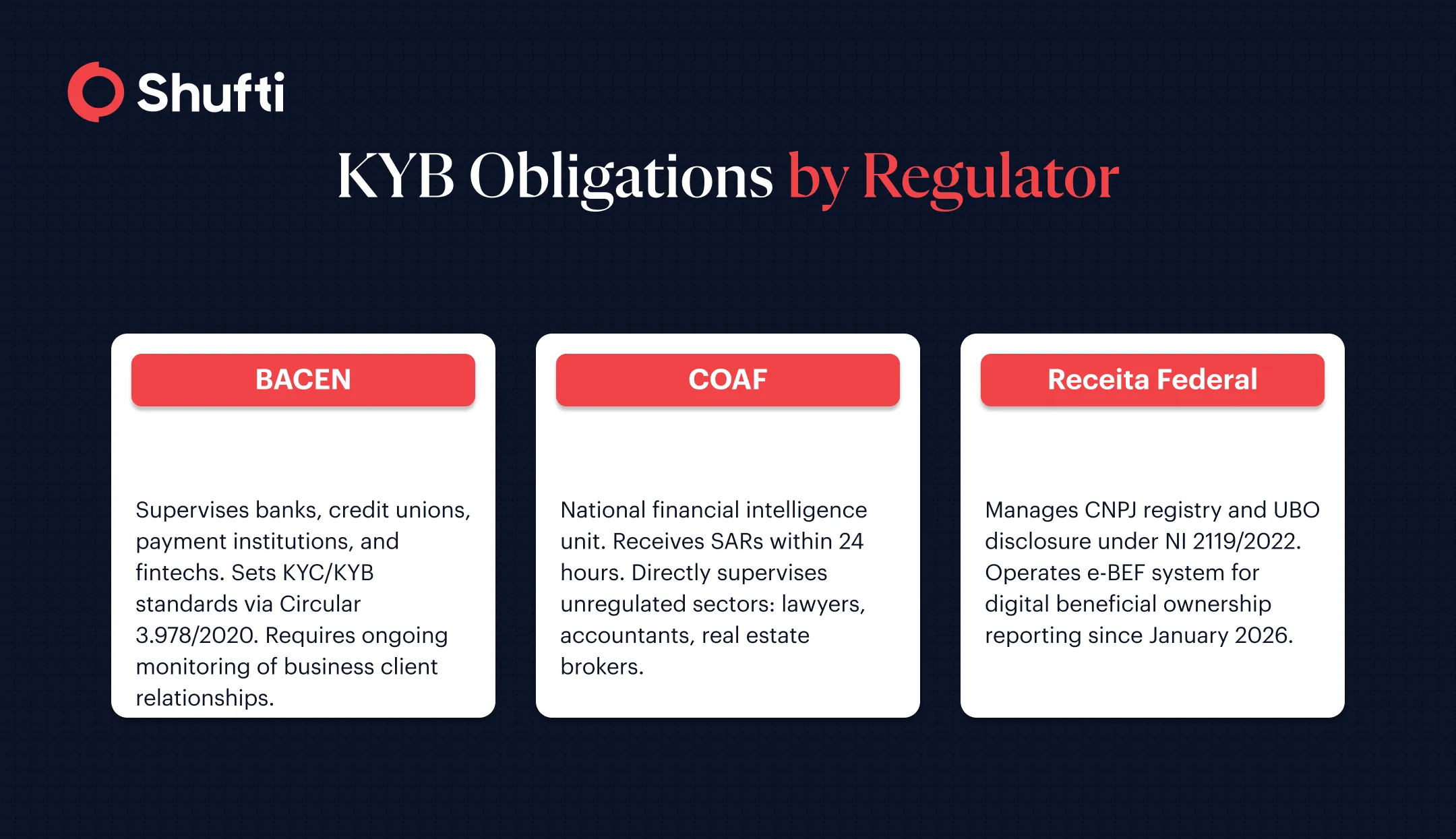
- Brazil’s KYB framework is governed by three regulators: BACEN (banks and fintechs), COAF (financial intelligence and SAR reporting), and the Receita Federal (CNPJ registry and UBO disclosure).
- Every Brazilian company must have an active CNPJ, the 14-digit national business identifier, which can be verified via the REDESIM portal before onboarding can proceed.
- UBO threshold is 25%. Any natural person holding 25%+ of capital must be identified and verified under Normative Instruction 2119/2022. Non-declaration suspends the CNPJ.
- Brazil launched the e-BEF system in January 2026, digitizing UBO reporting through a centralized federal platform following FATF’s 2023 Mutual Evaluation findings.
- Since August 2025, fintechs and payment institutions have faced the same KYB obligations as licensed banks: full CNPJ validation, UBO mapping, and COAF SAR reporting.
- Suspicious transactions must be reported to COAF within 24 hours. COAF issued BRL 44.2 million in AML fines in 2024.
- High-risk corporate clients (complex ownership, offshore controllers, elevated-risk sectors) trigger Enhanced Due Diligence (EDD) under BACEN Circular 3.978/2020.
Brazil collected BRL 44.2 million in AML fines during 2024, according to COAF’s enforcement data, and its financial intelligence unit is now actively running electronic compliance assessments across obligated sectors. For compliance teams building Know Your Business processes for Brazil’s corporate market, KYB compliance Brazil spans three overlapping regulators, a national UBO registry, and sector-specific mandates that expanded to cover fintechs in 2025. This guide covers the full framework, from the legislative foundation to the document set required for a defensible business onboarding in Brazil.
What does KYB compliance require in Brazil?
Know Your Business Brazil compliance means running a structured review that covers legal-entity validation, beneficial ownership analysis, and ongoing AML monitoring. That obligation rests on two foundational instruments. Lei 9.613/1998 is Brazil’s anti-money laundering law. It criminalized money laundering, established the Conselho de Controle de Atividades Financeiras (COAF) as the national financial intelligence unit, and created reporting obligations for all obligated entities. Banco Central do Brasil (BACEN) Circular 3.978/2020 translates those obligations into sector-specific standards for all supervised institutions.
Circular 3.978/2020 adds operational specificity to what the anti-money laundering law requires. BACEN uses it to set risk classification standards, define documentation thresholds for business onboarding, and mandate ongoing client monitoring rather than a single check at account opening. For corporate clients, that means the institution must document the entity’s corporate structure, identify its controllers, and apply enhanced due diligence (EDD) when the risk profile warrants it.
How do BACEN and COAF govern business verification in Brazil?
Understanding which regulator governs Brazil’s AML business verification and COAF reporting obligations is the starting point for any compliance team in the country. BACEN and COAF share Brazil’s AML supervisory space but divide oversight by sector.
BACEN supervises banks, credit unions, payment institutions, and fintech platforms. Its KYB requirements flow through Circular 3.978/2020. Institutions must document the purpose of each business relationship, risk-classify corporate clients, and maintain a current profile on each. Brazil’s broader AML regulatory framework sets out how BACEN’s obligations connect to the wider domestic compliance picture.
COAF operates as the national financial intelligence unit above the sectoral supervisors. It receives suspicious activity reports (SARs) from all obligated entities, analyses financial intelligence, and passes findings to law enforcement. Any institution that identifies a suspicious corporate transaction is required under Lei 9.613 to file a SAR with COAF within 24 hours. By 2024, COAF was producing close to 19,000 financial intelligence reports annually, up from roughly 12,000 in 2020, based on COAF’s integrated management data.
COAF also directly supervises sectors without a dedicated prudential regulator. Lawyers, accountants, real estate brokers, and luxury goods dealers report to COAF rather than to BACEN. For financial institutions, COAF reporting sits on top of BACEN’s KYB requirements, creating a layered compliance obligation rather than a single unified standard.
What documents are required for KYB verification of a Brazilian company?
CNPJ business verification in Brazil-side runs across three documentation tiers. A complete file at onboarding is the difference between a compliant record and a gap that surfaces during a BACEN inspection.
Corporate identity documents
The Cadastro Nacional da Pessoa Jurídica (CNPJ) is the 14-digit identifier issued by the Receita Federal (Brazil’s Federal Revenue Service) and sits at the center of every business verification. The CNPJ’s active status is verifiable through the REDESIM portal, Brazil’s business registration system operated by the Receita Federal. A suspended CNPJ signals either tax non-compliance or a failed UBO declaration. Either outcome requires escalation before the business relationship proceeds.
Beyond the CNPJ, the corporate identity layer includes the Contrato Social (articles of association), the company’s official registration certificate, and proof of registered business address.
Ownership documentation
Government-issued identification must be collected for every natural person meeting the ownership threshold. The legal benchmark is 25%. Any individual who directly or indirectly holds at least 25% of the company’s capital qualifies as a UBO under Normative Instruction 2119/2022 and must be verified on record.
AML evidence
Regulated institutions must document the source of the business’s funds, the intended purpose of the relationship, and any adverse media or sanctions hits against the entity and its controllers. Institutions conducting anti-money laundering screening on corporate clients are expected to refresh this layer periodically, not just at onboarding.
What are Brazil’s UBO verification requirements?
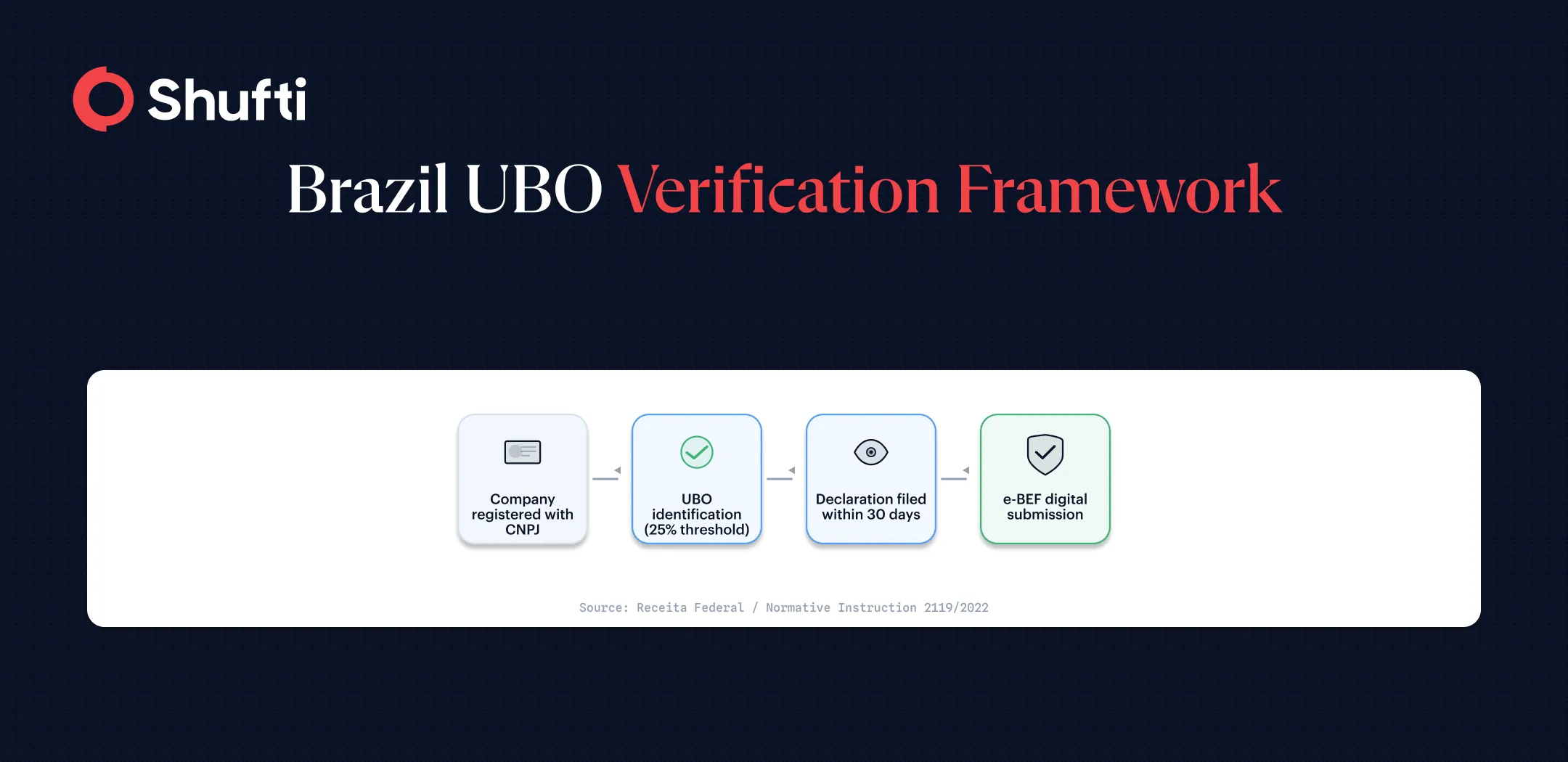
Brazil UBO verification requirements follow a structured disclosure model set by Normative Instruction 2119/2022, issued by the Receita Federal. Under this rule, all companies registered with the CNPJ must declare the existence or absence of a UBO within 30 days of registration. Beneficial ownership Brazil regulations define the UBO as a natural person who directly or indirectly holds more than 25% of the share capital or who exercises predominant control over the entity’s decisions.
Foreign companies operating in Brazil face the most demanding disclosure standard. They must declare their UBO or confirm its absence. Domestic companies without any natural person meeting the 25% threshold may file a negative declaration stating that no UBO exists, but that filing is still mandatory.
Non-compliance carries direct operational damage. A company that fails to make the required UBO declaration faces suspension of its CNPJ. Once suspended, the entity cannot conduct banking transactions, access financial investments, or obtain loans, creating immediate pressure on any business trying to work with regulated counterparts.
As of January 2026, Brazil’s beneficial ownership framework moved further with the operationalization of the e-BEF system. This digitalized UBO reporting required obligated entities to submit ownership information through a central federal platform. The FATF’s 2023 Mutual Evaluation of Brazil had flagged UBO transparency as a persistent gap in the country’s AML regime. The e-BEF rollout addresses it directly.
Is KYB mandatory for fintechs in Brazil?
Brazil’s fintech KYB regulations tightened substantially in August 2025. Normative Instruction No. 2,278, published by the Receita Federal, extended the same AML and business verification obligations that apply to banks to payment institutions and fintech platforms participating in payment arrangements. Fintechs that operated under lighter-touch rules must now apply a full KYB framework when onboarding corporate clients.
From August 2025, a fintech onboarding a business client in Brazil faces the same CNPJ validation, UBO identification, and SAR reporting requirements as a licensed bank.
KYB LATAM Brazil sits in a distinct regulatory position compared to other major markets in the region. Brazil’s AML regime layers a central bank regulator, a financial intelligence unit, and a national tax authority, each with overlapping corporate verification obligations. Compliance teams managing multiple Latin American jurisdictions will find that Brazil requires the most documentation and the most structured ongoing monitoring program.
BACEN KYB requirements in Brazil follow a risk-based approach throughout. Business profiles classified as high-risk, including entities with complex ownership structures, offshore controllers, or activity in elevated-risk sectors, trigger EDD requirements. Well-documented lower-risk businesses can move through the business verification process at a pace that avoids unnecessary onboarding friction for genuine counterparts.
How Shufti handles beneficial-ownership checks in Brazil
The compliance burden in Brazil’s KYB framework, layered across BACEN, COAF, and the Receita Federal, creates real friction for teams relying on manual processes or managing multiple vendor tools. A single corporate onboarding can require CNPJ verification, multi-tier UBO mapping, SAR-ready documentation, and a clear audit trail for BACEN inspection.
Shufti’s KYB verification maps entity ownership down to the UBO level and cross-checks the entity and its controllers against global sanctions and adverse media databases, matching the AML coverage BACEN and COAF require. Business AML screening runs alongside the verification step, not after it, so the compliance record is complete at onboarding rather than assembled retrospectively. Shufti covers 240+ jurisdictions, so Brazilian corporate clients with foreign ownership chains don’t create coverage gaps during the UBO mapping step.
See how Shufti maps beneficial ownership for Brazilian corporate clients end to end. Book a demo.
Frequently Asked Questions
What are the KYB requirements in Brazil?
KYB requirements in Brazil are governed by BACEN Circular 3.978/2020 and Lei 9.613/1998. Obligated entities must validate a company's CNPJ, collect corporate documents, identify all UBOs at or above the 25% ownership threshold, and screen for AML exposure. SAR reporting to COAF is mandatory for suspicious transactions.
How does COAF regulate AML in Brazil?
COAF is Brazil's financial intelligence unit. Obligated entities must report suspicious transactions to COAF within 24 hours of detection. COAF also directly supervises sectors without a dedicated prudential regulator, including lawyers, accountants, and real estate brokers, in addition to analyzing financial intelligence and sharing findings with law enforcement.
What is BACEN's role in KYB compliance in Brazil?
Banco Central do Brasil (BACEN) supervises the Brazilian financial sector and sets KYB obligations through Circular 3.978/2020. Banks, credit unions, payment institutions, and fintechs must follow BACEN's rules on CNPJ verification, UBO identification, risk classification, and ongoing monitoring of business client relationships.
How do I verify a Brazilian company's CNPJ?
The CNPJ is verifiable through the REDESIM portal, operated by Brazil's Receita Federal. Check the CNPJ's active status first, then collect the Contrato Social and registration certificate. A suspended CNPJ requires immediate escalation before onboarding proceeds.
What are the penalties for KYB non-compliance in Brazil?
Non-compliance with Brazil's KYB framework carries financial and operational penalties. COAF levied BRL 44.2 million in fines during 2024. Failure to file required UBO declarations leads to CNPJ suspension, blocking the entity from banking transactions, financial investments, and loan access.