AMLR Solutions
  AMLR Consultation
 EUDI Wallet
 Onboarding
 Ongoing Monitoring
 FRAML
FRAML KYC
KYC KYB
KYB KYI
KYI Age Assurance
 Workforce IAM
 Candidate Verification
 Account Takeover
 Bonus/ Promotion Abuse
 Chargeback Fraud
 Deepfake
 Document Fraud
 Fraud Networks
 Impersonation Fraud
 Money Mule Activity
 Multi-Accounting
 Party Fraud
 Regulatory & Compliance Risks
 Synthetic Identity Fraud
 Adult Content
 Banking
 Crypto
 Fintech
 Forex
Forex Compliance
 Fraud prevention
 Trust & safety
 Global expansion
 Compliance Officers
 Developers
 Fraud Analysts
 Product Managers
 Journey Builder
  Global Trust Platform
 Customer Profiles
 Vendor Comparison
 IDV Case Management
 AML Case Management
 Regulatory Reporting
 Agentic Rule Builder
  AI Compliance Co-Pilot
  Fraud Analytics
 Fraud Hub
  OCR
OCR Shufti AI
 Bank Account Verification
  Biometric Duplication
 Database Checks
 Document Intelligence
 Government ID
 Mobile Driver's License
 NFC
NFC Selfie Liveness
 Brand Personalisation
 Deployment Options
 Identity Methods
 IDV Modes
 Multi-tenancy
 On-Premise IDV
 Secure Capture
 Shufti MCP
















Global AML penalties totalled $3.8 billion in 2025 (Fintech Global), and many of those fines traced back not to deliberate non-compliance but to identity verification workflows that could not keep pace with onboarding volume. A compliance team relying on manual reviews or a patched-together in-house build cannot scale fast enough when regulators raise the bar quarterly.
KYC as a Service (KYCaaS) closes that gap by delivering document verification, biometric checks, AML screening, and risk scoring through a single API call, with the provider absorbing the infrastructure cost and the compliance update cycle. This article covers what KYCaaS delivers, which features matter when evaluating a provider, and where the technology is heading in 2026.
KYC as a Service is a third-party delivery model in which identity verification, customer due diligence, and AML screening are provided through an API or SDK on a subscription or usage basis, removing the need for businesses to build or maintain the underlying verification stack themselves.
Why KYC as a Service is replacing in-house verification
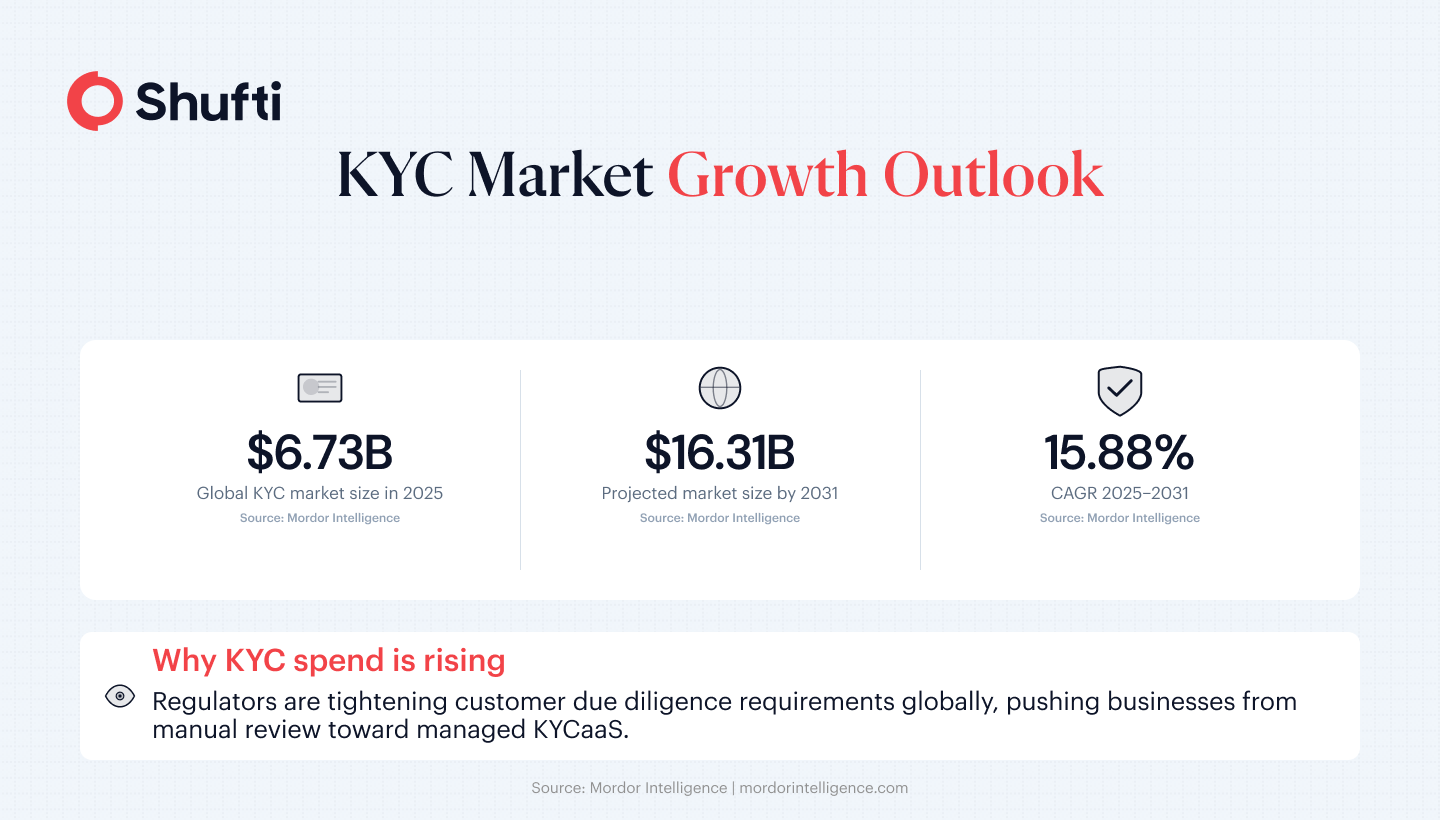
The global KYC market stood at USD 6.73 billion in 2025 and is projected to reach USD 16.31 billion by 2031 at a compound annual growth rate (CAGR) of 15.88%, according to Mordor Intelligence. That growth reflects a structural shift in how compliance teams approach the build-vs-buy decision, not simply more spend on an existing category.
Building identity verification in-house means owning every component of the stack. Teams take on optical character recognition (OCR) engines, liveness detection models, watchlist data feeds, and the engineering overhead to update each one when regulators revise their guidance.
The operational cost compounds every time a new document type enters circulation or a fresh Financial Action Task Force (FATF) mutual evaluation tightens requirements on customer due diligence. Managed KYCaaS providers absorb that overhead. The business integrates once, and the provider handles document template updates, model retraining, and watchlist refresh cycles.
For a fintech that cannot launch without a compliant onboarding flow, or a gaming platform under a hard licensing deadline, that speed-to-compliance is the practical argument for a third-party service over a custom build.
What features should a KYC SaaS platform include?
Not all KYCaaS platforms carry the same scope, and the gap between a document upload tool and a compliance-grade verification layer is wider than vendor marketing tends to suggest. Five categories of capability determine whether a platform is fit for regulated onboarding.
Document capture and verification starts with OCR extraction across passports, national IDs, and driver’s licences from multiple countries, with automated tamper detection running alongside data extraction.
Global document verification coverage across a wide range of document types handles the edge cases that narrower solutions reject, pushing teams into a manual review queue for the exact sessions where speed matters most.
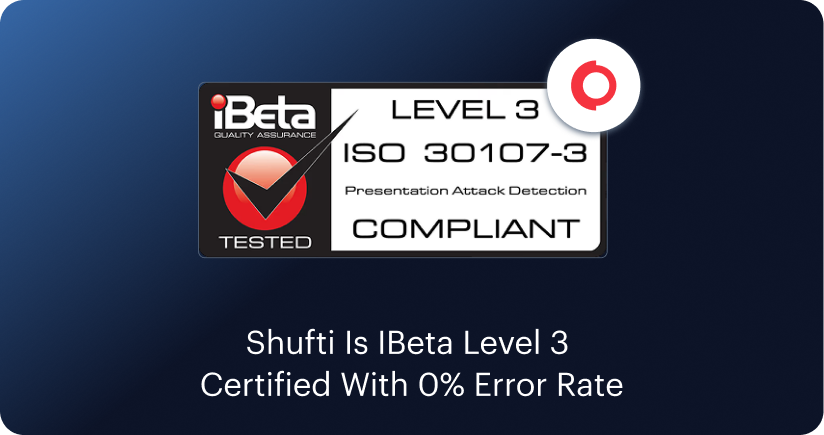
Biometric face matching with certified liveness detection confirms the person presenting the document is live and in-frame, rather than a printed photo or a replayed video. As of April 2026, iBeta Level 1 and Level 2 certification has become the benchmark that regulators and enterprise procurement teams reference when evaluating liveness quality.
AML and sanctions screening should run the verified identity against global watchlists, politically exposed person databases, and adverse media sources simultaneously.
Financial Action Task Force (FATF) Recommendation 10, last updated in October 2025, requires ongoing customer due diligence rather than a one-time check at onboarding, so the screening layer needs to support continuous monitoring as well as the initial verification pass.
Risk scoring and workflow flexibility let compliance teams route high-risk onboarding sessions to enhanced due diligence automatically, without manual triage at each step.
Shufti’s Journey Builder gives non-technical teams the ability to adjust verification flows by region or customer risk tier without waiting on an engineering release cycle.
API-first architecture and deployment options determine how quickly a team can go live and how much control it retains over data residency. Cloud-hosted APIs handle burst traffic without infrastructure planning. On-premises and hybrid deployments serve teams operating under strict data localisation requirements or zero-trust network policies.
Benefits of SaaS-based KYC over in-house systems
Speed is the most visible difference between a managed service and a manual or in-house verification workflow. A mature KYCaaS platform completes a full identity check, covering document capture, biometric match, and AML screening, in under 15 seconds.
Manual review queues for the same session often run 24 hours or longer, as compliance teams evaluating automation ROI frequently discover when they audit their current throughput. That gap directly affects conversion rates at registration, since users who encounter a waiting screen abandon the onboarding flow at higher rates than those who receive a real-time result.
Regulatory coverage matters just as much in practice, even if speed captures most of the attention during vendor evaluation. KYCaaS providers update watchlist feeds, document templates, and screening rules as regulations change, so a business onboarding customers across multiple jurisdictions does not need to track a separate regulatory update cycle for each one.
Global document verification across 230 or more countries means the platform handles the identity documents your customers actually present, rather than returning an unsupported-format error when an unfamiliar ID type arrives at high volume.
Cost structure also shifts in a practical way. In-house KYC systems carry fixed engineering and infrastructure costs regardless of onboarding volume. A SaaS model scales with actual usage, which matters for a startup validating its growth assumptions or an established platform managing seasonal volume spikes.
For a broader look at how eKYC fits within this model, the eKYC explained guide covers the digital-first verification approach that underpins most modern KYCaaS deployments. Teams in regulated sectors such as financial services can also review KYC service benefits for operators for a sector-specific perspective.
What KYC trends will shape compliance in 2026?
KYCaaS is moving quickly in 2026, driven by regulatory pressure and material advances in AI-powered fraud detection. Three developments stand out for compliance teams evaluating or re-evaluating their current verification stack.
Perpetual KYC (pKYC) replaces the annual or event-triggered review cycle with continuous, event-driven monitoring. Rather than re-verifying a customer on a fixed schedule, a pKYC model monitors behavioural signals and watchlist hits in real time, escalating only when the risk profile changes materially.
As of April 2026, the EU Anti-Money Laundering Authority (EU AMLA) is moving toward requiring ongoing monitoring standards across member states, making the shift from point-in-time to perpetual checks a regulatory obligation for firms with European customers, not a product differentiator.
Deepfake-resilient biometrics is now a standard procurement criterion rather than a differentiator. The volume of AI-generated identity fraud attempts in 2025 reached levels that forced regulators and enterprise clients to ask specifically whether a vendor’s liveness model is trained on current generative attacks, rather than on older static-image spoofing data. iBeta-certified models with adversarial training against synthetic media have become the expected baseline for a compliant onboarding stack entering 2026.
Unified KYC-plus-AML APIs are replacing multi-vendor stacks. A fragmented compliance architecture, with separate vendors for document verification, biometrics, and sanctions screening, creates reconciliation overhead and data handoff risk between systems. The market is consolidating around single-API providers that run all three layers in one call and return a unified risk decision, reducing integration complexity and closing audit trail gaps that distributed architectures introduce.
For context on how KYC compliance software is adapting to these changes, Shufti’s knowledge base covers the technical and operational considerations for teams evaluating the unified approach.
How Shufti helps compliance teams run KYC as a Service
Shufti delivers the full KYCaaS stack through a single API. The platform covers document verification across 10,000+ document types and 240+ countries, biometric face matching with iBeta Level 1 and Level 2-certified liveness detection, and AML screening against 100,000+ data sources including 3,500+ watchlists, 2.6M+ PEP profiles, and 215+ sanctions regimes refreshed every 15 minutes.
Verification completes in under 15 seconds on average, which addresses the throughput problem that separates a managed service from a manual or in-house alternative. The Journey Builder gives compliance and operations teams a no-code interface to configure verification flows by geography, customer type, or risk tier without an engineering sprint for each change, which matters for teams managing multiple regional compliance requirements simultaneously.
Shufti supports cloud, on-premises, and hybrid deployment architectures under PCI DSS, SOC2, GDPR, and ISO 27001:2013 certifications, covering the data residency and security requirements that enterprise clients and regulated sectors flag most frequently during vendor evaluation.
For teams evaluating integration scope, the full range of supported document types, API specifications, and deployment options is documented on Shufti’s KYC verification page.
Manual onboarding workflows and fragmented verification stacks are the two most common reasons compliance teams miss regulatory deadlines and absorb avoidable enforcement risk. Shufti’s KYC as a Service runs document verification, biometric liveness, and AML screening through one API call, covering 240+ countries in under 15 seconds. Request a demo to see the full verification flow against your actual onboarding volumes.
Frequently Asked Questions
What is KYC as a Service (KYCaaS)?
KYC as a Service is a third-party delivery model that provides identity verification, customer due diligence, and AML screening through an API or SDK on a usage or subscription basis. Businesses integrate once and run compliant onboarding without building or maintaining the underlying verification infrastructure themselves.
What are the benefits of SaaS-based KYC over in-house systems?
SaaS-based KYC delivers real-time verification results, typically in under 15 seconds, along with automatic regulatory and watchlist updates, global document coverage, and a variable cost model that scales with onboarding volume. In-house systems carry fixed engineering and infrastructure costs and require internal teams to track regulatory changes across every active jurisdiction independently.
What features should a KYC SaaS platform include?
A compliance-grade KYCaaS platform should cover document verification with tamper detection, biometric face matching with certified liveness, AML screening against global watchlists and PEP databases, automated risk scoring with enhanced due diligence routing, and a no-code workflow builder for operational flexibility. API-first architecture with cloud, on-premises, and hybrid deployment options rounds out the core requirements.
What are the key KYC trends for 2026?
Three trends are reshaping KYCaaS in 2026. The first is the move from point-in-time to perpetual KYC, driven by EU AMLA ongoing monitoring requirements. The second is the adoption of deepfake-resilient biometrics as a baseline procurement criterion. The third is the consolidation toward unified KYC-plus-AML APIs that replace fragmented multi-vendor stacks.
How is KYC as a Service priced?
KYCaaS providers typically offer three pricing structures. Usage-based billing ties charges directly to verification volume, making costs variable and predictable at any scale. A flat subscription covers a defined monthly throughput, and a hybrid model combines a base subscription with overage charges for high-volume periods. Startups with variable onboarding volumes often prefer usage-based structures to avoid fixed minimums. Enterprises with stable monthly volumes often find subscription pricing more predictable over a 12-month period.