AMLR Solutions
  AMLR Consultation
 EUDI Wallet
 Onboarding
 Ongoing Monitoring
 FRAML
FRAML KYC
KYC KYB
KYB KYI
KYI Age Assurance
 Workforce IAM
 Candidate Verification
 Account Takeover
 Bonus/ Promotion Abuse
 Chargeback Fraud
 Deepfake
 Document Fraud
 Fraud Networks
 Impersonation Fraud
 Money Mule Activity
 Multi-Accounting
 Party Fraud
 Regulatory & Compliance Risks
 Synthetic Identity Fraud
 Adult Content
 Banking
 Crypto
 Fintech
 Forex
Forex Compliance
 Fraud prevention
 Trust & safety
 Global expansion
 Compliance Officers
 Developers
 Fraud Analysts
 Product Managers
 Journey Builder
  Global Trust Platform
 Customer Profiles
 Vendor Comparison
 IDV Case Management
 AML Case Management
 Regulatory Reporting
 Agentic Rule Builder
  AI Compliance Co-Pilot
  Fraud Analytics
 Fraud Hub
  OCR
OCR Shufti AI
 Bank Account Verification
  Biometric Duplication
 Database Checks
 Document Intelligence
 Government ID
 Mobile Driver's License
 NFC
NFC Selfie Liveness
 Brand Personalisation
 Deployment Options
 Identity Methods
 IDV Modes
 Multi-tenancy
 On-Premise IDV
 Secure Capture
 Shufti MCP















TL;DR
- Watchlist screening checks customers against sanctions, PEP, and adverse media lists at onboarding and on an ongoing basis.
- OFAC alone recorded 14 enforcement actions worth $265.7 million in 2025.
- Clearing false positive alerts consumes most of a compliance team’s screening workload.
- Automated matching cuts manual review time but still needs human judgment to close out real hits.
On 28 May 2026, the UK Financial Conduct Authority (FCA) published its review of sanctions systems and controls at 150 authorised firms. The screening systems caught exact name matches on sanctioned individuals reliably. The moment a name carried a spelling variation, a transliteration difference, or an extra initial, performance dropped enough for the regulator to flag it directly. That is the entire watchlist screening problem in one finding.
The lists are public and the matching technology is not new, yet the firms that get caught are rarely the ones without a screening tool. They are the ones whose match logic stopped working the moment a name got complicated.
This guide covers what watchlist screening means in practice, which lists matter, how automated matching works, and where the process breaks down.
What is Watchlist Screening? And Why It Matters
Watchlist screening is the process of checking a customer, business, or transaction against government and regulatory lists to see whether that party is sanctioned, politically exposed, or otherwise flagged for risk, a process often described as AML watchlist screening when it sits inside a wider anti-money laundering programme. It runs onboarding and again on an ongoing basis, because a customer who cleared a check last year can appear on a list today. Regulators treat it as a baseline control, not an optional add-on.
A missed match is not treated as a data quality issue. It becomes an enforcement matter, and regulators on both sides of the Atlantic have made that expectation explicit in recent guidance. That is why watchlist screening software gets judged on its match logic, not on how many lists it claims to cover.
Nearly every regulated business runs some form of watchlist screening today. Banks, payment providers, crypto exchanges, gaming operators, and remittance firms all sit under a legal obligation to screen new customers and, in most jurisdictions, existing ones on an ongoing basis.
The obligation does not disappear because a business operates online, or because its customers are individuals rather than corporations. A crypto exchange onboarding a retail user faces the same sanctions-list obligation as a bank opening a current account, even though the products look nothing alike.
Which Lists Make Up Global Watchlist Screening
Global watchlist screening pulls from four categories of lists, each maintained by a different type of authority and updated on its own schedule.
Sanctions lists carry the most legal weight. Politically exposed person (PEP) databases and adverse media checks add context that a sanctions hit alone would miss. The European Commission maintains the EU’s own consolidated sanctions dataset, which folds together EU-only designations with UN Security Council listings the EU has adopted, so a single query can cover both regimes at once. Most screening platforms query all four list categories in a single pass rather than running separate checks for each.
| List type | Maintained by | What it flags | Update cadence |
| Sanctions lists | OFAC, EU Council, UK HM Treasury, UN Security Council | Individuals, entities, and vessels under asset freezes or trade restrictions | As designations change, often without advance notice |
| PEP databases | Commercial data providers aggregating government and public-record sources | Politically exposed persons and their close associates and family members | Continuously, as officials change roles |
| Adverse media | Commercial data providers aggregating licensed news sources | Credible reporting linking a party to financial crime, fraud, or corruption | Daily to weekly, depending on the provider |
| Internal watchlists | The regulated firm itself | Past fraud cases, closed accounts, or firm-specific risk flags | Set by the firm’s own risk policy |
PEP screening carries its own rulebook. The Financial Action Task Force (FATF)’s Recommendation 12 requires firms to apply extra due diligence to politically exposed persons, including senior management approval before opening the relationship and ongoing monitoring of the source of wealth.
A PEP hit is not automatically high risk. The designation triggers a deeper look, not an automatic decline, and a customer verification programme that treats every PEP hit as a rejection loses legitimate customers over a label.
How Automated Watchlist Screening Works
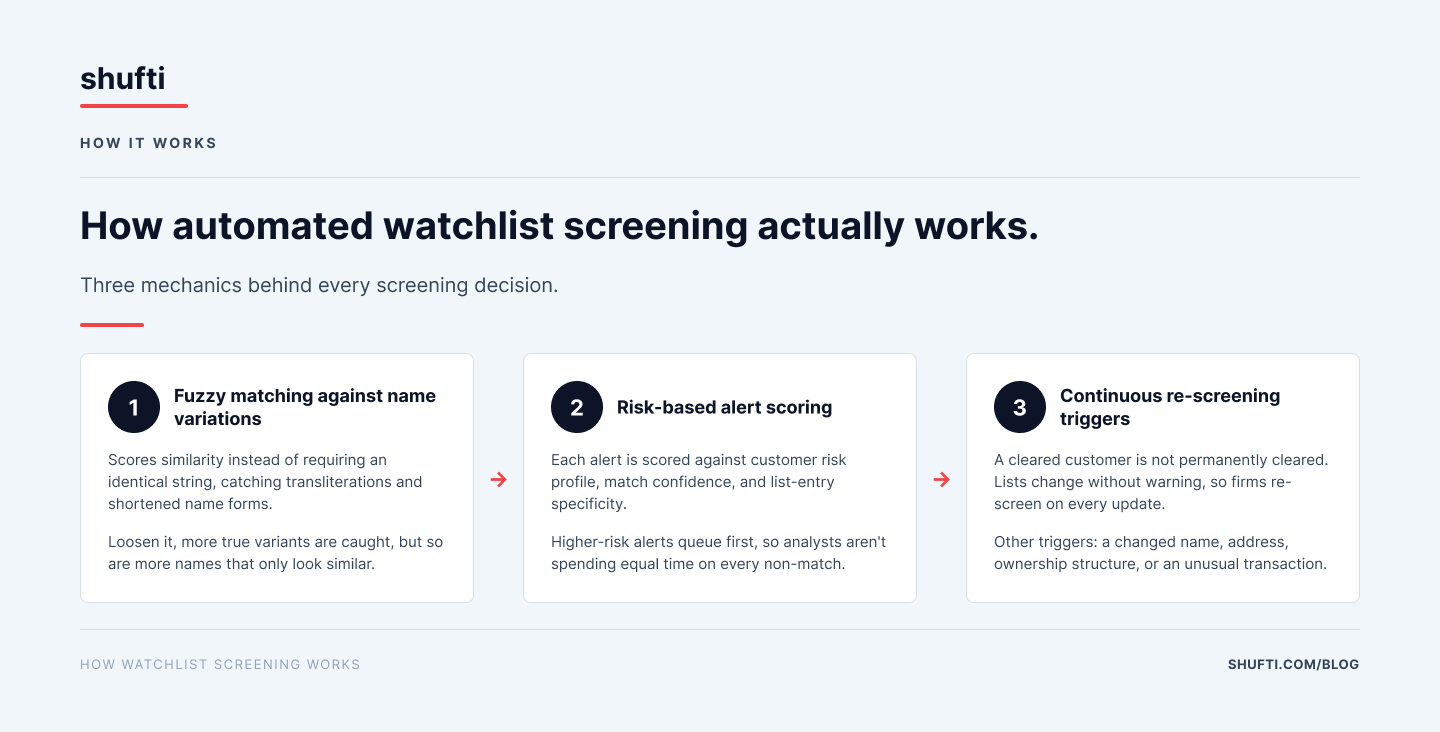
Automated watchlist screening compares a customer’s identifying details against list data using matching algorithms rather than manual lookups, then routes anything above a risk threshold to a human analyst. The mechanics split into three parts, how the system handles name variation, how it scores what counts as a match, and when it decides to check again.
Fuzzy Matching Against Name Variations:
Exact-match logic alone misses transliterated names, middle-name ordering differences, and typos, which is precisely the gap the FCA’s 2026 review flagged. Fuzzy matching algorithms score similarity rather than requiring an identical string, catching variants such as a name rendered under a different transliteration standard or a shortened form of a given name. The tradeoff is volume. Loosen the matching threshold to catch more true variants and the system also surfaces more names that only look similar. Tighten it and genuine matches slip through. Tuning that threshold correctly is the single highest-leverage decision in a screening programme, and it is exactly what the FCA found many firms had not tested properly.
Risk-Based Alert Scoring:
Not every list hit carries equal weight. A screening engine scores each alert against the customer’s risk profile, the confidence of the name match, and the specificity of the list entry, then queues higher-risk alerts for faster review. A weak partial match against a common name scores differently than an exact match against a rare name and date-of-birth combination. This scoring layer is what keeps a screening programme usable at volume. Without it, every alert receives the same priority, and analysts spend as much time on obvious non-matches as on the handful of hits that need real investigation.
Continuous Re-Screening Triggers:
A customer who cleared screening at onboarding is not permanently cleared. Sanctions lists change without warning, so most programmes re-screen the full customer base on every list update rather than waiting for a scheduled review. Additional triggers include a change in the customer’s name, address, or ownership structure, a large or unusual transaction, and periodic reviews tied to the customer’s risk rating.
Firms that only screen at onboarding are checking against a list that was accurate on day one and may not be accurate months later. Some programmes batch re-screening overnight, others run it in near real time as list updates are published, and the choice usually comes down to how quickly a firm needs to act once a customer appears on a new designation.
Why False Positives Are The Biggest Operational Drag On Screening Programmes:
Most screening alerts are not real matches. A common name, a shared date of birth, or a loose transliteration is enough to trigger a hit against a list entry that has nothing to do with the customer being screened. Clearing these alerts consumes most of a compliance team’s screening workload, and the FCA’s 2026 review linked that volume directly to under-tuned matching systems.
The collision risk is not evenly spread. Common family names concentrated in a single country, or names that transliterate into a handful of standard Latin spellings from a non-Latin script, generate disproportionately more false hits than names with more unique renderings.
A screening programme that ignores this pattern ends up over-scrutinising entire customer segments rather than the individuals who actually warrant a closer look, which is its own fairness and conversion problem on top of the compliance cost.
Every alert has to be reviewed and documented, whether it turns out to be a real match or not, because regulators expect a documented decision trail either way. That review burden scales with the number of customers screened, not with the number of real risks in the book, which is why the fix is rarely hiring more people. The fix is a better-tuned matching engine, clearer alert scoring, and a screening process that can explain why it cleared an alert, not just confirm that it did.
How Shufti Approaches Watchlist Screening
If your compliance team spends most of its week clearing alerts that turn out to be near misses on common names, the fix is rarely more headcount. It is a matching system tuned for real volume and a case trail that can show why an alert was cleared, not just that it was.
Shufti’s AML screening is a watchlist screening solution that runs sanctions, PEP, and adverse media checks against one shared decisioning model, so every cleared alert carries its own documented rationale. Coverage spans major sanctions lists including OFAC, the EU consolidated list, and UK HM Treasury, alongside 1,200+ PEP and RCA databases and adverse media in 80+ languages, with match thresholds that compliance teams tune themselves rather than accept a fixed vendor default.
See how Shufti’s AML screening clears real alerts on your own customer data by booking a 20-minute demo.
Frequently Asked Questions
What's the difference between watchlist screening and sanctions screening?
Sanctions screening is one part of watchlist screening. Sanctions screening checks only against government sanctions lists like OFAC or the UN Security Council list. Watchlist screening is the broader process, covering sanctions lists plus PEP databases, adverse media, and a firm's own internal risk lists in a single check.
How often should watchlist screening run on existing customers?
At minimum, every time an underlying list updates, since sanctions designations can be added without warning. Most compliance programmes also re-screen on a risk-based schedule, quarterly for high-risk customers and annually for standard-risk ones, plus immediately after any change to a customer's name, address, or ownership.