


 Face Verification
 Address Verification
 Document Verification
 Age Verification
 VideoIdent
 Fast ID
 Docless Verification
 Consent Verification
 NFC Verification
 Business Verification
 Due Diligence
 Investor Verification
 E-Signature

 QES
QES
 AML Screening
 Transaction Monitoring
 Adverse Media
 Business AML Screening
 PEP & RCA
 Sanctions
 Watchlist
 Behavioural Biometrics
 Device Fingerprinting
 Biometric Face Authentication
 MFA
MFA
 Fraud Hub
 Onboarding
 Ongoing Monitoring
 KYC
KYC
 KYB
KYB
 KYI
KYI
 Age Assurance
 Identity Verification
 Workforce IAM
 Candidate Verification
 Compliance
 Fraud prevention
 Trust & safety
 Global expansion
 Product Managers
 Compliance Officers
 Fraud Analysts
 Developers
 Deepfake Detection
 Bonus Abuse / Promotion Abuse
 Account Takeover
 Synthetic Identity Fraud
 Document Fraud
 Impersonation Fraud
 Multi-Accounting
 Fraud Networks
 Chargeback Fraud
 Money Mule Activity
 Party Fraud
 Regulatory & Compliance Risks
 Fintech
 Crypto
 iGaming
 Forex
Forex
 Social Network
 Marketplace
 Banking
 Gig Economy
 Payments
 Ride Hailing
 Adult Content
 Blind Spot Audit
 Deepfake Detector
 Liveness Spoofs
 Document Originality
 Document Deepfake
 Global Trust Platform
 Journey Builder
 Case Management
 Shufti AI
 Fraud Analytics
 Vendor Comparison
 Brand Personalisation
 AI Compliance Co-Pilot
 OCR
OCR
 Secure Capture
 Deployment Options
 Identity Methods
 API Documentation
 Mobile SDKs
 Service Status
 Help Center
 Contact Us
 Technical Support
 Supported Documents
 Supported Countries
 Content library
 Blogs
Blogs
 News
News
 Reports
 Insights
 Knowledgebase
 ROI calculator
 About
About
 Career
 Press Release
 Certifications
 Partnership
 Awards
 Events & Webinar
 Interactive Demo
 Podcast Studio
 Spotlight Studio
EU Instant Payments Regulation & AML Screening: What PSPs Must Do
- 01 When the EU Instant Payments Regulation Takes Effect
- 02 AML Screening Obligations the IPR Places on PSPs
- 03 Sanctions Screening in the 10-Second Payment Window
- 04 Verification of Payee Adds a Real-Time Fraud Layer
- 05 Penalties for Non-Compliance with EU Instant Payments AML Rules
- 06 How Shufti Supports PSPs on IPR AML Screening
PSPs across the EU face a deadline most compliance teams underestimated when the Instant Payments Regulation 2024 passed. From 9 October 2025, any PSP offering euro credit transfers must also send instant payments. These transfers settle in under 10 seconds, run around the clock, and carry the same fee as a standard SCT. The regulation does more than rewire payment rails. It rewrites how PSP AML screening EU-wide must work, how sanctions checks are run, and how Verification of Payee fits into onboarding.
This article covers the AML obligations the IPR places on PSPs, what EU instant payments AML screening looks like in practice, and how SEPA instant payment compliance can hold inside a 10-second window.
When the EU Instant Payments Regulation Takes Effect
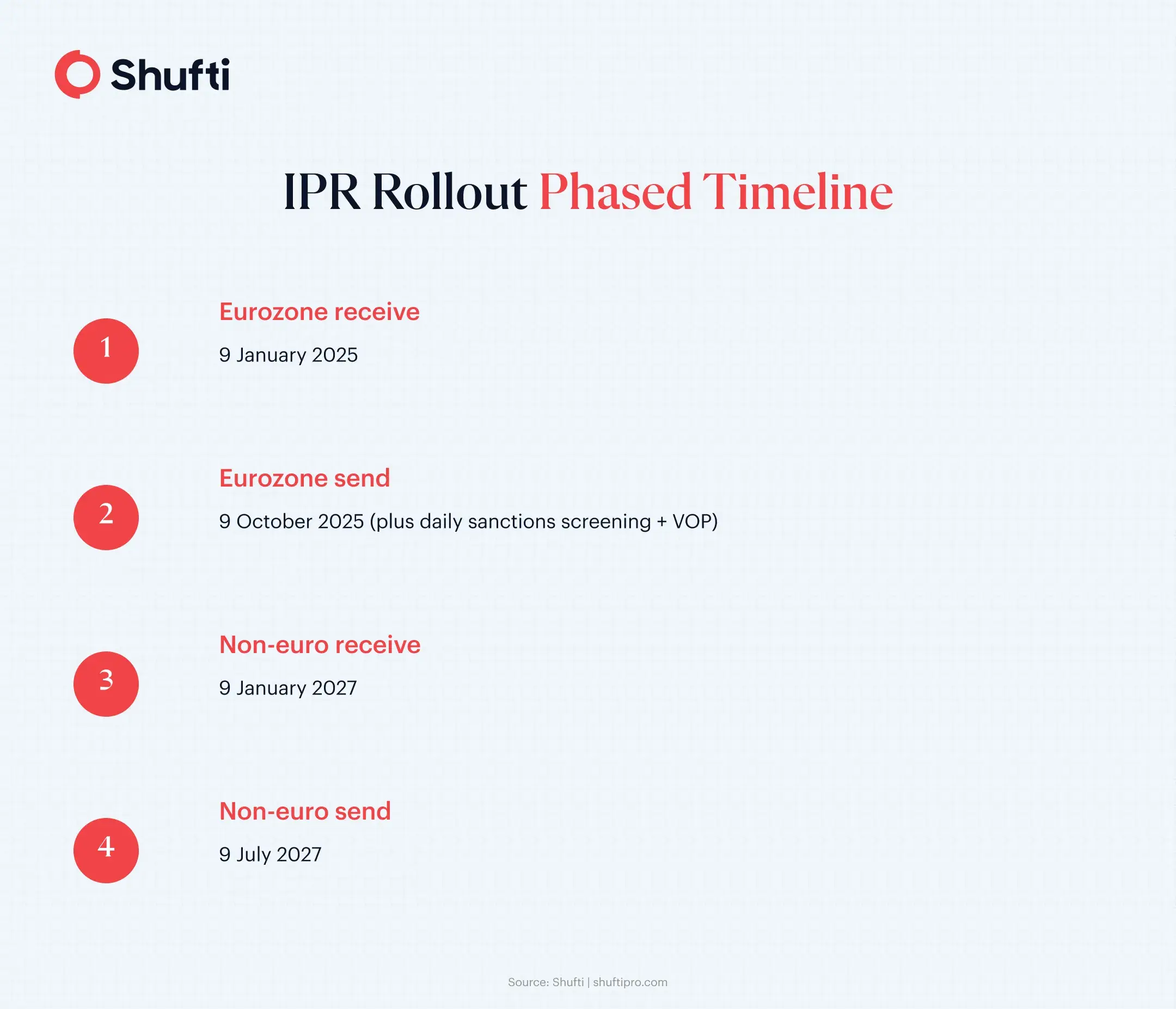
Regulation (EU) 2024/886 entered into force on 8 April 2024 with a phased rollout that splits eurozone and non-eurozone PSPs.
Eurozone PSPs had to be able to receive SEPA Instant Credit Transfers by 9 January 2025 and to send them by 9 October 2025. PSPs in non-euro Member States handling euro transactions get longer runways. Receiving applies from 9 January 2027 and sending from 9 July 2027. The European Central Bank confirmed the phased timetable for participants in the SEPA Instant scheme.
Two compliance milestones travel alongside the payment-rail dates. Daily sanctions screening of customers and Verification of Payee both kick in on 9 October 2025 for eurozone PSPs.
AML Screening Obligations the IPR Places on PSPs
The IPR amends the SEPA Regulation (260/2012) and addresses head-on how AML and sanctions controls must work when payments settle in seconds. Two changes drive most of the compliance redesign work.
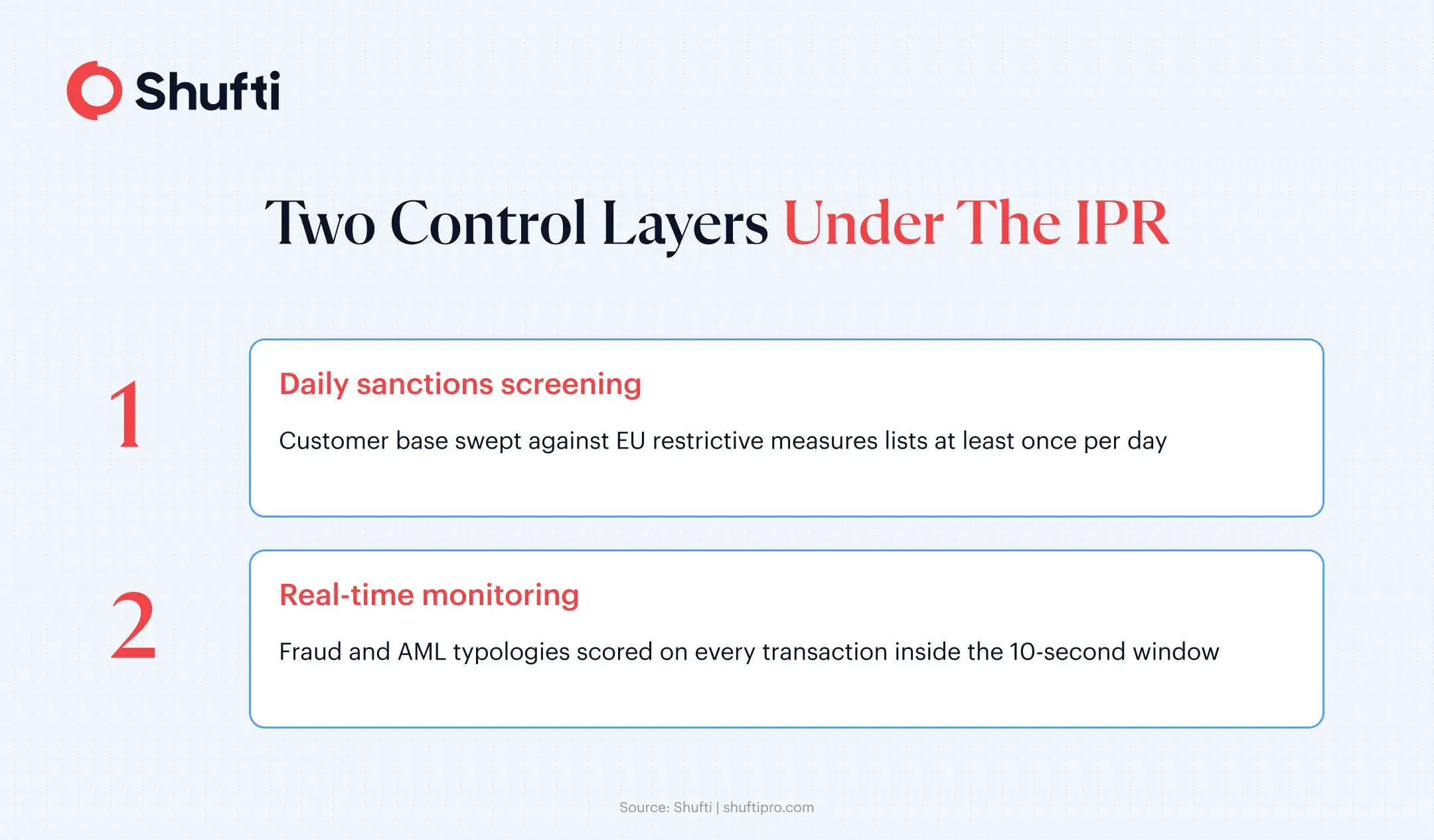
- First, Article 5d requires PSPs to screen their payment service users at least once per calendar day against EU restrictive measures lists. The unit of screening is the customer, not the transaction. PSPs check whether any of their PSUs (senders or receivers) appears on the EU consolidated sanctions list, and they do this daily as a sweep over the customer base.
- Second, the regulation does not replace AML and CFT obligations under the AML directive or the new AML Regulation (EU) 2024/1624. Transaction monitoring, suspicious activity reporting, and customer due diligence still apply to instant payments. The IPR reshapes one specific control (sanctions screening) without touching the rest of the AML framework.
In practice, this changes the operational shape of compliance teams. Daily sanctions screening replaces a transaction-level filter that, for many PSPs, ran inside the same workflow as fraud rules. The new model splits the two and demands a screening cadence reconciled against intraday list updates from the EU Council, with most firms also voluntarily covering OFAC, the UN Security Council, and UK HMT to meet correspondent-bank expectations.
For practical purposes this means PSPs need a daily sanctions screening run that covers the entire PSU base reliably, and a separate real-time monitoring layer that handles fraud and AML typologies inside the payment window.
Sanctions Screening in the 10-Second Payment Window
Banks do not need to screen every instant payment against sanctions at the transaction level under the IPR. The regulation deliberately moved the obligation from per-payment to daily customer screening because per-payment checks could not run reliably inside a 10-second window without producing false-positive rejection rates that would have made SCT Inst commercially unworkable.
This shift narrows the screening obligation but does not narrow transaction monitoring. Real-time AML controls (mule detection, structuring patterns, geographic risk scoring, behavioural anomaly flagging) still apply to instant payments, and they still need to run inside the 10-second envelope. PSPs therefore operate two parallel capabilities. The daily sanctions sweep covers the full PSU base against EU and any voluntary additional lists. The real-time monitoring layer scores transactions in flight and triggers holds, SARs, or reviewer queues based on fraud and typology signals.
The trade-off is clear. Removing per-transaction sanctions screening unlocks the 10-second commitment, but it raises the bar for the daily customer screening to be exhaustive, accurate, and reconciled against any list updates that landed in the previous 24 hours.
List freshness becomes the critical control variable here. The EU Council can publish new restrictive measures at any point during a business day, and a PSP that ran its daily sweep at 03:00 UTC against a list that updated at 09:00 UTC carries a six-hour gap where new listings are not reflected in the customer base. Some firms run two or three sweeps per day to close that gap. The IPR sets a minimum cadence, not a ceiling, and supervisors are likely to view a true once-a-day sweep as the floor of acceptable practice rather than the target.
Verification of Payee Adds a Real-Time Fraud Layer
From 9 October 2025 PSPs must also offer Verification of Payee (VOP) for every credit transfer (instant or standard) within the eurozone. The receiving PSP takes the IBAN and the payee name the sender supplied, matches them against the actual account-holder record, and returns a match, close-match, or no-match flag before the payer authorises the payment.
VOP is a fraud control on its face, but it changes the AML picture too. Authorised push-payment scams produce payments that look clean to traditional AML monitoring (the customer authorised the transfer voluntarily) but originate from social engineering. Catching the name mismatch upstream cuts the volume of suspicious payments hitting the AML reviewer queue and reduces false-positive load on transaction monitoring.
The European Payments Council operates the Verification of Payee scheme that PSPs use to interoperate. Firms that have not procured a VOP capability by the deadline will not be able to execute consumer credit transfers lawfully.
Penalties for Non-Compliance with EU Instant Payments AML Rules
The IPR leans on existing AML and SEPA enforcement provisions rather than creating a new penalty regime. PSPs that fall short on daily sanctions screening, transaction monitoring, or VOP face overlapping consequences.
Administrative fines under national AML law (often calibrated as percentages of annual turnover) come first. Supervisory enforcement actions from the national competent authority follow, and in serious cases authorisations granted under PSD2 can be revoked. Reputational damage and correspondent-bank de-risking add commercial cost on top of the regulatory fine.
The new EU Anti-Money Laundering Authority AMLA takes up direct supervision of selected large cross-border firms from 2025 onwards. AMLA’s involvement raises the practical stakes for PSPs that treat sanctions screening and monitoring as box-checking exercises rather than functioning controls.
How Shufti Supports PSPs on IPR AML Screening
PSPs working through SEPA instant payment compliance generally hit three problems at the same time. The daily sanctions screening run needs to cover a large PSU base accurately and within a tight operational window. Real-time transaction monitoring needs to flag suspicious instant payments without breaking the 10-second settlement target. And onboarding controls need to feed clean, verified customer data into both layers so screening hits reflect real risk rather than dirty records.
Shufti’s AML screening service runs sanctions, PEP, and adverse-media checks against more than 1,700 global watchlists, including EU consolidated sanctions, OFAC, UN, and UK HMT lists, with daily ongoing monitoring built in. The same platform covers KYC verification and KYB onboarding, so the customer records flowing into daily screening carry verified identity and beneficial ownership data from the start. For PSPs procuring VOP capability, the identity layer reduces the noise that name-mismatch false positives can generate downstream.
The outcome is a single compliance stack that covers the IPR’s intersecting obligations and scales to daily PSU sweeps without the false-positive overhead that legacy screening tools produce at instant-payments cadence.
Shufti’s AML screening platform gives PSPs daily sanctions monitoring, PEP and adverse-media coverage, and an integrated KYC onboarding layer built for SEPA instant payment compliance. Speak to a Shufti compliance specialist to scope a deployment ahead of your IPR deadline. Book a demo.
Frequently Asked Questions
What AML screening obligations does EU Instant Payments Regulation place on PSPs?
PSPs must screen all customers against EU restrictive measures lists at least once per day under Article 5d of the Instant Payments Regulation. Per-transaction sanctions screening is replaced by daily customer screening. Transaction monitoring under AMLD and the AML Regulation remains in force.
How must PSPs screen transactions against sanctions within the 10-second payment window?
The regulation removes per-transaction sanctions screening for SCT Inst. PSPs screen their customer base daily, so the 10-second window does not need to accommodate a sanctions check. Real-time fraud and AML transaction monitoring still apply inside the payment window.
Does EU Instant Payments Regulation require PSPs to update existing AML systems?
Most PSPs need to reconfigure sanctions screening from per-transaction to daily customer sweeps and procure Verification of Payee capability by 9 October 2025. Transaction monitoring and SAR reporting obligations under the AML framework remain in force.
What penalties apply for PSP non-compliance with EU Instant Payments AML rules?
The IPR draws on existing AML and SEPA enforcement powers. National competent authorities can impose administrative fines, issue enforcement orders, and in serious cases revoke PSD2 authorisation. AMLA will add direct supervisory pressure on large cross-border PSPs from 2025.