AMLR Solutions
  AMLR Consultation
 EUDI Wallet
 Onboarding
 Ongoing Monitoring
 FRAML
FRAML KYC
KYC KYB
KYB KYI
KYI Age Assurance
 Workforce IAM
 Candidate Verification
 Account Takeover
 Bonus/ Promotion Abuse
 Chargeback Fraud
 Deepfake
 Document Fraud
 Fraud Networks
 Impersonation Fraud
 Money Mule Activity
 Multi-Accounting
 Party Fraud
 Regulatory & Compliance Risks
 Synthetic Identity Fraud
 Adult Content
 Banking
 Crypto
 Fintech
 Forex
Forex Compliance
 Fraud prevention
 Trust & safety
 Global expansion
 Compliance Officers
 Developers
 Fraud Analysts
 Product Managers
 Journey Builder
  Global Trust Platform
 Customer Profiles
 Vendor Comparison
 IDV Case Management
 AML Case Management
 Regulatory Reporting
 Agentic Rule Builder
  AI Compliance Co-Pilot
  Fraud Analytics
 Fraud Hub
  OCR
OCR Shufti AI
 Bank Account Verification
  Biometric Duplication
 Database Checks
 Document Intelligence
 Government ID
 Mobile Driver's License
 NFC
NFC Selfie Liveness
 Brand Personalisation
 Deployment Options
 Identity Methods
 IDV Modes
 Multi-tenancy
 On-Premise IDV
 Secure Capture
 Shufti MCP


















Fraud teams keep asking the same question after a deepfake-driven onboarding incident. How did a face that looked real to the system turn out to belong to nobody?
The answer usually comes back to the same weak link. A biometric check confirmed a face was present, but not that the face was alive, in front of the camera, at that moment. That gap is what facial liveness detection is meant to close, and the gap has widened fast.
The FBI Internet Crime Complaint Center’s 2024 report logged a record $16.6 billion in reported losses, with AI-facilitated fraud flagged as a rising vector. Any identity stack that does not answer “is this person real and present right now” is exposed.
What is Facial Liveness Detection?
Facial liveness detection is the set of biometric checks that confirm a human face in front of the camera belongs to a live, physically present person, not a photo, a video replay, a 3D mask, or a synthetic video stream. It sits between face capture and face matching, and it is the layer most often bypassed when onboarding fraud succeeds. The reference standard here is ISO/IEC 30107-3:2023, which defines how presentation attack detection is tested and reported across the industry.
Two practical modes exist. Active liveness asks the user to blink, turn, or smile so a change in the feed can be measured. With a passive mode, the system analyses a single selfie or short video in the background, without any gesture. Most modern deployments run both, and risk policy decides how much friction the user sees.
The reason this layer has moved from nice-to-have to baseline is the shape of remote fraud. Face matching on its own answers a narrow question. Does this selfie match the document photo. It does not answer whether the selfie came from a real person in front of the lens, or from a video streamed in through a virtual camera. Liveness is the piece that closes that second question, and without it a face match is only half a verification.
What is Anti-spoofing in Facial Liveness Detection?
Anti-spoofing is the technical capability within liveness detection that identifies and rejects fraudulent face inputs, such as photos, replays, masks, or injected video streams, before they can pass as a legitimate live user.
How a Live Face Is Distinguished From a Spoof?
Active liveness, user action as signal
With active liveness, the user performs a small on-screen action. The system looks for motion consistent with a real person responding in real time. Micro-movements in the face, eyes, and jaw are hard to fake with a printed photo or a paused video. The trade-off is friction. Users on slow connections or in poor light can fail on the first try, and that rejection is expensive.
Passive liveness, Background Signals
Passive liveness does more work behind the scenes. Texture analysis looks for paper grain, screen moiré, and print patterns that do not exist on real skin. Frequency-domain cues are the strongest defence against digital replays because compression artefacts from re-encoded video leave a fingerprint that a live camera feed does not produce. Depth reconstruction then confirms the face has real geometry rather than a flat surface pointed at the camera.
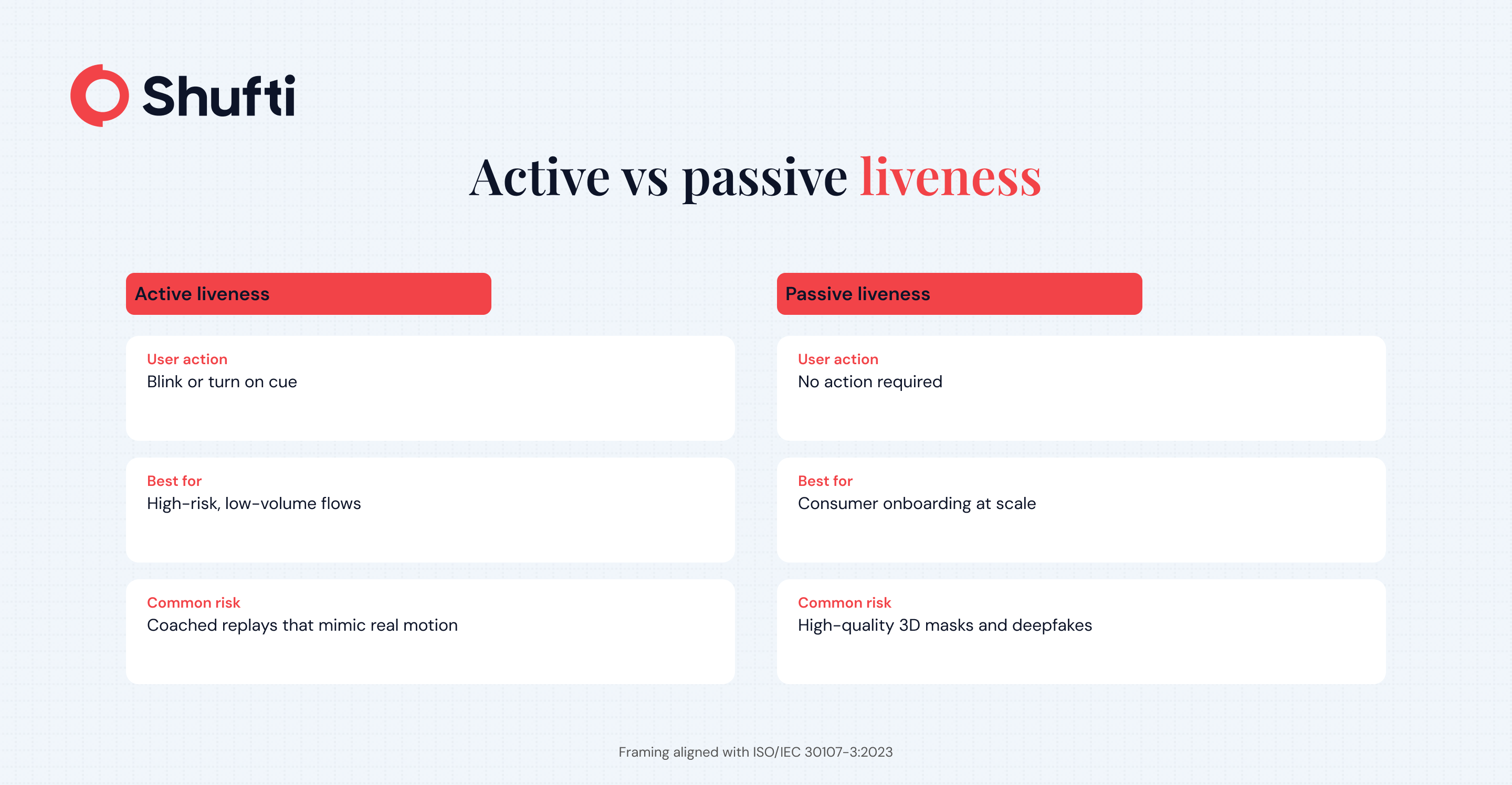
A well-configured flow combines both. That is also what the federal-level evaluation work suggests. The NIST Face Analysis Technology Evaluation, Part 10 report on passive software-based PAD algorithms found that no single algorithm caught every attack type across the range of presentation attack instruments tested, and that performance varied sharply by attack category.
The Attack Types Liveness Needs to Defeat
Practitioners evaluating a biometric stack often start with the wrong question. They ask “how accurate is it”, when the useful question is “which attacks does it actually catch”. The taxonomy breaks into two buckets.
Presentation Attacks
Presentation attacks are physical. Typical examples include a printed photo held to the lens, a laptop screen showing a pre-recorded video, and a silicone mask worn during onboarding. ISO/IEC 30107 treats these as the baseline test surface. A basic 2D RGB liveness model can usually catch a paper photo and a low-quality replay, but it struggles with high-resolution monitors, curved prints, and well-made 3D masks.
Liveness Detection for Face Recognition: Why It Cannot Be Optional
Liveness detection for face recognition closes the verification gap that biometric matching alone cannot close. A face recognition system is designed to answer one question: do these two faces belong to the same person? It does not determine whether the face presented to the camera was real, live, and physically present at the time of capture. That second question is what liveness detection answers, and it must run before the recognition step, not after it. Without that sequencing, a face match result is built on unverified input.
The practical consequence of skipping liveness upstream becomes clear in fraud scenarios. An attacker who presents a high-quality photo, a screen replay, or a deepfake-injected stream to a recognition system without a liveness gate will produce a biometric match, because the comparison is between two images, not between an image and a live person. The matching algorithm has no mechanism to detect that the input was spoofed. Liveness detection for face recognition is the control that makes the entire biometric chain trustworthy.
In regulated identity verification, this is no longer an architectural preference, it is a compliance requirement. eIDAS 2.0 specifies that high-assurance remote identity verification must include presentation attack detection. FATF guidance on remote KYC onboarding treats liveness as a prerequisite for any biometric-based identity check to carry legal weight. DHS Biometric Technology Rally results have consistently shown that systems without effective liveness controls fail at rates that are commercially and legally unacceptable. Liveness detection for face recognition is not an enhancement to the stack; it is the layer that makes the stack valid.
How Does Facial Liveness Detection Prevent Photo Spoofing?
Texture analysis detects paper grain and print patterns absent from real skin, while depth reconstruction confirms a three-dimensional face is present rather than a flat printed surface.
Injection and Synthetic Attacks
Injection attacks skip the camera entirely. Fraudsters feed a pre-generated video stream, often a deepfake, straight into the device’s camera buffer through a virtual camera driver. The system sees what looks like a normal feed, but no real face was ever present. Europol’s Innovation Lab has flagged deepfake creation as an emerging staple tool of organised crime. Synthetic identity assembly, where stolen data, a generated face, and a forged document are combined, is the fastest-growing variant.
The defensive problem here is that a good injection attack never touches a physical surface. Texture cues vanish. Depth geometry can be simulated. Frequency-domain artefacts become the strongest remaining signal, alongside device and session telemetry that reveals whether the camera stream matches what the hardware should be producing. Stacks built on 2D RGB alone were trained for a problem that has already moved on.
3D Facial Liveness Detection: How It Differs from Standard Liveness Checks
3D facial liveness detection is a method of confirming live presence by using depth sensors, structured light projectors, or time-of-flight cameras to reconstruct the physical geometry of a human face. Because the system measures real three-dimensional depth, it can reject flat presentation attacks, printed photos, screen replays, and paper masks more reliably than 2D algorithms that rely on image-level signals alone. The geometry of a real face simply cannot be replicated by a flat surface held to a camera.
The distinction between 3D facial liveness detection and its 2D counterpart becomes most significant when evaluating high-assurance use cases. Hardware-controlled environments, government ID issuance, border systems, or high-value financial account opening benefit from the physical certainty that 3D depth mapping provides. In these contexts, the additional hardware requirement is acceptable because the stakes of a successful spoof are severe.
For most commercial KYC and remote onboarding deployments, however, 2D AI-based passive liveness has become the dominant approach. It achieves equivalent or better performance against modern injection and deepfake attacks without requiring specialist sensors, and it runs on the standard cameras already in users’ devices. The right choice between 3D facial liveness detection and passive 2D depends entirely on the threat model, and increasingly, the most sophisticated threats are injection-based rather than physical, which 3D hardware alone does not address. Whether running liveness face detection through 2D AI or 3D hardware, the objective is the same, reject any input that is not a real, present person.
What are The Latest Attack Vectors Against Facial Liveness Detection?
The fastest-moving threats are deepfake injection attacks via virtual camera drivers and synthetic identity fraud combining AI-generated faces with forged documents both of which bypass physical presentation entirely and require frequency-domain and session-level defences.
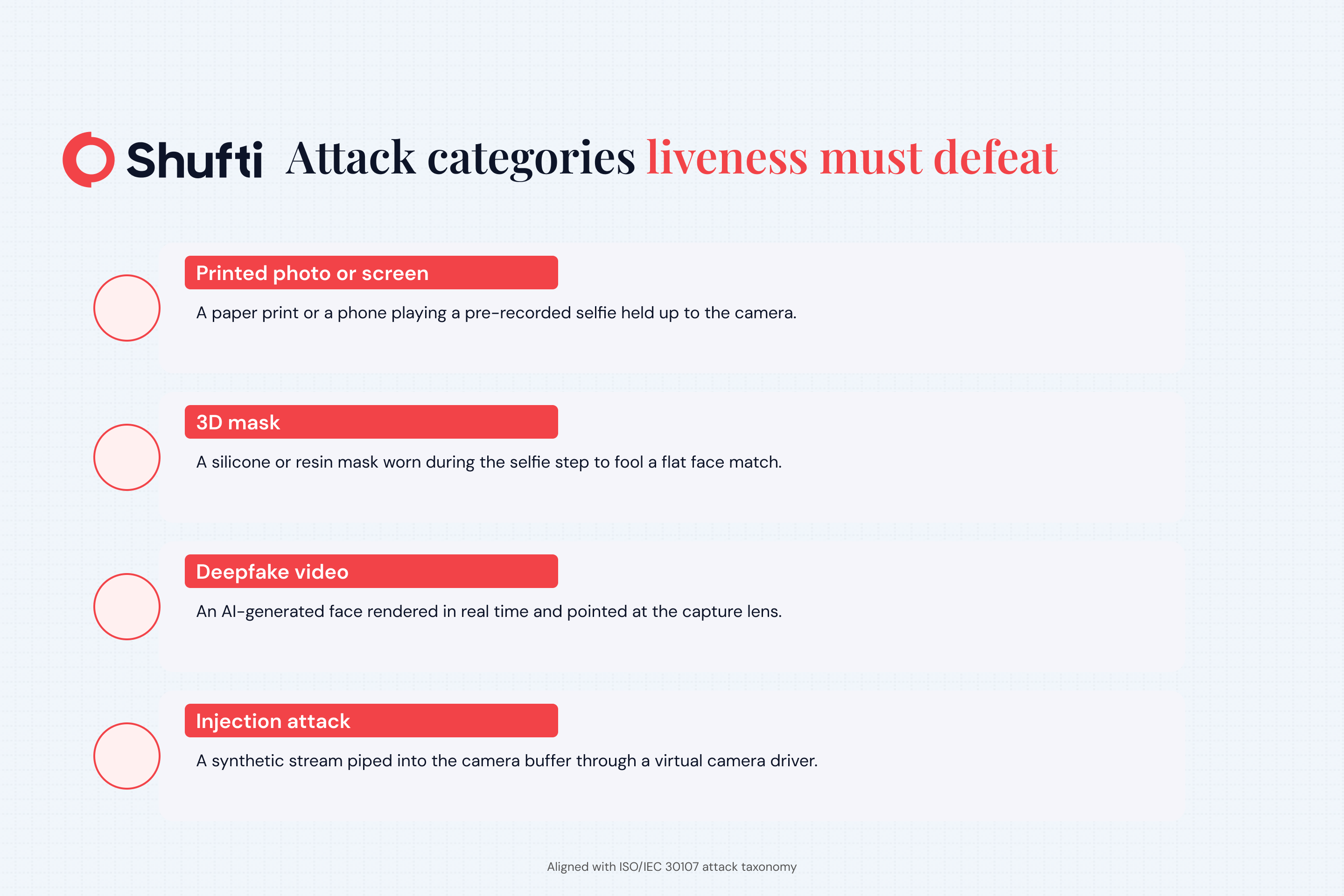
A credible liveness stack is tested against all of these, not just the cheap ones.
How to Evaluate Facial Liveness Detection in Remote Onboarding?
Regulated remote identity verification is where liveness has to hold up, and that is where most shortcuts become visible. The patterns below are what separate reliable deployments from checkbox ones.
Independent Benchmarks Matter
Internal test scores are not enough. The two external programmes worth tracking are the NIST FATE PAD evaluations, which score algorithms under a controlled protocol, and the US Department of Homeland Security’s Biometric Technology Rally, which stresses entire identity-verification stacks against realistic attack mixes. Published rally results have shown that a meaningful share of tested systems fails at least one goal. If a provider will not cite independent evaluation data, that silence is the finding.
Where Teams Get it Wrong?
Three mistakes keep showing up in post-incident reviews. The first treats liveness as a single toggle rather than a policy, with no fallback for ambiguous cases. Teams also tend to rely on a single signal type, usually 2D RGB, which is blind to frequency-domain cues.
The last mistake is running liveness only at account opening, so high-value actions like large withdrawals or beneficiary changes never get a fresh check. Mature programmes run liveness at onboarding and re-use the biometric template for step-up checks at risky moments.
One more pattern matters here. Accessibility and demographic performance shape whether a liveness programme is usable at scale. A system that fails more often on darker skin tones, older users, or users wearing glasses will either push those users to a manual channel or lose them outright. Independent evaluations, not internal lab numbers, are the way to check this. Demographic fairness and false-reject rates belong on the same scoreboard as spoof-detection performance.
Practical Next Steps For Your Evaluation
If the last face verification review was written more than 18 months ago, the threat model has changed. A short, practical exercise helps validate the current stack. Start with a red-team sample that feeds the stack a printed photo, a screen replay, a simple deepfake clip, and, if testing capacity exists, an injection attempt via a virtual camera.
Compare pass rates against ISO/IEC 30107-3 attack categories rather than vendor marketing claims. False-reject rates on legitimate users matter too, especially with glasses, beards, and in low light, because rejections kill revenue and push users to abandon legitimate sign-ups.
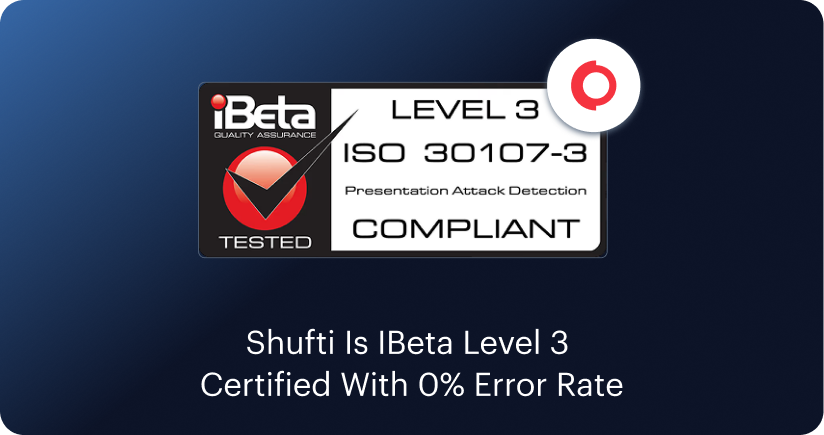
Match the evidence to the provider’s documentation next. A credible provider publishes PAD test levels aligned with ISO/IEC 30107-3, submits algorithms to NIST FATE or a DHS rally, and offers on-premises deployment for regulated environments that cannot send biometric data to a third party. Clear, verifiable answers here matter far more than any single accuracy number.
Take the Next Step in Your Liveness Evaluation
Remote onboarding cannot stand up to the current generation of presentation and injection attacks when a single, older liveness signal is doing all the work. Shufti’s face verification combines active and passive liveness, frequency-domain artefact detection, and injection attack screening across 56+ anti-spoofing vectors, independently validated at iBeta Level 1 and Level 2 and DHS RIVR 2025. Request a demo to run your current stack against a real attack sample and see where the gaps are.
Frequently Asked Questions
Does facial liveness detection affect user drop-off rates?
Yes. Active liveness adds friction that raises abandonment, particularly on mobile and slow connections. Passive liveness reduces this significantly. Drop-off impact should be tracked separately from spoof-detection performance when choosing between the two modes.
Is biometric data from liveness checks subject to privacy regulations?
In most jurisdictions, yes. Regulations such as GDPR, CCPA, and Illinois BIPA classify facial biometric data as sensitive personal data with strict rules on storage, consent, and retention. On-premises deployment options exist specifically for regulated environments that cannot transfer this data to third-party servers.
Does facial liveness detection work with medical face masks or head coverings?
Partial occlusion is a known edge case. Modern systems handle light coverings reasonably well using periocular signals around the eyes, but full-face coverings degrade accuracy. Providers should publish false-reject rates specifically for occluded-face scenarios rather than only full-face test conditions.
How is facial liveness detection tested and certified?
The primary independent frameworks are ISO/IEC 30107-3 presentation attack detection testing, iBeta Level 1 and Level 2 certification, and the US Department of Homeland Security's Biometric Technology Rally. Vendor self-reported accuracy figures are not a substitute for results from these programmes.