AMLR Solutions
  AMLR Consultation
 EUDI Wallet
 Onboarding
 Ongoing Monitoring
 FRAML
FRAML KYC
KYC KYB
KYB KYI
KYI Age Assurance
 Workforce IAM
 Candidate Verification
 Account Takeover
 Bonus/ Promotion Abuse
 Chargeback Fraud
 Deepfake
 Document Fraud
 Fraud Networks
 Impersonation Fraud
 Money Mule Activity
 Multi-Accounting
 Party Fraud
 Regulatory & Compliance Risks
 Synthetic Identity Fraud
 Adult Content
 Banking
 Crypto
 Fintech
 Forex
Forex Compliance
 Fraud prevention
 Trust & safety
 Global expansion
 Compliance Officers
 Developers
 Fraud Analysts
 Product Managers
 Journey Builder
  Global Trust Platform
 Customer Profiles
 Vendor Comparison
 IDV Case Management
 AML Case Management
 Regulatory Reporting
 Agentic Rule Builder
  AI Compliance Co-Pilot
  Fraud Analytics
 Fraud Hub
  OCR
OCR Shufti AI
 Bank Account Verification
  Biometric Duplication
 Database Checks
 Document Intelligence
 Government ID
 Mobile Driver's License
 NFC
NFC Selfie Liveness
 Brand Personalisation
 Deployment Options
 Identity Methods
 IDV Modes
 Multi-tenancy
 On-Premise IDV
 Secure Capture
 Shufti MCP











Main Takeaway
- Most teams leave Veriff over data residency, hard-market accuracy, or pricing.
- Veriff is SaaS-only with EU residency on AWS, no on-premises option.
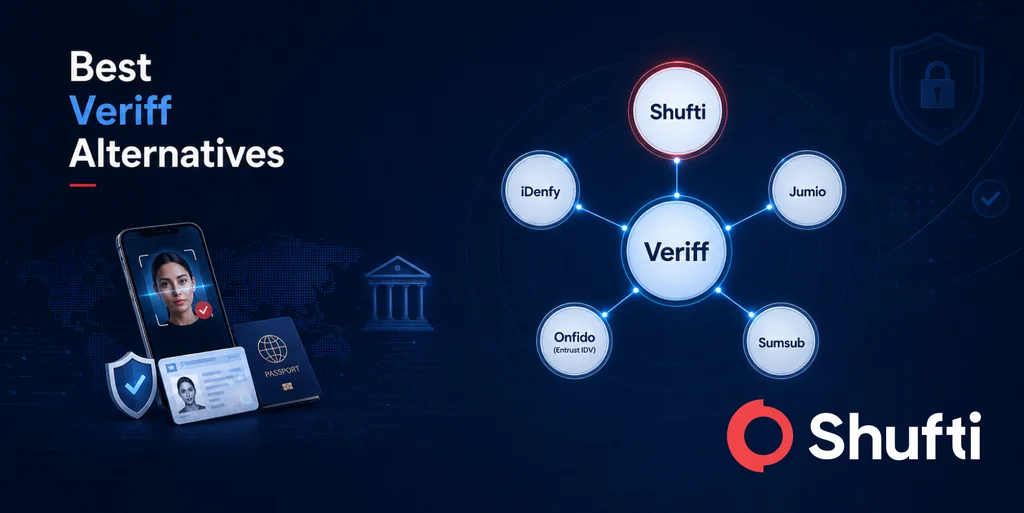
- The five strongest alternatives span enterprise, SMB, and full-stack ownership.
- Technology ownership, not feature count, separates these vendors in practice.
- The right vendor reveals itself when tested against your hardest verification cases.
- Veriff rates 1.4 with 200+ reviews on Trustpilot while Shufti rates 4.8 with 3000+ reviews on the same platform.
- The G2 rating for Veriff is 4.5 with 61 reviews while Shufti rates 4.6 with 120+ reviews.
Teams rarely shop for a Veriff alternative because the product stopped working. They shop because a constraint surfaced that the architecture cannot move past: a regulator that demands on-premises and in-country data residency, Veriff does not offer, pass rates that sag on Vietnamese or Indonesian documents, or a finance team questioning per-verification cost as volume scales. Those pressures are intensifying.
This guide compares five identity verification vendors against Veriff on the criteria that actually decide a switch.
Why do businesses look for Veriff alternatives?
Veriff, headquartered in Estonia, runs AI-driven document and biometric verification across 240+ countries with 12,000+ supported document template types and an average verification time of nearly one minute, per Veriff’s website. It is a capable SaaS product with a 4.5/5 rating across 61 reviews. What pushes buyers to look elsewhere is deployment and cost, and end-user experience.
The most common trigger is deployment. Veriff is SaaS-only with EU data residency hosted on AWS, and offers no on-premises or local-cloud option, which rules it out for organizations bound by data-sovereignty frameworks such as Saudi Arabia’s PDPL, the UAE’s NESA, Thailand’s PDPA, or Indonesia’s OJK.
The cost and consumer experience also plays a role. G2 reviewers note pricing can run high against simpler tools, and Veriff’s Trustpilot rating sits at 1.4/5 across 200+ reviews, with recurring complaints about legitimate submissions being rejected. None of these is disqualifying on its own. Together, they explain why a Veriff pricing comparison or a search for a cheaper, more deployable alternative usually starts here.
What to look for in a Veriff alternative in 2026?
The right replacement is not the vendor with the longest feature list. It is the vendor whose architecture removes the specific constraint that pushed you off Veriff. Six criteria separate the field.
Technology ownership versus orchestrated stacks
The single most consequential difference between IDV vendors is whether they own their technology or orchestrate third-party components. A vendor that licenses liveness from one provider, OCR from another, and document forensics from a third has fragmented accountability when something breaks, and cannot retrain a model on its own timeline because it waits on a partner’s release cycle. Ownership has downstream effects on pricing, customizability, dependability, and data security through a single chain of custody. It is the criterion most likely to matter two years after you switch.
Hard-market document accuracy
If your users live outside the US and Western Europe, ask what each vendor’s models were trained on. Tools built primarily on EU and US documents treat Vietnamese, Indonesian, Brazilian, and GCC IDs as edge cases, which shows up as lower pass rates and more manual review. Vendors that trained on those documents from the start, rather than retrofitting them, hold a measurable accuracy advantage in exactly the markets where Veriff users report the most friction.
Independent liveness conformance
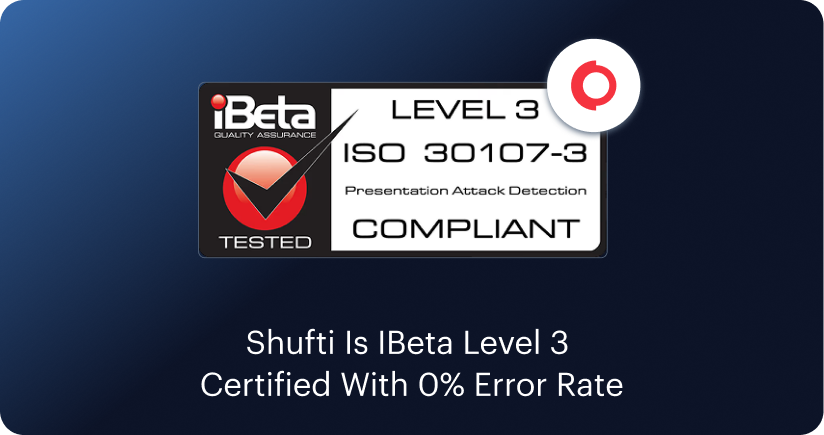
Deepfakes and injection attacks are now the dominant biometric threat vector, so independent liveness testing matters more than vendor self-claims. The reference standard is iBeta conformance under ISO/IEC 30107-3. iBeta Level 3, introduced in mid-2025, is the highest published tier and is held by only three vendors globally. Level 2 conformance, whether held directly or through a liveness partner such as FaceTec, is the common baseline. A vendor with no independent submission at any level is asking you to take spoofing resistance on faith.
Deployment flexibility
Since deployment is the most common reason teams leave Veriff, it deserves explicit scrutiny. SaaS-only vendors cannot serve organizations under strict data-residency laws. If you operate in the GCC, Southeast Asia, or any regime requiring data to stay in-country, you need a vendor offering local-cloud or on-premises deployment, not just regional SaaS hosting.
Doc-less and eID verification depth
Document upload is where onboarding conversion leaks. The strongest vendors reduce that drop-off with passive verification against authoritative data sources and active electronic-ID integrations (BankID, Singpass, MitID, OneID), so a returning user can be verified without photographing a passport. Depth here, measured in data-source count, country coverage, and live eID connections, directly affects pass rates.
Migration path off your current provider
A Veriff alternative is only worth choosing if you can switch without breaking onboarding. Practical migration means running the new vendor in parallel on live traffic before cutover, mapping your existing data fields to the new API, retaining historical verification records for audit continuity, and defining whether existing users are grandfathered or re-verified. Vendors with mature APIs and migration support shorten this from a quarter-long project to a phased rollout.
The 5 best Veriff alternatives in 2026
As the publisher of this guide, we list Shufti first for transparency. The remaining four vendors are listed alphabetically and described on the same factual basis. Each entry includes an overview, key strengths, considerations, certifications and recognitions, current public ratings, and the use case the vendor is best suited to. All product details are sourced from each vendor’s public website, the KuppingerCole Analysts 2025 market assessment, public iBeta conformance listings, and verified review platforms.
Veriff alternatives compared at a glance
The Veriff baseline row is included at the bottom so you can read each alternative against the incumbent you are replacing.
| Vendor | Technology ownership | iBeta liveness level | Deployment | G2 rating | Trustpilot | Best fit |
| Shufti | Own IP (full stack) | L3 | SaaS, Local Cloud, on-prem | 4.6 (130+) | 4.8 (3,800+) | Teams verifying users across multiple regions who also need on-premises or local-cloud deployment |
| iDenfy | Orchestrated (i.e., FaceTec liveness) | Via FaceTec (L2) | SaaS | 4.9 (220) | 4.1 (26) | Smaller or growing businesses that want KYC and AML in one bundle |
| Jumio | Partially orchestrated | L2 | SaaS | 4.0 (22) | 1.4 (85) | Existing clients prone to migrate mission-critical systems |
| Onfido (Entrust IDV) | Orchestrated (iProov, Namirial) | L2 | SaaS | 4.3 (114) | 1.1 (369) | Organizations already in the Entrust ecosystem or needing qualified electronic signatures |
| Trulioo | Own + partners (IDMerit) | L2 (facial biometrics) | SaaS | 4.4 (40) | 2.8 (3) | KYB-heavy and emerging-market programs that need deep, non-document data-source verification |
| Veriff (incumbent) | Own | L2 | SaaS (EU residency, AWS) | 4.5 (61) | 1.4 (222) | Businesses verifying primarily EU and US users who are comfortable with SaaS-only delivery |
Sources: KuppingerCole Analysts 2025 market assessment, public iBeta conformance listings, vendor public sites, G2.com vendor profiles, Trustpilot vendor profiles. All data accurate as of June 2026; verify directly with each vendor before procurement.
#1. Shufti
Shufti is a UK-headquartered KYC and AML vendor built entirely on owned intellectual property: OCR, liveness detection, document intelligence, KYC, KYB, and AML, all developed and maintained in-house rather than licensed from partners. That ownership is what made Shufti a genuinely ‘Glocal’ IDV vendor: the same architecture verifies a US driver’s licence with the same engineering control as a Vietnamese national ID, an Indonesian KTP, or a Saudi national ID, and the engineering team can retrain models for any country or vertical challenge on its own release timeline. It is the architecture that mainstream IDV players turned to when their orchestrated stacks struggled with non-Latin scripts. For teams leaving Veriff over hard-market accuracy or deployment limits, it addresses both constraints directly.
Key strengths:
Shufti is trained on and actively verifying 10,000+ document types across 240+ countries and jurisdictions every month, not just listed in a lifetime catalogue. Its in-house OCR reaches 99.7% accuracy across 150+ languages and scripts and outperforms Google Vision on various non-Latin scripts.
It holds iBeta Level 3 conformance under ISO/IEC 30107-3, the highest published independent presentation-attack detection standard, held by only three vendors globally. Its doc-less identity hub spans 270+ authoritative data sources for passive checks across 95+ countries, plus 40+ active eID integrations including BankID, Singpass, MitID, and OneID, with three eIDV modes (Passive, Active, Biometrically Enriched) served through a single API.
It supports physical IDs, Digital IDs and EUDI Wallets, NFC chip verification, and Qualified Electronic Signatures under eIDAS 2.0. Public clients include Binance, Stripe, ByteDance/TikTok, XM, and Coinbase. Compared with Veriff, the practical differences are full-stack ownership instead of a liveness partner, on-premises deployment, and models built for non-Latin documents from the start.
Considerations:
Shufti has a smaller commercial presence in North American markets than US-headquartered peers, which is a brand-awareness and contracting consideration rather than a capability one. Pricing varies by deployment model and is not published per-transaction; enterprise and on-premises contracts are quoted directly.
Deployment Options:
- SaaS
- Cloud
- Local Cloud
- On-premise for data-residency compliance
Certifications and recognitions:
- iBeta Level 3 conformance under ISO/IEC 30107-3
- DHS RIVR 2025 Top Performer: 98.49% True Accept Rate, zero False Template Creation events in the U.S. Department of Homeland Security Remote Identity Validation Rally 2025
- SOC 2 Type II
- PCI DSS
- GDPR compliance, Cyber Essentials, Cyber Essentials Plus
- HIPAA compliance
- Leader, G2 Summer 2026 Identity Verification Grid
- KuppingerCole Analysts 2025: highest overall technical capability score (79/100) and the only vendor in the market positioning assessment with no partner dependencies across core capabilities
Ratings (as of June 2026):
- Shufti G2 Reviews: : 4.5/5
- Shufti Trustpilot Reviews: 4.8/5 (3,800+ reviews), the highest Trustpilot rating and volume combination among the vendors compared
Best for:
Buyers replacing Veriff because of data-residency limits, weak non-Latin document performance, or the absence of an on-premises option, and any organization that wants one vendor to cover document verification, biometrics, doc-less checks, and AML without stitching partners together. The positioning is simple: One platform. Fully owned technology. Global coverage with real local depth.
#2. iDenfy
iDenfy is a Lithuania-headquartered identity verification and fraud-prevention vendor known for an SMB-friendly, all-in-one KYC and AML platform with responsive support. Its 3D liveness is powered by FaceTec, integrated to add presentation-attack detection to the platform, per Biometric Update.
Key strengths:
iDenfy supports 3,000+ document types across 240+ countries and more than 60 digital ID types, including Swedish BankID, the UK’s OneID, Estonian Smart-ID, and, per a June 2026 expansion, Denmark’s MitID. It bundles ID verification, AML screening, and business verification under one contract, and is consistently praised for ease of integration and customer support. For teams leaving Veriff over price, iDenfy’s transparent, lower-volume-friendly pricing is a frequent draw.
Considerations:
iDenfy’s liveness depends on FaceTec, which holds iBeta PAD Level 1 and Level 2 conformance; iDenfy does not hold an independent iBeta filing under its own name. Its document and country coverage is narrower than that of the largest enterprise vendors, and its commercial footprint is smaller, which can matter for very high-volume global deployments.
Certifications and recognitions:
- ISO/IEC 27001:2022 (certificate issued by TÜV Thüringen under DAkkS accreditation)
- SOC 2 Type II
- FaceTec liveness with iBeta PAD Level 1 and Level 2 conformance under ISO/IEC 30107-3
- GDPR compliance
Ratings (as of June 2026):
- Trustpilot: 4.1/5 (26 reviews)
- G2: 4.9/5 (220 reviews)
Best for:
Small and mid-sized businesses and scaling fintechs that want an easy-to-integrate, well-supported KYC and AML bundle at predictable pricing, particularly across Europe, and that do not require on-premises deployment or the deepest hard-market document coverage.
#3. Jumio
Jumio is a US-headquartered identity verification provider with one of the largest enterprise customer bases in the category. Jumio uses iProov for liveness and moved that capability in-house in late 2024.
Key strengths:
Jumio supports 5,000+ document types across roughly 42 languages and is a default shortlist entry for large, mature-market enterprises that prioritize vendor scale and an established compliance track record. Its breadth of integrations and enterprise tooling is well-suited to organizations standardizing identity verification across multiple business units.
Considerations:
Jumio’s document and language coverage trails the widest-coverage vendors, and its consumer-facing reputation is weak: its Trustpilot rating sits at 1.5/5 across 82 reviews. Like Veriff, it is a SaaS product without the local-cloud or on-premises flexibility that data-residency regimes require.
Certifications and recognitions:
- ISO/IEC 27001:2022
- SOC 2 Type 2
- PCI DSS
- iBeta Level 2 PAD conformance under ISO/IEC 30107-3
Ratings (as of June 2026):
- Trustpilot: 1.4/5 (85 reviews)
- G2: 4.0/5 (22 reviews)
Best for:
Established enterprises in mature Western markets that prioritize vendor scale and an existing large-deployment relationship over architectural ownership or deployment flexibility.
#4. Onfido (Entrust IDV)
Onfido, founded in the UK, was acquired by Entrust in April 2024 and rebranded as Entrust IDV. it orchestrates several partners, including iProov, Namirial, and SecureKey, and uses human reviewers as a fallback for non-Latin script OCR, which adds cost and latency.
Key strengths:
Onfido supports 6,000+ government-issued IDs across roughly 44 languages and is now embedded in Entrust’s broader security and credential portfolio, which appeals to organizations consolidating identity, authentication, and PKI under one vendor relationship. It holds ETSI certification for QES under eIDAS, supporting qualified electronic signature use cases.
Considerations:
The reliance on human review for complex non-Latin documents is a structural cost-and-speed consideration, and analysts have observed a slower innovation pace following the acquisition. Its Trustpilot rating is 1.1/5 across 363 reviews, reflecting consumer-side friction.
Certifications and recognitions:
- ISO/IEC 27001 (BSI certified, IS 660122)
- SOC 2 Type II
- ETSI-certified IDV for QES under eIDAS
- iBeta Level 2 PAD conformance under ISO/IEC 30107-3
Ratings (as of June 2026):
- Trustpilot: 1.1/5 (369 reviews)
- G2: 4.3/5 (114 reviews)
Best for:
Enterprises with existing Entrust security relationships, or those prioritizing government-sector deployment and qualified electronic signatures alongside identity verification.
#5. Trulioo
Trulioo is a Vancouver, Canada-headquartered identity verification vendor, founded in 2011 and built around its GlobalGateway platform. Its stack combines owned technology with partners such as IDMerit, per the Gartner Magic Quadrant for Identity Verification 2025, and its core differentiator is depth in non-document, data-source verification rather than document scanning alone.
Key strengths:
GlobalGateway draws on 450+ data sources, including government registers, credit bureaus, and telecom operators, across 240+ countries, alongside 14,000+ document types, per Trulioo’s public site. That data-source depth lets Trulioo verify users passively in markets where document capture alone has gaps, which is why J.P. Morgan Payments selected Trulioo for identity verification services in 2023, per PYMNTS, and Trulioo also partners with Mastercard on identity verification. Its facial biometric technology holds iBeta Level 2 conformance under ISO/IEC 30107-3, per Trulioo’s own newsroom.
Considerations:
Trulioo’s iBeta conformance covers its facial biometrics specifically at Level 2, not the Level 3 tier, and G2 reviewers note that match rates can be inconsistent in some of the harder-to-reach markets it lists among its 240+ countries. Its Trustpilot rating sits at 2.8/5, reflecting consumer-side friction similar to other enterprise IDV vendors on this list.
Certifications and recognitions:
- ISO/IEC 27001 (certified since 2015)
- SOC 2 Type 2 (since February 2024)
- iBeta Level 2 PAD conformance for facial biometrics under ISO/IEC 30107-3
Ratings (as of July 2026):
- Trustpilot: 2.8/5 (3 reviews)
- G2: 4.4/5 (40 reviews)
Best for:
Buyers, particularly in KYB-heavy or emerging-market programs, who need deep non-document identity verification drawing on authoritative data sources rather than document capture alone.
How to choose the right Veriff alternative for your business?
The vendor that fits is the one that handles your verification cases under your specific regulatory regime, with a deployment model that meets your data-residency requirements. Most teams leaving Veriff fall into one or more of four situations.
Scenario 1: You left Veriff over data residency or the lack of on-premises
This is the most common driver, and it eliminates most of the field immediately, because Jumio, Onfido, Trulioo, and Veriff themselves are all SaaS-only. Shufti is the primary fit here, offering SaaS, Cloud, Local Cloud, and on-premises deployment for frameworks such as PDPL, NESA, PDPA, and OJK, so data can stay in-country without re-platforming. If your residency requirement is EU-only, iDenfy’s EU-hosted SaaS may suffice, but it does not extend to GCC or Southeast Asian on-premises mandates.
Scenario 2: You need stronger accuracy on non-Latin and hard-market documents
If your pass rates dropped on Vietnamese, Indonesian, Brazilian, or GCC documents, the issue is training data. Shufti is the primary fit, with owned models trained on those documents from inception, 99.7% OCR accuracy across 150+ languages, and public clients (Binance, Stripe, ByteDance/TikTok) operating in exactly this profile. Onfido’s human-review fallback for non-Latin OCR can close gaps but adds cost and latency rather than solving the accuracy question structurally.
Scenario 3: You face high deepfake and injection-attack exposure
For crypto, forex, gaming, and fintech, independent liveness conformance is the deciding factor. Shufti is the most defensible choice, holding iBeta Level 3 conformance, one of only three vendors globally, with full-stack ownership that lets it ship defence updates on its own timeline. Vendors without an independent iBeta submission at any level should be treated cautiously in this scenario, and even Level 2 conformance, the tier held by Jumio, Onfido, Trulioo, and Veriff on this list, should be weighed against your organization’s specific deepfake threat profile.
Scenario 4: You are an SMB or scaling team that wants simple integration and predictable pricing
If the move off Veriff is mainly about cost and ease, iDenfy is a strong specialist fit, with an all-in-one KYC and AML bundle, transparent pricing, and a 4.9/5 G2 rating built on ease of use and support. Teams that expect to scale into multiple regions or data-residency regimes later should weigh Shufti’s broader architecture to avoid a second migration.
Marketing pages don’t reveal the right vendor. Verification performance on your actual traffic does. The procurement question is which vendor’s structural advantages match your specific verification reality: where your users live, which compliance regimes you face, how you deploy, and how exposed you are to AI-driven fraud. For most buyers facing more than one of those questions, Shufti’s combination of full-stack ownership, iBeta Level 3 conformance, deployment flexibility, and doc-less depth is the broadest single vendor answer. The only way to confirm is a proof of concept on your hardest documents, in your highest-risk markets, with your fraud team running attack scenarios.
Run a proof of concept on your hardest verification cases, and benchmark the result against any vendor on this list, through a live walkthrough with Shufti.
Frequently Asked Questions
What is the best Veriff alternative in 2026?
There is no single best alternative; it depends on your constraints. For broad global coverage with data residency and on-premises deployment, Shufti is the strongest single-vendor option. For an SMB-friendly KYC and AML bundle at predictable pricing, iDenfy is a strong fit.
What are the top alternatives to Veriff in 2026?
The five strongest alternatives are Shufti, iDenfy, Jumio, Onfido (now Entrust IDV), and Trulioo. They differ mainly in technology ownership, deployment flexibility, hard-market document accuracy, and independent liveness conformance, which are the factors most likely to have driven you off Veriff.
How does AI improve identity verification compared to Veriff?
Vendors with owned, full-stack AI can retrain models for specific markets and threats on their own timeline rather than waiting on partners. That improves OCR accuracy on non-Latin documents and tightens deepfake defence. Shufti, for example, reports 99.7% OCR accuracy across 150+ languages and holds iBeta Level 3 liveness conformance.
Which Veriff alternative is best for fintech companies?
It depends on regulatory reach. Shufti suits fintechs needing multi-market coverage, AML, and data residency under one platform. Trulioo fits fintechs and KYB programs that need deep, non-document verification across many data sources, including emerging markets. iDenfy suits smaller fintechs wanting an easy, cost-predictable KYC and AML bundle.
Why do businesses look for Veriff alternatives?
Common reasons are Veriff's SaaS-only deployment with no on-premises option for data-residency law, EU and US training-data weighting that narrows accuracy on non-Latin documents, per-verification pricing concerns at scale, and consumer-side rejection complaints reflected in its 1.7/5 Trustpilot rating.
How do you migrate from Veriff to another provider?
Run the new vendor in parallel on live traffic before cutover, map your existing data fields to the new API, retain historical verification records for audit continuity, and decide whether existing users are grandfathered or re-verified. Vendors with mature APIs and migration support make this a phased rollout rather than a hard switch.