



 Face Verification
 Address Verification
 Document Verification
 Age Verification
 VideoIdent
 Fast ID
 Docless Verification
 Consent Verification
 NFC Verification
 Business Verification
 Due Diligence
 Investor Verification
 E-Signature

 QES
QES
 AML Screening
 Transaction Monitoring
 Adverse Media
 Business AML Screening
 PEP & RCA
 Sanctions
 Watchlist
 Behavioural Biometrics
 Device Fingerprinting
 Biometric Face Authentication
 MFA
MFA
 Fraud Hub
 Onboarding
 Ongoing Monitoring
 KYC
KYC
 KYB
KYB
 KYI
KYI
 Age Assurance
 Identity Verification
 Workforce IAM
 Candidate Verification
 Compliance
 Fraud prevention
 Trust & safety
 Global expansion
 Product Managers
 Compliance Officers
 Fraud Analysts
 Developers
 Deepfake
 Bonus Abuse / Promotion Abuse
 Account Takeover
 Synthetic Identity Fraud
 Document Fraud
 Impersonation Fraud
 Multi-Accounting
 Fraud Networks
 Chargeback Fraud
 Money Mule Activity
 Party Fraud
 Regulatory & Compliance Risks
 Fintech
 Crypto
 iGaming
 Forex
Forex
 Social Network
 Marketplace
 Banking
 Gig Economy
 Payments
 Ride Hailing
 Adult Content
 Blind Spot Audit
 Deepfake Detector
 Liveness Spoofs
 Document Originality
 Document Deepfake
 Global Trust Platform
 Journey Builder
 Case Management
 Shufti AI
 Fraud Analytics
 Vendor Comparison
 Brand Personalisation
 IDV Modes
 AI Compliance Co-Pilot
 OCR
OCR
 Secure Capture
 Deployment Options
 Identity Methods
 API Documentation
 Mobile SDKs
 Service Status
 Help Center
 Contact Us
 Technical Support
 Supported Documents
 Supported Countries
 Content library
 Blogs
Blogs
 News
News
 Reports
 Insights
 Knowledgebase
 ROI calculator
 About
About
 Career
 Press Release
 Certifications
 Partnership
 Awards
 Events & Webinar
 Interactive Demo
 Podcast Studio
 Spotlight Studio
iGaming Address Verification: Geolocation, PoA and Compliance 2026

TL;DR
- Address verification is a core compliance requirement for iGaming operators. Regulators such as the UKGC, KSA, Spelinspektionen, and German authorities require operators to verify player identity, address, and jurisdiction as part of KYC and AML obligations.
- Fake addresses and VPN usage increase regulatory and fraud risks. Players may use false address information or location-masking tools to bypass jurisdictional restrictions, claim ineligible bonuses, or evade responsible gambling controls.
- UKGC’s 2026 deposit limit requirements raise the importance of address verification. Effective enforcement of player protection measures depends on confirming where players actually reside and whether they are accessing services from permitted jurisdictions.
- Modern iGaming verification combines multiple layers. Operators use doc-less database checks, proof-of-address (PoA) documents, forensic document analysis, and geolocation signals to validate player residency and detect fraud.
- Integrated address verification and geolocation solutions improve compliance and user experience. A risk-based workflow can verify most players in seconds while escalating higher-risk cases to enhanced due diligence, helping operators meet regulatory requirements without creating unnecessary onboarding friction.
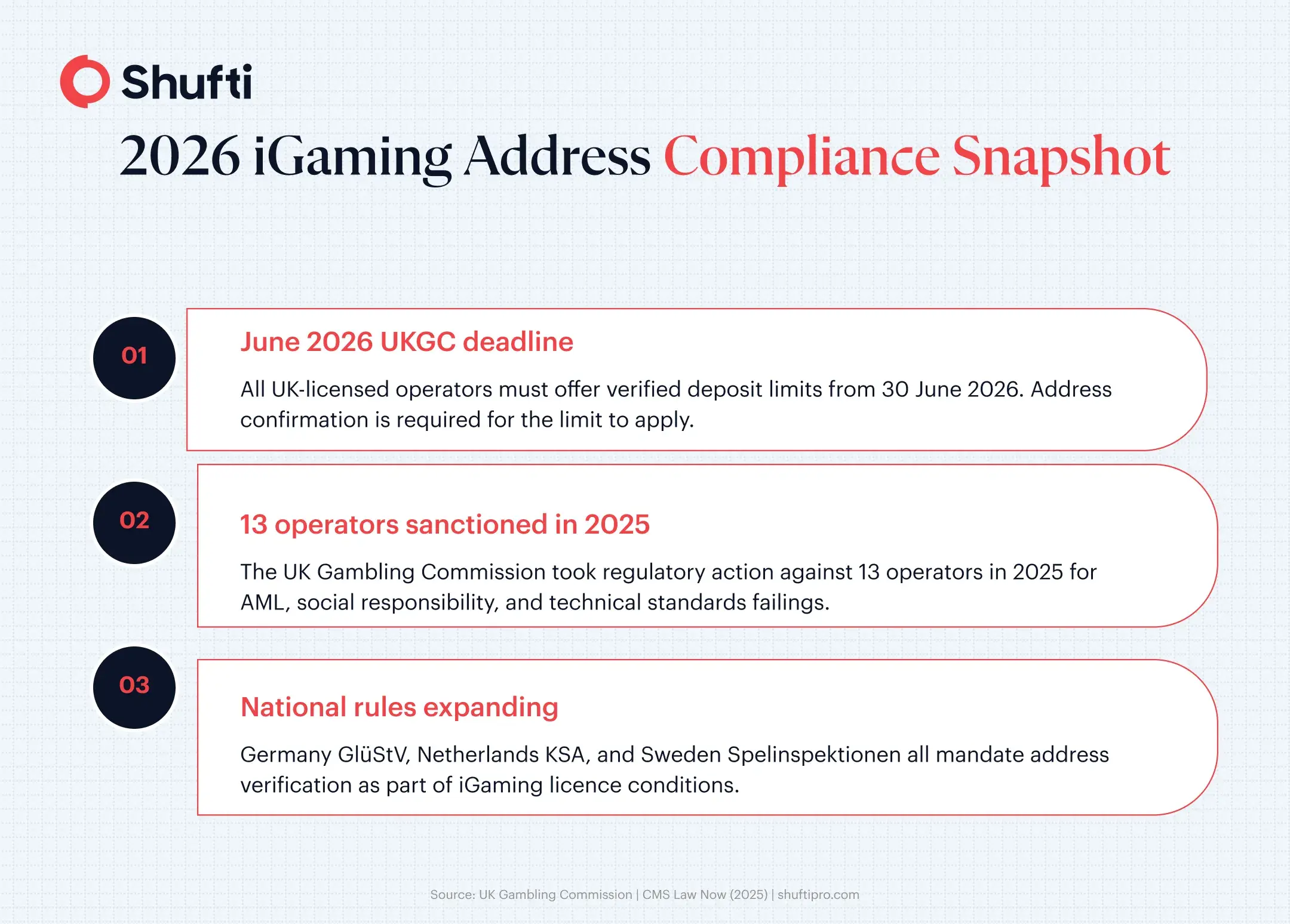
From 30 June 2026, every UK-licensed online casino must offer customers a verified deposit limit under the UK Gambling Commission’s (UKGC) revised Remote Technical Standards, and that obligation only holds if operators know where each player actually lives. For a player who registered with a spoofed address or connected through a virtual private network (VPN), that limit may never apply. The iGaming address check gap at onboarding is not a side issue. Deposit limits, jurisdictional access controls, and AML reporting obligations all hinge on whether a player’s declared address is real. Operators need a clear picture of where the requirement comes from, how the regulatory stakes have risen in 2026, and what the verification workflow must handle.
Address verification for iGaming is the process of confirming that a player’s declared residential address matches their actual location and jurisdiction. The check draws on document-based proof of address (PoA), database cross-referencing, and live geolocation signals to produce an auditable record that the operator can present to regulators.
Why are fake addresses a growing risk in iGaming?
Players who register with false addresses do not always intend outright fraud. Fake address gambling enables multiple forms of harm. Players use it to claim bonuses from ineligible regions, bypass deposit limits set at the jurisdiction level, access platforms from countries where online gambling is prohibited, and evade player interaction checks triggered by behavioural data. Understanding where each harm originates gives operators a clearer picture of where igaming address verification must intervene.
What fake address registration looks like in practice
A player in a restricted jurisdiction submits a valid-looking utility bill from an online casino address belonging to a family member in a licensed market. Standard optical character recognition (OCR) alone cannot distinguish a genuine recent bill from an older one reused for the purpose. The result is a verified account in the operator’s system built on false residential data from the first step. The core mechanic behind a large share of online casino address fraud is real documents that pass automated checks, used at the wrong time or by the wrong person. Sophisticated document forgery is not always involved.
How VPN use compounds the player geolocation check problem
Player geolocation check failure typically begins with VPN and proxy tools. A player physically located in a jurisdiction where gambling is restricted connects through a server in a licensed market. Their apparent IP address clears the geolocation filter and they proceed through onboarding. Geolocation verification online has to account for this reality because checking IP alone is not sufficient. Operators need signals that triangulate device location, declared address, and network characteristics together. A full alignment across all three produces a clear risk picture. A divergence between any two is where fraud prevention in iGaming begins.
What does the UKGC’s deposit limit regime mean for address verification?
The UK Gambling Commission’s deposit limit rules taking full effect from 30 June 2026 require operators to offer verified, customer-controlled limits on deposits. An address the operator cannot confirm is a limit the operator cannot meaningfully enforce, because limits set by regulation and player self-declaration both depend on accurate residential data. AML compliance in gambling is also tightening across multiple national frameworks, each adding its own address-layer obligation alongside the UKGC requirement.
UKGC address verification and the responsible gambling framework
Under the revised standards, UKGC address verification is part of a broader customer interaction and player identity verification gaming obligation that runs from account opening through the player’s full lifetime on the platform. In 2025, the UKGC took regulatory action against 13 operators for failings spanning AML, social responsibility, and technical standards. Betfred’s retail estate was fined £825,000 by the Commission in December 2025 for AML failings tied to customer identity verification at B3 gaming machines. These enforcement actions have sharpened industry attention on the practical adequacy of address checks, not just their presence in the onboarding flow.
Germany, the Netherlands, and Sweden: address obligations beyond the UK
National rules across Europe are expanding address-layer requirements in iGaming. In Germany, the Glücksspielstaatsvertrag (GlüStV) 2021 framework requires address verification as part of player registration under the national gambling licence regime. The Dutch Kansspelautoriteit (KSA) mandates player identity and address confirmation as part of its online gambling licence conditions. Sweden’s Spelinspektionen requires operators to verify player identity and location at registration. For operators managing multi-jurisdictional platforms, player identity verification in gaming now means satisfying overlapping address obligations through a single, configurable workflow rather than separate national check processes.
How does address verification work for online casino operators?
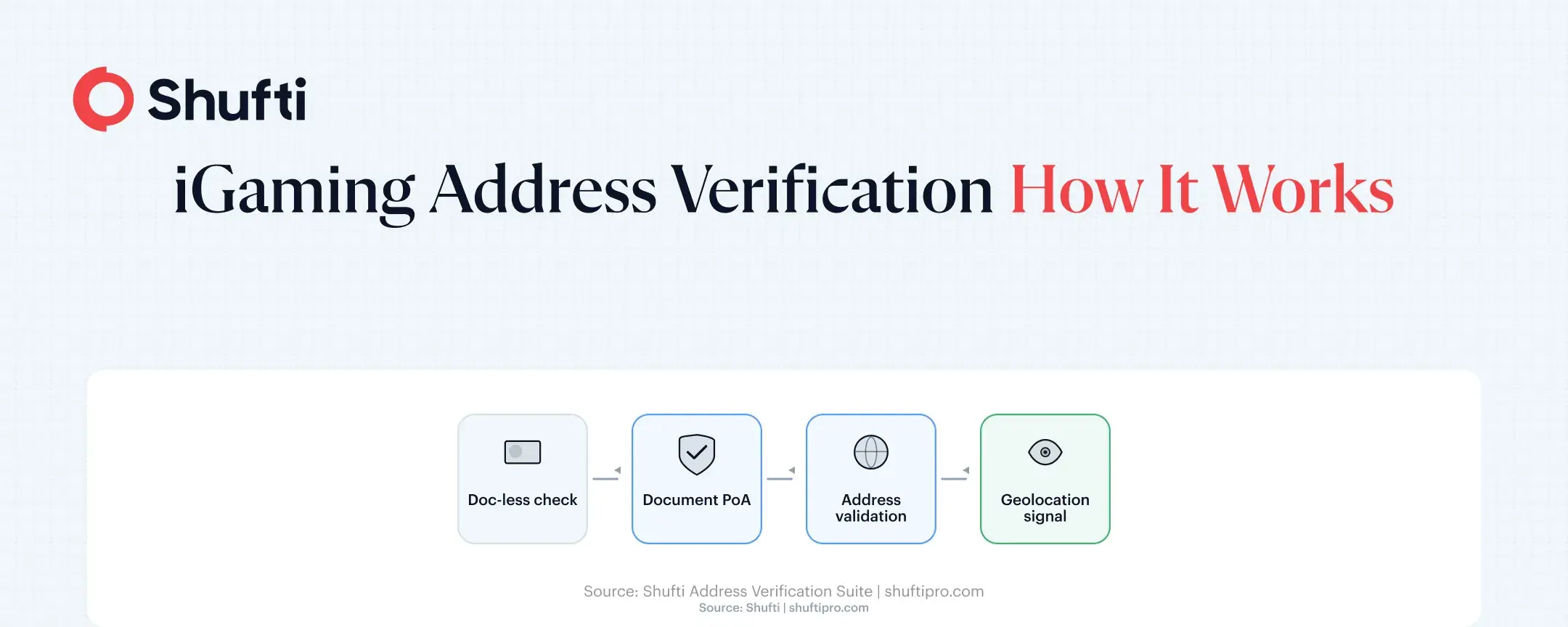
Address verification for iGaming is a layered workflow that routes each player to the method appropriate for their risk level, jurisdiction, and account stage. The objective is to confirm residence without unnecessary friction for the majority of players, while escalating scrutiny for those whose data patterns indicate higher risk. The global online gambling market according to research was valued at USD 121.96 billion in 2025, displaying a CAGR of 9.6% from 2026 to 2034. Verification speed matters as much as accuracy for that reason.
Gambling proof of address: document-based checks for casino operators
Gambling proof of address requirements typically accept utility bills, bank statements, government correspondence, or tenancy agreements dated within three months. Proof of address casino checks verify that the name and address on the document match the player’s registration data, that the document has not been digitally altered, and that it falls within the accepted date window. Forensic analysis includes metadata inspection, layout integrity checks, and AI-manipulation detection for high-value player onboarding and enhanced due diligence (EDD) cases. Proof of address for iGaming goes beyond an OCR data read.
Doc-less address verification for faster player onboarding
For the majority of players, document upload creates friction that causes onboarding drop-off. Doc-less address verification cross-references a player’s name, date of birth, and declared address against government registries, telecom records, credit bureau data, and utility databases, with no document upload required. Where data sources are available, this route returns a result in seconds and covers lower-risk players without sacrificing the audit trail. Higher-risk or jurisdiction-specific cases escalate to document-based checks automatically when the doc-less check cannot confirm a match.
Geolocation and risk signals for jurisdictional compliance
Geolocation verification online compares the IP address of the player’s device at session time against their declared residential address. A mismatch triggers a risk signal that the compliance system must handle. Online gambling compliance tools that combine IP geolocation with VPN and proxy detection reduce false-negative jurisdictional clearance. An address verification API for gaming typically surfaces these signals alongside the address match result, so operators can apply routing rules without building separate signal-handling logic. KYC software for casino operators that integrates geolocation at this layer gives compliance teams a single decision point rather than three separate data sources to reconcile. VPN and proxy signals that appear at login, not just at registration, allow operators to catch location discrepancies that a one-time onboarding check would not surface.
How Shufti helps iGaming operators verify player address and location
iGaming compliance teams increasingly need address verification and geolocation checks through one API rather than separate vendor contracts. Shufti’s address verification suite covers the full workflow: doc-less database checks against government and telecoms records in 85+ countries, document proof of address with forensic document intelligence for EDD cases, and live geolocation risk signals that flag VPN, proxy, and Tor usage. Doc-less checks process in under three seconds, document PoA in approximately 35 seconds, and geolocation signals surface in the same response. AML screening runs alongside address verification, which means a single onboarding workflow handles both residency confirmation and sanctions, PEP, and watchlist obligations without routing the player through separate steps. For operators managing iGaming KYC requirements across UKGC, GlüStV, KSA, and other national frameworks, the configurable hybrid workflow escalates players from doc-less to document PoA automatically when jurisdiction rules or risk triggers require it.
Player address and location fraud sits at the centre of the industry’s biggest compliance obligations in 2026, from deposit limit enforcement to jurisdictional licensing and AML compliance in gambling. Shufti’s address verification suite gives online casino operators doc-less speed, forensic document PoA, and live geolocation risk signals through a single API that adapts to national regulatory frameworks. Request a demo to see how the verification flow handles your player jurisdictions and onboarding volumes.
Frequently Asked Questions
Is address verification required for online casinos?
Yes. All UKGC-licensed operators must verify player identity and address as part of Know Your Customer obligations. From 30 June 2026, deposit limit enforcement also depends on confirmed player address data. Most EU licensing regimes carry equivalent requirements.
How does geolocation work in gambling?
Geolocation in gambling compares a player's IP address at login against their declared residential address. Modern systems also detect VPN, proxy, and Tor usage, which can mask a player's real location. A mismatch between IP location and declared address triggers a risk flag for compliance review.
What documents are required for KYC in gaming?
Standard KYC gaming documents include a government-issued photo ID and proof of address, typically a utility bill, bank statement, or official correspondence dated within three months. Some operators use doc-less verification against database sources as an alternative for lower-risk players.
What is AML in iGaming?
Anti-Money Laundering (AML) compliance in iGaming requires operators to verify players, monitor transactions for suspicious activity, and screen against sanctions lists and politically exposed person (PEP) databases. Address verification is part of the customer due diligence (CDD) process that underpins AML obligations.
What happens if verification fails in iGaming?
If address or identity verification fails, operators must restrict the player's account until verification is completed. Continued access without verification risks regulatory sanction, including fines and licence suspension. Under UKGC rules, unverified players cannot have deposit limits applied, creating a direct compliance gap.