





 Face Verification
 Address Verification
 Document Verification
 Age Verification
 VideoIdent
 Fast ID
 Docless Verification
 Consent Verification
 NFC Verification
 Business Verification
 Due Diligence
 Investor Verification
 E-Signature

 QES
QES
 AML Screening
 Transaction Monitoring
 Adverse Media
 Business AML Screening
 PEP & RCA
 Sanctions
 Watchlist
 Behavioural Biometrics
 Device Fingerprinting
 Biometric Face Authentication
 MFA
MFA
 Fraud Hub
 Onboarding
 Ongoing Monitoring
 KYC
KYC
 KYB
KYB
 KYI
KYI
 Age Assurance
 Identity Verification
 Workforce IAM
 Candidate Verification
 Compliance
 Fraud prevention
 Trust & safety
 Global expansion
 Product Managers
 Compliance Officers
 Fraud Analysts
 Developers
 Deepfake Detection
 Bonus Abuse / Promotion Abuse
 Account Takeover
 Synthetic Identity Fraud
 Document Fraud
 Impersonation Fraud
 Multi-Accounting
 Fraud Networks
 Chargeback Fraud
 Money Mule Activity
 Party Fraud
 Regulatory & Compliance Risks
 Fintech
 Crypto
 iGaming
 Forex
Forex
 Social Network
 Marketplace
 Banking
 Gig Economy
 Payments
 Ride Hailing
 Adult Content
 Blind Spot Audit
 Deepfake Detector
 Liveness Spoofs
 Document Originality
 Document Deepfake
 Global Trust Platform
 Journey Builder
 Case Management
 Shufti AI
 Fraud Analytics
 Vendor Comparison
 Brand Personalisation
 AI Compliance Co-Pilot
 OCR
OCR
 Secure Capture
 Deployment Options
 Identity Methods
 API Documentation
 Mobile SDKs
 Service Status
 Help Center
 Contact Us
 Technical Support
 Supported Documents
 Supported Countries
 Content library
 Blogs
Blogs
 News
News
 Reports
 Insights
 Knowledgebase
 ROI calculator
 About
About
 Career
 Press Release
 Certifications
 Partnership
 Awards
 Events & Webinar
 Interactive Demo
 Podcast Studio
 Spotlight Studio
KYB Compliance UK: Guidelines for Corporate Due Diligence

-
Add us as a Preferred Source
- 01 What is Know Your Business in the UK?
- 02 What regulations govern KYB in the UK?
- 03 The PSC Register and Beneficial Ownership checks in the UK
- 04 What documents are required for UK corporate customer due diligence?
- 05 When does enhanced due diligence apply to UK businesses?
- 06 KYB for fintech firms in the UK
- 07 How Shufti handles UK corporate KYB checks
- KYB (Know Your Business) verifies the identity, ownership, and risk of corporate clients, going beyond individual KYC checks.
- UK KYB is governed by three instruments: MLR 2017 (core legal duty), FCA supervision (practical standard), and ECCTA 2023 (Companies House powers).
- Firms must identify every beneficial owner holding more than 25% ownership or control (a PSC).
- From 18 November 2025, Companies House requires identity verification for all directors and PSCs on new filings, but a verified PSC still needs sanctions, PEP, and adverse media screening.
- Enhanced due diligence (EDD) is mandatory for high-risk third countries, PEP-linked entities, unclear-purpose transactions, and non-face-to-face relationships.
- KYB applies to all firms regulated under MLR 2017, including banks, payment institutions, e-money firms, accountants, solicitors, and estate agents.
- Required documents span three layers: entity documents (incorporation, registration number), ownership documents (PSC extract), and UBO identity documents (ID and proof of address for each 25%+ owner).
HM Treasury’s 2025 National Risk Assessment states that over £100 billion is laundered every year through the UK or through UK corporate structures. For compliance teams at banks, fintechs, and payment institutions, that figure sits at the center of the UK risk picture for KYB compliance. Verifying individual customers has a defined workflow. Corporate clients, with layered ownership, nominee directors, and overseas shareholders, are consistently where that workflow breaks down. The Financial Conduct Authority (FCA) made this explicit in its 2024 multi-firm customer due diligence review: firms get corporate checks wrong more often than individual ones.
The guide covers what UK KYB compliance actually requires today, from the Money Laundering Regulations 2017 through to the Companies House changes that took effect in November 2025.
What is Know Your Business in the UK?
Know Your Business (KYB) in the UK is the process through which regulated firms verify the identity, ownership, and risk profile of corporate clients before establishing a business relationship or completing a qualifying transaction. Where KYC focuses on natural persons, KYB focuses on legal entities. These include limited companies, partnerships, trusts, and other structures that can obscure who actually controls the flow of funds.
The process sits inside the UK’s wider anti-money laundering (AML) framework. UK Money Laundering Regulations KYB obligations attach at the point of onboarding and continue through the life of the relationship via ongoing monitoring. Any regulated business within the scope of the Money Laundering, Terrorist Financing, and Transfer of Funds Regulations 2017, from banks and payment institutions to accountants, solicitors, and estate agents, must carry out customer due diligence (CDD) on corporate clients.
One practical distinction from KYC matters here. Corporate structures can be deliberately built to pass document checks while concealing beneficial ownership. KYB is specifically designed to trace through those structures.
What regulations govern KYB in the UK?
UK KYB compliance sits at the intersection of three regulatory instruments. Each addresses a different dimension of the verification problem, and together they define what FCA KYB requirements actually ask of supervised firms.
Money Laundering, Terrorist Financing and Transfer of Funds Regulations 2017
The Money Laundering, Terrorist Financing and Transfer of Funds Regulations 2017 (MLR 2017) form the primary legal basis for KYB in the UK. They require regulated firms to verify corporate clients’ identities and identify all ultimate beneficial owners (UBOs) above the 25% ownership threshold, understand the purpose and nature of the business relationship, and apply ongoing monitoring proportionate to risk. MLR 2017 was updated in 2019 and again in 2022 following the Financial Action Task Force (FATF) evaluation of the UK’s AML regime.
The FCA’s supervisory role in KYB compliance
The FCA supervises financial services firms for AML compliance and sets the practical standard against which KYB processes are judged. FCA KYB requirements extend beyond a literal reading of MLR 2017. Firms must also follow the FCA’s Financial Crime Guide. AML enforcement penalties have escalated sharply across regulated sectors, according to HM Treasury’s annual AML/CTF supervision reports.
Economic Crime and Corporate Transparency Act 2023
The Economic Crime and Corporate Transparency Act 2023 (ECCTA) expanded Companies House’s powers substantially. From November 2025, mandatory identity verification applies to all company directors and Persons with Significant Control (PSC), making registry data more reliable as a KYB input than it was before.
The PSC Register and Beneficial Ownership checks in the UK
The Persons with Significant Control (PSC) register, held at Companies House, is the UK’s public record of who owns or controls each registered company. Compliance teams use it as the standard starting point for any beneficial ownership UK PSC check. Since 2016, UK companies have been legally required to identify their PSCs and report changes within 14 days of confirming them.
What counts as a PSC?
A person qualifies as a PSC under UK law if they own more than 25% of shares or voting rights, have the right to appoint or remove the majority of directors, or exercise significant influence or control over the company. UK UBO verification PSC register checks must identify every individual meeting any of those thresholds. Where ownership is held through a chain of entities rather than directly, firms must trace the full chain to reach the natural persons at the top.
What changed in November 2025
The ECCTA 2023 introduced mandatory identity verification for directors and PSCs. From 18 November 2025, new registrations require verification before Companies House accepts the filing. For KYB teams, Companies House KYB UK data now carries a higher baseline of accuracy. That said, a verified PSC is not a risk-cleared PSC. Your firm still needs to screen every UBO for sanctions, politically exposed persons (PEP) status, and adverse media.
What documents are required for UK corporate customer due diligence?
Documentation failures are where UK corporate customer due diligence most commonly breaks down in FCA reviews. The problem is usually not wrong documents but incomplete ones. Firms verify the entity’s legal name and registration number but stop short of UBO identification, or they collect UBO information without verifying it against an independent source.
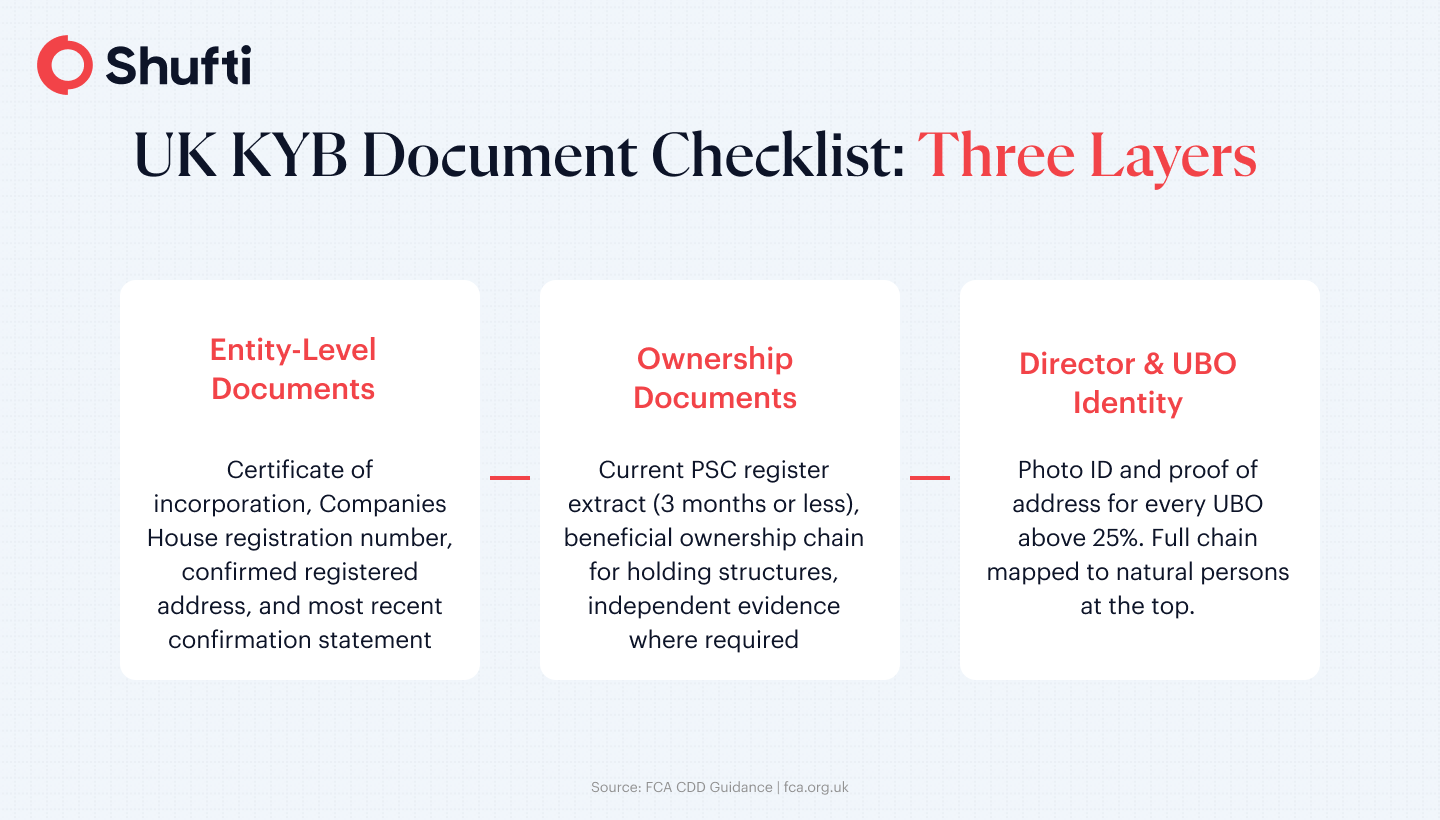
Entity-level documents
The certificate of incorporation, the Companies House registration number, confirmation of the registered address, and the most recent confirmation statement form the baseline. For entities not registered in the UK, equivalent documents from the home jurisdiction apply.
Ownership documents
A current PSC register extract from Companies House is the starting point. Where that extract is more than three months old, or the structure involves layers of holding companies, independent evidence of beneficial ownership is also required.
Director and UBO identity
Photo ID and proof of address for every UBO above the 25% threshold. Where ownership passes through a chain of legal entities, the full chain must be mapped and the natural persons at the top independently verified.
When does enhanced due diligence apply to UK businesses?
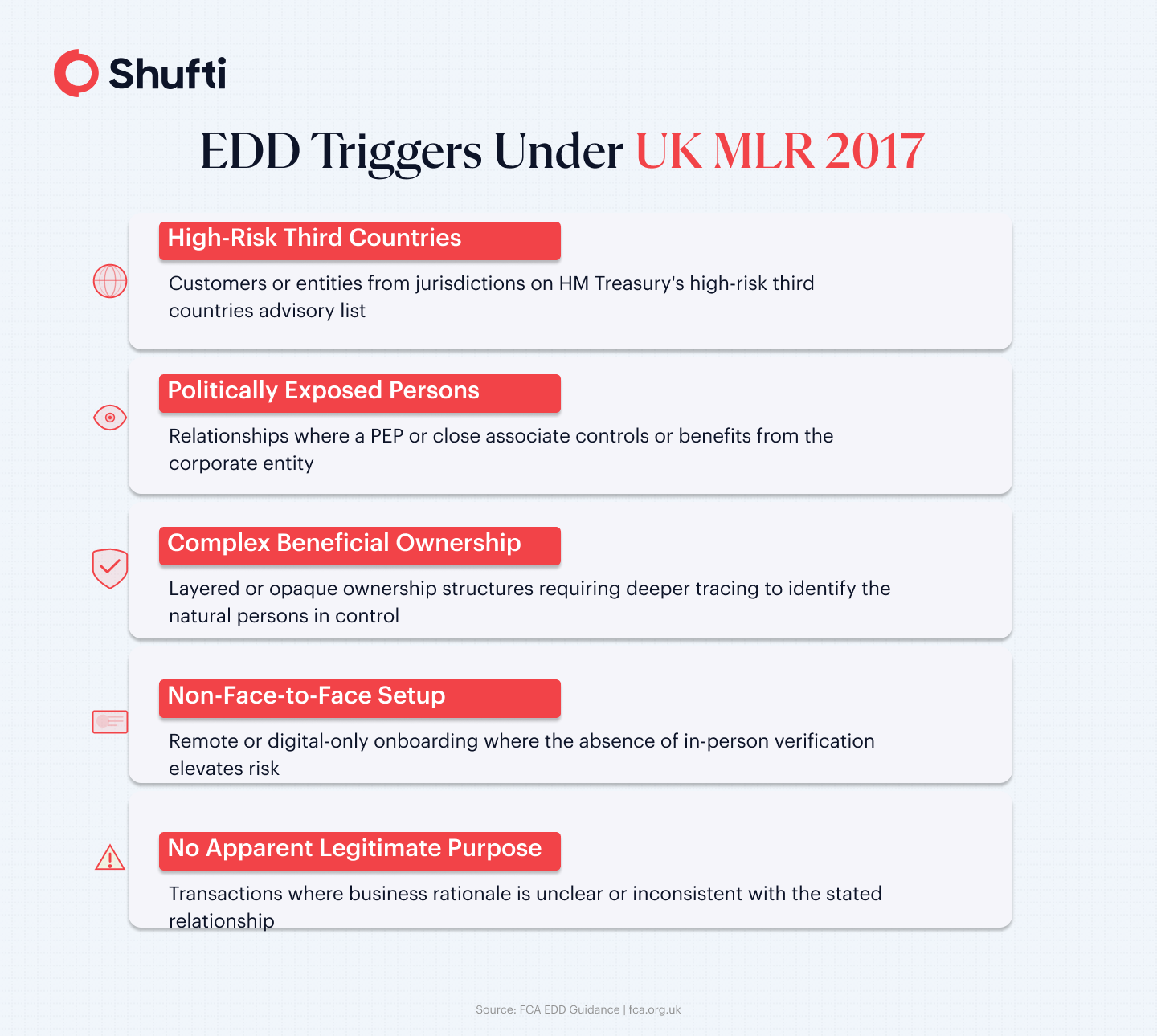
Standard CDD covers most corporate clients. Enhanced due diligence (EDD) applies when the risk profile of the relationship requires deeper scrutiny. MLR 2017 makes EDD mandatory in specific circumstances, and the FCA expects firms to apply it in others based on their own risk assessment framework.
Mandatory EDD triggers under MLR 2017
The regulations require EDD for relationships involving customers from high-risk third countries designated by HM Treasury as of February 2026, relationships where a PEP or their close associate controls or benefits from the entity, transactions with no apparent legitimate purpose, and non-face-to-face relationships where the remote setup elevates risk.
FCA expectations on enhanced due diligence UK businesses
The FCA’s 2024 CDD review found that stronger firms applied EDD proactively to complex corporate structures, even without a mandatory MLR 2017 trigger. The FCA’s guidance on EDD for high-risk customers identifies source of funds and source of wealth documentation, more frequent AML screening, and senior management sign-off as the expected measures for elevated-risk corporate relationships.
KYB for fintech firms in the UK
KYB fintech UK obligations run alongside FCA authorization. Payment institutions, e-money institutions, and registered cryptoasset businesses all fall within MLR 2017’s scope. They face the same UK AML business verification requirements as banks, without necessarily having the compliance infrastructure banks have built over decades. For many, a managed KYB as a Service model reduces that infrastructure gap without requiring a full in-house build.
Merchant and PSP onboarding
The highest KYB volume for most fintech firms sits in merchant and payment service provider (PSP) onboarding. Each merchant in a payments flow is a corporate client needing KYB verification before receiving funds. FCA KYB requirements apply regardless of merchant size.
Post-Brexit regulatory divergence
After Brexit, the UK’s AML framework diverged from the EU’s. HM Treasury published proposals for UK-specific MLR 2017 amendments in September 2025, meaning UK firms must track FCA and HMRC guidance independently of European updates. The UK no longer automatically adopts EU Anti-Money Laundering Directives, including 6AMLD.
How Shufti handles UK corporate KYB checks
Corporate KYB checks in the UK stall for one of two reasons. Either the firm is pulling entity data from Companies House manually and cross-referencing against sanctions lists in separate steps, or UBO identification is left to an analyst to complete ad hoc. Both approaches are slow and produce audit trails that rarely hold up under FCA scrutiny.
Shufti’s Know Your Business verification connects Companies House registry lookups, UBO traversal, and business AML screening in a single automated workflow. Director and UBO identity verification runs across 240+ countries, and the AML layer screens against 3,500+ global watchlists, including UK-designated sanctions regimes, with data refreshed every 15 minutes. The result is a consistent, auditable KYB record for each corporate client.
See how Shufti’s automated KYB workflow fits your compliance stack. Book a demo.
Frequently Asked Questions
What are the KYB requirements in the UK?
UK KYB requirements are set under the Money Laundering, Terrorist Financing and Transfer of Funds Regulations 2017. Firms must verify the identity of corporate clients, identify all UBOs above the 25% ownership threshold, understand the purpose of the business relationship, and apply ongoing monitoring proportionate to the client's risk.
What is the FCA's role in KYB compliance?
The FCA supervises financial services firms for AML compliance and enforces MLR 2017. It sets the practical standard against which KYB processes are judged and issues guidance through its Financial Crime Guide. Poor documentation and inadequate EDD for high-risk corporate clients are the most common failure modes in FCA reviews.
What is the PSC register in UK KYB?
The PSC register, held at Companies House, is the UK's public record of individuals who own or control more than 25% of a company. KYB teams use it to identify UBOs. From November 2025, all PSCs must verify their identities with Companies House under the ECCTA 2023.
What documents are needed for KYB in the UK?
Standard UK KYB documents include the certificate of incorporation, Companies House registration number, registered address confirmation, a current PSC register extract, and verified photo ID plus proof of address for all UBOs. Complex structures require mapping the full ownership chain to the natural persons at the top.
Is KYB mandatory for all UK businesses?
KYB is mandatory for regulated businesses under MLR 2017, including banks, payment institutions, e-money firms, accountants, solicitors, and estate agents, when onboarding corporate clients. Unregulated sectors are not legally required to conduct KYB, though many do so as a matter of risk management.