AMLR Solutions
  AMLR Consultation
 EUDI Wallet
 Onboarding
 Ongoing Monitoring
 FRAML
FRAML KYC
KYC KYB
KYB KYI
KYI Age Assurance
 Workforce IAM
 Candidate Verification
 Account Takeover
 Bonus/ Promotion Abuse
 Chargeback Fraud
 Deepfake
 Document Fraud
 Fraud Networks
 Impersonation Fraud
 Money Mule Activity
 Multi-Accounting
 Party Fraud
 Regulatory & Compliance Risks
 Synthetic Identity Fraud
 Adult Content
 Banking
 Crypto
 Fintech
 Forex
Forex Compliance
 Fraud prevention
 Trust & safety
 Global expansion
 Compliance Officers
 Developers
 Fraud Analysts
 Product Managers
 Journey Builder
  Global Trust Platform
 Customer Profiles
 Vendor Comparison
 IDV Case Management
 AML Case Management
 Regulatory Reporting
 Agentic Rule Builder
  AI Compliance Co-Pilot
  Fraud Analytics
 Fraud Hub
  OCR
OCR Shufti AI
 Bank Account Verification
  Biometric Duplication
 Database Checks
 Document Intelligence
 Government ID
 Mobile Driver's License
 NFC
NFC Selfie Liveness
 Brand Personalisation
 Deployment Options
 Identity Methods
 IDV Modes
 Multi-tenancy
 On-Premise IDV
 Secure Capture
 Shufti MCP













The FATF’s cyber-enabled fraud report found that 156 jurisdictions, representing 90% of all countries assessed globally, identified fraud as a primary money laundering predicate offence. That number covers consumer fraud, but the larger exposure often sits at the business layer. Shell companies, synthetic business identities, and concealed beneficial ownership are how illicit funds move at scale, and they pass basic registry checks without difficulty.
For FinTech platforms processing business onboarding at volume, that gap is the risk. This article maps each fraud method to the specific KYB FinTech verification layer built to stop it.
Why is business fraud rising in FinTech?
Business verification platforms in FinTech are the process of confirming that a business attempting to open an account or access a platform is legally registered, operated by the people it claims, and free from sanctions exposure. Unlike consumer identity checks, KYB in FinTech targets the entity itself. That means verifying its corporate structure, ownership chain, and regulatory standing across the jurisdictions where it operates.
Company registration and legal structure
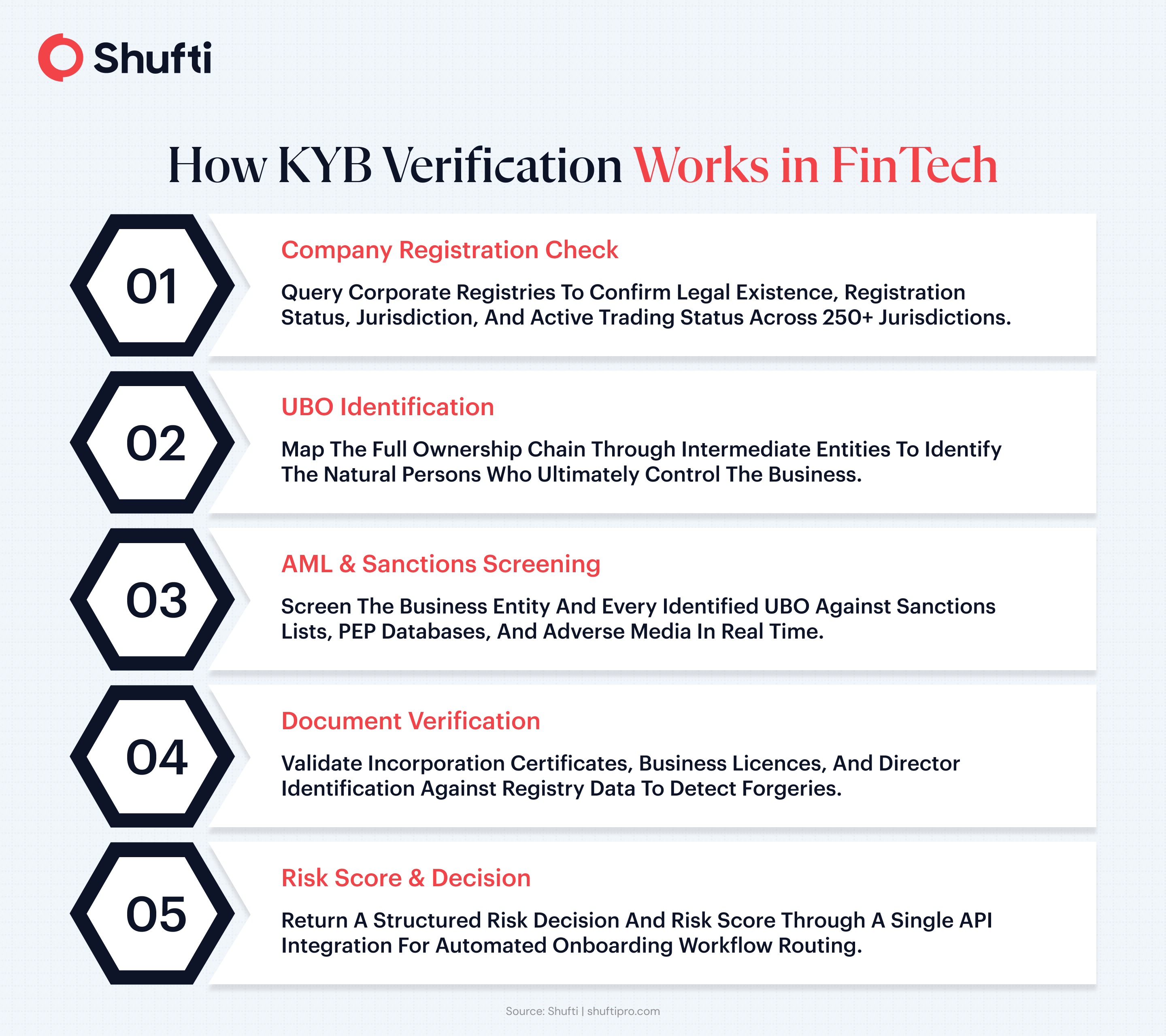
The foundation of any KYB check is confirming a business exists in the way it presents itself. That means querying corporate registries to verify registration status, jurisdiction of incorporation, registered address, and active trading status. A company with lapsed filings, a mismatched registered address, or an incorporation date that predates its industry is a red flag that standard onboarding forms will never surface.
Business verification FinTech platforms also cross-check the documents submitted at onboarding, including incorporation certificates, business licences, and articles of association, against registry records. Forged documents are common enough that document verification is not optional at this stage.
UBO Identification and Verification
UBO identification is the most fraud-relevant step in the KYB process. FATF’s Recommendation 24 on beneficial ownership of legal persons exists precisely because layered ownership structures are the primary mechanism for hiding illicit control. Actual control of a business rarely matches what appears in a registry. A genuine UBO check traces shareholding chains through multiple intermediate entity layers and runs every identified individual against sanctions lists, PEP databases, and adverse media.
A business that passes company registration review but conceals a sanctioned beneficial owner at the third ownership layer represents a failure of incomplete KYB, not a gap that could not have been closed.
What is the difference between KYB and KYC?
The structural difference is the subject. KYC verifies a natural person. That means confirming a consumer or individual user is who they claim to be, that their ID documents are genuine, and that they do not appear on sanctions or PEP watchlists. KYB in FinTech runs the same process at the entity level and then continues further.
KYB requires verifying that the business itself is registered and legitimate, and then tracing the ownership chain down to the natural persons who ultimately control it. One corporate entity can require three or four individual-level checks embedded inside a single KYB process. That makes KYB structurally more complex than KYC, and the gap between the two is exactly where fraud hides.
The regulatory requirements also differ. FATF Recommendation 24 governs beneficial ownership of legal persons and requires jurisdictions to maintain accurate, up-to-date ownership information accessible to competent authorities. Consumer due diligence sits under separate FATF guidance covering natural persons. Any FinTech platform handling both individual and business customers needs both programmes, with the KYB layer sitting on top of the KYC infrastructure for the individuals running those businesses.
Why do FinTech companies face elevated business fraud risk?
The volume and velocity of business onboarding at FinTech platforms create conditions that fraud exploits well. A traditional bank might onboard dozens of new corporate clients per quarter, with relationship managers reviewing each one manually. A B2B payment platform or neobank can onboard hundreds per day, often with no human review at the point of entry. That volume removes the friction that historically caught bad actors.
High-volume digital onboarding creates entry points
The UNODC estimates that between 2% and 5% of global GDP, roughly $800 billion to $2 trillion, is laundered through the financial system annually. A meaningful share of that moves through business accounts opened on FinTech platforms. Shell companies and synthetic business identities cost very little to create, and they require only a convincing registration document and a plausible-looking corporate structure to pass a basic onboarding screen.
At the scale that FinTech fraud prevention requires, platforms cannot rely on document review alone. When onboarding volume is high and checks are shallow, fraudsters iterate. They test document formats, refine corporate structures, and probe for jurisdictions where registry data is sparse or slow to update.
Cross-border operations amplify exposure
Cross-border onboarding defines most FinTech business models. A payment platform might process business accounts from Malta, Singapore, and the UAE in the same week. Each jurisdiction carries different registry data quality, different beneficial ownership disclosure requirements, and different sanctions exposure profiles. A KYB process calibrated for one market can miss red flags entirely on businesses from registries that do not publish real-time data.
EU FinTech compliance requirements tightened further when the Anti-Money Laundering Authority launched operations in July 2025 and lowered beneficial ownership disclosure thresholds to 15% for high-risk sectors. Platforms still applying a 25% threshold are now out of step with those requirements for businesses they onboard in scope sectors.
What types of fraud can KYB detect in FinTech?
KYB fraud prevention targets specific fraud types that standard consumer checks miss entirely. The businesses using these methods do not fail basic registry checks. They pass them. What KYB solutions FinTech platforms look for is the pattern of signals that distinguishes a legitimately registered company from one built to deceive.
Shell companies and synthetic business identities
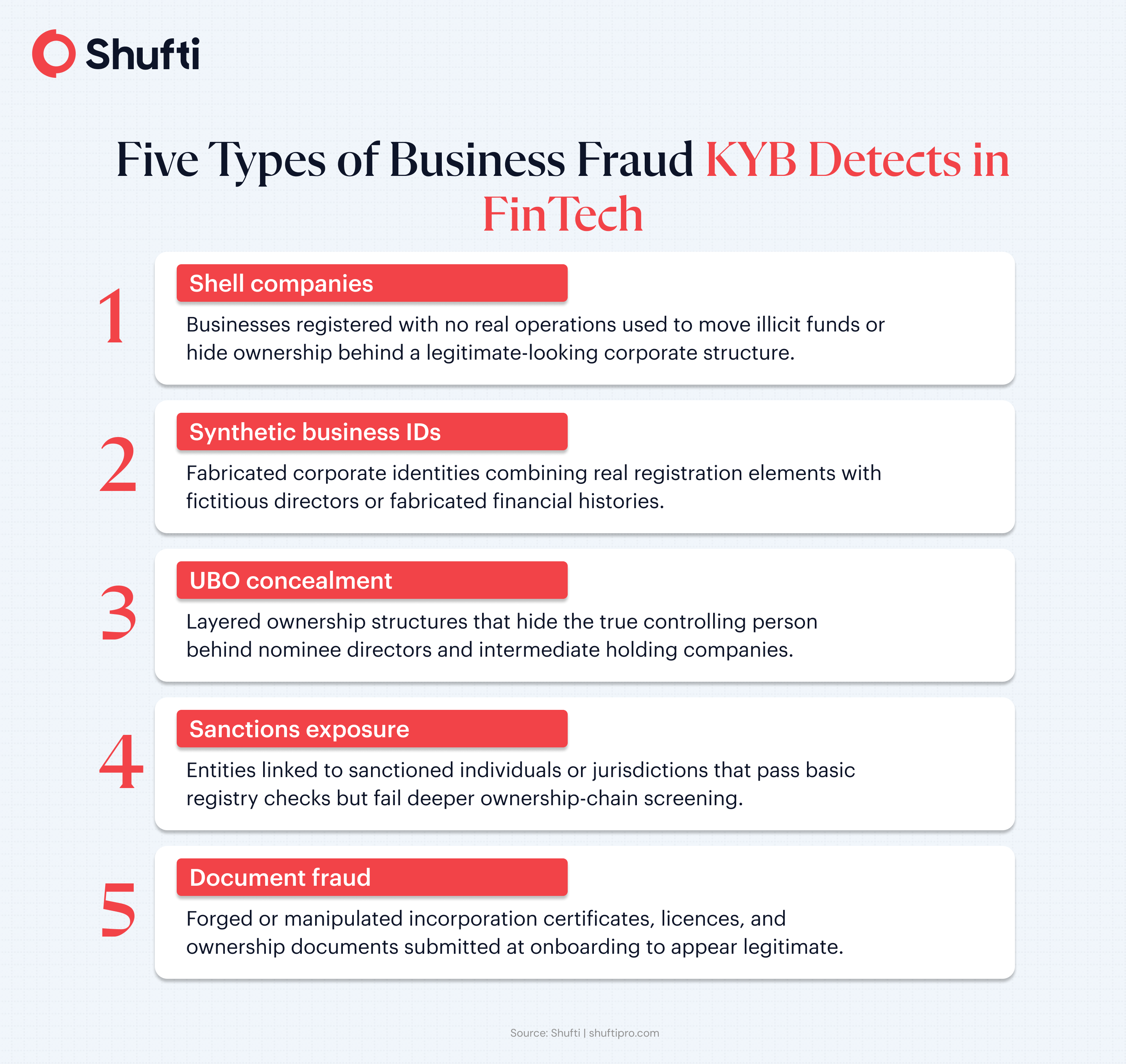
A shell company is a registered business with no genuine operations. It holds accounts and receives payments, but it has no real commercial activity, real employees, or real owners matching the registered directors. Shell company detection requires cross-referencing registration data against commercial activity records, financial filing history, and the declared nature of the business.
Synthetic business identities go further. They combine real registration elements, such as a genuine company number, with fictitious directors or fabricated financial histories. A Know Your Business FinTech check that only verifies the company number misses the fabricated layer entirely.
UBO concealment through layered ownership
Beneficial ownership fraud hides the real controller behind nominee directors and intermediate holding companies. FATF Recommendation 24 identifies this as one of the most persistent money laundering mechanisms globally. A sanctioned individual can sit three or four corporate layers back and never surface in a basic company registry check. Effective KYB fraud prevention maps the full ownership chain, not just the first layer of directors.
Sanctions exposure and document fraud
Entities linked to sanctioned individuals often pass initial registry checks because the connection is indirect. Entity-level AML screening run alongside KYB catches these connections by checking every person and company in the ownership chain against current sanctions lists.
Document fraud at onboarding involves forged incorporation certificates, business licences, and director identification. Shallow document review catches obvious forgeries. Deeper forensic verification finds altered registration dates, cloned certificate numbers, and documents sourced from jurisdictions where incorporation templates are publicly available.
Why are KYB compliance FinTech requirements tightening?
Regulatory pressure on business verification has intensified over the past three years. KYB compliance FinTech obligations are now shaped by two overlapping frameworks that are both fully in force.
FATF’s 2022 revision of Recommendation 24 set higher standards for beneficial ownership transparency globally. Member jurisdictions must maintain up-to-date ownership registers and make accurate ownership data quickly accessible to competent authorities. For FinTech platforms operating across multiple markets, that translates to a compliance baseline that depends on automated, real-time registry data rather than manual checks carried out weeks after account opening.
The EU Anti-Money Laundering Authority launched in July 2025 with a unified customer due diligence rulebook that applies directly across member states without national transposition. Its threshold reduction for beneficial ownership in high-risk sectors, from 25% to 15%, means platforms must verify ownership at a deeper level than most existing KYB processes were designed to reach.
FATF’s research also found that in the UK, fraud now accounts for more than 40% of all recorded crime. Much of that flows through business accounts. Regulators are drawing that line explicitly, and business verification is no longer framed purely as a compliance obligation. It sits inside a fraud containment strategy.
How Shufti helps FinTech platforms run KYB at scale?
Most KYB failures at FinTech platforms share the same root cause. Checks are shallow, coverage is narrow, and ownership verification stops at the first layer of directors. Fraudulent entities pass onboarding, create ongoing liability, and the problem surfaces only after the damage is done.
Shufti’s Know Your Business verification covers 250+ jurisdictions through automated corporate registry lookup. Ownership chains are mapped to the UBO level, with each identified individual screened in real time against AML watchlists, sanctions regimes, and adverse media. That process does not require a compliance team running queries manually against separate data sources. The full check runs through a single API integration and returns a structured risk decision.
For entity-level Business AML screening, Shufti draws on more than 100,000 AML data sources and 3,500 watchlists, with data refreshing every 15 minutes.
See how Shufti closes the ownership gap on your compliance workflow. Request a demo.
Frequently Asked Questions
What is KYB in FinTech and how does it work?
Know Your Business in FinTech is the process of verifying a legal entity before granting it access to a financial platform. It covers company registration checks, UBO identification, AML and sanctions screening, and document verification, typically delivered through an automated API that returns a structured risk decision.
Why is KYB important for financial institutions?
Financial institutions face regulatory requirements to verify that business counterparties are legitimate, not sanctioned, and that their beneficial owners are known. Without KYB, platforms expose themselves to fraud losses, regulatory fines, and reputational damage from onboarding shell companies or entities linked to sanctioned individuals.
What is the difference between KYC and KYB?
KYC verifies a natural person's identity. KYB verifies a legal entity's registration, ownership structure, and regulatory standing. KYB typically requires multiple embedded KYC checks on the individuals behind the business, plus corporate registry queries and entity-level AML screening that consumer KYC does not cover.
How does KYB help in business verification?
KYB automates the checks that manual onboarding teams cannot run across hundreds of business applications per day. Corporate registry lookups confirm legal existence. UBO mapping identifies the real owners. AML screening flags sanctions and PEP exposure. Document verification catches forged or manipulated incorporation papers. Together, these checks produce a reliable risk profile for each business entity.
How does KYB prevent fraud in FinTech?
KYB closes the gaps that standard consumer checks miss at the business level. It detects shell companies through registry and activity cross-referencing, surfaces UBO concealment through ownership chain mapping, catches sanctions exposure through entity-level AML screening, and identifies forged documents through forensic verification. Each layer targets a specific fraud method.