AMLR Solutions
  AMLR Consultation
 EUDI Wallet
 Onboarding
 Ongoing Monitoring
 FRAML
FRAML KYC
KYC KYB
KYB KYI
KYI Age Assurance
 Workforce IAM
 Candidate Verification
 Account Takeover
 Bonus/ Promotion Abuse
 Chargeback Fraud
 Deepfake
 Document Fraud
 Fraud Networks
 Impersonation Fraud
 Money Mule Activity
 Multi-Accounting
 Party Fraud
 Regulatory & Compliance Risks
 Synthetic Identity Fraud
 Adult Content
 Banking
 Crypto
 Fintech
 Forex
Forex Compliance
 Fraud prevention
 Trust & safety
 Global expansion
 Compliance Officers
 Developers
 Fraud Analysts
 Product Managers
 Journey Builder
  Global Trust Platform
 Customer Profiles
 Vendor Comparison
 IDV Case Management
 AML Case Management
 Regulatory Reporting
 Agentic Rule Builder
  AI Compliance Co-Pilot
  Fraud Analytics
 Fraud Hub
  OCR
OCR Shufti AI
 Bank Account Verification
  Biometric Duplication
 Database Checks
 Document Intelligence
 Government ID
 Mobile Driver's License
 NFC
NFC Selfie Liveness
 Brand Personalisation
 Deployment Options
 Identity Methods
 IDV Modes
 Multi-tenancy
 On-Premise IDV
 Secure Capture
 Shufti MCP












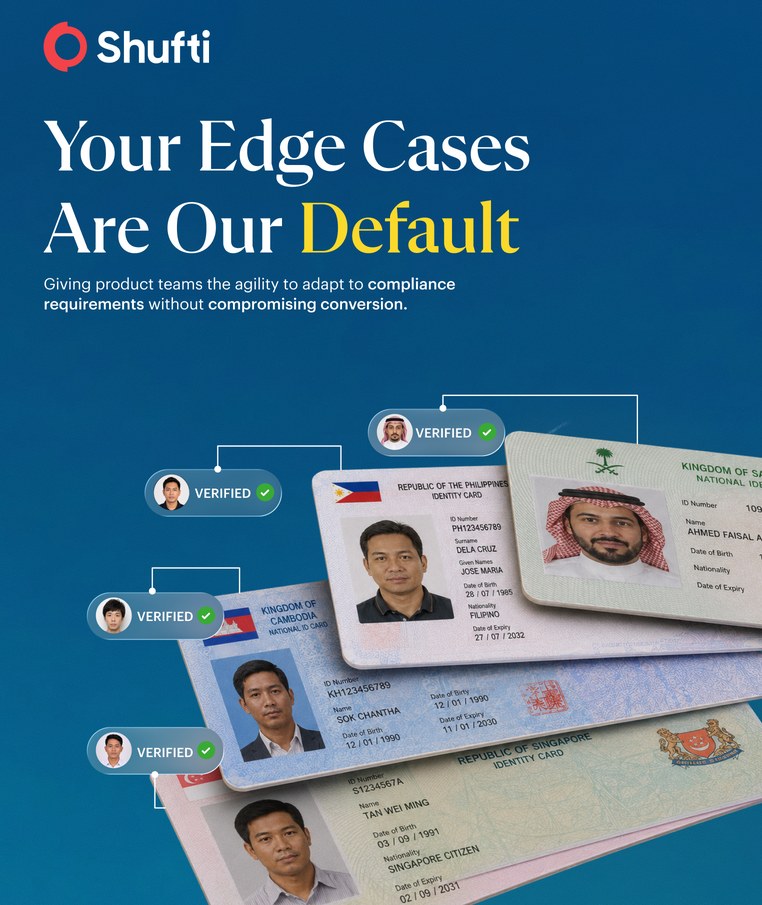
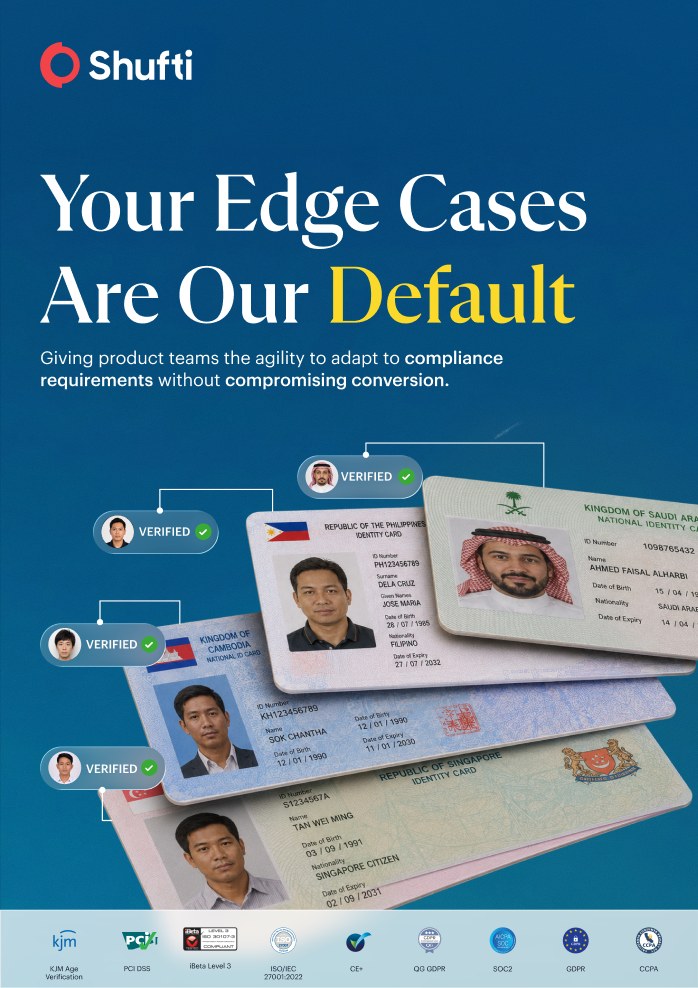
Your Edge Cases Are Our Default
Adapting identity verification to continuous regulatory change.
How the right KYC solution lets product owners implement new compliance requirements quickly, without losing genuine users, meeting the goals of compliance and conversion at the same time.
Schedule a DemoWhy This Guide
KYC and AML regulations and risk exposure change continuously
How flexible is your KYC solution provider?

Customer Due Diligence requirements move constantly
Sanctions and PEP lists are revised, new markets are added, regulators raise Enhanced Due Diligence thresholds and new product lines shift risk. Each change has to be reflected in the Identity Verification and customer risk assessment flow.

The burden lands on product
In most organisations the work of implementing it falls on the KYC product teams, who must ensure document verification, biometric checks and ongoing monitoring are customised to assess risk under new rules, without losing genuine customers or creating queues.

Outsourced stacks create a queue
A KYC solution provider that does not own its technology relies on third-party engines. A new script, a revised sanctions rule or a new document type becomes a request passed upstream, and a wait on that vendor's roadmap.
Identity Reconciliation
Identity Verification Is Not Just Document Verification but Data Reconciliation Challenge
The harder job is matching the identity a person presents against the records held about them across banks, registries, sanctions lists and address databases. In many scenarios, failures to reconcile lead to rejection of genuine customers and acceptance of false ones, leading to revenue loss and compliance failure.
Genuine Users Rejected
Lost conversionA document can belong to a legitimate owner and still fail verification, because the name it carries does not match the name entered or the record held. If that name is not reconciled, a genuine customer is rejected.
Prohibited Users, Accepted
Compliance breachA document can be genuine while the person presenting it belongs to a sanctioned jurisdiction. A sound solution must establish that the issuing country is not sanctioned under the applicable AML programme.
Regulatory Adaptability
What an adaptable verification stack delivers
The value of a verification platform is measured not by the length of its feature list, but by the speed with which it can be adapted to a new requirement.
| Capability | Outcome for the product organisation |
|---|---|
| Adapts matching, address, geo and deployment logic without a vendor release | Faster market launches, higher pass rates and more conversions |
| Requirement handled by the provider or by configuration | Fewer engineering dependencies |
| Change delivered as a scoped task | Shorter implementation cycles |
| Rule changes absorbed without re-planning | Less roadmap disruption |
| Fewer false rejections of genuine users | Higher customer conversion |
| Changes reflected without a queue | Lower risk due to non-compliance |
Name Matching And Scripts
Non-Latin scripts, and the two-sided cost of a mismatch
Names frequently fail to reconcile across borders because the same individual is recorded in different scripts and conventions. It is among the most common verification failures, and it is rarely associated with fraud.
| Script | Why the match fails | Example |
|---|---|---|
| Arabic & Kurdish | One name romanises several ways; the article “al” is joined, hyphenated or dropped | Mohammed / Muhammad / Mohammad as one person |
| Spanish & Latin American | Two surnames, with systems retaining different parts and treating particles inconsistently | Juan Carlos Pérez García as Juan Pérez or Pérez García |
| Greek | Inconsistent romanisation of Greek characters | Ιωάννης as Ioannis, Yiannis or Giannis |
| Chinese (Pinyin) | Distinct names collapse to one romanised string; single syllables map to many characters | 李 as Li or Lee; two people both as Wang Wei |
| Japanese & Brazilian | Family-name-first ordering, competing romanisations, particles truncated or reordered | 大野 as Ono, Ohno or Ōno |
AML compliance challenges for FinTechs in the remittance sector
Certain sectors such as some remittance service providers are particularly likely to encounter bottlenecks due to name-reconciliation challenges. The sender’s name captured during identity verification may differ from the name associated with the recipient account in the home country because of transliteration, naming conventions, abbreviations, spelling variations, or differences in record formats. These inconsistencies can reduce the accuracy of name matching, increase false positives, delay transaction processing, and make effective AML screening more difficult.
Geofencing And Sanctions
How the Right AML Compliance Solution Helps Meet KYC Requirements
A sanctions list is revised late on a Friday and compliance requires the change live by Monday. How quickly new AML Compliance change gets incorporated depends upon flexibility of KYC Solution.
Third-party dependent
- 01List or rule changes
- 02Raise a support request
- 03Wait in the provider backlog
- 04Assign engineering to a workaround
- 05Release delayed, conversion affected
Owned stack
- 01List or rule changes
- 02Rules maintained and updated centrally
- 03Configure market and risk rules directly
- 04No engineering cycle required
- 05Change effective, roadmap unaffected
The Right Way to Implement Risk Control- Case of Compliance Geo-Fencing
Location signals alone can be insufficient as a user in a sanctioned jurisdiction can route through a permitted country via VPN. The reliable control operates at the identity layer, combining connection location, issuing country, nationality shown on the document, and VPN detection.
Owning The Stack
How Shufti Delivers Fast, Market-Specific AML Compliance Customisation due to Tech Ownership
Real-world verification rarely fails on a single universal rule. It requires continuous customisation as governments modernise systems, cultures order names differently, and local scripts demand specialised OCR.
Address modernisation
Digital-first businesses across Vietnam faced a Customer Due Diligence challenge after the country's July 2025 address reforms, as old ID cards carry outdated address conventions. Shufti recognises the card and returns the updated convention automatically, harmonising the address structure with government databases in line with new requirements.
Name ordering by spacing
Japanese cards write the family name first, breaking name matching. Shufti splits the name based on the spacing on the card, so first and last names resolve correctly.
Generational surname
The generational family name sits where most systems expect the first name. Shufti extracts it into the correct field every time.
In-house OCR
Generic OCR engines often struggle to process Burmese identity documents accurately, resulting in the rejection of legitimate users. Shufti’s proprietary Burmese OCR model delivers the highest document-reading accuracy, performing approximately 20–30% better than general-purpose OCR engines and achieving an accuracy rate of around 85%.
Case Studies

Customising Fraud Detection for Evolving Global Fraud Patterns
Product-level customisation · Fraud detection
Dismantling organised fraud rings through Shufti's Proprietary Fraud Analytics Solution
Shufti detected industrial-scale fraud rings, evidenced by multiple IDs submitted against identical backgrounds, and responded with Repeat Offender Suppression built on digital fingerprinting and behavioural tracking, alongside replay and stream-tampering detection.
Take the next step
KYC and AML workflows based on risk exposure and new market expansion
Shufti’s fully owned technology stack enables rapid customisation of AML risk rules, thresholds, and workflows. This allows Product Owners to adapt risk configurations quickly as regulatory and market requirements evolve.
Request a demoVendor Checklist
A KYC Solution Checklist for Product Owners
The single question that predicts your future roadmap load is whether the provider owns its stack, because ownership decides whether change is configuration or a support ticket.
Compliance adaptability & ownership
- Does the vendor demonstrate the value of its owned technology stack in responding to evolving regulatory requirements?
- Does the vendor offer rapid customization without lengthy development cycles?
- Can new requirements be implemented through configuration rather than bespoke development?
- Does the solution evolve with emerging fraud typologies such as deepfakes, injection attacks and synthetic identities?
Market expansion & coverage
- Is the platform configurable enough to support expansion into new countries without a new solution?
- Can name matching and transliteration be tuned to new languages and scripts without vendor engineering?
- Can address extraction and normalisation adapt to new formats, including document-free Proof of Address?
Risk, sovereignty & viability
- Can workflows, decision rules and thresholds be configured to the organisation's risk appetite?
- Can geo-restrictions and sanctions rules be reconfigured as regulations change, with watchlists actively maintained?
- Does the platform support cloud, on-premise, offline and in-country deployment where sovereignty requires it?


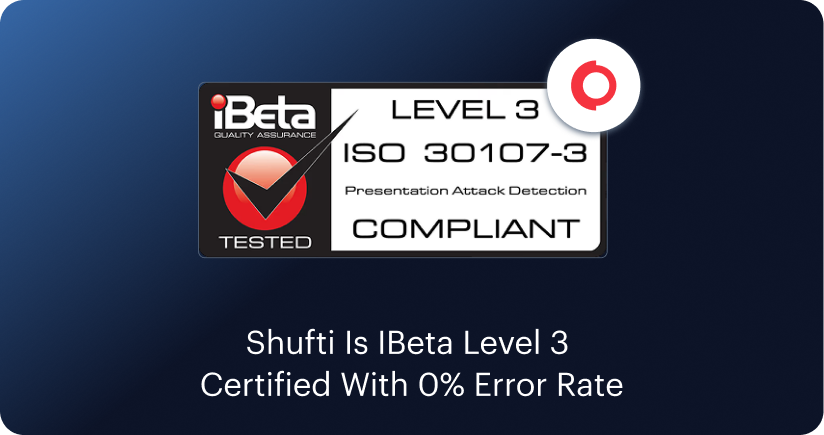
Certifications
Independently audited and certified for enterprise-grade security and data protection.




Frequently asked questions (FAQs)
One of the attributes of the right KYC solution provider is that it builds and runs its own identity verification and AML components, name matching, biometrics, OCR and screening, rather than reselling third-party engines. When a rule changes, the party that built the system makes the change, so it becomes a configuration or a scoped task instead of a request in someone else’s backlog.
When verification policies, matching thresholds, geo rules and screening filters are exposed as configuration, a product owner can change acceptance criteria per market, segment or product line directly. Engineering is only needed when a genuinely new capability is required, not when an existing rule moves.
Yes. A risk-based approach means Customer Due Diligence measures, acceptance thresholds and step-up checks vary with assessed risk. Look for a platform where geo-restrictions, sanctions screening rules and country risk policies can be adjusted independently rather than applied globally.
Verification of market-specific identity documents is the first constraint, as not all identity documents are built to ICAO standards, so layouts, fields and machine-readable zones vary widely. The challenge increases for non-Latin markets, where the same person is recorded in different scripts and conventions across systems, and Proof of Address documents differ in language, structure and plausibility rules. Both name matching and address normalisation reject genuine customers quietly, and both need the reading and matching layer tuned rather than a new vendor.
Ask how a specific change would be delivered, a new script, a revised sanctions list, an unfamiliar document type, and who does the work. The answer that predicts your future roadmap load is whether that change is a configuration handled by the KYC solution provider or a support ticket in an upstream backlog.
The best KYC risk solution is one that owns its identity verification and AML stack end to end, so risk rules, thresholds and screening filters are configurable by the product team rather than dependent on a third-party engine. Practically, it should cover document and document-free verification across non-standard identity documents, support a risk-based approach that varies Customer Due Diligence by market, segment and product line, keep sanctions and watchlists current, and offer in-country, on-premise and offline deployment where sovereignty rules require it.
The best identity verification solution for data privacy is one that lets you control where verification runs and where data is stored. Data privacy and residency cannot be solved in the product layer, so confirm the KYC solution provider supports in-country cloud, on-premise, offline and customer-hosted deployment, otherwise a sovereignty rule closes the market outright rather than adding a feature gap.