KYC for Fintech & Neobank Onboarding: Compliance Automation Guide 2026
- 01 What KYC compliance means for fintechs and neobanks?
- 02 The regulatory pressure tightening around neobank KYC
- 03 What fraud risks are digital banks actually fighting?
- 04 How digital onboarding works in fintech?
- 05 KYC automation software: what good looks like in 2026
- 06 How do fintechs manage ongoing compliance with perpetual KYC?
- 07 Practical next steps for fintech compliance teams
- 08 How Shufti helps fintechs and neobanks automate KYC compliance?
TL;DR
- Regulators across the US, UK, EU, and Nigeria are enforcing stricter KYC and AML rules on fintechs and neobanks. The FCA fined two major UK neobanks in 2025, marking a shift to zero-tolerance supervision of digital-first financial services.
- Digital onboarding in fintech requires automated document capture, biometric liveness, and AML screening. Manual processes cannot scale to neobank volumes.
- Fake ID detection online and card cloning fraud prevention require separate defensive layers: forensic document analysis, active liveness checks, and real-time transaction intelligence.
- KYC API fintech integrations compress onboarding to under 15 seconds and eliminate the manual review queues that drive customer abandonment.
- Perpetual KYC for fintech replaces scheduled reviews with event-driven monitoring, reducing compliance operations cost by 60-80% at mid-size institutions according to PwC research.
- AI-powered KYC automation software handles the verification volumes neobanks generate without adding headcount to the compliance team.
- The best KYC solutions for neobanks combine identity verification, AML screening, and fraud detection in a single API rather than requiring separate vendor integrations for each function.
In July 2025, the Financial Conduct Authority (FCA) fined Monzo £21 million for AML control failures that persisted through years of rapid customer growth. The fine landed while the neobank was actively onboarding hundreds of thousands of users, a detail regulators noted explicitly. Digital banks built for speed are learning that the faster they scale, the more exposed their compliance gaps become to regulatory scrutiny. This guide covers what KYC fintech neobank compliance requires in 2026, how digital onboarding automation should work, and what separates the fintechs passing audits from those receiving enforcement notices.
What KYC compliance means for fintechs and neobanks?
Know Your Customer (KYC) compliance is the regulated process by which a financial institution verifies a customer’s identity, assesses their risk profile at onboarding, and monitors their behaviour throughout the relationship. For fintechs and neobanks, the regulatory baseline is identical to traditional banking, but the execution environment is entirely different. Every step happens remotely and at volume, with no physical fallback.
Why neobanks face higher KYC scrutiny than traditional banks?
Digital bank KYC carries inherent risk that regulators have started pricing into their enforcement posture. A traditional bank branch can physically inspect a passport and verify the presence in person. A neobank completing neobank identity verification has no such option. Every check is digital, which means every fraud technique that targets digital systems lands directly in the onboarding flow.
The FCA’s financial crime guidance for regulated firms identifies neobanks and challenger banks as consistently underperforming traditional institutions on high-risk customer due diligence (CDD) and ongoing transaction monitoring. Regulators draw a direct line from fast growth to thin compliance controls. The operational assumption now is that a neobank acquiring one million users in 18 months must demonstrate that its controls are scaled with the customer base. That means automated, not manual, neobank KYC process execution.
The regulatory baseline: what every digital bank must do?
AML compliance fintech requirements vary by jurisdiction, but the floor is consistent across the US, UK, EU, and most regulated APAC markets. Identity verification for fintech must cover collection and verification of a government-issued identity document, biometric matching of the document holder against that document, sanctions and PEP screening at the point of onboarding, and ongoing transaction monitoring post-account opening.
FinCEN’s Bank Secrecy Act (BSA) requirements mandate Customer Identification Program (CIP) procedures for every US-registered fintech accepting deposits or transferring funds. In the UK, the Money Laundering Regulations 2017 require Customer Due Diligence (CDD) before establishing any business relationship. In Nigeria, the Central Bank of Nigeria (CBN) requires digital-first financial services providers to complete biometric KYC on all account holders. The same obligation applies to neobanks licensed there. The floor is high, and it is rising.
The regulatory pressure tightening around neobank KYC
Regulatory pressure on fintech KYC compliance is not a future concern. It is present in enforcement actions now. The FCA’s 2025 enforcement record shows two UK neobanks fined within months of each other for AML control failures. The global digital identity market reached $64.44 billion in 2025 and is projected to reach $145.80 billion by 2030, a growth trajectory that tracks directly with the volume of regulated digital onboarding now required across financial services globally. The three regulatory regimes most directly shaping neobank compliance obligations are the US BSA/AML framework, the FCA regime in the UK, and the evolving EU framework under the Anti-Money Laundering Authority (AMLA) and Markets in Crypto-Assets Regulation (MiCA).
FinCEN and the BSA/AML requirements for US fintechs
The Financial Crimes Enforcement Network (FinCEN) administers the BSA and, as of 2025, is expanding AML expectations specifically for digital-asset platforms and payment fintechs. Fintechs that transmit money, hold customer funds, or facilitate payments must register as Money Services Businesses (MSBs) and file Suspicious Activity Reports (SARs). The Customer Due Diligence Rule, effective since 2018 and tightened in subsequent guidance, requires beneficial ownership identification even for digital-native business accounts. Early 2025 enforcement actions targeted fintechs and broker-dealers specifically, signalling that FinCEN is actively pursuing the same standards for digital platforms as for traditional banks.
FCA enforcement actions on UK neobanks
The FCA’s posture toward neobanks hardened noticeably in 2024 and 2025. Beyond the Monzo fine, the FCA fined Starling Bank £28.9 million for AML screening failures and stated in its 2025 supervisory review that neobanks would be held to the same compliance bar as traditional institutions, regardless of company age. The FCA’s specific failure categories in each enforcement action cover inadequate screening of Politically Exposed Persons (PEPs), gaps in high-risk customer monitoring, and transaction monitoring rules that do not adapt to evolving fraud patterns. Each category directly defines what any KYC automation software deployed by a UK neobank must address.
EU AMLA, MiCA, and what the European regulatory squeeze means for digital banks
As of April 2026, the EU Anti-Money Laundering Authority (AMLA) is in its pre-operational phase, with direct supervisory powers over the highest-risk obliged entities taking effect in 2028. The Markets in Crypto-Assets Regulation (MiCA) came into full effect in December 2024, extending KYC fintech neobank compliance obligations explicitly to crypto-adjacent fintech services. Any EU-registered fintech handling stablecoin payments, crypto transfers, or tokenised assets now faces simultaneous KYC requirements under the Sixth Anti-Money Laundering Directive (6AMLD) and MiCA. The combined effect is a stricter, more uniform compliance floor across all EU member states. Direct supervisory consequences await firms that fall short.

What fraud risks are digital banks actually fighting?
Onboarding fraud in digital banking has changed character since neobanks reached scale. The fraudster submitting a low-quality scanned fake through a desktop browser is no longer the primary threat. US consumer fraud losses reached $12.5 billion in 2024, a 25% increase over 2023, and a growing portion originates at the account-opening stage. Fintechs face three distinct fraud categories at onboarding, each requiring a separate defensive layer.
Fake ID detection online
Fake id detection online has become harder because the quality of fraudulent documents has improved substantially. Generative AI tools produce convincing replicas of passports, driver’s licences, and national identity cards that pass standard visual inspection. Modern document verification must go beyond optical character recognition (OCR) and field extraction, comparing the physical security features embedded in legitimate documents against issuing-authority databases. Forensic checks cover UV pattern simulation, font geometry validation, microprint authenticity, and Machine Readable Zone (MRZ) verification. These multi-point forensic checks identify synthetic forgeries that a surface-level OCR pass would approve. Without dedicated fake id detection layers, a neobank running standard document capture is approving fraudulent accounts in every onboarding cohort.
Card cloning fraud prevention
Card cloning fraud prevention requires real-time transaction intelligence that most neobanks lack at launch. Cloned cards generate transaction patterns that differ subtly from the genuine cardholder’s behaviour, with different geolocation, atypical merchant categories, and velocity spikes that sit just below single-transaction alert thresholds. A real-time fraud detection KYC API cross-references device fingerprint, IP geolocation, and historical spend behaviour simultaneously, flagging anomalies within the same onboarding session rather than catching them hours later in a batch review. The evolution of AI in KYC fraud prevention shows that integrating fraud signals into the identity verification decision cuts the window between fraud attempt and flag from hours to milliseconds. That difference determines whether a cloned card is blocked before first use or recovered from after.
Synthetic identity and deepfake threats in neobank onboarding
Deepfake-assisted account-opening fraud reached a measurable scale in 2025. Fraudsters submit a face-swapped video or a synthesised selfie during biometric verification, attempting to match a stolen identity document with a generated face. Standard passive liveness checks are vulnerable because they measure stillness and depth rather than signs of digital manipulation. Active liveness challenges combined with AI-based frame-level analysis catch face-swap attacks that passive liveness misses. Neobanks face this attack vector at higher rates than traditional banks because their fully digital onboarding architecture makes biometric verification the only check standing between a fraudster and a funded account.
How digital onboarding works in fintech?
Digital onboarding fintech platforms compress what traditional banks complete across two or three branch visits into a process that takes under five minutes on a mobile device. The efficiency gain creates regulatory responsibility. An automated flow that moves fast can also approve fraudulent applications fast. A well-designed neobank KYC process builds verification quality into each step rather than appending checks at the end of the flow.
The neobank KYC process step by step
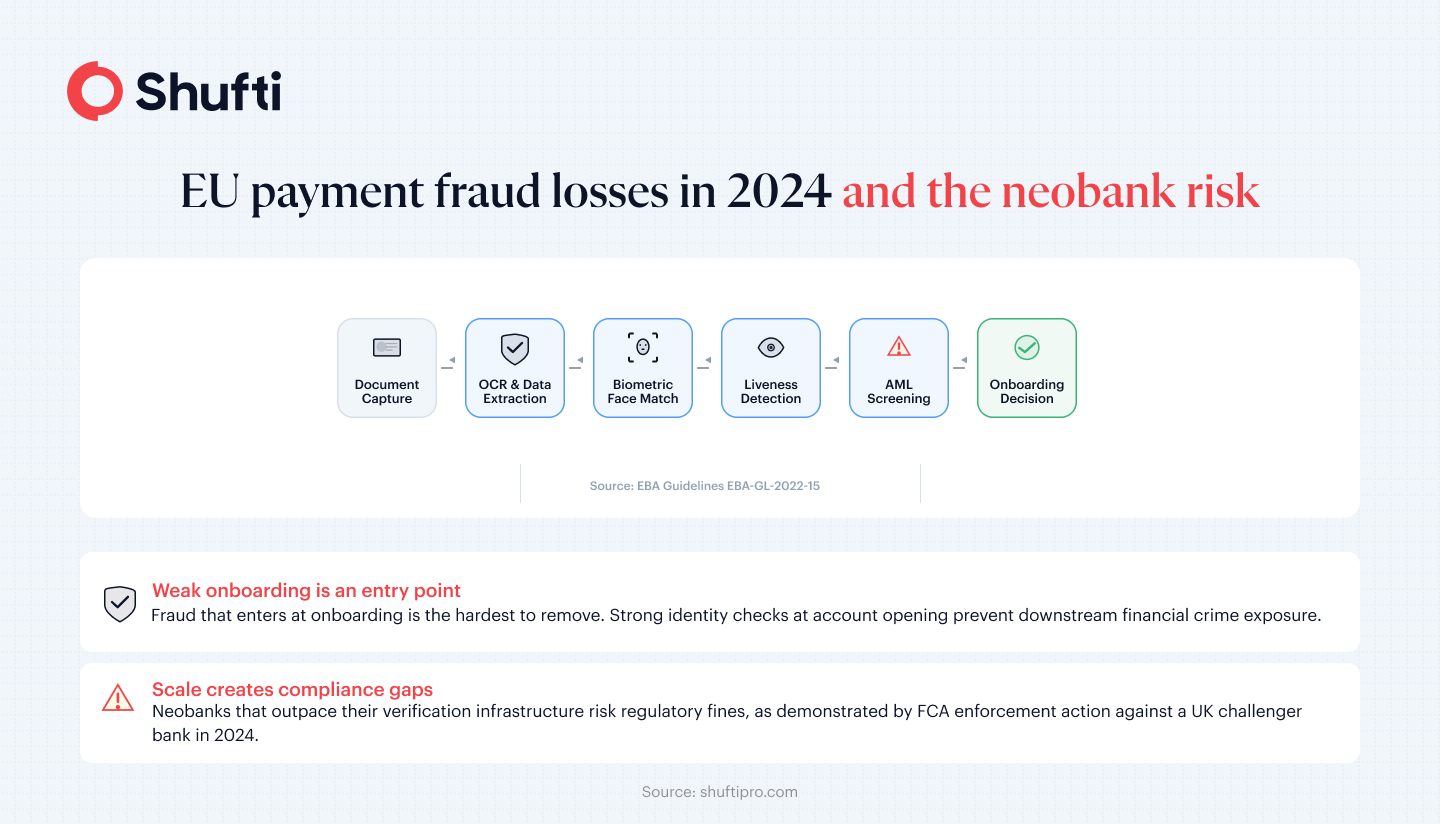
The neobank kyc process runs through five sequential steps before an account is opened. The customer submits a government-issued identity document through the mobile camera. The platform runs document authentication, covering forgery detection, security-feature verification, and MRZ validation. A biometric liveness check matches the customer’s face to the document photo in real time. An AML screening query checks the customer against sanctions lists, PEP databases, and adverse media. A risk score is generated and, where regulation requires it, Enhanced Due Diligence (EDD) is triggered for high-risk profiles before account access is granted. The full sequence runs in under 15 seconds on a GPU-accelerated stack. Above that threshold, drop-off increases materially.
API KYC onboarding and integration
API KYC onboarding is the architecture most fintechs adopt because it separates the KYC compliance engine from the product logic entirely. A kyc api fintech integration handles identity capture, document verification, biometric matching, and AML screening through a single endpoint, returning a pass or fail decision with a risk signal that the fintech’s core system acts on. The fintech controls the user experience. The API handles the compliance logic. This integration pattern means fintechs can upgrade their verification stack, add new check types such as address verification or biometric re-verification, or extend coverage to new jurisdictions without rebuilding the onboarding flow. Understanding how AI transforms identity verification covers how the API layer handles deepfake detection as a native part of the biometric check rather than a separate downstream step.
Document verification and biometric matching in neobank onboarding
Document verification for a cross-border neobank covers more than 10,000 document types across 230 countries. That coverage matters when a fintech company is onboarding users across multiple markets from a single platform. Biometric matching links the verified document to the physical person presenting it. The combination of a forensically verified document and a confirmed live biometric match creates a verification chain that is difficult to defeat without either a genuine document in hand or a high-quality deepfake attack. When both checks run inside the same API call rather than as sequential, separate requests, the timing gap between document approval and biometric confirmation disappears. Fraud rings have exploited that gap by substituting a different face between steps.

KYC automation software: what good looks like in 2026
KYC automation software handles the verification scale that neobanks generate. A neobank acquiring 50,000 users per month cannot staff a manual review team proportional to that volume, and the compliance risk of the backlog is not manageable. Seventy percent of financial institutions lose clients due to slow onboarding, which means the cost of slow fintech KYC automation is both a compliance liability and a direct revenue problem. The automation stack a fintech deploys in 2026 must handle three distinct functions without them being separate procurement decisions.
AI-powered KYC automation software capabilities
AI-powered KYC automation software performs document classification, OCR extraction, forgery-signal detection, and risk-based decisioning without human intervention on standard cases. Machine learning models trained on large volumes of genuine and fraudulent documents identify forgery signals that rule-based systems miss entirely, particularly for high-quality synthetic forgeries that pass field-level OCR but fail on font geometry or security-feature pattern checks. The result is a first-pass auto-approval rate that removes manual review queues from the majority of verifications and concentrates analyst time on genuinely ambiguous cases. The best kyc software fintech compliance teams use combines an auto-capture SDK that guides mobile users to a clean document photo, an OCR engine that validates extracted data fields against issuing-authority formats, and a forgery-detection model that scores document integrity before a biometric check runs.
Real-time fraud detection KYC API
A real-time fraud detection KYC API does not verify identity only at the moment of account opening. It cross-references the submitted identity against known fraud databases, watchlists, device intelligence, and behavioural signals in a single API call, returning a combined risk score alongside the identity verification decision. When fraud signals feed into the KYC decisioning step rather than processing through a separate downstream layer, the window between fraud attempt and flag drops from hours to milliseconds. For card cloning fraud prevention specifically, this means a synthetic identity that passes document verification can still be blocked by a device fingerprint anomaly or IP velocity signal caught within the same session. Blocking happens before the account is opened, not after first use.
What to look for in KYC solutions for neobanks?
KYC solutions for neobanks need to meet a specific set of requirements that generic enterprise identity platforms do not consistently satisfy. The mobile-first deployment must include auto-capture guidance, because most neobank users are onboarded on a phone in sub-optimal lighting conditions. End-to-end API response time must stay under 15 seconds, because drop-off increases sharply above that threshold. The platform must cover the geographies the neobank serves. For cross-border fintechs, that means 200-plus countries and multiple document types per country. The AML screening layer must integrate directly with the identity verification result in a single API call, not require a second separate query, because the risk picture is incomplete without both signals together. The KYC and AML compliance framework for fintechs covers how the combined identity-plus-AML stack differs from point-solution approaches in practice.
How do fintechs manage ongoing compliance with perpetual KYC?
Periodic KYC reviews, where a compliance team revisits customer files on a one-, three-, or five-year cycle, create dangerous gaps. A customer who was low-risk at onboarding may become a PEP match, appear in adverse media, or shift to high-risk transaction patterns in the months between scheduled reviews. Perpetual KYC for fintech addresses this by making monitoring continuous rather than calendar-driven, triggered by real-world events rather than fixed intervals.
How perpetual KYC for fintech works?
Perpetual KYC replaces the fixed review cycle with event-driven re-verification. Triggers include a new watchlist match, a change in the customer’s jurisdiction, unusual transaction velocity, a change in source-of-funds declaration, or a shift in the customer’s risk score driven by behavioural signals. When a trigger fires, the system runs a targeted re-check tailored to what changed. This might be an AML re-screen, a document re-verification, or a request for updated information, rather than a full-file review. PwC’s analysis of perpetual KYC implementations found that mid-size banks adopting event-driven continuous monitoring reduced their compliance operations cost by 60-80% by eliminating the full-file reviews that scheduled refresh cycles require. For a neobank at scale, that is a material operational saving.
Continuous KYC monitoring for neobanks vs periodic reviews
Continuous KYC monitoring neobanks run looks different from the bulk re-verification batches that traditional banks process quarterly. Rather than pulling 50,000 customer files and working through them in sequence, the continuous model maintains a live risk score per customer that updates whenever new signals arrive. When a score crosses a defined threshold, a focused review triggers. Most customers never require a review after onboarding because their risk profile remains genuinely stable. Compliance team attention concentrates on customers who actually changed, not spread uniformly across the entire book. The practical effect is that a neobank with 500,000 customers might trigger EDD for fewer than 2% of its book in any given month. That is a sustainable workload rather than a quarterly paralysis of the compliance function.
When to trigger enhanced due diligence in a continuous model?
Enhanced Due Diligence (EDD) in a continuous monitoring model triggers proportionally, not uniformly. Common trigger conditions include a new PEP designation, an adverse media hit from the ongoing monitoring feed, a change in the customer’s stated source of funds, a transaction pattern that deviates from the baseline established at onboarding, or a jurisdiction change to a country on a high-risk list. The continuous model means EDD is applied where risk genuinely exists rather than being distributed across the full customer book on a schedule. Compliance resources align with actual risk, not calendar assumptions about when risk is likely to change.
Practical next steps for fintech compliance teams
The right KYC stack for a fintech or neobank does not emerge from a single procurement decision. The choices made at setup, from the regulatory map to the fraud risk model to the integration architecture, determine whether the compliance programme holds under regulatory scrutiny. The framework below covers those decisions in the order they typically arise.
Start with the regulatory map. Before selecting any KYC automation software, identify every jurisdiction the fintech operates in and the verification requirements each imposes. A US-licensed money transmitter has different CIP obligations than an FCA-authorised e-money institution or a CBN-regulated Nigerian payment provider.
The regulatory map determines which document types must be accepted, which biometric methods are permitted, and whether video-assisted verification is required for any customer segment. A platform that cannot cover the required document types in the required jurisdictions cannot solve the compliance problem regardless of how capable the underlying technology is.
Then establish the fraud risk model for the specific product. A neobank offering prepaid debit cards faces different fraud patterns than a peer-to-peer payment fintech. Fake id detection online, card cloning fraud prevention, and synthetic identity fraud each require different detection layers.
The fraud risk model determines which verification checks the KYC stack must include, the risk score thresholds that trigger EDD, and the transaction monitoring rules that the AML layer must run post-onboarding. The intersection of KYC verification and fraud prevention in fintech and payments covers how these layers interact in production environments where both onboarding and transaction fraud are active threats.
After that, define the integration architecture. API KYC onboarding through a single endpoint is the most common pattern for fintechs building from scratch. Fintechs migrating from an existing provider must confirm that the new API returns data in a format compatible with their existing case management and SAR filing workflows. A smooth onboarding experience that creates a downstream compliance data problem does not solve the original issue.
Finally, build the monitoring layer from the start. Continuous KYC monitoring for neobanks is harder to retrofit than to build into the initial stack design. If the data architecture does not capture the signals required for event-driven re-verification at launch, adding it later requires a material rebuild of the risk data model. The cost of doing it right at launch is always lower than the cost of doing it twice.
How Shufti helps fintechs and neobanks automate KYC compliance?
Fintechs and neobanks face a specific problem that Shufti’s platform is designed to handle. The platform verifies thousands of users per day across multiple countries and document types, keeps the onboarding experience tight enough to avoid drop-off, and produces the audit trail regulators examine during supervisory reviews.
Shufti’s identity verification for fintech runs through a single API covering document forensics, biometric liveness, and ongoing AML screening without requiring separate integrations. The document verification layer covers over 10,000 document types across 230 countries, which handles the cross-border onboarding volumes that neobanks generate. The biometric matching holds a 98.72% accuracy rate, iBeta Level 1 and Level 2 certified, which covers the liveness and deepfake detection requirements that regulators and enterprise customers are specifically asking about. The single-API architecture means compliance data flows into one audit trail rather than three separate vendor logs. That is what a regulatory examination expects to find.
For the ongoing monitoring side, Shufti’s AML screening runs against 100,000-plus data sources, 3,500 global watchlists, and 2.6 million PEP profiles, updated every 15 minutes. The continuous monitoring layer triggers re-verification when a customer’s risk profile changes rather than on a fixed schedule. The event-driven model supports perpetual KYC workflows for fintech compliance teams directly. Deployment options cover cloud, on-premises, and hybrid, which means the stack can meet data residency requirements in jurisdictions that restrict cross-border customer data transfer.
Manual KYC and fragmented compliance stacks are the root cause of most enforcement actions against fintechs and neobanks. Shufti’s KYC verification combines document forensics, biometric liveness, AML screening, and continuous monitoring in a single API built for the verification volumes digital banks generate. Request a demo to see the full verification flow, including fake ID detection, liveness, and real-time AML screening, running on your own onboarding test cases.
Frequently Asked Questions
What is KYC automation in fintech?
KYC automation in fintech replaces manual document review and identity checks with AI-driven verification running in real time. The system captures identity documents, runs biometric matching and AML screening, and returns a risk decision through a single API call without human intervention on standard cases.
How do neobanks handle AML compliance?
Neobanks meet AML compliance by integrating automated sanctions screening, PEP checks, and adverse media monitoring into the onboarding flow, then running continuous transaction monitoring post-account opening. Event-driven re-verification rather than periodic bulk reviews is the model regulators now expect for digital banks processing high onboarding volumes.
What documents are required for fintech KYC?
Most jurisdictions require a government-issued photo ID (passport, national identity card, or driver's licence) combined with a biometric liveness check. Some markets also require proof of address. The exact document set depends on the jurisdiction and the customer's risk tier at onboarding.
Is API-based KYC secure?
API-based KYC is secure when the provider holds recognised certifications such as ISO 27001 and SOC 2 Type II. The API architecture is not the risk. The risk lies in the data-handling practices and data-residency compliance of the provider running the verification infrastructure.
How can fintechs reduce onboarding fraud?
Fintechs reduce onboarding fraud by layering fake ID detection, biometric liveness, and real-time AML screening into the same onboarding step rather than running them sequentially. Device intelligence combined with identity verification catches synthetic identity and card cloning attempts that pass document checks alone.