AMLR Solutions
  AMLR Consultation
 EUDI Wallet
 Onboarding
 Ongoing Monitoring
 FRAML
FRAML KYC
KYC KYB
KYB KYI
KYI Age Assurance
 Workforce IAM
 Candidate Verification
 Account Takeover
 Bonus/ Promotion Abuse
 Chargeback Fraud
 Deepfake
 Document Fraud
 Fraud Networks
 Impersonation Fraud
 Money Mule Activity
 Multi-Accounting
 Party Fraud
 Regulatory & Compliance Risks
 Synthetic Identity Fraud
 Adult Content
 Banking
 Crypto
 Fintech
 Forex
Forex Compliance
 Fraud prevention
 Trust & safety
 Global expansion
 Compliance Officers
 Developers
 Fraud Analysts
 Product Managers
 Journey Builder
  Global Trust Platform
 Customer Profiles
 Vendor Comparison
 IDV Case Management
 AML Case Management
 Regulatory Reporting
 Agentic Rule Builder
  AI Compliance Co-Pilot
  Fraud Analytics
 Fraud Hub
  OCR
OCR Shufti AI
 Bank Account Verification
  Biometric Duplication
 Database Checks
 Document Intelligence
 Government ID
 Mobile Driver's License
 NFC
NFC Selfie Liveness
 Brand Personalisation
 Deployment Options
 Identity Methods
 IDV Modes
 Multi-tenancy
 On-Premise IDV
 Secure Capture
 Shufti MCP
















TL;DR
- Real estate agents in the UK, EU, and US are legally required to verify buyer identity, check the source of funds, and screen against sanctions lists before any property transaction is completed.
- In the UK, this has been mandatory under MLR 2017 since 2017, supervised by HMRC; trading without registration is a criminal offence.
- In the US, FinCEN’s nationwide residential real estate rule took effect in March 2026, covering all non-financed residential transfers with no price-threshold exemptions.
- In the EU, the AMLR designates real estate professionals as obliged entities from July 2027; 2026 is the preparation window.
- New Zealand’s AML/CFT Act includes conveyancers as designated reporting entities under FATF-aligned standards.
- High-risk buyers, cross-border purchasers, corporate buyers, and high-value properties require enhanced due diligence (EDD), not just standard checks.
- Manual and paper-based verification no longer meets audit requirements; digital workflows with timestamped audit trails are now the baseline expectation.
- Ongoing monitoring is required for transactions spanning multiple months. A buyer who cleared screening in January may appear on a sanctions list by March.
As of March 1, 2026, the Financial Crimes Enforcement Network’s (FinCEN) final rule on residential real estate transfers took nationwide effect in the US, replacing geographic targeting orders with a blanket requirement covering every non-financed residential property transfer. For estate agents and conveyancers already operating under KYC requirements in the UK and EU, the US shift confirms a pattern. Property markets globally are under increasing regulatory scrutiny, and manual buyer verification is no longer adequate. This guide covers what KYC real estate compliance requires in 2026, which regulations apply by jurisdiction, and how to build a buyer verification process that holds up under audit.
What is KYC in real estate?
KYC (Know Your Customer) in real estate means verifying the identity of every party to a property transaction before the deal proceeds. Real estate KYC compliance is not a discretionary process. The Financial Action Task Force (FATF) Risk-Based Approach Guidance for the Real Estate Sector identifies property as an asset class criminals use to move large sums in a single transaction while obscuring ownership through legal entities. The checks required range from standard document verification to full source of funds review, depending on the buyer’s risk profile and the transaction value.
Property buyer verification
Property buyer verification confirms that the person named in a transaction is who they claim to be. Agents and solicitors collect government-issued identity documents (passports, driver’s licences, or national ID cards) and validate them against the individual presenting them. For cross-border buyers, digital document capture with biometric matching is the practical alternative to in-person review. When the buyer acts through a company or trust, estate agent identity verification extends to confirming the beneficial owner behind the structure, not just the nominee who signs the paperwork.
Source of funds in real estate transactions
A source of funds check in real estate confirms that the money a buyer brings to a property transaction comes from a legitimate origin. Buyers typically provide bank statements, investment records, sale proceeds from a previous property, or inheritance documents, and the agent or conveyancer reviews these before the deal proceeds. Running a source of funds check early in the transaction is one of the most direct defenses against real estate money laundering because it places the evidentiary burden on the buyer before contracts are exchanged.
How KYC works in real estate transactions
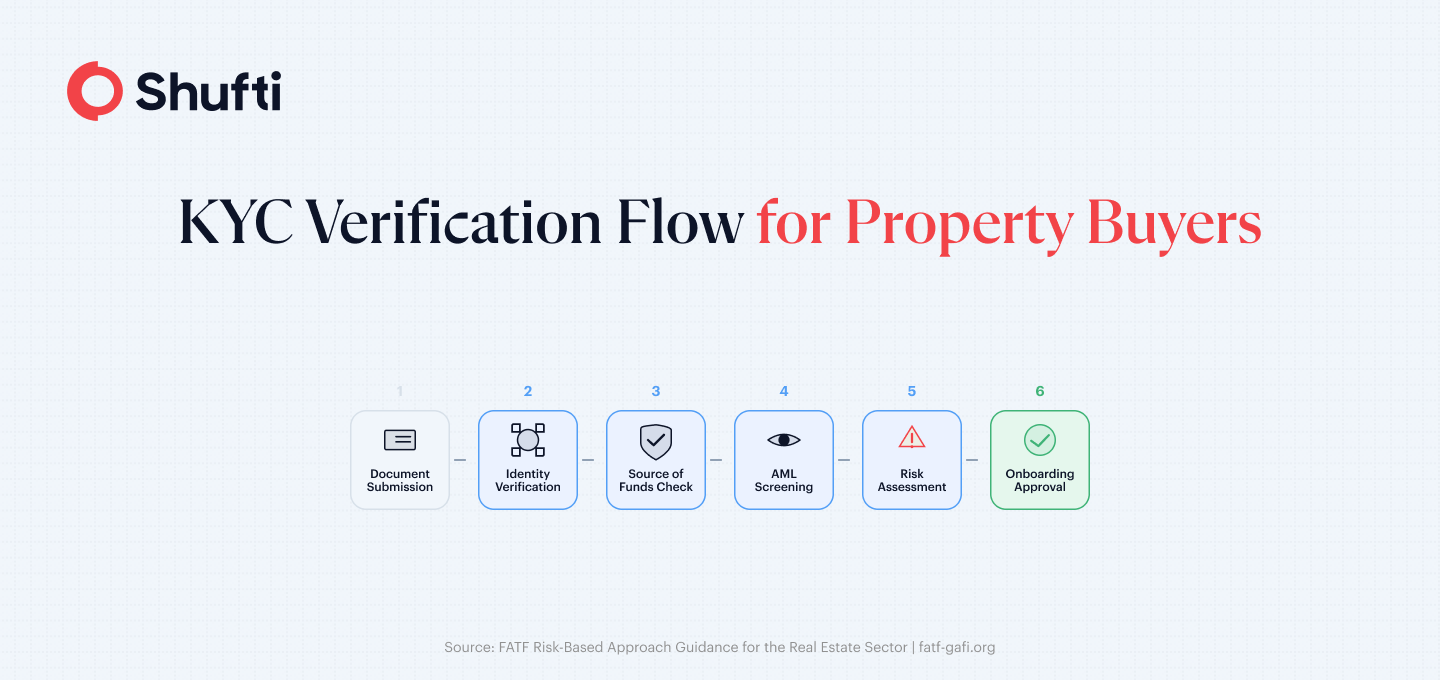
The KYC process in a property transaction runs across several checkpoints, each designed to answer a distinct compliance question. Identity verification for property buyers, source of funds review, and AML screening in property transactions form a chain of evidence that agents and conveyancers can present to regulators or auditors. The sequence varies by jurisdiction, but the three components are consistent across major markets.
Document verification for property buyers
Document verification uses optical character recognition (OCR) and forensic document analysis to extract data from a buyer’s identity document and confirm it against issuing authority records. For in-person transactions, agents may still do this manually, but digital document verification produces a timestamped audit trail that paper-based review cannot replicate. KYC software for real estate increasingly processes passports and national identity documents from multiple jurisdictions in a single workflow, removing the need for agents to handle each country’s document format separately.
AML screening in property transactions
Once identity is confirmed, AML screening in property transactions checks the buyer against global watchlists, sanctions lists, and politically exposed person (PEP) databases. Property transaction compliance at this stage extends well beyond a single regional search. A buyer purchasing a high-value property in London may appear on an OFAC sanctions list, an EU sanctions register, or a foreign PEP database that a local check would not surface. AML compliance in property means running these checks at the point of onboarding and maintaining ongoing monitoring for transactions that span several months.
AML regulations that apply to real estate in 2026
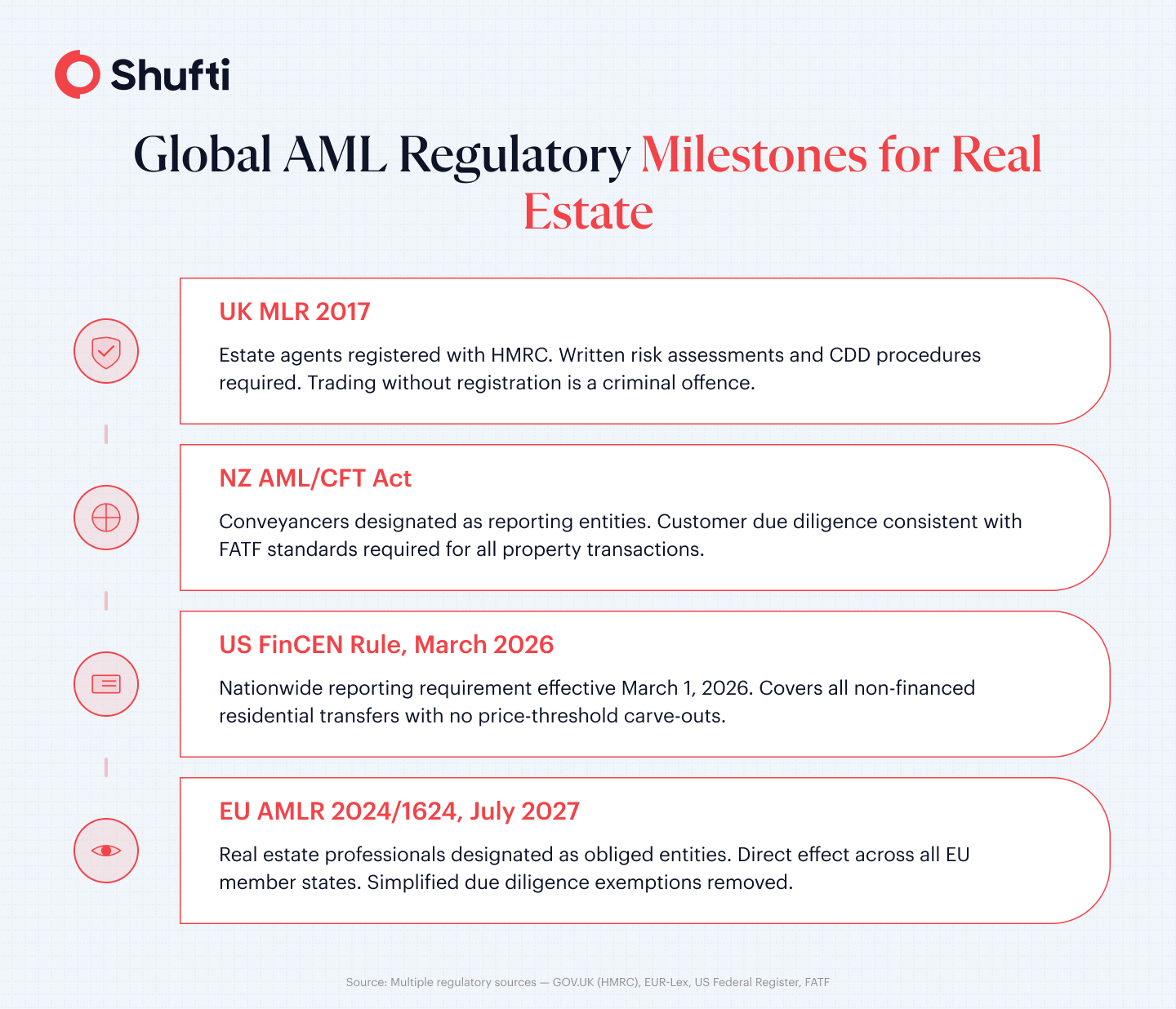
Across the UK, the EU, the US, and New Zealand, AML real estate regulations are moving in a consistent direction. More professionals are being brought into scope, transaction coverage is expanding, and enforcement is tightening. The 2026 calendar marks a turning point, with the US rule now in effect and the EU single rulebook approaching its 2027 application date. Understanding which regime applies and which firms it covers is where property AML compliance starts for agents and conveyancers mapping their obligations.
UK MLR 2017 and estate agent obligations
In the UK, estate agents have operated as regulated entities under the Money Laundering, Terrorist Financing and Transfer of Funds (Information on the Payer) Regulations 2017 (MLR 2017) since those regulations came into force. HMRC supervises estate agency businesses and requires them to maintain written risk assessments, implement customer due diligence procedures, and train staff on AML obligations. Trading as an estate agency business without registering with HMRC is a criminal offense. KYC for real estate agents in the UK is therefore not a question of good practice. It is a legal baseline set by statute. The UK KYC and AML regulations guide covers how the UK framework sits alongside broader global obligations.
EU AMLR, US FinCEN rule, and NZ AML/CFT Act
The EU Anti-Money Laundering Regulation 2024/1624 (AMLR) formally designates real estate professionals as obliged entities under EU AML law, with the regulation applying from July 10, 2027. Unlike previous directives, the AMLR takes direct effect across all member states without requiring national transposition, removing the patchwork of simplified due diligence exemptions that existed under earlier frameworks. For EU-based firms, 2026 is the preparation window. For UK firms with EU operations post-Brexit, both regimes apply.
In the US, FinCEN’s residential real estate rule replaced geographic targeting orders with a nationwide reporting framework effective March 2026, covering all non-financed residential transfers with no price-threshold carve-outs. In New Zealand, the Anti-Money Laundering and Countering Financing of Terrorism (AML/CFT) Act includes conveyancers as designated reporting entities, requiring customer due diligence consistent with FATF standards.
How to prevent real estate fraud with KYC and AML screening
Real estate fraud prevention requires more than a single identity check at the offer stage. Property transactions run for weeks or months, and risk can change between the initial verification and the point of completion. A buyer who passed AML screening in January may appear on a sanctions list in March. Corporate buyers who seemed straightforward at onboarding may obscure a beneficial owner with a restricted profile. Ongoing monitoring is the component that manual real estate KYC compliance workflows consistently miss.
Building a tiered risk approach for property buyers
Proptech KYC compliance follows a risk-based approach, not a one-size-fits-all process. Low-risk buyers with clean AML results, a traceable source of funds, and standard documentation move through quickly. High-risk transactions warrant enhanced due diligence (EDD). These include cross-border purchases, corporate buyers, high-value properties, and buyers from jurisdictions FATF identifies as elevated risk. Automated KYC software for real estate routes each file to the appropriate review level without requiring agents to apply manual risk judgments on every application.
Avoiding common AML compliance failures in property transactions
The most common audit failures in estate agent AML reviews involve incomplete source of funds documentation, absent written risk assessments, and manual records that lack timestamps. Digital property transaction compliance workflows address all three. They capture documents at submission, log each verification step automatically, and produce an audit trail that survives regulatory inspection. For real estate AML compliance programs that began as spreadsheets and email threads, moving to a digital workflow is the most practical path to audit readiness.
How Shufti helps estate agents meet AML compliance
Manual KYC in property transactions leaves gaps that regulators are increasingly willing to act on. For firms still running buyer verification through paper files and email requests, the 2026 regulatory calendar creates a practical deadline for moving to a digital, audit-ready process. Shufti’s AML screening draws on over 100,000 data sources, 3,500+ global watchlists, and 2.6 million PEP profiles across 215+ sanction regimes, with data updated every 15 minutes. That coverage matters in property transactions where cross-border buyers can appear in sanctions and PEP databases that regional tools miss entirely.
For agents needing document verification across multiple markets, Shufti processes over 10,000 document types from 240+ countries, making it practical for firms handling international buyers without building separate verification workflows per jurisdiction. Every check generates a timestamped audit trail, the kind of evidence that satisfies HMRC reviews, FATF-aligned assessments, and the documentation requirements of the incoming EU AMLR.
Property buyers who complete verification through Shufti are screened at the point of onboarding and monitored on an ongoing basis, so risk changes after the initial check are captured before they become compliance failures.
Frequently Asked Questions
What KYC checks are required in real estate?
Estate agents must verify buyer identity using government-issued documents, run source of funds checks, and screen buyers against sanctions lists and PEP databases. In the UK, MLR 2017 sets the baseline. The EU AMLR applies from July 2027. High-risk buyers require enhanced due diligence.
What is the source of funds verification in property transactions?
Source of funds verification confirms that the money used to buy a property came from a legitimate origin. Buyers provide bank statements, investment records, or inheritance documents. Estate agents review these before a transaction proceeds. It is a legal requirement in the UK and most regulated property markets.
Do real estate agents need to comply with AML rules?
Yes. In the UK, estate agents must register with HMRC under MLR 2017. Trading without registration is a criminal offence. In the EU, agents become obliged entities under the AMLR from July 2027. In the US, FinCEN's residential real estate rule has applied nationwide since March 2026.
What documents are required for property KYC?
Buyers typically provide a government-issued photo ID (passport or driver's licence) and proof of address dated within three months. High-value or high-risk transactions add source of wealth documentation and beneficial ownership information when the buyer acts through a company or trust.
How does AML compliance apply to property transactions?
AML compliance in property requires agents and conveyancers to verify buyer identity, confirm source of funds, and screen buyers against sanctions and PEP databases before a transaction completes. Ongoing monitoring applies when deals span multiple months. Regulators in the UK, EU, US, and New Zealand enforce these requirements.