AMLR Solutions
  AMLR Consultation
 EUDI Wallet
 Onboarding
 Ongoing Monitoring
 FRAML
FRAML KYC
KYC KYB
KYB KYI
KYI Age Assurance
 Workforce IAM
 Candidate Verification
 Account Takeover
 Bonus/ Promotion Abuse
 Chargeback Fraud
 Deepfake
 Document Fraud
 Fraud Networks
 Impersonation Fraud
 Money Mule Activity
 Multi-Accounting
 Party Fraud
 Regulatory & Compliance Risks
 Synthetic Identity Fraud
 Adult Content
 Banking
 Crypto
 Fintech
 Forex
Forex Compliance
 Fraud prevention
 Trust & safety
 Global expansion
 Compliance Officers
 Developers
 Fraud Analysts
 Product Managers
 Journey Builder
  Global Trust Platform
 Customer Profiles
 Vendor Comparison
 IDV Case Management
 AML Case Management
 Regulatory Reporting
 Agentic Rule Builder
  AI Compliance Co-Pilot
  Fraud Analytics
 Fraud Hub
  OCR
OCR Shufti AI
 Bank Account Verification
  Biometric Duplication
 Database Checks
 Document Intelligence
 Government ID
 Mobile Driver's License
 NFC
NFC Selfie Liveness
 Brand Personalisation
 Deployment Options
 Identity Methods
 IDV Modes
 Multi-tenancy
 On-Premise IDV
 Secure Capture
 Shufti MCP










TL,DR
- Tiered KYC is now the regulatory standard, not a workaround. FATF’s Feb 2025 update to Recommendation 1 ties AML obligations to financial inclusion, making proportional verification the expected design.
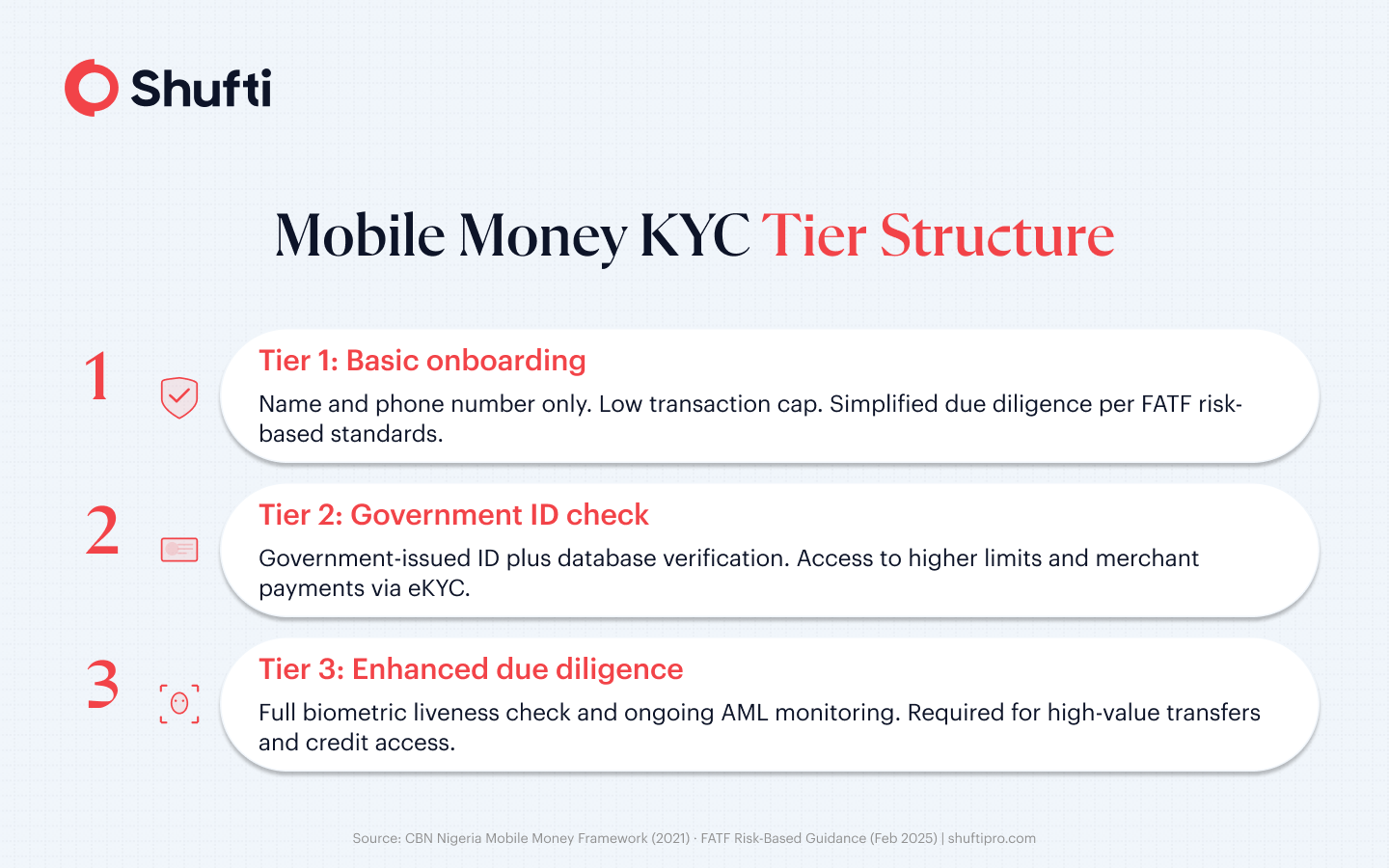
- Three tiers, scaling verification with risk/limits. Tier 1: name + phone, low caps; Tier 2: government ID + database verification; Tier 3: biometric liveness + full EDD for high-value/international accounts.
- eKYC is the operational backbone, document + OCR, biometric/liveness matching, and document-free database checks (against telco and national registry data) let operators verify in seconds without branch visits.
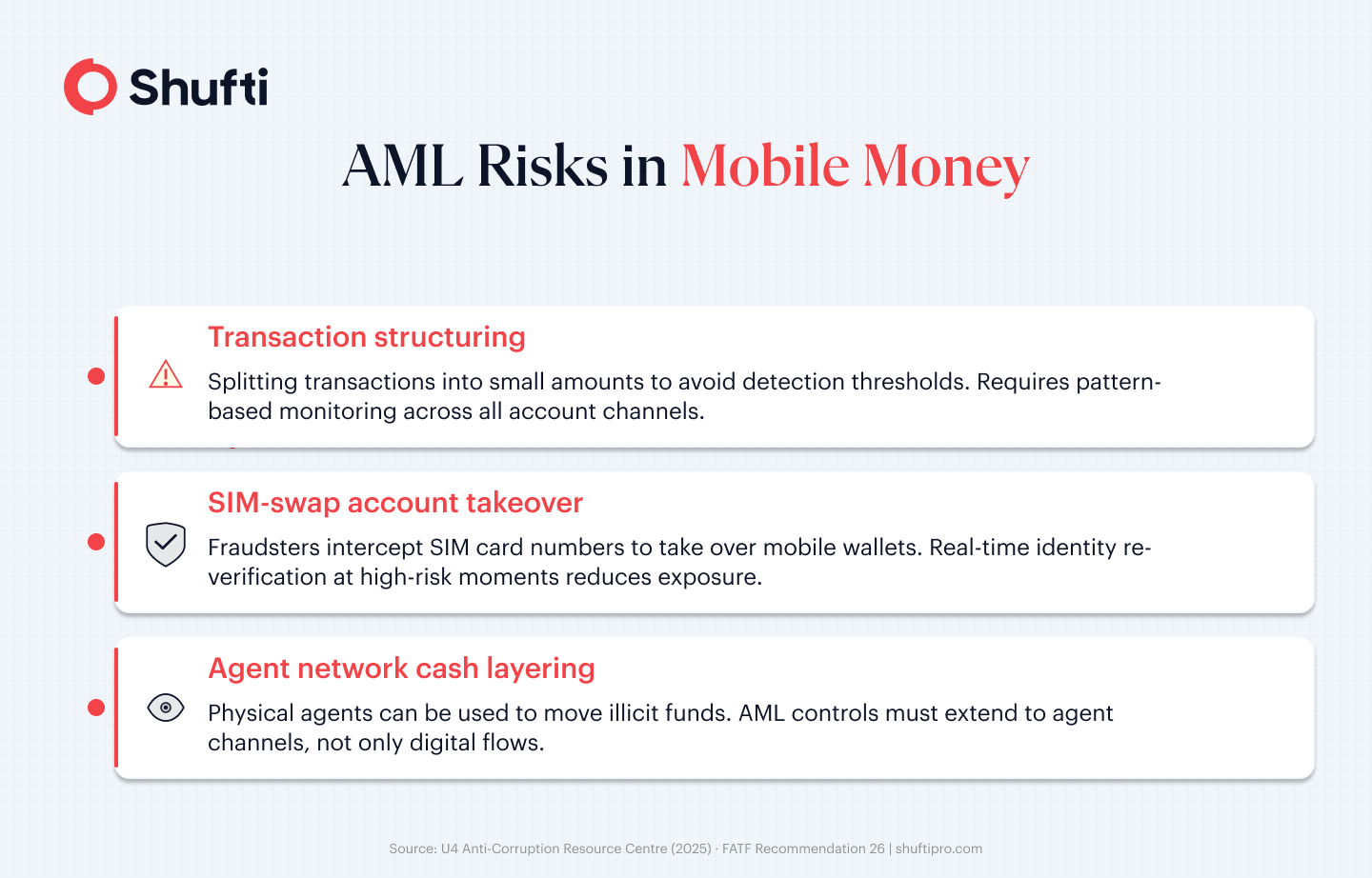
- AML is ongoing, not one-time, mobile money’s high-velocity, low-value profile demands continuous transaction monitoring against structuring, SIM-swap account takeover, and agent network abuse (reinforced by CBN’s March 2026 Baseline Standards).
- Telecom/GSMA overlap reduces duplication. SIM-registration identity data can feed Tier 1 wallet onboarding; CBN links wallets to BVN/NIN at Tier 2+.
- Shufti positioning, single API across all three tiers: database eKYC + biometric liveness + AML screening (3,500+ watchlists, 2.6M PEPs, 215+ sanction regimes), with a demo CTA close.
In February 2025, the Financial Action Task Force (FATF) updated Recommendation 1 to require a risk-based approach that explicitly balances AML obligations against financial inclusion, a direct signal to mobile money operators that proportional, tier-based KYC is not just acceptable but the expected standard. Mobile money platforms now process over $2 trillion in transactions annually, with 2.3 billion registered accounts globally, and regulators from Lagos to Nairobi are watching onboarding practices closely. This article explains how tiered eKYC works for mobile money operators, what AML compliance requirements apply, and how to structure a mobile money KYC program that satisfies regulators without shutting out the customers you are trying to serve.
What is tiered KYC for mobile money operators?
Tiered KYC for mobile money operators (MMOs) is a regulatory framework in which identity verification requirements and transaction limits scale together. The lower the KYC level, the lower the account cap. The higher the verified identity assurance, the higher the limit. This design lets MMOs onboard low-income users with minimal documentation while reserving enhanced due diligence (EDD) for accounts carrying real financial risk. The GSMA’s guidance on overcoming the KYC hurdle identifies tiered or progressive KYC as the primary mechanism for balancing financial inclusion with AML integrity in emerging markets.
Tier 1 — basic mobile wallet onboarding
Tier 1 accounts require only a name, phone number, and self-declared address to open. Transaction limits are low, typically covering airtime top-ups, peer-to-peer transfers under a set daily cap, and bill payments. Under the Central Bank of Nigeria’s (CBN) 3-Tiered KYC framework, Tier 1 mobile money accounts accept basic identifiers with no face-to-face interaction required. The risk exposure at this level is low by design, and FATF’s risk-based approach permits simplified customer due diligence (CDD) accordingly.
Tier 2 — standard verification with government ID
Tier 2 requires a government-issued ID, a passport photograph, and date-of-birth confirmation. In many jurisdictions, including Nigeria’s CBN framework, Tier 2 customers must be verified against a government-backed database. This tier opens higher daily transfer limits, savings functionality, and merchant payment access. Mobile money KYC at this level is where electronic KYC (eKYC) delivers the biggest compliance dividend. Database checks against national ID registries or telecom records can replace in-branch visits without reducing verification assurance.
Tier 3 — enhanced due diligence for high-value accounts
Tier 3 is the highest level of mobile money KYC verification. Full customer due diligence applies, including a liveness check to confirm the applicant is physically present and not presenting a static image. Account holders at this tier access international transfers, business accounts, and credit products. Identity verification for mobile users at this level must satisfy the same AML standards as licensed financial institutions, and biometric checks are the mechanism regulators accept as proof of presence.
How does eKYC work for mobile wallets and digital payment apps?
Electronic KYC (eKYC) replaces paper-based identity verification with automated checks against authoritative databases, captured documents, and biometric signals. For mobile wallet identity verification, eKYC is the operational backbone. A customer submits their details through a mobile app, and the eKYC solutions mobile banking stack cross-references that data against telecom records, national ID databases, or credit bureau data, returning a verified result in seconds rather than days. The process eliminates branch visits and reduces onboarding drop-off, which GSMA data links directly to the growth of monthly active mobile money accounts.
Document and biometric checks for eKYC mobile payments
Document-based eKYC mobile payments verification captures an image of a government ID, extracts data using optical character recognition (OCR), and cross-checks the name, date of birth, and document number against issuing authority records. A biometric layer then matches the ID photo to a live selfie, with liveness detection blocking static-image spoofing. KYC software mobile apps increasingly integrate both steps into a single SDK that functions in low-bandwidth environments, a critical requirement for emerging-market MMO deployments where connectivity is inconsistent.
Database-driven eKYC for low-friction onboarding
Database eKYC performs identity verification without requiring a document upload. The user enters their name, date of birth, and phone number. The system cross-references those attributes against telco subscription records and national registry data to confirm the identity matches. This approach suits Tier 1 and Tier 2 mobile money accounts where the regulatory risk profile supports simplified due diligence. Best eKYC solutions for MMOs support both document and database paths from a single API, letting operators apply the right method per tier without managing multiple vendor integrations.
What are the AML compliance requirements for mobile money operators?
AML compliance mobile money obligations follow the same risk-based framework as conventional banking, but the risk profile differs in specific ways. Mobile money platforms carry high transaction velocity, large volumes of low-value transfers, and diverse user bases spanning formal and informal economies. FATF Recommendation 26 requires supervisory authorities to apply AML/CFT oversight to mobile money operators where they perform functions equivalent to those of financial institutions. MMO compliance, therefore, demands the same screening infrastructure as a bank, applied proportionately across tiers.
FATF’s risk-based approach and financial inclusion
As of February 2025, FATF’s revised guidance on AML/CFT and financial inclusion explicitly instructs jurisdictions and private-sector operators to consider the risks of financial exclusion when designing compliance controls. Operators that apply blanket EDD to all accounts, regardless of value or risk, are not more compliant. They are excluding low-risk customers unnecessarily and creating the informal-channel substitution risk that FATF’s proportionality principle is designed to prevent. Tiered KYC is the preferred design, not a compliance shortcut.
AML risks specific to mobile money and mobile payment compliance
The U4 Anti-Corruption Resource Centre’s 2025 analysis of mobile money AML/CFT risks identifies structuring, SIM-swap fraud, enabling account takeover, and agent network abuse as the dominant risk vectors for MMOs. Mobile payment compliance programs must monitor transaction patterns across agent and digital channels simultaneously. AML screening for mobile money is not a one-time onboarding check. Ongoing monitoring of transaction behaviour is a regulatory expectation under both FATF guidance and Nigeria’s CBN March 2026 Baseline Standards for Automated AML Solutions, which extended mobile money operator obligations to include automated transaction monitoring with a compliance deadline running to March 2028.
How do telecom KYC requirements connect to the GSMA framework?
KYC requirements for telecoms and mobile money operators often overlap, particularly where the same parent company provides both the SIM and the wallet. The GSMA framework treats KYC obligations as a shared infrastructure problem. A SIM registration database, which is mandated by regulation, can double as the identity verification layer for Tier 1 mobile money onboarding. Digital wallet verification does not always require a separate document collection step if the telecom operator has already verified the subscriber’s identity at SIM registration.
The CBN Nigeria Mobile Money Services Framework requires MMOs to link wallet accounts to a unique identifier, typically the Bank Verification Number or National Identity Number, at Tier 2 and above. This means telecom identity verification infrastructure already in place for SIM registration can accelerate eKYC onboarding at the wallet layer, reducing duplication for both the operator and the customer. Regulators across Sub-Saharan Africa and South Asia are adopting similar interoperability models, making the GSMA’s tiered KYC guidance increasingly relevant beyond Nigeria’s market.
How Shufti help mobile money operators meet tiered KYC and AML requirements?
Meeting tier-based KYC across a large mobile user base involves two parallel challenges. The first is verification coverage, reaching customers in markets with thin credit bureau data and limited document infrastructure. The second is AML depth screening of a high-velocity, low-value transaction population without generating false-positive overload that freezes legitimate accounts.
Shufti’s identity verification covers 240+ countries and 10,000+ document types, with a database eKYC layer that cross-references against 235+ trusted sources, including telecom records and national registries. For Tier 1 and Tier 2 mobile money KYC, operators run automated verification against the same data sources regulators recognise, without requiring customers to visit an agent or upload documents manually. For Tier 3 accounts, biometric liveness detection delivers the proof-of-presence assurance EDD requires, with each check completing in under 15 seconds.
On the AML side, Shufti’s AML screening covers 3,500+ global watchlists, 2.6 million PEP profiles, and 215+ sanction regimes, with ongoing monitoring that surfaces risk changes after initial onboarding. MMOs running high-volume, low-value transaction portfolios receive risk signals calibrated to the account tier, not a flat screening threshold that treats every user the same way.
Frequently Asked Questions
What is a tiered KYC system for mobile money?
A tiered KYC system scales identity verification requirements with account limits. Tier 1 uses basic identifiers with low transaction caps. Tier 2 adds government ID verification. Tier 3 requires full biometric due diligence. This structure aligns with FATF's risk-based approach to customer due diligence.
How does eKYC work for mobile wallets?
eKYC for mobile wallets uses automated checks against national databases, telecom records, or captured ID documents to verify a user's identity without a branch visit. The process typically takes under 30 seconds and returns a pass/fail result the app uses to assign the correct account tier.
What documents are needed for mobile wallet verification?
Tier 1 requires only a name and phone number. Tier 2 requires a government-issued ID such as a national identity card, passport, or driver's licence. Tier 3 adds a biometric liveness check, matching the user's live selfie to their ID document photo in real time.
Is KYC mandatory for mobile payment operators?
Yes. FATF Recommendation 26 requires supervisory authorities to apply AML/CFT oversight to any mobile money operator performing functions equivalent to a financial institution. Most national regulators, including Nigeria's CBN, Kenya's CBK, and Ghana's BoG, have implemented specific mobile money licensing frameworks that include mandatory KYC and transaction monitoring obligations.
What are the main AML risks in mobile money?
The primary AML risks in mobile money are structuring, SIM-swap account takeover, and agent network cash layering. Effective mobile payment compliance programs address all three through tiered onboarding controls, real-time transaction monitoring, and ongoing AML screening against sanctions lists and PEP databases.