AMLR Solutions
  AMLR Consultation
 EUDI Wallet
 Onboarding
 Ongoing Monitoring
 FRAML
FRAML KYC
KYC KYB
KYB KYI
KYI Age Assurance
 Workforce IAM
 Candidate Verification
 Account Takeover
 Bonus/ Promotion Abuse
 Chargeback Fraud
 Deepfake
 Document Fraud
 Fraud Networks
 Impersonation Fraud
 Money Mule Activity
 Multi-Accounting
 Party Fraud
 Regulatory & Compliance Risks
 Synthetic Identity Fraud
 Adult Content
 Banking
 Crypto
 Fintech
 Forex
Forex Compliance
 Fraud prevention
 Trust & safety
 Global expansion
 Compliance Officers
 Developers
 Fraud Analysts
 Product Managers
 Journey Builder
  Global Trust Platform
 Customer Profiles
 Vendor Comparison
 IDV Case Management
 AML Case Management
 Regulatory Reporting
 Agentic Rule Builder
  AI Compliance Co-Pilot
  Fraud Analytics
 Fraud Hub
  OCR
OCR Shufti AI
 Bank Account Verification
  Biometric Duplication
 Database Checks
 Document Intelligence
 Government ID
 Mobile Driver's License
 NFC
NFC Selfie Liveness
 Brand Personalisation
 Deployment Options
 Identity Methods
 IDV Modes
 Multi-tenancy
 On-Premise IDV
 Secure Capture
 Shufti MCP
















TL;DR
- Online travel fraud hits OTAs at three points: account creation, payment, and post-stay, with airlines alone losing over $1 billion a year to payment fraud (IATA).
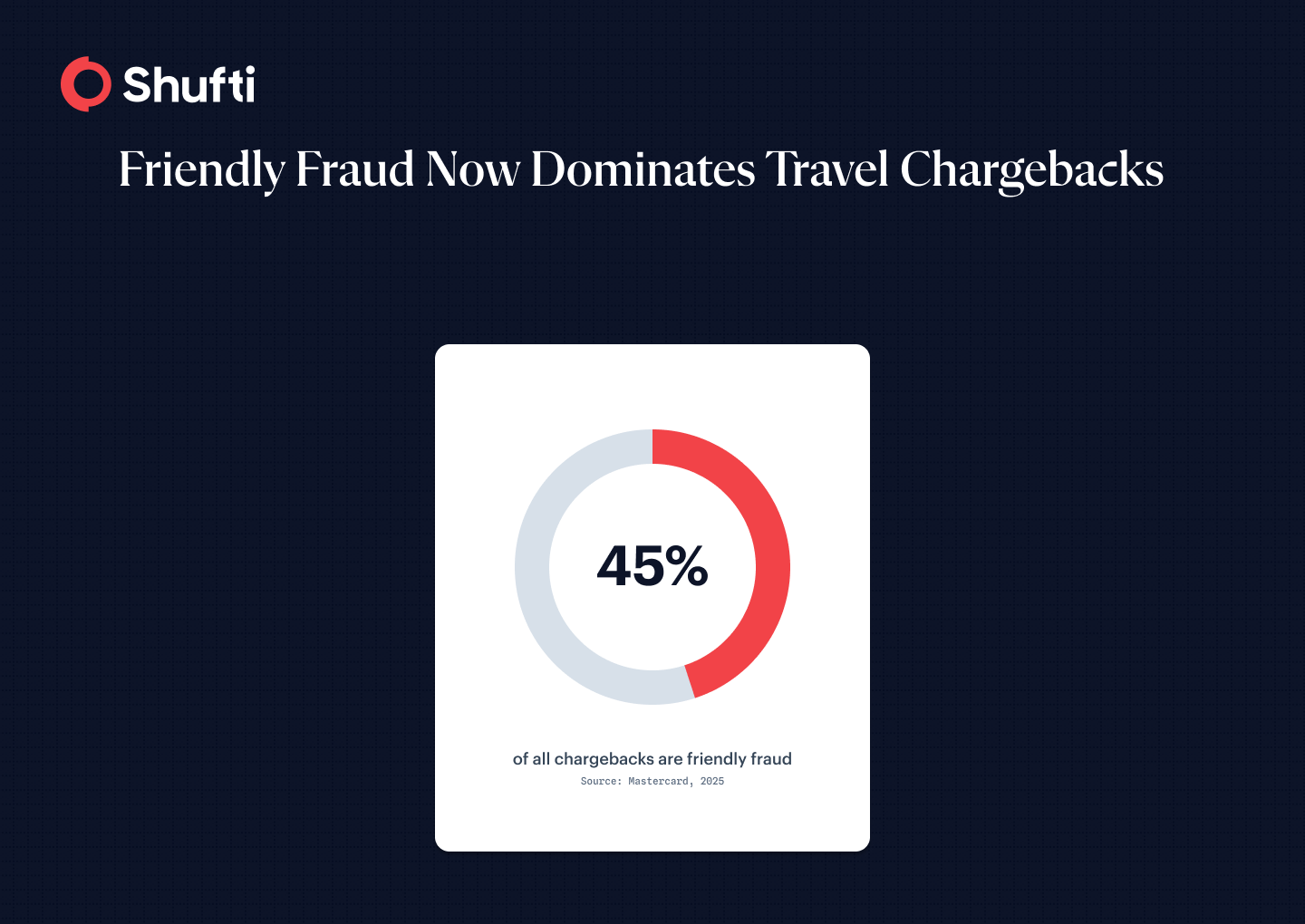
- Main attack types: payment/card testing, account takeover on loyalty accounts, friendly fraud (now ~45% of all chargebacks per Mastercard), and fake booking sites impersonating OTA brands.
- Loyalty program fraud is a $3.1 billion blind spot: points are redeemed fast and rarely recoverable once stolen.
- Fraud has automated and moved earlier in the funnel, most platforms still only screen at checkout, missing account creation and loyalty redemption.
- Fix Layer identity verification (document + biometric checks) at account opening and loyalty redemption, not just at payment, since that’s where intervention is still cheap.
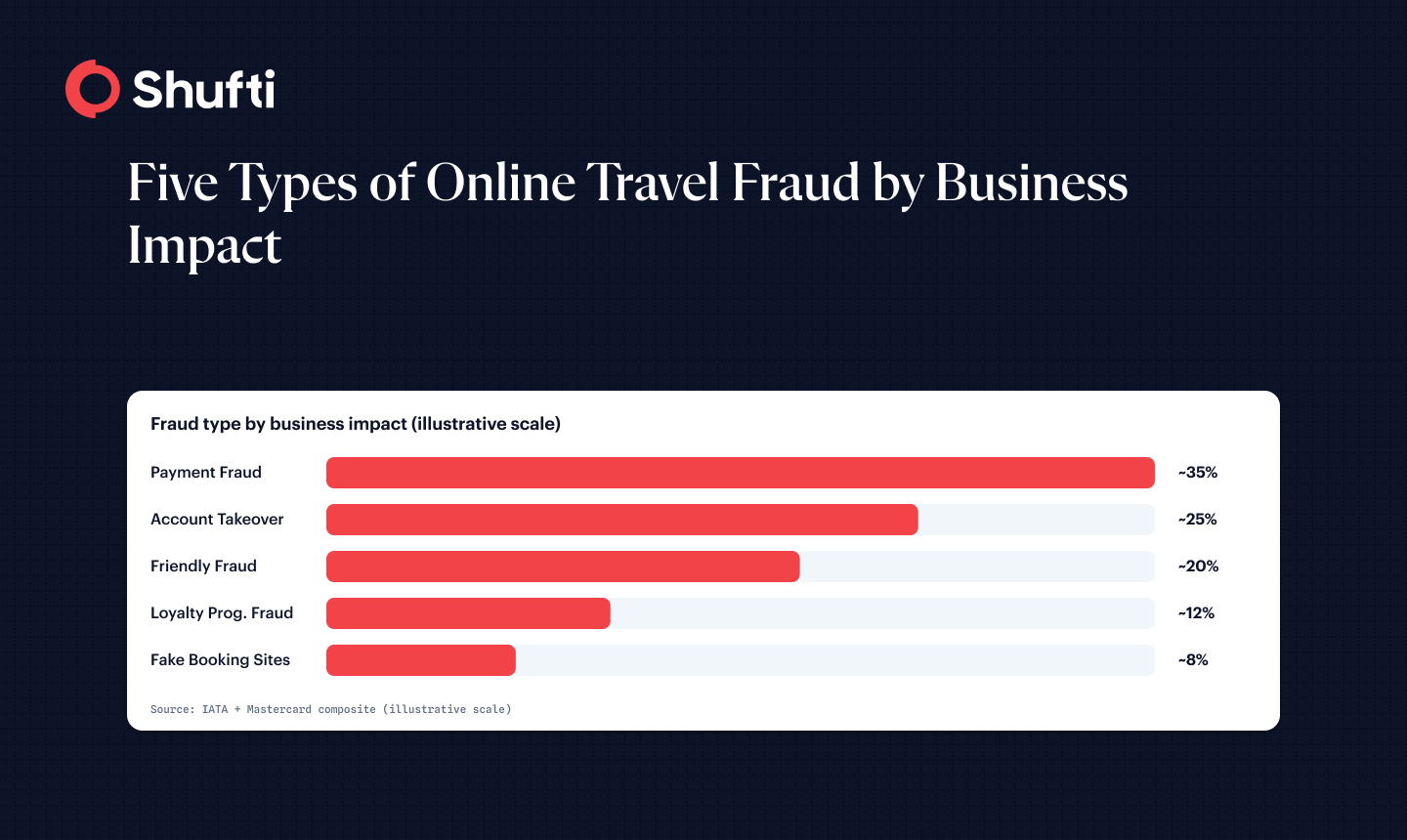
The International Air Transport Association (IATA) estimates airlines alone lose over $1 billion annually to payment fraud, and that figure excludes losses from hotel bookings, loyalty program theft, and the fake travel sites that collect card credentials from consumers who never receive a reservation.
For online travel agencies (OTAs) and hospitality operators, fraud is no longer a background cost. It sits between revenue and margin as a measurable, recoverable problem. The tactics used against travel platforms in 2026 are more automated than anything the industry faced five years ago, and the attack surface now runs the full length of the booking journey.
The sections below cover where fraud enters the travel booking funnel, how specific attack types work, what the data shows about chargeback trends, and what travel operators can do to close the gaps.
What is online travel fraud?
Online travel fraud is the deliberate misuse of digital booking systems to obtain travel services, money, or personal data without legitimate authorization. Fraud in the online travel industry takes several distinct forms across the customer journey, and each form targets a different stage. Building effective booking fraud prevention systems depends on distinguishing which attack type is active at which touchpoint, because controls designed for payment fraud will not stop account takeover, and identity checks at checkout will not recover losses from friendly fraud after the fact.
Airline booking fraud detection: what carriers face
Airline booking fraud typically involves payment made with stolen card credentials, synthetic identities, or compromised accounts. The fraudster books a ticket, the legitimate cardholder disputes the charge, and the airline absorbs the loss twice. It loses the ticket revenue and absorbs the chargeback fee. The IATA Perseuss platform, the industry’s primary fraud intelligence-sharing network, tracks coordinated attacks where one fraud ring cycles through multiple carrier systems within hours.
Hotel booking fraud prevention: the Property Side
Hotel platforms face a different attack profile. Booking fraud at properties frequently pairs stolen payment data with false identity information at the time of reservation, making it difficult to flag before check-in. Property management systems that rely solely on payment network signals miss the identity layer entirely. Post-stay chargebacks, loyalty point abuse, and reservations made under synthetic accounts are the three variants hotel operators report most consistently.
Fake Booking Sites and Consumer-facing Fraud
Fake booking sites do not target operators directly. They target travelers through impersonation of legitimate OTA brands, collecting payment credentials from consumers who believe they are making genuine reservations. The resulting chargebacks land on the impersonated brand’s dispute ratio when consumers pursue their card issuer. The reputational cost compounds the financial one.
How do scammers target online travel booking platforms?
OTAs are targeted at three distinct moments in the customer journey. Account creation, the payment stage, and the post-service period each present a different fraud vector, and the volume of automated attempts at all three has grown substantially over the past 18 months. Online travel fraud detection systems that focus only on checkout miss two of the three attack stages.
Payment Fraud and Card Testing
Payment fraud in travel booking is driven largely by card testing, where fraudsters use booking flows to confirm whether stolen card numbers are active. Travel transactions suit this because high-value purchases attract less initial scrutiny than patterns of small, identical charges. Once a card is confirmed active, higher-value bookings or ticket resale follow. Detection systems that analyze transaction behavior at checkout can catch card-testing patterns that payment processors alone miss, but only if the platform applies those signals before authorization rather than as a post-transaction review.
Account takeover attacks on OTA platforms
Account takeover (ATO) attacks against OTAs combine credential stuffing with loyalty point theft. A fraudster gains access to a legitimate frequent-traveler account using a previously breached password, drains the loyalty balance, or books flights for resale. The account owner rarely notices immediately. The FBI’s 2024 Internet Crime Complaint Center (IC3) Report recorded over $16.6 billion in internet crime losses in 2024, with account takeover consistently appearing among the highest-cost attack categories across digital commerce.
Friendly fraud in Travel Bookings
Friendly fraud occurs when a legitimate cardholder completes a booking or stay, then files a chargeback claiming the transaction was unauthorized. The traveler receives the service and the platform loses the revenue plus the dispute fee. Mastercard’s 2025 chargeback analysis reports that friendly fraud now accounts for approximately 45% of all chargebacks globally, making it the single largest category of disputed transactions by volume.
What do travel payment fraud trends reveal for 2026?
Travel payment fraud has shifted in two measurable directions over the past two years. Volume is up across all fraud categories, and the timing of fraud has moved earlier in the booking funnel. Both shifts change how OTA fraud prevention tools need to be designed and deployed.
Loyalty program fraud: the $3 billion blind spot
Beyond direct booking fraud, travel loyalty programs represent a liability that many operators still underestimate. The U.S. loyalty program fraud results in approximately $3.1 billion in stolen rewards value annually. Loyalty points function as currency inside travel platforms. When a loyalty account is compromised, the redemption window is short, and recovery of consumed rewards is rarely possible. Platforms that apply identity verification at booking and payment but not at loyalty redemption leave one of the widest gaps in their fraud exposure.
AI-powered fraud rings and booking automation
The travel sector in 2026 faces fraud operations that run booking attempts at machine speed. Automated scripts cycle through checkout flows, testing payment credentials, probing loyalty systems, and creating synthetic accounts faster than manual review queues can process them. Travel payment fraud trends in 2026 reflect this shift to automation clearly. The defining feature of modern booking fraud is the velocity of the attack, not any individual transaction. Platforms that still rely on manual review as their primary fraud response are structurally outpaced before a case is even flagged.
How can travel companies prevent booking fraud?
Fraud prevention in travel means layering controls across the booking funnel, not concentrating them at a single checkpoint. Most platforms have payment screening in place. Fewer apply identity controls at account creation, and fewer still apply verification at loyalty redemption. The widest gaps sit at the edges of the funnel, where accounts are opened and where accumulated rewards move.
Identity verification as a fraud control layer
Effective online travel fraud detection requires knowing who is on the other side of a booking before a transaction is authorized. Document verification and biometric checks at account creation reduce the pool of synthetic and stolen identities that enter the booking funnel before they can generate fraud. For platforms with loyalty programs, adding an identity verification check at high-value point redemptions closes the account takeover window that fraud rings actively exploit.
OTA fraud prevention tools and booking fraud prevention systems
Modern OTA fraud prevention tools operate across multiple layers simultaneously. Identity verification applies at onboarding, device and behavioral signals apply at login, and payment risk scoring applies at checkout. Booking fraud prevention systems that integrate identity checks with transaction monitoring are positioned to catch fraud at the stage where intervention is cheapest.
Fraud caught only at the chargeback stage costs the platform lost revenue, the dispute fee, and any services or points already consumed, with no path to recovery. For travel fraud prevention solutions to be effective in 2026, airline booking fraud detection and hotel booking fraud prevention both require identity controls from account opening, not just from the payment page.
How Shufti help travel platforms detect booking fraud?
The fraud pattern most travel operators describe is consistent with what the data confirms. Most platforms concentrate screening at the payment stage, but fraud in the online travel industry is typically set up earlier, at account creation and loyalty enrollment, where identity verification is absent or bypassed through synthetic credentials. By the time a fraudulent booking surfaces as a chargeback, the loss is locked in.
Shufti’s fraud prevention solutions and face verification apply identity checks at the points in the booking funnel where intervention remains actionable. Checks run at account opening, before high-value loyalty redemptions, and during step-up verification on sessions that trigger anomaly rules. The verification is designed to fit inside existing booking flows without adding visible friction for genuine travelers. Shufti has processed 280 million identity checks across 240+ countries and territories, and the detection stack covers document authenticity and biometric liveness in a single flow.
Frequently Asked Questions
What is online travel fraud?
Online travel fraud is the deliberate misuse of digital booking systems to obtain travel services, money, or personal data without authorization. Common forms include payment fraud with stolen card credentials, account takeover targeting loyalty balances, friendly fraud chargebacks after genuine stays, and fake booking sites collecting card data from consumers.
How do scammers target travel booking platforms?
Scammers target OTAs in three stages. At account creation, synthetic or stolen identities are used to open accounts. At payment, stolen cards and card testing are common. Post-stay, chargebacks are filed on genuine bookings. Loyalty accounts are also targeted via credential stuffing, with points drained quickly after access is gained.
What are common fraud risks in OTAs?
Payment fraud, account takeover, friendly fraud chargebacks, and loyalty program theft are the four most prevalent fraud risks in online travel agencies. Automated scripts running card tests and credential stuffing at machine speed have increased the volume of all four categories throughout 2025.
What is friendly fraud in the travel industry?
Friendly fraud in travel occurs when a legitimate cardholder completes a booking or stay and then disputes the charge as unauthorized. Mastercard's 2025 analysis puts friendly fraud above 45% of all chargebacks globally. Travel operators have limited recourse once the service has been consumed.
How does identity verification reduce travel fraud?
Identity verification reduces travel fraud by confirming who is opening an account or redeeming loyalty points before a fraudulent transaction completes. Document checks and biometric matching at onboarding stop synthetic identities from entering the booking funnel. Verification at loyalty redemption closes the account takeover window fraud rings rely on.