AMLR Solutions
  AMLR Consultation
 EUDI Wallet
 Onboarding
 Ongoing Monitoring
 FRAML
FRAML KYC
KYC KYB
KYB KYI
KYI Age Assurance
 Workforce IAM
 Candidate Verification
 Account Takeover
 Bonus/ Promotion Abuse
 Chargeback Fraud
 Deepfake
 Document Fraud
 Fraud Networks
 Impersonation Fraud
 Money Mule Activity
 Multi-Accounting
 Party Fraud
 Regulatory & Compliance Risks
 Synthetic Identity Fraud
 Adult Content
 Banking
 Crypto
 Fintech
 Forex
Forex Compliance
 Fraud prevention
 Trust & safety
 Global expansion
 Compliance Officers
 Developers
 Fraud Analysts
 Product Managers
 Journey Builder
  Global Trust Platform
 Customer Profiles
 Vendor Comparison
 IDV Case Management
 AML Case Management
 Regulatory Reporting
 Agentic Rule Builder
  AI Compliance Co-Pilot
  Fraud Analytics
 Fraud Hub
  OCR
OCR Shufti AI
 Bank Account Verification
  Biometric Duplication
 Database Checks
 Document Intelligence
 Government ID
 Mobile Driver's License
 NFC
NFC Selfie Liveness
 Brand Personalisation
 Deployment Options
 Identity Methods
 IDV Modes
 Multi-tenancy
 On-Premise IDV
 Secure Capture
 Shufti MCP

















Since January 2025, the FBI’s Internet Crime Complaint Center (IC3) logged more than 5,100 account takeover fraud complaints with losses exceeding $262 million. That figure covers only reported incidents. For banks and fintechs managing digital account channels, attackers have largely stopped trying to break in. They find stolen credentials, replay them, and walk right through authentication. This article covers how account takeover fraud works, which methods are landing most often in financial services right now, and the layered controls that actually stop them.
Account takeover (ATO) fraud occurs when a third party gains unauthorised access to an existing financial account by exploiting stolen credentials, compromised authentication, or social engineering. Unlike new-account fraud, which targets the onboarding process, ATO targets accounts that are already open and trusted by the institution.
What is account takeover fraud in banking?
Account takeover fraud in banking is distinct from other fraud categories because the attacker starts with a legitimate identity, not a synthetic one. The account has passed onboarding checks, built a transaction history, and earned the trust of the platform. That history is precisely what makes the fraud hard to detect and financially damaging once access is achieved.
Why financial accounts are the primary target
Financial accounts hold direct access to funds. A compromised bank account or payroll account gives an attacker immediate withdrawal capability, wire transfer initiation, or access to linked payment methods. The FBI’s November 2025 IC3 advisory noted that once access is obtained, attackers typically wire funds to cryptocurrency wallets, which makes recovery difficult. That recovery difficulty is why financial institutions sit at the top of the target list. The damage is fast, funds can move within hours, and reversal windows close quickly once a transfer clears.
How ATO fraud differs from new-account fraud
New-account fraud creates an identity from scratch. Account takeover uses a real person’s identity against them. The distinction matters operationally because the detection signals are different. New-account fraud triggers onboarding controls. ATO fraud triggers post-login anomaly detection. Institutions that invest heavily in onboarding verification but leave session monitoring thin will stop synthetic identities at the door while missing the account takeover that happens on day 90 of a legitimate customer relationship. The full mechanics of how ATO escalates from initial access to fund extraction are documented in this account takeover causes and prevention overview.
How does account takeover fraud happen?
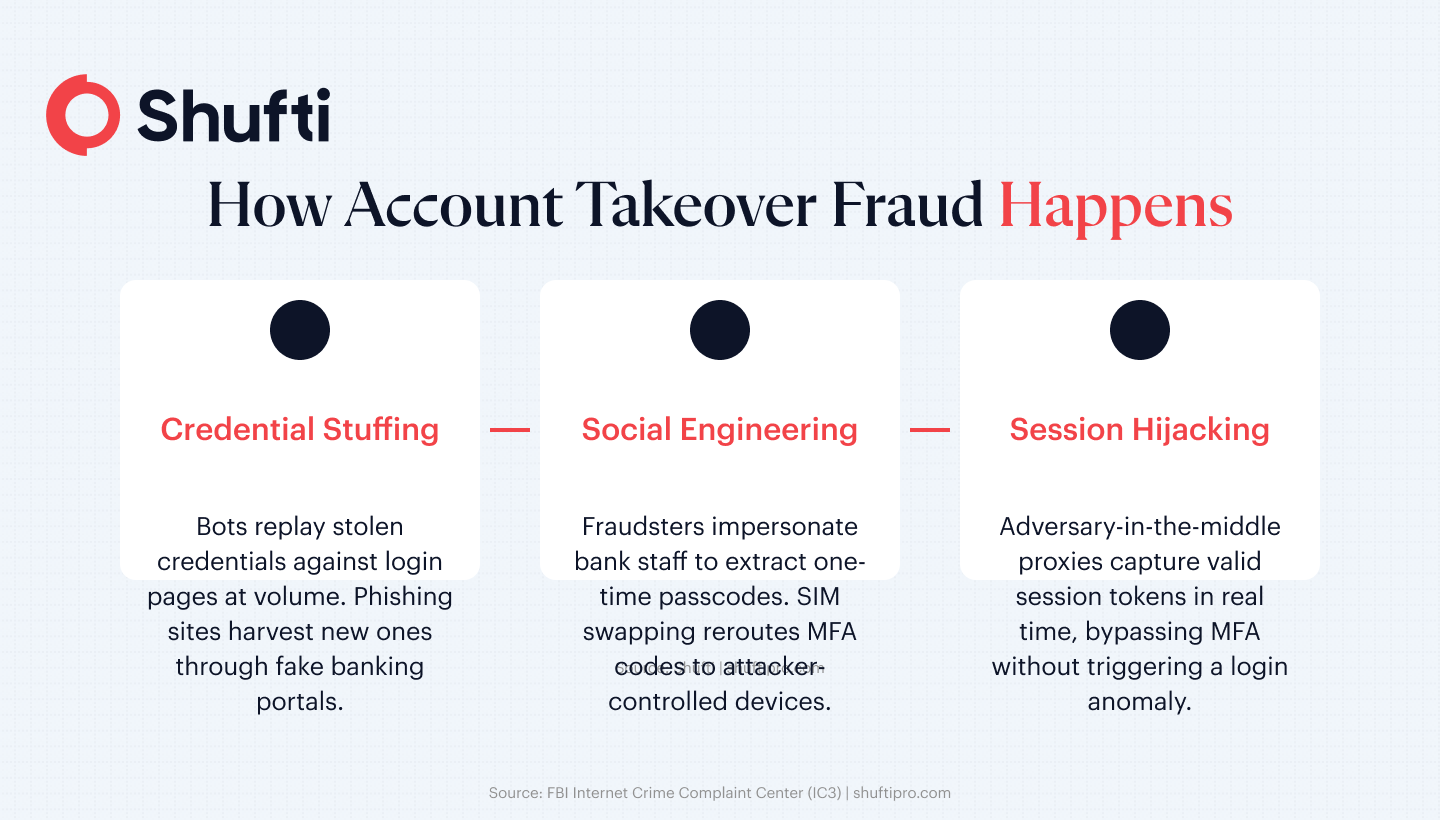
Most account takeover attacks follow a predictable sequence, and the stages where they succeed have shifted over time. Ten years ago, weak passwords were the primary entry point. By 2025, attackers will focus on authentication bypass rather than password guessing, because stolen credentials are widely available and bypassing multi-factor authentication (MFA) has become a routine capability for organised fraud groups. The three methods below account for the majority of ATO incidents reported to financial regulators in 2025.
Credential stuffing and phishing
Credential stuffing feeds breached username-and-password pairs into automated bots that test millions of combinations against bank login pages in rapid succession. Phishing attacks complement this by building fake portals that mimic legitimate banking sites to capture credentials directly. The FBI’s account takeover alert specifically identified search engine optimisation (SEO) poisoning as a growing variant, where fraudsters purchase paid ads that rank above legitimate bank results and direct users to convincing fake login pages. Once credentials are captured, they are tested automatically, often within minutes of the phishing session ending.
Social engineering and SIM swapping
Social engineering targets the human layer of authentication rather than the technical one. Fraudsters impersonate bank employees, fraud investigation teams, or law enforcement officers to convince account holders to read out one-time passcodes or confirm login credentials over the phone. SIM swapping extends this further. A fraudster convinces a mobile carrier to transfer a victim’s phone number to an attacker-controlled SIM card. The attacker then intercepts text message-based MFA codes and resets account passwords. Once the phone number is rerouted, most downstream authentication controls fall in rapid succession.
Adversary-in-the-middle attacks
Adversary-in-the-middle (AiTM) phishing proxies are the most technically sophisticated ATO vector active in financial services today. A real-time proxy sits between the victim and the legitimate bank site. The proxy forwards credentials to the real login page and captures the authenticated session cookie at the same time. AiTM attacks bypass MFA entirely because the session token is valid. The account holder is locked out within seconds while the attacker holds an active authenticated session on the legitimate platform, with no anomalous login event to flag.
How to prevent account takeover fraud
Account takeover fraud prevention requires controls at three distinct stages. A single control layer cannot cover the full attack surface that ATO groups now exploit. Institutions that have measurably reduced ATO losses have combined identity verification at account opening with real-time session monitoring and a defined recovery workflow. The three stages below each target a separate failure point in the attack chain.
Verify identity at account opening
Weak onboarding verification creates accounts that become easy targets weeks or months later. When an account is opened without biometric identity confirmation, an attacker holding matching stolen credentials faces no friction at login. Document verification paired with a live biometric match at account opening ties each account to a specific person, not just a username and password. Any subsequent login attempt that cannot reproduce that biometric match raises a detection signal before a transaction is initiated.
Monitor sessions with behavioural signals
Behavioural signals during a session often flag ATO before a transaction completes. Device fingerprinting catches logins from unrecognised devices or IP addresses. Velocity checks flag multiple failed authentication attempts across geographies in a short window. Transaction pattern analysis compares current session behaviour against a customer’s established baseline. These controls add no friction for the genuine account holder but create meaningful barriers for an attacker operating on an unfamiliar device with stolen credentials. For high-value transactions, real-time identity re-verification as an additional checkpoint is well-established practice across regulated banking sectors.
Build a recovery workflow for compromised accounts
Detection without a fast recovery pathway leaves the second half of the problem unsolved. When a suspicious session is flagged, the institution needs a clear process to freeze the account, notify the customer through an out-of-band channel, and re-verify the genuine account holder’s identity before restoring access. Recovery should require a fresh biometric check against the identity established at onboarding. A knowledge-based answer as the sole recovery mechanism creates a second entry point for the attacker, particularly if the social engineering phase has already extracted that information.
How Shufti helps financial institutions stop ATO attacks
The most common gap in an ATO prevention stack is the disconnect between onboarding controls and post-login monitoring. An account verified at opening exists in a separate system from the session that gets flagged 60 days later, and re-linking them requires a fresh identity check that most institutions’ stacks are not built to run in real time.
Shufti’s fraud prevention solution establishes an identity baseline at account opening using biometric liveness verification. Each new account is anchored to a confirmed person, not just a username and password. When a session later triggers a risk flag, face verification runs a rapid re-check against that original baseline to confirm whether the person currently in session is the genuine account holder — without routing the customer through a full re-onboarding flow.
Shufti’s liveness detection carries iBeta Level 1 and Level 2 certification, and the verification pipeline runs across cloud, on-premises, or hybrid deployment through a single API. For institutions protecting high-risk or vulnerable customer segments across multiple jurisdictions, the same identity verification infrastructure covers account opening, continuous authentication, and account recovery in a unified stack.
Account takeover fraud succeeds most often where identity verification stops at onboarding and session monitoring starts too late to matter. Shufti’s fraud prevention and face verification capabilities close that gap, connecting onboarding identity to every subsequent risk event in the account lifecycle. Request a demo to see how the detection and recovery workflow runs on your account volumes.
Frequently Asked Questions
What is account takeover fraud in banking?
Account takeover (ATO) fraud occurs when a third party gains unauthorised access to an existing bank account using stolen credentials, social engineering, or authentication bypass. Unlike new-account fraud, ATO targets accounts that are already open and trusted by the institution, which makes it harder to catch through standard onboarding controls.
How does account takeover fraud happen?
The most common methods are credential stuffing, phishing, SIM swapping, and adversary-in-the-middle proxy attacks. Each method targets a different authentication layer, and newer techniques are designed specifically to bypass MFA without triggering a login anomaly.
What are the early warning signs of account takeover attacks?
Device fingerprint changes on an established account, login attempts from unfamiliar geographies, multiple failed authentication attempts in a short window, and transaction patterns that deviate from a customer’s baseline are the signals most associated with active ATO attempts in financial services.
How can banks detect account takeover fraud in real time?
Combining behavioural session monitoring with device fingerprinting and transaction velocity checks gives institutions the signal density needed for real-time detection. Biometric re-verification against the identity established at onboarding confirms whether the current user is the genuine account holder.
Why is account takeover fraud increasing in financial services?
The availability of breached credential databases has lowered the cost of mounting ATO campaigns. Authentication methods common in branch-based banking, such as text message one-time passcodes and knowledge-based answers, are now routinely bypassed by current attack tooling, which widens the gap between what institutions rely on and what actually stops modern ATO fraud. CMS Note: FAQPage schema markup. HowTo schema applies — article contains a step-by-step prevention framework.