AMLR Solutions
  AMLR Consultation
 EUDI Wallet
 Onboarding
 Ongoing Monitoring
 FRAML
FRAML KYC
KYC KYB
KYB KYI
KYI Age Assurance
 Workforce IAM
 Candidate Verification
 Account Takeover
 Bonus/ Promotion Abuse
 Chargeback Fraud
 Deepfake
 Document Fraud
 Fraud Networks
 Impersonation Fraud
 Money Mule Activity
 Multi-Accounting
 Party Fraud
 Regulatory & Compliance Risks
 Synthetic Identity Fraud
 Adult Content
 Banking
 Crypto
 Fintech
 Forex
Forex Compliance
 Fraud prevention
 Trust & safety
 Global expansion
 Compliance Officers
 Developers
 Fraud Analysts
 Product Managers
 Advanced Journey Builder
  Global Trust Platform
 Customer Profiles
 Vendor Comparison
 IDV Case Management
 AML Case Management
 Regulatory Reporting
 Agentic Rule Builder
  AI Compliance Co-Pilot
  Fraud Analytics
 Fraud Hub
  OCR
OCR Shufti AI
 Bank Account Verification
  Biometric Duplication
 Database Checks
 Document Intelligence
 Government ID
 Mobile Driver's License
 NFC
NFC Selfie Liveness
 Brand Personalisation
 Deployment Options
 Identity Methods
 IDV Modes
 Multi-tenancy
 On-Premise IDV
 Secure Capture
 Shufti MCP













TL;DR
|
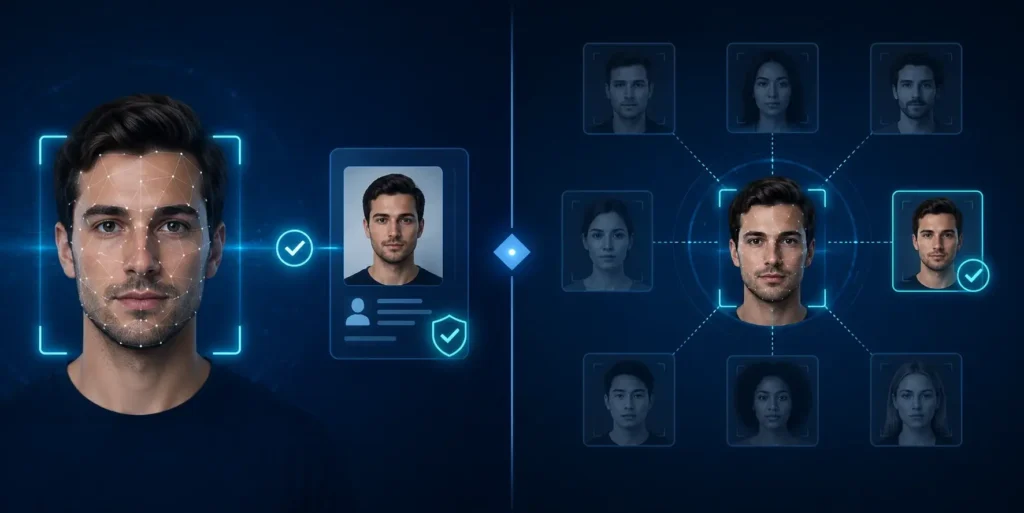
Ask ten people what face recognition means, and you will likely get ten different answers. Some pictures of unlocking a phone. Others think of police lineups or airport security gates. In reality, face recognition and face verification describe two distinct technologies, and this face verification vs recognition comparison starts with a single technical distinction: how many faces the system checks against.
Face verification checks one face against another face. Face recognition checks one face against many. That difference shapes where each technology fits, how private it is, and how accurate it can realistically be.
What Is Face Verification?
Face verification, sometimes called face matching, answers a narrow question: is this the same person? The system takes a live image, usually a selfie, and compares it against a single reference image, such as the photo on a passport or ID card already on file.
Because it only ever compares two images, face verification does not need to search a large database. This keeps the process fast and reduces the storage and privacy burden compared with recognition-based systems.
Common use cases for face verification:
- Confirming identity during account onboarding (KYC)
- Re-authenticating a user before a high-risk action, such as changing payment details
- Matching a traveller’s face to their passport photo at an automated border gate
What Is Face Recognition?
Face recognition, sometimes described as face search or face identification, works the opposite way. Instead of comparing two images, it takes one face and searches it against a database that may hold thousands or millions of stored faces to find a possible match.
This one-to-many search is what makes face recognition useful for spotting people rather than confirming a claim they have already made.
Common use cases for face recognition:
- Flagging known fraudsters or repeat offenders already in a database
- Detecting the same person attempting to open multiple accounts under different names
- Screening against watchlists at airports, casinos, or secure facilities
Face Verification vs Face Recognition: Key Differences
| Type | Face verification |
Face recognition |
|
Comparison type |
One-to-one (1:1) | One-to-many (1:N) |
| Question it answers | Is this the person they claim to be? |
Has this face appeared in our records before? |
|
Data required |
A single reference image | A database of enrolled faces |
| Typical setting | Onboarding, KYC, step-up authentication |
Fraud detection, watchlists, surveillance |
|
Consent model |
Usually permission-based |
Often runs without active user consent |
When comparing face recognition verification systems, this one distinction, one face versus many, is the deciding factor behind almost every other difference in this article.
How Do Security Levels Compare?
Security in face verification comes from narrowing the check to a single, known claim. There is no ambiguity about who the system is checking against, which lowers the chance of a false match slipping through unnoticed.
Face recognition carries a different risk profile. Searching across a large database increases the odds of a false match simply because there are more faces to compare against. Well-built systems offset this with larger, higher-quality training data and stricter matching thresholds, but the underlying risk is different from a straightforward 1:1 check.
Accuracy and Error Rates: What’s the Difference?
Both technologies are measured using two error types: false acceptance (matching two different people as the same person) and false rejection (failing to match the same person to themselves).
Face verification tends to report lower false acceptance rates because it only ever compares against one known image. Face recognition, working across larger galleries, becomes more exposed to false acceptance as the database grows, though tighter similarity thresholds help manage this. Both are affected by the same environmental factors: lighting, camera quality, ageing, and obstructions such as glasses or face coverings.
| NIST’s latest 1:N face recognition benchmark tested algorithms against a database of 12 million enrolled faces. The top-performing system still achieved a 0.07% identification error rate, showing that a larger database does not have to come at the cost of accuracy. |
Privacy Considerations
Face verification is generally the more privacy-friendly of the two. Most implementations compare, return a match decision, and do not need to retain a searchable gallery of faces long-term.
Face recognition depends on maintaining a database of enrolled faces to search against, which raises different regulatory and consent questions, particularly where the system runs without the individual actively opting in, such as in public surveillance. This is part of why face recognition faces tighter scrutiny under data protection rules in several jurisdictions.
Why Is Face Verification Preferred in Banking and KYC?
Financial institutions favour face verification for onboarding and authentication for a few practical reasons:
- It is permission-based. The customer knows a check is happening and takes an active step, usually a selfie, to complete it
- It does not require building or maintaining a facial database, which reduces compliance overhead
- It ties directly to a single claimed identity, which fits regulatory expectations for proving a customer is who they say they are
Face recognition can still play a supporting role in banking, for example, flagging repeat fraud attempts, but it is rarely the primary tool for onboarding a new customer.
Which One Do You Need?
If the goal is to confirm a claimed identity at a single point in time, such as opening an account or approving a transaction, face verification is the right fit. If the goal is to detect whether a face has appeared before, whether that means catching a repeat fraudster or matching someone against a watchlist, face recognition is the better tool.
Many identity programmes end up combining face recognition verification workflows: verification at the point of onboarding, and recognition running quietly in the background to catch duplicate or fraudulent accounts.
| See how Shufti’s face verification fits your KYC and onboarding flow. Request a demo to see it in action. |