


 Face Verification
 Address Verification
 Document Verification
 Age Verification
 VideoIdent
 Fast ID
 eIDV
eIDV
 Consent Verification
 NFC Verification
 Business Verification
 Due Diligence
 Investor Verification
 E-Signature

 QES
QES
 AML Screening
 Transaction Monitoring
 Adverse Media
 Business AML Screening
 PEP & RCA
 Sanctions
 Watchlist
 Behavioural Biometrics
 Device Fingerprinting
 Biometric Face Authentication
 MFA
MFA
 Fraud Hub
 Onboarding
 Ongoing Monitoring
 KYC
KYC
 KYB
KYB
 KYI
KYI
 Age Assurance
 Identity Verification
 Workforce IAM
 Candidate Verification
 Compliance
 Fraud prevention
 Trust & safety
 Global expansion
 Product Managers
 Compliance Officers
 Fraud Analysts
 Developers
 Deepfake
 Bonus Abuse / Promotion Abuse
 Account Takeover
 Synthetic Identity Fraud
 Document Fraud
 Impersonation Fraud
 Multi-Accounting
 Fraud Networks
 Chargeback Fraud
 Money Mule Activity
 Party Fraud
 Regulatory & Compliance Risks
 Fintech
 Crypto
 iGaming
 Forex
Forex
 Social Network
 Marketplace
 Banking
 Gig Economy
 Blind Spot Audit
 Deepfake Detector
 Liveness Spoofs
 Document Originality
 Document Deepfake
 Global Trust Platform
 Journey Builder
 Case Management
 Shufti AI
 Fraud Analytics
 Vendor Comparison
 Brand Personalisation
 IDV Modes
 AI Compliance Co-Pilot
 OCR
OCR
 Secure Capture
 Deployment Options
 Identity Methods
 API Documentation
 Mobile SDKs
 Service Status
 Help Center
 Contact Us
 Technical Support
 Supported Documents
 Supported Countries
 Content library
 Blogs
Blogs
 News
News
 Reports
 Insights
 Knowledgebase
 ROI calculator
 About
About
 Career
 Press Release
 Certifications
 Partnership
 Awards
 Events & Webinar
 Interactive Demo
 Podcast Studio
 Spotlight Studio
VideoIdent vs. Standard Automated KYC: Which method is right for your business?

TL;DR
- Standard automated KYC clears most users in under 15 seconds, unattended.
- VideoIdent is attended, live video identity proofing run by a trained agent.
- Germany and Austria legally require attendant verification for certain account openings.
- A risk-based model routes most users to automation and steps up to VideoIdent.
- VideoIdent produces an examiner-ready evidence pack for later audits and disputes.
Most businesses running remote onboarding pick a verification method and apply it uniformly. Either automated KYC handles everything, or video verification gets treated as a compliance overhead reserved for high-stakes markets. Neither approach holds up under scrutiny.
The real question isn’t which method outperforms the other. It’s understanding where each one earns its place in a verification workflow and what breaks when you reach for the wrong tool at the wrong moment.
This article maps both methods, explains where regulation draws the line, and gives you a framework for deploying each one where it actually pays off.
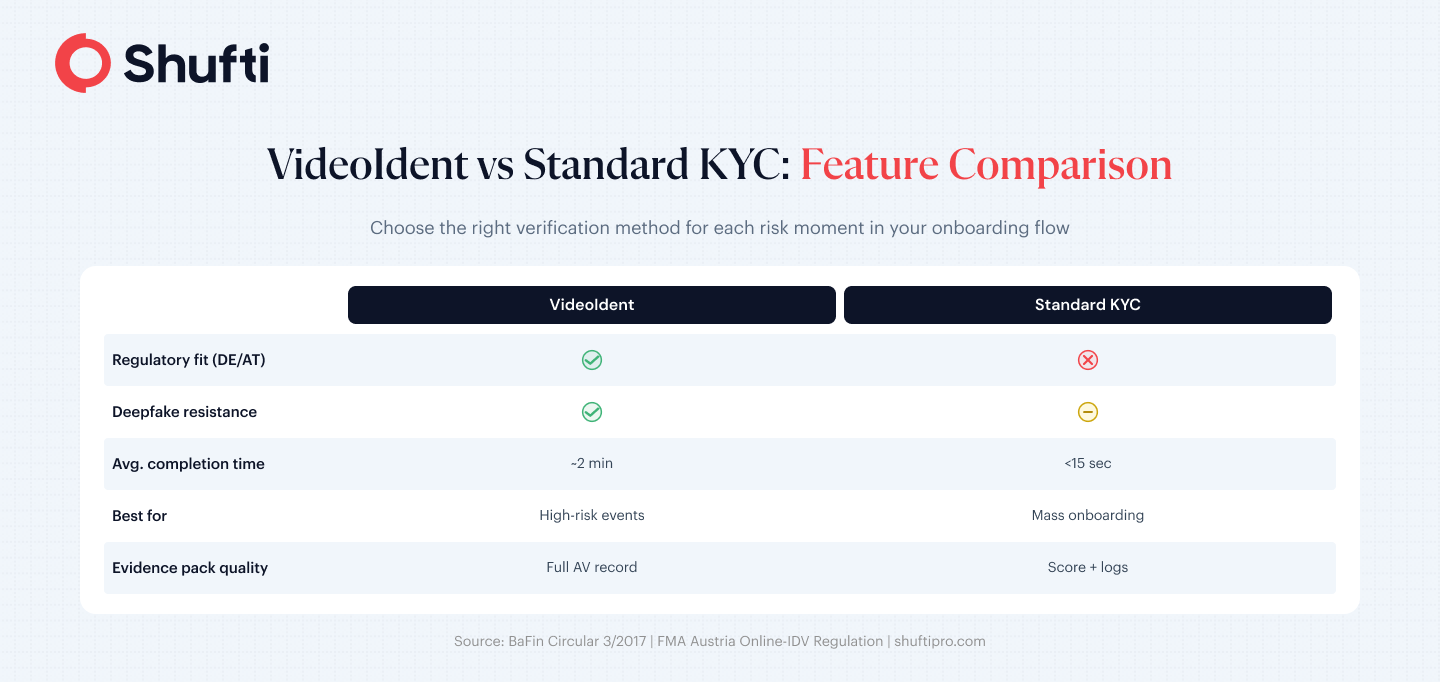
| Dimension | Standard automated KYC | VideoIdent |
| Method | Document upload, OCR, biometric match, liveness check | Attended live video session with a trained agent |
| Speed | Under 15 seconds for most users | Around two minutes per session |
| Scale & cost | High throughput, low unit cost, no agents | Agent-led; reserved for high-risk cases |
| Best for | Low-risk, high-volume onboarding | High-value openings, tier upgrades, account recovery, regulated markets |
| Evidence | Standard compliance record | Examiner-ready evidence pack, 5-year retention in Germany |
What standard KYC covers and where it falls short?
Standard automated KYC is the workhorse of digital onboarding. A user uploads an identity document, the system reads and validates it via OCR, a biometric face match confirms the document belongs to the person presenting it, and a liveness check confirms the person is present rather than a static image.
Done well, automated KYC clears the majority of users in under 15 seconds. There is no practical ceiling on throughput, and the process runs without agent involvement, which keeps unit costs low and scales without proportional headcount growth.
The limits appear at high-risk moments. Automated systems score identity signals and assign a risk rating, but they work from the data the user submits. Sophisticated fraud, including deepfake video injection and synthetic identity construction, is specifically designed to produce a clean signal. The World Economic Forum reports that identity fraud is accelerating as AI tools lower the barrier to constructing convincing synthetic submissions.
Automated KYC is also not the right instrument when a regulator requires attended verification. In Germany and Austria, account opening for regulated financial services legally requires a trained agent to inspect the document in real time. For teams reviewing these requirements in depth, the video KYC regulations guide covers the current framework across major jurisdictions.
What does VideoIdent add that automation cannot replicate?
VideoIdent is attended, live video-based identity proofing. A trained KYC agent conducts a real-time video session with the user, inspecting the identity document for security features, running a liveness challenge, capturing a biometric face match, and generating a complete evidence package.
In Germany, BaFin Circular 3/2017 specifies exactly what that evidence package must contain. The requirements include random inspection of three or more document security features, MRZ validation, a liveness challenge using a spoken system-generated code, TAN or OTP session binding, a full audio and video recording of the session, explicit consent captured on camera with a timestamp, and a minimum five-year retention period.
Austria’s FMA Online Identification Regulation adds structured screenshot requirements, typed numeric code entry as a second factor, and mandatory monitoring of the procedure by the operating organization.
These requirements exist because certain onboarding moments carry fraud risk that automated scoring cannot adequately address. High-value account opening, tier upgrades, account recovery after a lockout, withdrawal requests above defined thresholds, and SIM registration under Germany’s GwG all sit in this category. A trained agent observing a live interaction can catch behavioural signals, assess document physicality, and identify coached fraud attempts in ways that an algorithm working from submitted data cannot.
The evidence pack VideoIdent produces is also structurally different from what standard KYC generates. It is designed for examiner review and dispute resolution, not just a compliance record. That distinction matters when an auditor asks how a specific account was verified two years later.
How does a risk-based strategy use both methods?
Practitioners don’t face a binary choice between VideoIdent and standard KYC. The real challenge is routing users to the right method at the right moment without creating unnecessary friction or compliance exposure.
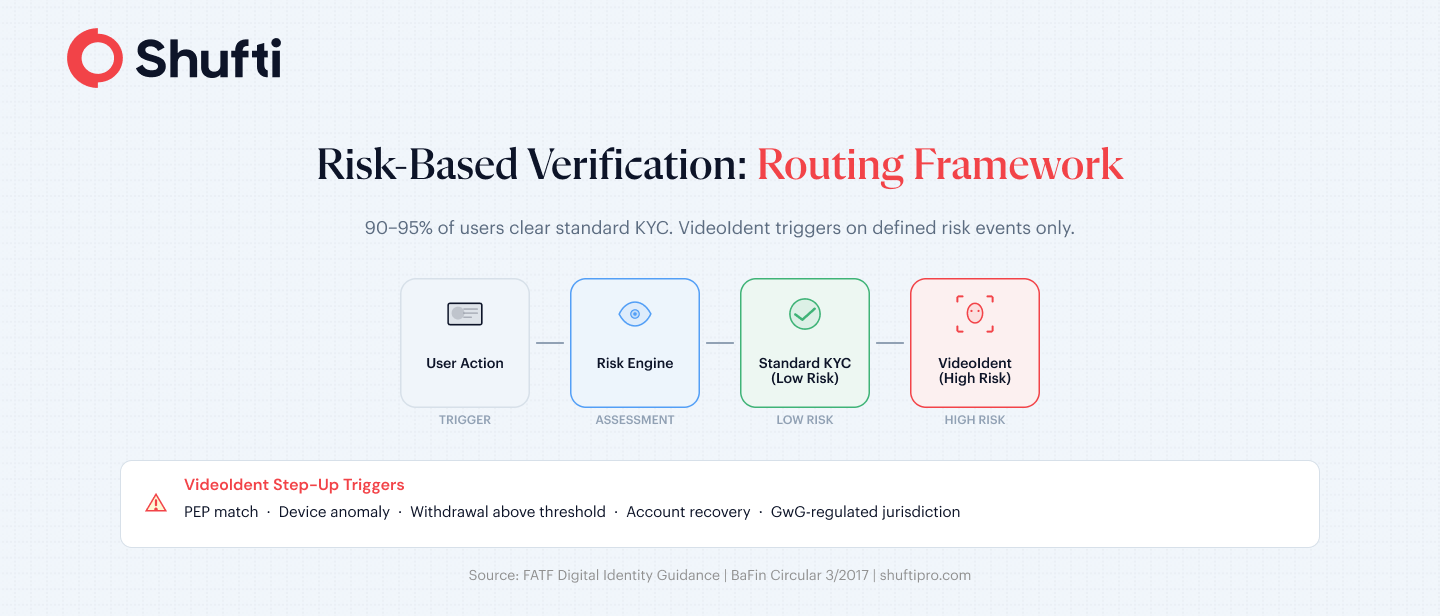
FATF’s Guidance on Digital Identity confirms that supervised remote identity proofing carries equivalent assurance to in-person verification when appropriate risk controls are in place. This supports a layered model where most users move through automated verification, and a smaller subset are stepped up to attended verification based on defined triggers.
In practice, this means configuring your verification workflow around a risk engine. Low-risk users, those presenting clean documents, matching devices, and standard behavioural patterns, move through automated KYC without interruption. A narrower set of events triggers VideoIdent. These include a PEP match, a device anomaly, a withdrawal request above a defined threshold, an account recovery attempt, or a jurisdiction that requires attended verification by regulation.
This routing model reduces the volume of video sessions to cases where they are warranted. It also keeps conversion rates intact for the majority of users who do not need attended verification.
The operational questions follow from this structure. Can your VideoIdent provider cover the hours your users are active? Do they support your language requirements across different markets? Can you bring your own agents for specific shifts while using external agents for overflow? These decisions shape how reliably the step-up layer performs when it is triggered.
What to consider before committing to a deployment model?
The wrong deployment model is more costly to fix than the wrong vendor choice. A few questions are worth working through before you commit.
Does your regulatory environment require attended verification? Germany and Austria have explicit requirements tied to specific onboarding scenarios under BaFin Circular 3/2017 and the FMA Online Identification Regulation. Other jurisdictions are moving toward risk-based frameworks that permit automated verification for lower-risk onboarding but expect stronger controls at higher-risk moments.
Where does fraud concentrate in your onboarding flow? Account openings are a known target, but tier upgrades and account recovery events carry concentrated risk too. If your fraud data shows loss concentrating at cash-out, the step-up trigger belongs there, not at the top of the funnel.
Can your current VideoIdent provider adapt its flows without a six-to-eight week change cycle? Regulatory expectations evolve, and so do fraud tactics. If modifying an agent script or adding a trigger condition requires a formal vendor change request, that is an operational constraint worth weighing at the selection stage.
What does your evidence pack actually contain? Pull a sample session record and ask whether an auditor could reconstruct what happened from it. If the answer is uncertain, the format needs work before you face a regulatory review.
For teams working across multiple jurisdictions, the KYC compliance regulations guide covers the regional frameworks in detail.
Frequently Asked Questions
Does VideoIdent verification take longer than standard KYC onboarding?
Standard automated KYC completes in under 15 seconds for most users. A VideoIdent session averages around two minutes, which reflects the agent-led document inspection and liveness challenge the method requires.
Which method has a lower customer dropout rate?
Automated KYC generally sees lower dropout because it requires less user effort. VideoIdent dropout depends heavily on wait times and session design, with well-configured flows connecting users to agents in under 30 seconds.
Is standard KYC still legally sufficient for high-risk customer verification?
In Germany and Austria, attended verification is required for specific onboarding scenarios under BaFin Circular 3/2017 and the FMA Online Identification Regulation. Standard automated KYC does not satisfy those requirements regardless of accuracy rates.
How do regulators view VideoIdent compared to traditional KYC compliance?
FATF guidance treats supervised remote identity proofing as equivalent in assurance to in-person verification when appropriate controls are in place. Regulators in Germany and Austria go further, specifying VideoIdent as the required method for certain remote onboarding scenarios.
Can businesses use both VideoIdent and standard KYC together?
Yes, and for most regulated businesses this is the right model. Standard automated KYC handles the majority of users, while VideoIdent triggers on defined risk events or in jurisdictions requiring attended verification.