









 AMLR Solutions
  AMLR Consultation
 EUDI Wallet
 Onboarding
 Ongoing Monitoring
 FRAML
FRAML KYC
KYC KYB
KYB KYI
KYI Age Assurance
 Workforce IAM
 Candidate Verification
 Account Takeover
 Bonus/ Promotion Abuse
 Chargeback Fraud
 Deepfake
 Document Fraud
 Fraud Networks
 Impersonation Fraud
 Money Mule Activity
 Multi-Accounting
 Party Fraud
 Regulatory & Compliance Risks
 Synthetic Identity Fraud
 Adult Content
 Banking
 Crypto
 Fintech
 Forex
Forex Compliance
 Fraud prevention
 Trust & safety
 Global expansion
 Compliance Officers
 Developers
 Fraud Analysts
 Product Managers
 Journey Builder
  Global Trust Platform
 Customer Profiles
 Vendor Comparison
 IDV Case Management
 AML Case Management
 Regulatory Reporting
 Agentic Rule Builder
  AI Compliance Co-Pilot
  Fraud Analytics
 Fraud Hub
  OCR
OCR Shufti AI
 Bank Account Verification
  Biometric Duplication
 Database Checks
 Document Intelligence
 Government ID
 Mobile Driver's License
 NFC
NFC Selfie Liveness
 Brand Personalisation
 Deployment Options
 Identity Methods
 IDV Modes
 Multi-tenancy
 On-Premise IDV
 Secure Capture
 Shufti MCP


High-Value & Luxury Goods
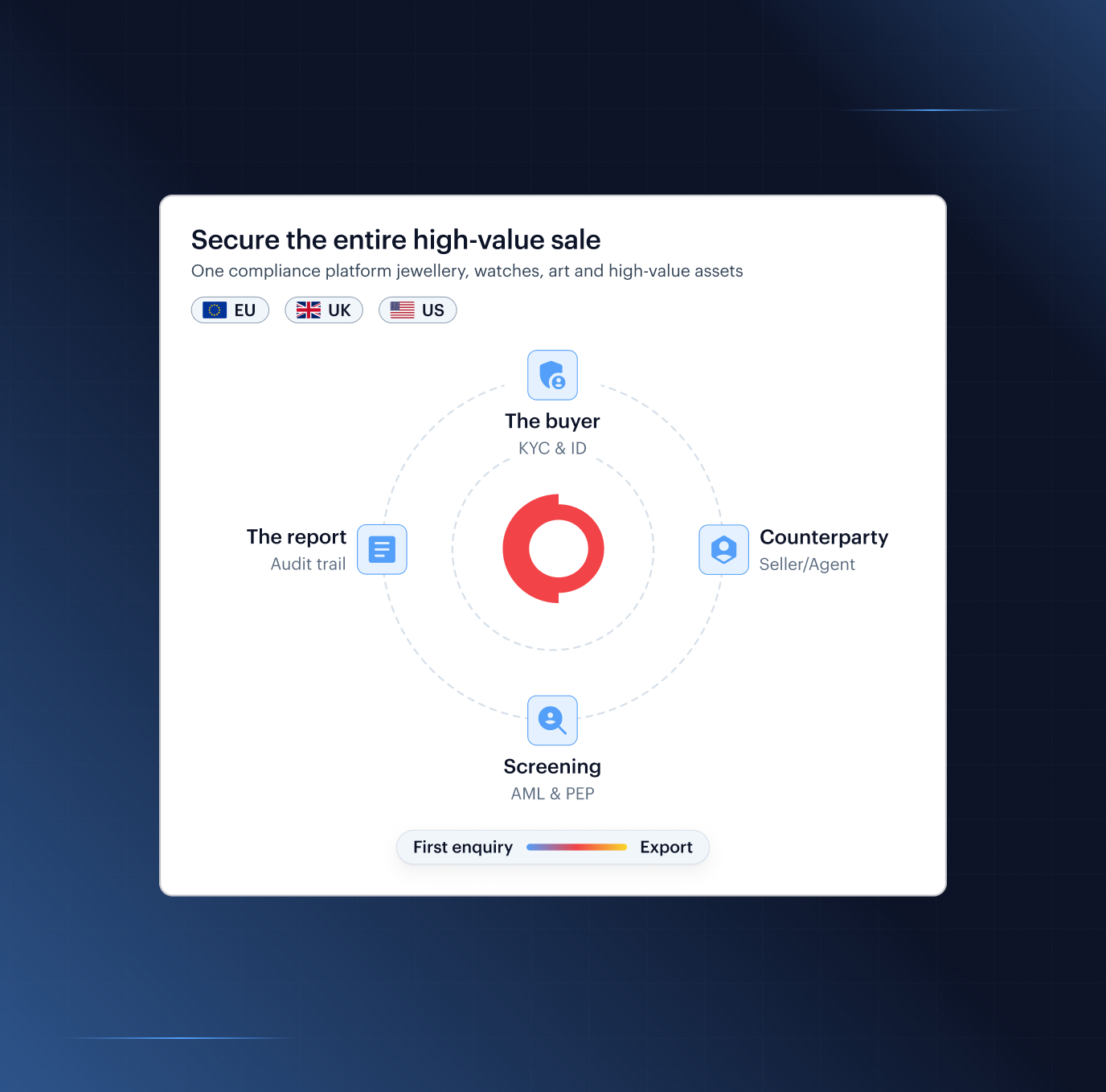
Secure the Entire High-Value Sale with One Compliance Platform
Dealers in jewellery, watches, art and high-value assets come into scope under AMLR, joining regimes already in force in the UK and US. Shufti covers the buyer, the counterparty, the screening and the report, from first enquiry to export.
Compliance without compromise
Why High-Value Dealers Choose Shufti
-
In Scope for the First Time
AMLR brings traders in precious metals and stones, high-value goods, cultural goods and free zone operators inside the AML perimeter, alongside regimes already in force in the UK and US. Most dealers have no compliance function to extend, so the programme has to arrive complete.
-
The Buyer Is Not Always the Buyer
Payments split below the cash limit, a third party settling the invoice, a purchaser collecting on someone else's behalf. Screening runs on the person who pays and the person who collects, not only the name on the invoice.
-
Built for the Showroom, Not the Bank
A private client will not complete a banking onboarding flow at a counter. Verification runs in under thirty seconds on a phone or tablet, escalating only when value, jurisdiction or payment route requires it.



The perimeter moved
Seven Ways a High-Value Dealer Comes Into Scope
Applies from
10 July, 2027
Jewellers and dealers in precious metals and stones

Watch, fashion, leather, and other high-value goods traders

Art, antiques, cultural goods dealers, and intermediaries

Free zone and customs warehouse operators

Anyone accepting cash for goods or services

Vehicle sellers

Yacht and aircraft sellers
Secure Every Stage of the High-Value Sale

Enquiry & Appointment
Fake high-net-worth enquiry
A budget well above the usual range, pressing for a private appointment and rapid completion.
How Shufti solves it
Device fingerprinting identifies the hardware, the environment and whether the session runs from an emulator or a masked location.
Reconnaissance before a theft
Detailed questions about stock, storage and staffing from a party with no purchase history.
How Shufti solves it
Session signals link the enquiry to earlier contacts from the same device, including ones made under different names.
Repeat enquiry under a new name
A client previously refused returns with a new name and email.
How Shufti solves it
The hardware and software environment matches the earlier session, and the link surfaces before an appointment is confirmed.
Appointment booked for a third party
The person booking is not the person who will attend or pay.
How Shufti solves it
Identification at the enquiry stage establishes who the customer actually is, before the relationship is built around an intermediary.
Bot-driven stock and price scraping
Automated agents harvest inventory and pricing at scale, often preceding coordinated purchase attempts.
How Shufti solves it
Behavioural signals separate scripted interaction from a genuine enquiry before it reaches the sales team.
Client Identification
Forged passport at the counter
A high-quality forgery passes visual inspection by staff with no forensic training.
How Shufti solves it
Shufti authenticates passports, national IDs and residence permits across 240+ regions actively processed, checking MRZ integrity and security features in seconds.
Deepfake in a remote sale
Private sales increasingly complete remotely, and a video call is not proof of presence.
How Shufti solves it
iBeta Level 3 certified liveness catches deepfake video, replayed footage and injected camera streams.
Borrowed or stolen document
The document is genuine and the person presenting it is not its holder.
How Shufti solves it
Facial biometrics match the live capture to the document photograph, and NFC reads and validates the chip where present.
Address that does not exist
An address that cannot be reached, or that resolves to a mail forwarding service.
How Shufti solves it
Residence is confirmed from documentary proof with structured extraction across 150+ languages and geospatial checks.
Client refuses identification
A buyer declines to complete verification once the requirement is explained.
How Shufti solves it
The refusal is recorded with the reason and the timestamp, so the decision not to proceed is evidenced rather than abandoned.
EU buyer presents a digital wallet
From December 2027, EU buyers can present an EUDI Wallet credential instead of a document.
How Shufti solves it
Shufti is integrating with EU wallet, and the document, NFC and biometric path stays in the same flow.
Source of Funds & Wealth
Wealth with no explanation
The buyer can pay but cannot account for how the wealth accumulated.
How Shufti solves it
Source of wealth is collected separately from source of funds, covering sale agreements, inheritance records, tax filings and property history.
Funds from a third party
The invoice is settled from an account in another name.
How Shufti solves it
Structured questions establish the relationship and the reason before payment is accepted, and the third party enters screening in their own right.
Proceeds presented as crypto gains
Funds described as trading profits with no traceable origin.
How Shufti solves it
Exchange statements are collected and structured rather than filed, and where the origin cannot be evidenced the case escalates.
Loan secured against the piece
The purchase is financed against the asset being bought, obscuring where the underlying value came from.
How Shufti solves it
The lender and the arrangement are documented as part of the record, not treated as the answer to it.
Documents that cannot be verified
Statements or valuations arrive in a format or language nobody on the floor can assess.
How Shufti solves it
Documents are extracted and structured across 150+ languages, so the evidence is readable and comparable.
Screening & Risk Assessment
Sanctioned buyer behind a proxy
The named purchaser is clear and the person who benefits is not.
How Shufti solves it
Screening runs on the buyer, the payer and the collecting party, with connected-party detection across shared addresses, devices and identifiers.
Politically exposed purchaser
Political exposure brings enhanced obligations, including source of wealth and senior approval before the sale proceeds.
How Shufti solves it
Screening covers office holders, family members and close associates, and holds former office holders in scope.
Adverse media on the owner
Reporting on fraud, corruption or enforcement often precedes any formal listing.
How Shufti solves it
Adverse media screening covers 50,000+ sources in 80+ languages, with disambiguation so a common name does not stop a legitimate sale.
Delivery into a high-risk jurisdiction
The buyer is unremarkable and the destination is not.
How Shufti solves it
Jurisdiction feeds the risk score, and enhanced measures apply where the delivery address rather than the buyer carries the exposure.
Common-name false positive
A frequent name generates a match unrelated to the person in the showroom.
How Shufti solves it
Screening is bound to the verified identity, so date of birth, nationality and document data narrow the match.
Consignment & Trade-In
Consignor who does not own the piece
Goods offered by a party with no demonstrable title, sometimes acting for an undisclosed owner.
How Shufti solves it
Business verification confirms the entity against live registries and structured questions establish the chain of ownership.
Shell company vendor
A recently incorporated entity with no filed accounts and an address shared with dozens of others.
How Shufti solves it
Live registry calls across 240+ sources return status and filing history, and shared-address detection surfaces the network.
Stolen goods as a trade-in
A piece offered against a new purchase, arriving without provenance or with mismatched paperwork.
How Shufti solves it
The person presenting it is identified and screened, and connected-party detection links them to earlier transactions.
Undisclosed beneficial owner
The company is legitimate and the person controlling it is not disclosed.
How Shufti solves it
Ownership chains are walked in full, with control assessed alongside ownership so a controller holding no shares still surfaces.
Circular trading in a dealer network
The same pieces move repeatedly between connected dealers, each transfer adding apparent provenance.
How Shufti solves it
Connected-party detection surfaces entities sharing directors, addresses and identifiers.
Quotation & Reservation
Reservation under a different name
The item is reserved in one name and collected in another, presented as a gift or family arrangement.
How Shufti solves it
The person taking delivery is identified and screened before release, not treated as a detail at the door.
Deposit from an unrelated account
A holding deposit arrives from a party with no stated connection to the buyer.
How Shufti solves it
The relationship is established when the deposit is accepted, so the question is not reopened when the balance settles.
Price steered below a threshold
A buyer negotiates under a reporting or cash threshold, or asks for the sale to be split across invoices.
How Shufti solves it
Linked transactions are assessed together and the pattern is flagged against the case.
Reservation flipped to a third party
The reservation transfers to someone who never appeared during the sale.
How Shufti solves it
The case stays open across the reassignment, so the new party is verified rather than inheriting the original clearance.
Consent never recorded
Verification data is collected without recorded permission to process it.
How Shufti solves it
Consent is captured in the same session as the identity check and tied to the same case.
Payment
Structuring below the cash limit
Payments broken into instalments that each sit under the threshold, across days or across family members.
How Shufti solves it
Linked transactions are assessed as one, so a sequence designed to stay under a limit is visible as a sequence.
Third-party settlement
The buyer is verified and someone else pays.
How Shufti solves it
The payer is identified and screened in their own right, and the relationship to the purchaser is documented before the goods are released.
Payment split across instruments
Part cash, part card, part transfer, part trade-in, with no single instrument crossing a threshold.
How Shufti solves it
Each element is recorded against one case rather than one system.
Funds from a high-risk jurisdiction
The buyer presents no concerns and the money arrives from somewhere that does.
How Shufti solves it
Origin feeds the risk score, and enhanced measures apply to the payment route rather than only to the person.
Refund rerouted elsewhere
A completed sale is reversed and the refund requested to an account other than the one that paid.
How Shufti solves it
The destination is verified before release, closing a route used to convert goods back into clean funds.
Threshold Reporting
Linked transactions below the threshold
Several purchases by the same buyer, none individually reportable, together well above the limit.
How Shufti solves it
Purchases are held against one customer record rather than one invoice, so the aggregate is visible.
Vehicle sale just under €250,000
A sale lands immediately below the reporting threshold, with the balance moved into accessories or a separate agreement.
How Shufti solves it
The full consideration is recorded and the proximity to the threshold is flagged.
Commercial or non-commercial
Whether a sale is commercial changes whether it must be reported, and the judgement is often made by whoever writes the invoice.
How Shufti solves it
The basis is captured at the point of sale so it can be explained later.
Report filed without its evidence
A report submitted with the transaction detail but not the identity, screening and source of funds records behind it.
How Shufti solves it
Everything sits on one case and exports together.
Retention period missed
Records held indefinitely, or deleted before the period expires.
How Shufti solves it
Retention is configured to the required period and personal data is removed at expiry, so holding it too long is no longer the cautious option.
Delivery, Export & Free Zone
Delivery to a freight forwarder
The buyer verifies cleanly and the goods ship to a logistics agent rather than the address on file.
How Shufti solves it
The forwarder is verified as an entity and the ultimate destination is recorded.
Goods routed through a free port
Items move into a free zone and change hands without leaving storage.
How Shufti solves it
Free zone and customs warehouse operators are themselves obliged entities from 2027, so the counterparty is verified rather than assumed.
Export licence evasion
Goods declared under a lower value or different classification to avoid a licensing requirement.
How Shufti solves it
The declared consideration and the export value sit on the same record, so a discrepancy is visible.
Sanctioned end destination
The buyer, the payer and the forwarder are all clear, and the final delivery point is not.
How Shufti solves it
Screening extends to the destination and to the parties handling the shipment.
Collection by an undisclosed agent
Someone arrives to collect who took no part in the sale, presenting an authorisation letter.
How Shufti solves it
The collecting party is identified and matched against the authorisation before release.
Repeat Client & Ongoing Monitoring
Client sanctioned after the sale
A buyer who cleared every check appears on a sanctions list months later, having done nothing since.
How Shufti solves it
Screening continues after the sale and a designation change re-screens the client base within fifteen minutes.
Newly politically exposed
An appointment, an election or a family member taking office changes a client's status without any contact.
How Shufti solves it
Political exposure is monitored continuously, and the flag does not clear the day someone leaves office.
Buying pattern that changes
A client whose purchases were occasional begins buying frequently, at higher value, or across new categories.
How Shufti solves it
Activity is assessed against the profile established at the first sale.
Expired document on file
The evidence the record rests on is no longer valid, and nobody notices until the next sale.
How Shufti solves it
Expiry triggers re-verification of the document alone, not the full journey again.
Review interval exceeded
A client record has not been revisited within the required period, and the gap surfaces at an inspection.
How Shufti solves it
Cadence is configured by risk tier and enforced against the maximum interval.
Resale & Secondary Market
Buyer returning under a new identity
A client previously refused returns with new documents and a new name.
How Shufti solves it
Biometric deduplication searches the enrolled records, so the same face is recognised whatever the name attached to it.
Piece re-entering altered provenance
An item comes back to market with paperwork improved between sales.
How Shufti solves it
The earlier transaction record is retained in full, so the provenance presented now can be checked against the provenance recorded then.
Circular resale connected parties
The same asset sold repeatedly between apparently unrelated parties, each sale establishing a higher value.
How Shufti solves it
Connected-party detection surfaces the shared addresses, directors and identifiers behind the sequence.
Vendor who is the original buyer
A piece consigned for sale by the person who bought it, through an entity created for the purpose.
How Shufti solves it
Ownership chains are recomputed at every check, so the individual behind the entity surfaces.
Refused client returning via a reseller
A client who failed verification acquires the piece through an intermediary dealer.
How Shufti solves it
The reseller is verified and screened as an entity, and connected-party detection links them to the party originally refused.
undersTand more
Frequently Asked Questions
In the EU, AMLR brings traders in precious metals and stones, other high-value goods, dealers in cultural goods from €10,000, and free zone and customs warehouse operators inside the AML perimeter from 10 July 2027. The UK already regulates high value dealers, and the US applies rules to dealers in precious metals, stones and jewels. FATF Recommendation 22 treats the sector as a designated non-financial business globally.
Not every sale. AMLR sets customer due diligence thresholds for occasional transactions, and identification applies from a lower amount where cash is involved. Most dealers configure verification to trigger on value, payment method and risk rather than applying the same check to every walk-in.
AMLR introduces a Union-wide limit of €10,000 on cash payments for goods and services, with customer identification required from €3,000 in cash. Member States may set lower national limits. Payments split into instalments are assessed as linked transactions rather than judged individually.
Sales of vehicles from €250,000 and of watercraft and aircraft from €7.5 million must be reported to the Financial Intelligence Unit where the transaction is non-commercial. The report needs the identity, screening and source of funds evidence behind it, not only the transaction detail.
Supervision is national, so the arrangement differs by Member State. Dealers should confirm their position with their national supervisor rather than assume the EU rules answer it. Shufti provides the documentation a supervisor will ask for at registration.
The refusal is itself a record. Records must be retained from a refusal as well as from a completed relationship, so declining to proceed has to be evidenced with the reason and the date rather than simply abandoned at the counter.
Sandbox access is immediate. A single-location rollout through a hosted link needs no build, and point-of-sale and CRM integrations run through one REST API.
Evaluate Shufti Against Your Current High-Value Goods Compliance Stack
AMLR, the UK high value dealer regime and FATF Recommendation 22 all require the buyer, the counterparty, the payment and the report to sit on one record. Point solutions cannot share identity data or produce a single evidence trail.