










 AMLR Solutions
  AMLR Consultation
 EUDI Wallet
 Onboarding
 Ongoing Monitoring
 FRAML
FRAML KYC
KYC KYB
KYB KYI
KYI Age Assurance
 Workforce IAM
 Candidate Verification
 Account Takeover
 Bonus/ Promotion Abuse
 Chargeback Fraud
 Deepfake
 Document Fraud
 Fraud Networks
 Impersonation Fraud
 Money Mule Activity
 Multi-Accounting
 Party Fraud
 Regulatory & Compliance Risks
 Synthetic Identity Fraud
 Adult Content
 Banking
 Crypto
 Fintech
 Forex
Forex Compliance
 Fraud prevention
 Trust & safety
 Global expansion
 Compliance Officers
 Developers
 Fraud Analysts
 Product Managers
 Journey Builder
  Global Trust Platform
 Customer Profiles
 Vendor Comparison
 IDV Case Management
 AML Case Management
 Regulatory Reporting
 Agentic Rule Builder
  AI Compliance Co-Pilot
  Fraud Analytics
 Fraud Hub
  OCR
OCR Shufti AI
 Bank Account Verification
  Biometric Duplication
 Database Checks
 Document Intelligence
 Government ID
 Mobile Driver's License
 NFC
NFC Selfie Liveness
 Brand Personalisation
 Deployment Options
 Identity Methods
 IDV Modes
 Multi-tenancy
 On-Premise IDV
 Secure Capture
 Shufti MCP


Remittance and cross-border payments
Verify both sides of every transfer
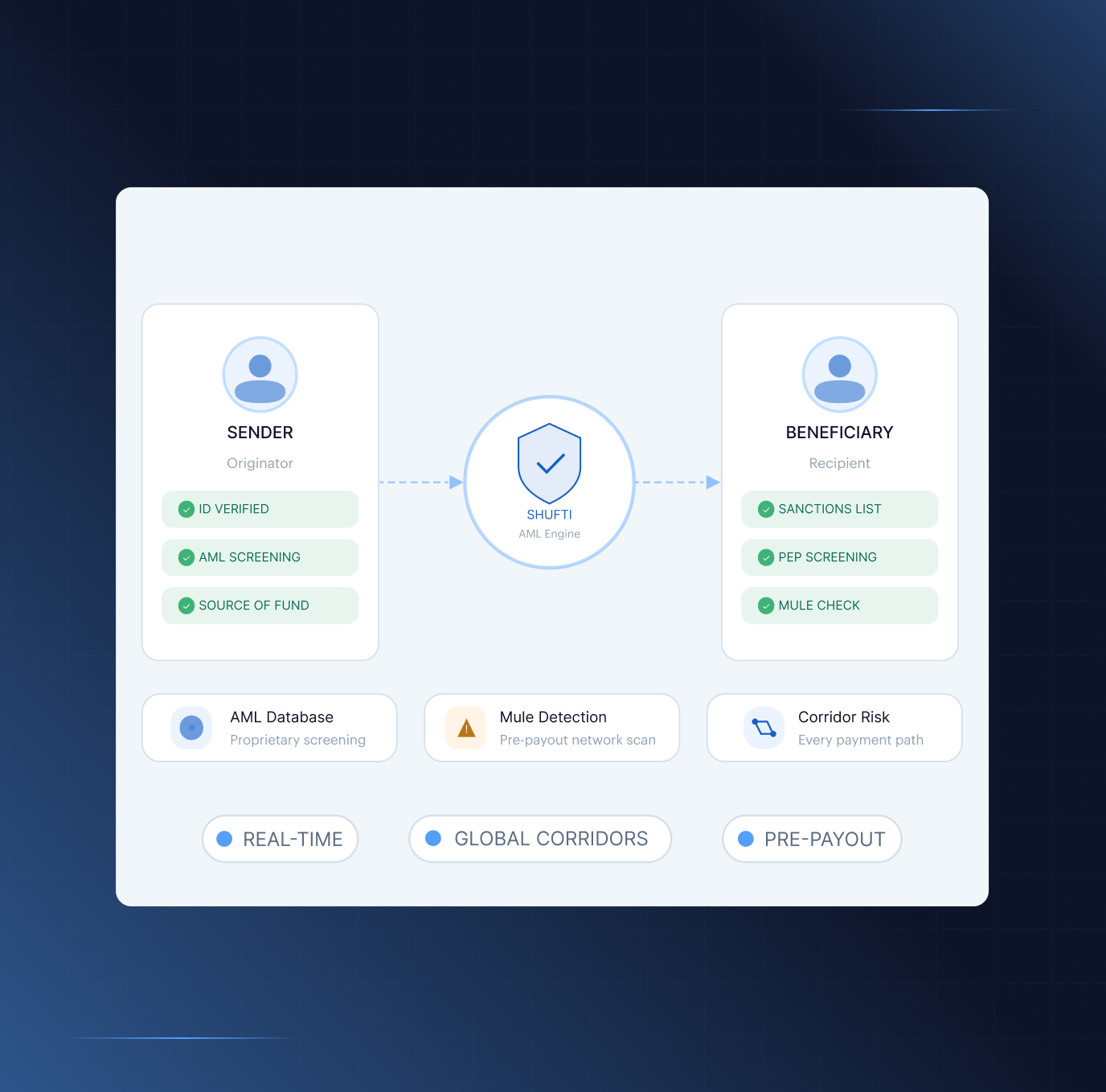
Verify and screen senders and beneficiaries against Shufti's proprietary AML database, detect money mule networks before payout, and monitor risk across every payment corridor, all from one platform.
Proven performance
Built for remittance compliance teams that need speed and proof
- <30sMedian time-to-decision for supported verification flows
- 240+Regions covered for government-issued identity documents
- L3iBeta Level 3 liveness conformance, independently tested against advanced spoofing and deepfakes
Trusted by Leading Digital Enterprises Worldwide






Compliance and fraud gaps
The remittance risks point checks miss
-
Sender and receiver verification gaps
Most verification stops at the sender. The June 2025 revision of FATF Recommendation 16, the Travel Rule, changed that: beneficiary institutions must now actively use and verify the originator and beneficiary information they receive, not simply store it. A sender-only stack cannot meet this on the receiving side.
Shufti solution
Shufti verifies the sender and the beneficiary within the same case and keeps evidence for both parties on the transfer record, so the obligation is met on both sides of the payment.
-
Money mules pass standard KYC
A money mule is often a real person using a genuine document, so identity and liveness checks clear them. The risk lives in the network: shared devices, reused connections, and abnormal funding and payout behaviour that a single-account view never shows. Reported mule cases rose sharply in 2025 (Cifas).
Shufti solution
Fraud Hub combines device, network, and behavioural signals and links related accounts, surfacing the mule network at registration and as transfer behaviour develops.
-
Corridor and regulatory complexity
Growth means serving thin-file customers on local documents while meeting different KYC thresholds, reporting rules, and data-residency laws across several regulators at once. Each new market can otherwise demand its own integration and control set.
Shufti solution
Shufti covers government-issued identity across 240+ regions, screens against sanctions, PEP, and adverse media with its own engine, and can run onshore where data cannot leave the country, so one platform scales across corridors.


Verification across every transfer touchpoint

Sign Up
Bulk Account Farming
A fraud ring scripts many sign-ups from a small pool of devices and networks to seed future mule and synthetic accounts before any transfer is attempted.
How Shufti solves it
Device Fingerprinting recognises the shared device and session attributes, Behavioural Biometrics separates automated form-filling from genuine human input, and Fraud Hub clusters the linked sign-ups into one case and blocks the batch, so the ring is stopped before an account is funded.
Synthetic Identity Registration
An applicant enters a plausible but fabricated identity that blends real and invented data and passes basic format checks at sign-up.
How Shufti solves it
eIDV validates the submitted attributes, name, date of birth, and national ID number, against independent and government data sources, so an identity that cannot be corroborated is caught at entry before it builds any history.
Duplicate Account Creation
The same person opens several accounts under small variations in name, email, phone, or device to spread activity and dodge limits.
How Shufti solves it
Fraud Hub links repeated device, network, and contact patterns across registrations and flags the duplicates, so one person cannot quietly run many accounts.
Concealed Device Environment
A registrant hides behind an emulator, VPN, or tampered device stack to mask coordinated activity behind a clean-looking sign-up.
How Shufti solves it
Shufti's device intelligence scores the session, detects emulators, tampered stacks, and anonymising networks, and routes high-risk sign-ups to stronger verification or manual review, keeping the cheapest point in the journey as the place organised fraud is caught.

Verify Identity (KYC)
Forged or Altered Document
A new customer submits a tampered passport or national ID, or a fully fake one, to pass onboarding.
How Shufti solves it
Document Verification authenticates the document itself: it reads the printed data and machine-readable zone, matches the layout to the official template, and runs forensic tamper checks. For chip-based IDs, NFC Verification reads the encrypted chip and validates its cryptographically signed data, the strongest available proof of authenticity.
Genuine Document, Wrong Holder
A real document is presented by someone who is not its owner.
How Shufti solves it
Face Verification matches a live selfie to the document portrait and confirms the person presenting the ID is its owner, binding the account to the true holder rather than to a valid-looking document.
AI Deepfake or Camera Injection
A remote fraudster uses a face swap, a 3D mask, or a synthetic video fed straight into the camera to defeat the selfie check.
How Shufti solves it
Face Verification is certified to iBeta Level 3, the standard that tests resistance to 3D masks, prosthetics, and software injection attacks rather than only printed photos and screens, so these advanced spoofs are rejected.
Document-Light Market or Address Rule
In some corridors a customer has no readily verifiable document, or the rule set requires a confirmed residential address.
How Shufti solves it
eIDV confirms the customer's attributes against independent data sources where a document is not available, and Address Verification checks the stated address against proof-of-address documents or data sources when residence must be proven.

Risk Screening
Sanctioned or Restricted Customer
A new customer may appear on a sanctions or restricted-party list, where a single miss can mean severe penalties.
How Shufti solves it
Sanctions Screening checks the customer against current lists at onboarding using Shufti's own engine, with no external vendor in the critical path, which supports faster resolution and clearer audit ownership. A confirmed match is blocked before the account is approved.
Politically Exposed Person
A customer is a politically exposed person, or a close associate of one, and needs closer scrutiny without an automatic block.
How Shufti solves it
PEP Screening identifies the exposure and its level so the team applies proportionate enhanced due diligence to that individual instead of turning away a whole category of legitimate customers.
Adverse Media Signal
A customer is named in credible reporting on fraud, corruption, or other financial crime.
How Shufti solves it
Adverse Media Screening surfaces the relevant coverage and attaches it to the case, so a risk that never appears on a formal list is still visible at onboarding.
High-Risk Jurisdiction and False Positives
A customer tied to a high-risk country raises the risk level, while broad name-matching buries analysts in false positives that slow every genuine customer.
How Shufti solves it
Geographic risk feeds the customer's risk score, and Shufti's tuned name-and-entity matching cuts false positives, so enhanced checks focus where risk is real and clean customers are not delayed.

Add Beneficiary
Unverified Beneficiary
A customer adds a beneficiary whose identity is never confirmed, the exact gap the FATF Recommendation 16 Travel Rule now targets on the receiving side.
How Shufti solves it
Shufti verifies the beneficiary when they are added, authenticating a document with Document Verification or confirming attributes with eIDV where no document is available, and links that proof to the beneficiary record so evidence exists before the first transfer.
Beneficiary on a Watchlist or Mule Network
A newly added beneficiary may be a sanctions match, or a mule quietly receiving from many unrelated senders.
How Shufti solves it
AML Screening checks the beneficiary against sanctions, PEP, and adverse media data at the point they are added, and Fraud Hub flags a payee already linked to multiple unrelated senders, so a risky beneficiary is caught before money is sent.
Local, Thin-File Beneficiary
A beneficiary in a high-volume corridor holds only a local document such as a Pakistani CNIC or an Indian voter ID and has a limited data footprint.
How Shufti solves it
Document Verification supports these local formats across 240+ regions, and eIDV confirms the beneficiary against local data sources where no document is presented, so thin-file payees are still verified.
Bank Account Verification
The beneficiary's bank account may not belong to the person the customer intends to pay, so funds could be sent to the wrong or a fraudulent account.
How Shufti solves it
Bank Account Verification confirms that the beneficiary's name matches the holder of the destination bank account before the transfer is set up, so payouts reach the verified account rather than a mismatched or spoofed one.

Fund Transfer
Stolen Card or Account Pay-In
A sender funds a transfer with a stolen card, a compromised bank account, or a hijacked wallet, so the money entering the system is already illicit.
How Shufti solves it
Transaction Monitoring scores the funding instrument and pay-in behaviour, and Fraud Hub links the pay-in to device and network signals, so a suspicious funding source is held for review before a transfer is built on top of it.
Third-Party Funding
The account is topped up by people unrelated to the account holder, a common money mule pattern where one account collects funds from many senders.
How Shufti solves it
Fraud Hub flags many-to-one funding into a single account, and Transaction Monitoring weighs the pattern against the customer's profile, so third-party pay-ins that signal mule activity are surfaced early.
Structured Pay-Ins
Funds are loaded in many small amounts kept under reporting thresholds before being sent on.
How Shufti solves it
Transaction Monitoring aggregates pay-ins across time and channels and scores the overall pattern, so structuring at the funding stage is caught even when each top-up looks small.
Chargeback and First-Party Fraud
A sender funds and sends, then disputes the pay-in as unauthorised, leaving the operator exposed after the money has left.
How Shufti solves it
Device Fingerprinting and Behavioural Biometrics confirm the genuine account holder authorised the pay-in, and that evidence sits on the case to defend against a later dispute.

Send Money
Out-of-Profile Transfer
A verified customer initiates a transfer unusual for their value band, corridor, or counterparty, the kind of layering that looks ordinary at the single-transaction level.
How Shufti solves it
Transaction Monitoring scores the transfer against rules and behavioural models before it proceeds and can allow, hold, or trigger a step-up check, so a suspicious value or corridor change is caught at initiation rather than after settlement.
Structuring Below Thresholds
A customer splits a large sum into many small transfers kept under reporting thresholds to avoid scrutiny.
How Shufti solves it
Transaction Monitoring aggregates activity across transfers and time and scores the overall pattern, not each payment alone, so structuring is caught even when no single transfer looks unusual.
Authorised Push Payment Scam
A genuine customer is coached by a scammer into authorising a payment they believe is legitimate, so identity checks pass and only context reveals the fraud.
How Shufti solves it
Transaction Monitoring and Fraud Hub flag the out-of-profile behaviour, and Consent Verification captures the customer's explicit, recorded authorisation, giving the team grounds to pause and review a high-risk instruction before funds move.
Sanctions or PEP Hit at Transfer
A party can become a sanctions or PEP match between onboarding and the moment a transfer is sent.
How Shufti solves it
AML Screening re-checks the sender and beneficiary against current lists at the point of transfer, so a newly listed party is stopped before the payment proceeds.

Receive Funds
Substituted Collector at Payout
At a cash or agent payout, the person collecting the funds may not be the verified beneficiary.
How Shufti solves it
Document Verification and Face Verification re-confirm the collector against the beneficiary evidence already on the record, so the final step of the chain proves who actually receives the money.
Coerced or Mule Beneficiary
The named beneficiary may be a coerced individual or a mule collecting funds for a criminal network.
How Shufti solves it
Transaction Monitoring and Fraud Hub weigh the beneficiary's funding pattern and network links at payout, so a beneficiary receiving from many unrelated senders is flagged before the funds are handed over.
Agent Network Misuse
Agent and cash-out locations can be exploited or run under weaker controls, and many operate under local data rules.
How Shufti solves it
Shufti applies the same identity and screening checks at the agent tier as in the digital flow and can run inside the country where required, so agents meet one consistent control standard.
Risk Changed Before Release
A beneficiary cleared earlier can match a sanctions-list update in the window before funds are released.
How Shufti solves it
A check at release re-runs Sanctions Screening against the latest lists, so a status change between approval and payout is caught and the payout held before funds leave the corridor.

Source of Funds Check
Unexplained Large Transfer
A customer sends an amount far above their profile, and regulation requires evidence of where the funds came from before it proceeds.
How Shufti solves it
Shufti triggers enhanced due diligence from the risk score, captures supporting documents such as payslips or bank statements through Document Verification, and records them on the case, so the source of funds is evidenced rather than assumed.
Wealth Inconsistent With Profile
Activity does not match the customer's stated occupation or expected volumes, a classic laundering signal.
How Shufti solves it
Transaction Monitoring flags the mismatch between the declared profile and actual flows, prompting a source-of-funds and source-of-wealth review before higher-value transfers continue.
High-Risk Customer or Corridor
A politically exposed person, a high-risk jurisdiction, or a sensitive corridor calls for deeper checks than standard due diligence.
How Shufti solves it
AML Screening and geographic risk drive an enhanced due diligence path, and ongoing monitoring keeps the source-of-funds evidence current, so the enhanced status is maintained rather than verified once and forgotten.

Periodic Review
Cleared Yesterday, Flagged Today
A customer who passed onboarding can later become a sanctions or adverse-media match, and point-in-time checks would miss it.
How Shufti solves it
Ongoing AML Screening re-screens the customer base continuously as lists and news change and raises an alert when a cleared customer becomes a match, so risk ratings stay current between scheduled reviews.
Behavioural Drift Over Time
An established customer gradually shifts to corridors, values, or counterparties that no longer fit their profile.
How Shufti solves it
Transaction Monitoring tracks the profile over time and raises the change while the pattern is forming, and AML Screening re-checks any new counterparties, so a review is driven by current risk signals rather than a static schedule alone.
Scheduled Enhanced Review for High-Risk Customers
High-risk customers and PEPs require enhanced due diligence on a set cadence, not only event-driven checks.
How Shufti solves it
Ongoing Monitoring schedules and prompts the review and pulls refreshed screening and monitoring evidence onto the record, so the enhanced review is completed on time and fully documented.
Expired or Stale KYC Data
A customer's identity document expires or their details change, and stale data weakens every downstream check.
How Shufti solves it
The review prompts re-verification through Document Verification and a fresh Face Verification match, or updated attributes through eIDV, so the record is refreshed without a full re-onboarding.

Close Account
Exit With a Defensible Record
When an account closes, the operator must still retain a complete record and answer later regulator or law-enforcement requests about that customer.
How Shufti solves it
Because screening, monitoring, and case evidence accumulate on one record across the relationship, the full history is retained and can be produced on demand after closure, without reconstructing it from separate systems.
Closure to Shed a Risk History
A customer under suspicion may close and try to reopen accounts to escape a risk history, a common mule and layering tactic.
How Shufti solves it
Fraud Hub links the closing account to its devices, networks, and behaviour, so a return under a new identity is recognised, and outstanding AML Screening and reporting obligations are completed before closure is finalised.
Dormant Account Reactivated as a Mule
An account left open but unused can be sold or reactivated later as a ready-made mule with a clean-looking history.
How Shufti solves it
Transaction Monitoring flags dormancy followed by sudden reactivation and unusual flows, and Fraud Hub links the account to known networks, so a revived account is re-checked rather than trusted on its age.
Built for every role that owns the remittance decision
Each role sees the checks and evidence that matter for its part of the transfer, drawn from the same case record.
Compliance Officer
Own KYC, AML, sanctions, PEP, adverse media, and Travel Rule obligations across corridors. Sender and receiver verification, in-house watchlist screening, and one audit-ready case record per user sit under a single vendor and contract, which makes each decision easier to defend.
Head of Product
Match verification strength to risk, lighter for low-value flows and stronger for high-value transfers, through one API spanning documents, biometrics, NFC, and data checks. Local pass-rate coverage across 240+ regions protects conversion as you enter new corridors.
Head of Engineering
Integrate identity, screening, monitoring, and fraud signals through a single REST API for the full transfer lifecycle, and choose SaaS, local cloud, or on-premise per market without rebuilding the integration.
Fraud Analyst
Work mule, device, network, and transfer signals in one case. Fraud Hub links related accounts so an investigation targets the network behind an alert, not only the single flagged account.
Frequently asked questions
Frequently Asked Questions
It is the process of confirming who is involved in a cross-border transfer before or during the payment. Depending on the corridor it can combine document authentication, biometric and liveness checks, data-source validation, address checks, device signals, watchlist screening, and transaction monitoring within one case.
Yes. Sender KYC and receiver verification run in the same workflow, and the evidence for both parties is stored on one transfer record, giving an operator a single case that shows both sides of the payment were checked.
Requirements vary by jurisdiction, but most regimes expect identity verification of the customer, sanctions and PEP screening, transaction monitoring, and ongoing due diligence. Shufti covers document, biometric, and data-based checks, in-house screening, and monitoring from one platform.
Document Verification authenticates an identity document itself, checking its data, template, and security features to confirm it is genuine. eIDV validates identity attributes such as name, date of birth, and ID number against independent or government data sources, and can work where no document is presented. The two are often used together: the document proves authenticity, and eIDV corroborates the data behind it.
Shufti screens parties against sanctions, PEP, and adverse media using its own screening engine, with no external vendor in the critical path. Screening runs at onboarding, at transfer, and on an ongoing basis, and every result is recorded for audit.
Because mules often use genuine identities, identity checks alone are not enough. Fraud Hub reads device, network, and behavioural signals and links related accounts, while Transaction Monitoring tracks funding patterns and escalates the risk score as mule behaviour builds.
Receiver verification confirms the beneficiary's identity and attaches that proof to the transfer. It matters because the June 2025 update to FATF Recommendation 16 requires the beneficiary institution to use and verify the information it receives, so verifying only the sender leaves a compliance gap.
Yes. Shufti covers government-issued identity across 240+ regions, including local documents used in South Asia, Africa, LATAM, and the GCC such as the CNIC, national ID, and voter ID, without a separate integration for each market.
Tuned matching and risk scoring across identity, screening, and behavioural signals reduce both false positives and false negatives, which lowers analyst workload and keeps genuine transfers moving while preserving a complete audit trail.
Yes. Shufti deploys as standard SaaS, local sovereign cloud, or fully on-premise, with the same product capability in each mode, so a market that requires data to stay in-country can still be served.
Ready to verify both sides of every transfer?
Bring sender KYC, receiver verification, screening, mule detection, and monitoring onto one platform, and run it in the deployment mode each market allows. Book a demo to walk your corridors and see where it fits.
Your Go-To for KYC/AML & Fraud
Resources

18 December, 2025
State of Global AML Compliance 2025 FATF Data Insight
AML laws read strongly on paper while enforcement lags behind. A data-led analysis of FATF findings, the gap between rules and results, and where RegTech closes it.
Report