AMLR Solutions
 AMLR Consultation
 Onboarding
 Ongoing Monitoring
 FRAML
FRAML KYC
KYC KYB
KYB KYI
KYI Age Assurance
 Workforce IAM
 Candidate Verification
 Account Takeover
 Bonus/ Promotion Abuse
 Chargeback Fraud
 Deepfake
 Document Fraud
 Fraud Networks
 Impersonation Fraud
 Money Mule Activity
 Multi-Accounting
 Party Fraud
 Regulatory & Compliance Risks
 Synthetic Identity Fraud
 Adult Content
 Banking
 Crypto
 Fintech
 Forex
Forex Compliance
 Fraud prevention
 Trust & safety
 Global expansion
 Compliance Officers
 Developers
 Fraud Analysts
 Product Managers
 Advanced Journey Builder (AJB)
 Global Trust Platform
 Customer Profiles
 Vendor Comparison
 IDV Case Management
 AML Case Management
 Regulatory Reporting
 Travel Rule Protocols
 Agentic Rule Builder
 AI Compliance Co-Pilot
 Fraud Analytics
 Fraud Hub
 OCR
OCR Shufti AI
 Bank Account Verification
 Biometric Duplication
 Database Checks
 Document Intelligence
 Government ID
 Mobile Driver's License
 NFC
NFC Selfie Liveness
 Brand Personalisation
 Deployment Options
 Identity Methods
 IDV Modes
 Multi-tenancy
 On-Premise IDV
 Secure Capture











TL;DR
- Global insurance fraud exceeded $80 billion in 2025, with UK insurers detecting £1.16 billion in fraudulent claims and 98,400+ fraud cases in 2024 alone
- Identity verification in insurance is now a formal regulatory obligation under the EU’s Insurance Distribution Directive (IDD) and FATF’s risk-based guidance, not optional due diligence
- Verification must cover the full policy lifecycle, not just onboarding — fraud patterns differ at application stage (synthetic identities, forgery) versus claims stage (impersonation, beneficiary manipulation)
- At claims stage, biometric liveness detection covering 56+ anti-spoofing vectors is the only reliable defence against deepfakes and AI-generated imagery
- Electronic identity verification (eIDV) cross-references applicant data against registries across 85+ countries in under three seconds, removing document upload friction at onboarding
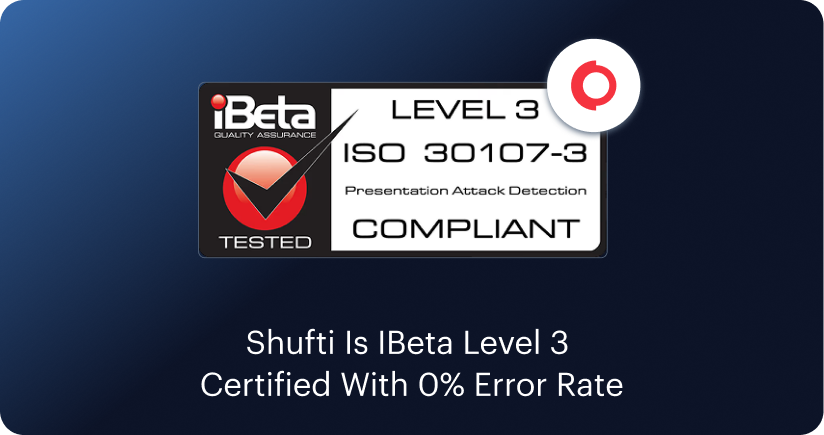
- AI-powered verification automates forensic document checks across thousands of variables, with independent iBeta Level 1 and Level 2 certification providing the auditable benchmark
- Deloitte’s 2026 Global Insurance Outlook identifies AI-powered identity and fraud risk modernisation as the defining strategic priority for insurers this year
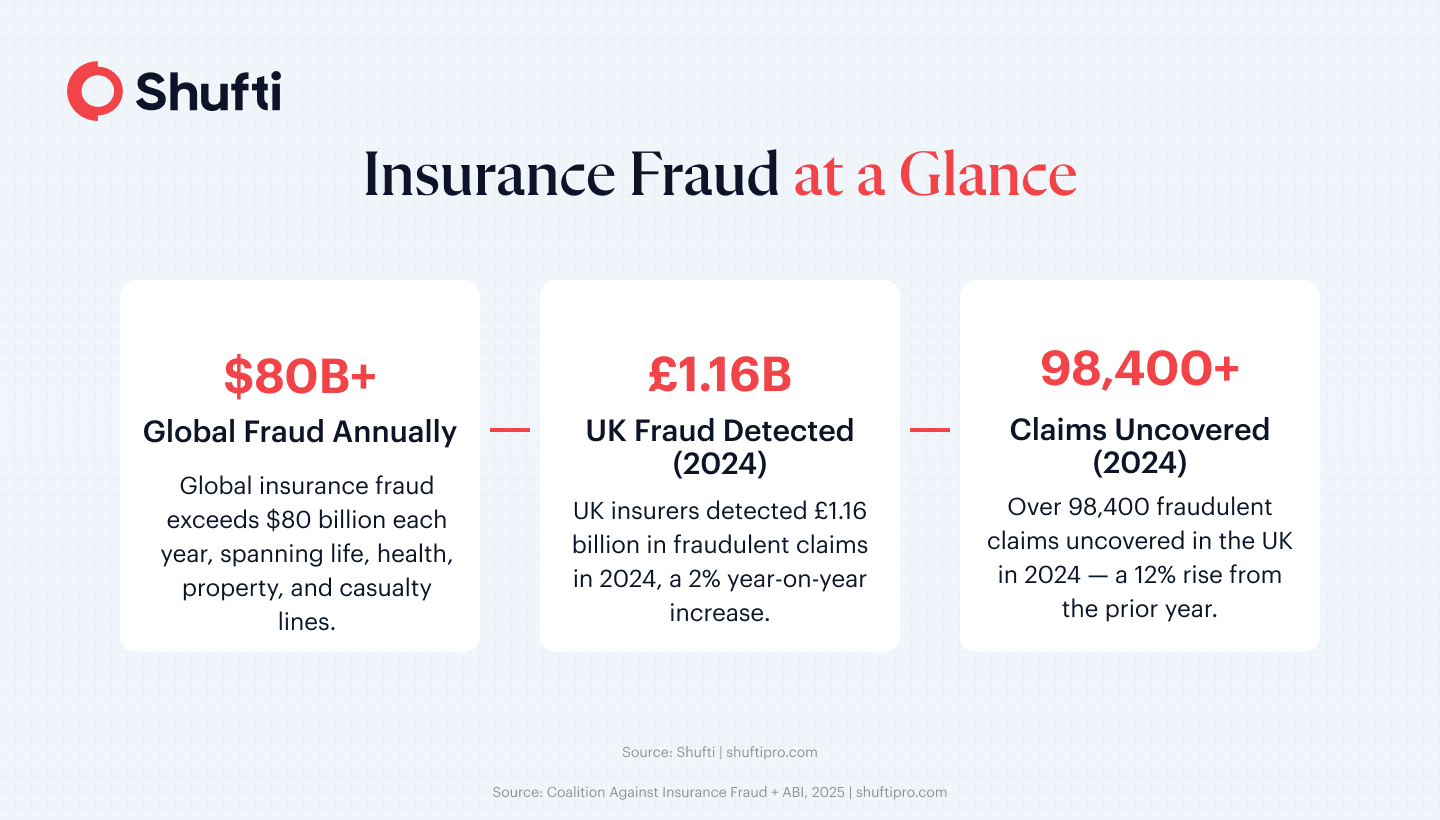
Insurance fraud costs were estimated to exceed $80 billion annually in 2025. In the UK alone, insurers detected £1.16 billion in fraudulent general insurance claims in 2024, a 2% increase year on year, while uncovering more than 98,400 fraud-related claims, a 12% rise from 2023.
Behind those numbers is a shared failure point. Policies written on fabricated names, claims submitted by people who cannot prove they hold the policy, and payouts routed to unverified beneficiaries are each a verification gap that an insurer paid for.
This article explains what identity verification in insurance covers, why regulators now treat it as a compliance baseline, and how modern technology is addressing it across the full policy lifecycle.
Identity verification in insurance is the process of confirming that a person applying for a policy, submitting a claim, or receiving a payout is genuinely the individual they present themselves to be. It combines document authentication, biometric matching, database cross-referencing, and AML screening to establish and maintain an auditable identity record across the life of a policy.
Why do insurance companies need identity verification?
Two distinct forces drive the requirement. Regulators in most markets now treat identity verification as a formal compliance obligation rather than optional due diligence, placing it alongside anti-money laundering controls in the same regulatory framework. Fraud losses at scale give the requirement a direct commercial dimension. Insurers who treat verification as a one-time onboarding step rather than a lifecycle function often discover the cost of that decision at claims time.
The regulatory obligation
The EU’s Insurance Distribution Directive (IDD) requires insurers and intermediaries to conduct customer due diligence and verify policyholder identity as part of their AML and counter-terrorist financing obligations. The Financial Action Task Force risk-based approach guidance for the life insurance sector, available via the Financial Stability Board, establishes identity verification and customer due diligence as a baseline control for life insurers and intermediaries operating globally.
In practice, insurers offering life, annuity, and investment-linked products must verify customer identity at onboarding and revisit that verification when risk indicators change. Failure to maintain documented compliance creates direct regulatory exposure, not only reputational risk.
The scale of insurance fraud
Global insurance fraud exceeded $80 billion in 2025. That figure spans life, health, property, and casualty lines, with claims fraud accounting for a substantial share. UK insurers’ detection of 98,400 fraudulent claims in a single year confirms the problem is growing even as detection capabilities improve.
The connection to identity is direct. Most insurance fraud involves misrepresentation of some kind. A claimant who is not who they say they are, a policy written on a fabricated identity, and a payout routed to an unverified beneficiary are all verification failures at root. Insurance fraud prevention identity verification targets those failure modes before they translate into settled losses.
How does identity verification work across the insurance policy lifecycle?
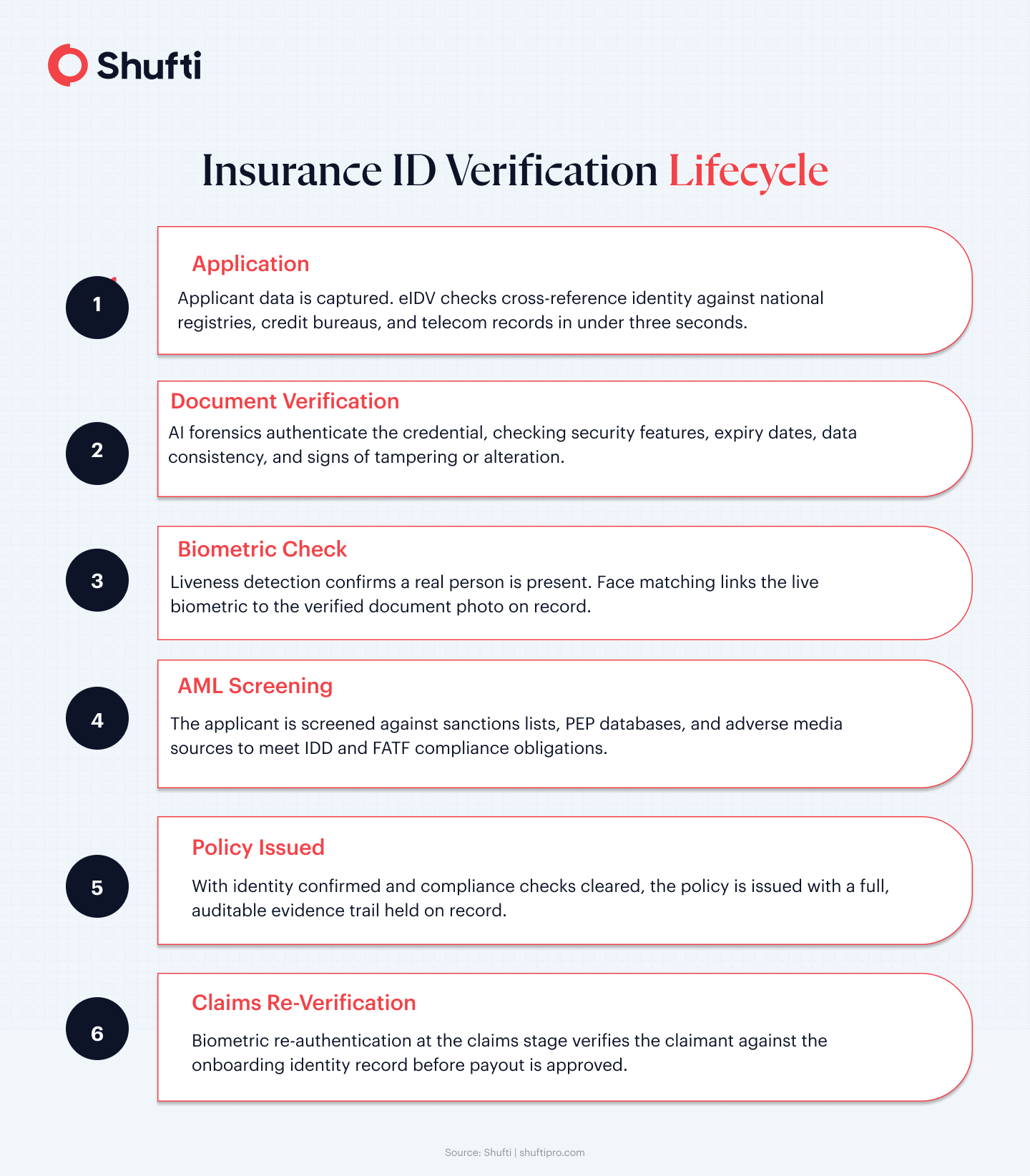
Identity verification in insurance is not a single check completed at onboarding. A policyholder’s risk profile shifts across the relationship, and the verification obligation shifts with it. Applying for a policy carries different requirements than submitting a high-value claim three years into the contract. Getting the scope right matters because fraud patterns differ by lifecycle stage. Application fraud tends to involve synthetic identities and document forgery, while claims fraud more often exploits impersonation or beneficiary manipulation. The digital identity verification insurance companies now deploy covers the full arc, from initial application through underwriting, renewal, and payout re-authentication.
Insurance customer onboarding identity checks
At the application stage, insurance customer onboarding identity checks cover three separate assurances. The applicant must exist as a verifiable person, their identity document must be genuine, and their background must not trigger any AML or sanctions screening concerns.
Document verification authenticates the credential itself, checking security features, expiry dates, data consistency, and signs of alteration across a wide range of global document types. Electronic identity verification cross-references the applicant’s name, date of birth, and address against national registries, credit bureau records, and telecom data, returning a verified result without requiring the customer to upload supporting files. AML screening against sanctions lists, PEP databases, and adverse media sources completes the insurance KYC identity verification process at onboarding.
Biometric identity verification at the claims stage
Biometric identity verification for insurance claims addresses a different and more acute fraud risk. At payout, the financial incentive for fraud reaches its highest point in the policy lifecycle. A claimant may attempt to impersonate the policyholder, present a stolen identity document, or use AI-generated imagery to pass a basic visual check.
Biometric identity verification insurance claims processes use liveness detection to confirm that a real, present person is behind the submission, ruling out photographs, recorded video, and synthetic imagery in a single step. Liveness detection operating across 56 or more anti-spoofing attack vectors, including deepfake detection, provides an assurance ceiling that document checks alone cannot reach. When biometric matching links the verified live face to the identity document held on record from onboarding, the chain of custody from application to payout becomes auditable.
How does AI powered identity verification for insurers work?
AI-powered identity verification for insurers automates the forensic and biometric judgments that previously required manual review queues. On the document side, machine learning models assess authenticity across thousands of variables, from font consistency and microprint integrity through hologram detection and data field cross-validation. Independent certification bodies such as iBeta test biometric components against Level 1 and Level 2 presentation attack standards, providing an independently audited assurance benchmark that goes beyond vendor self-reporting. DHS RIVR 2025 testing provides a further performance reference evaluated across demographically diverse populations.
The eKYC insurance onboarding solution layer removes a persistent friction point from the application journey. Rather than asking applicants to upload utility bills or proof-of-address documents, electronic identity verification cross-references applicant data against government registries, telecom records, and credit bureau databases across more than 85 countries, returning a verified result in under three seconds. For insurers serving geographically distributed policyholders, this reduces drop-off at the verification step without lowering the underlying identity assurance standard.
Deloitte’s 2026 Global Insurance Outlook identifies AI adoption and digital transformation, including identity and fraud risk modernisation, as the defining strategic priority for insurers this year. For compliance officers evaluating the best identity verification software for insurance deployments, the practical benchmarks are independent certification evidence, coverage across the document types the insurer encounters globally, and lifecycle support from onboarding through claims adjudication. Selecting an insurance identity verification API provider that unifies document authentication, biometric verification, and AML screening through one integration also eliminates the audit fragmentation that creates compliance risk when systems do not share a common evidence format.
How Shufti helps insurers verify policyholders and stop fraud
Most insurers running identity checks today manage at least two or three separate vendor relationships to cover document verification, biometric checks, and AML screening, each with its own integration and audit trail format. When a high-value claim arrives and the verification systems do not communicate, the gap between those layers is exactly where fraud hides.
Shufti’s identity verification platform covers the full policy lifecycle through a single API, combining document forensics, biometric liveness detection with 56-plus anti-spoofing vectors, eIDV database checks across 85-plus countries, and AML screening against more than 100,000 data sources. For compliance teams managing IDD and FATF obligations, that means one evidence standard and one audit format from policyholder onboarding to payout.
Shufti’s combined face and document verification flow delivers a 99.5% pass rate in under 15 seconds, measured across production deployments.
Book a demo to see how identity verification fits across your insurance policy lifecycle.
Frequently Asked Questions
How does identity verification work in insurance?
Insurers verify policyholder identity using document authentication, biometric liveness checks, electronic identity database verification, and AML screening. Each check runs at a relevant point in the policy lifecycle, from application through to claims. Modern systems return a verified result in under 15 seconds through a single API integration.
Why do insurance companies need identity verification?
Insurance companies face a dual obligation. Regulators, including the EU's Insurance Distribution Directive and FATF guidance for the life insurance sector, require identity verification as an AML compliance baseline. Commercially, identity fraud accounts for a significant share of global insurance fraud losses estimated above $80 billion annually.
What is eKYC in the insurance industry?
eKYC in insurance refers to the electronic process of verifying a policyholder's identity using digital means rather than physical document submission. It typically involves cross-referencing applicant data against government registries, credit bureaus, and telecom databases, returning a verified result in seconds without requiring the customer to submit paper documents.
How does identity verification prevent insurance fraud?
Identity verification prevents insurance fraud by confirming the real identity of applicants at onboarding and re-verifying claimants before payout. Biometric liveness detection, document forensics, and AML screening each target a different fraud vector, together making it much harder to submit a false-identity claim, fabricate a policy, or misdirect a payout.
Is biometric identity verification used in insurance claims?
Yes. Biometric identity verification is increasingly used at the claims stage to re-authenticate the claimant against the identity record from onboarding. Liveness detection confirms a real person is present, while facial matching links the live biometric to the document on file, making it especially relevant for high-value claims.