


 Face Verification
 Address Verification
 Document Verification
 Age Verification
 VideoIdent
 Fast ID
 Docless Verification
 Consent Verification
 NFC Verification
 Business Verification
 Due Diligence
 Investor Verification
 E-Signature

 QES
QES
 AML Screening
 Transaction Monitoring
 Adverse Media
 Business AML Screening
 PEP & RCA
 Sanctions
 Watchlist
 Behavioural Biometrics
 Device Fingerprinting
 Biometric Face Authentication
 MFA
MFA
 Fraud Hub
 Onboarding
 Ongoing Monitoring
 KYC
KYC
 KYB
KYB
 KYI
KYI
 Age Assurance
 Identity Verification
 Workforce IAM
 Candidate Verification
 Compliance
 Fraud prevention
 Trust & safety
 Global expansion
 Product Managers
 Compliance Officers
 Fraud Analysts
 Developers
 Deepfake
 Bonus Abuse / Promotion Abuse
 Account Takeover
 Synthetic Identity Fraud
 Document Fraud
 Impersonation Fraud
 Multi-Accounting
 Fraud Networks
 Chargeback Fraud
 Money Mule Activity
 Party Fraud
 Regulatory & Compliance Risks
 Fintech
 Crypto
 iGaming
 Forex
Forex
 Social Network
 Marketplace
 Banking
 Gig Economy
 Payments
 Ride Hailing
 Adult Content
 Blind Spot Audit
 Deepfake Detector
 Liveness Spoofs
 Document Originality
 Document Deepfake
 Global Trust Platform
 Journey Builder
 Case Management
 Shufti AI
 Fraud Analytics
 Vendor Comparison
 Brand Personalisation
 IDV Modes
 AI Compliance Co-Pilot
 OCR
OCR
 Secure Capture
 Deployment Options
 Identity Methods
 API Documentation
 Mobile SDKs
 Service Status
 Help Center
 Contact Us
 Technical Support
 Supported Documents
 Supported Countries
 Content library
 Blogs
Blogs
 News
News
 Reports
 Insights
 Knowledgebase
 ROI calculator
 About
About
 Career
 Press Release
 Certifications
 Partnership
 Awards
 Events & Webinar
 Interactive Demo
 Podcast Studio
 Spotlight Studio
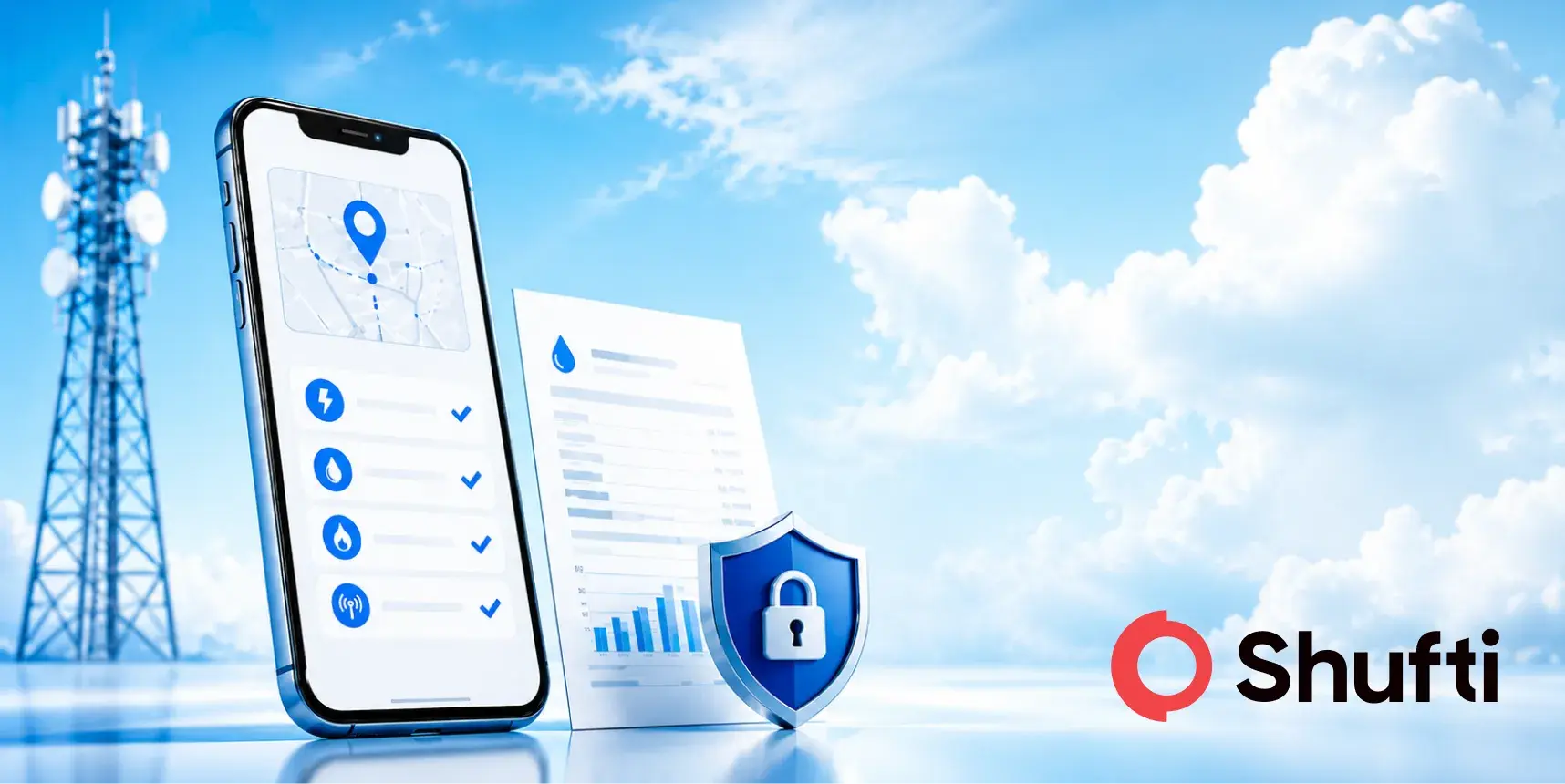
Address Verification for Telecoms & Utilities: KYC, Fraud & Regulatory Compliance 2026
TL;DR
- Address verification is a critical component of telecom KYC and fraud prevention. Telecom and utility providers must verify customer addresses during onboarding, account changes, and SIM swap requests to meet regulatory requirements and reduce fraud risks.
- SIM swap fraud and fake address submissions remain major threats. Fraudsters often use forged utility bills, stolen identities, or manipulated address information to gain control of mobile numbers and bypass authentication controls.
- Regulators are increasing scrutiny of subscriber verification practices. FCC rules, Ofcom requirements, and EU privacy regulations all require telecom providers to maintain accurate, verifiable subscriber information and auditable records.
- Modern telecom verification combines doc-less and document-based checks. Providers use database cross-referencing for fast onboarding and escalate to utility bill verification, document forensics, and enhanced checks when risk signals are detected.
- Digital KYC platforms improve compliance while reducing friction. Address verification APIs that integrate database checks, document authentication, and geolocation risk analysis help telecoms and utilities create audit-ready verification workflows without slowing customer onboarding.
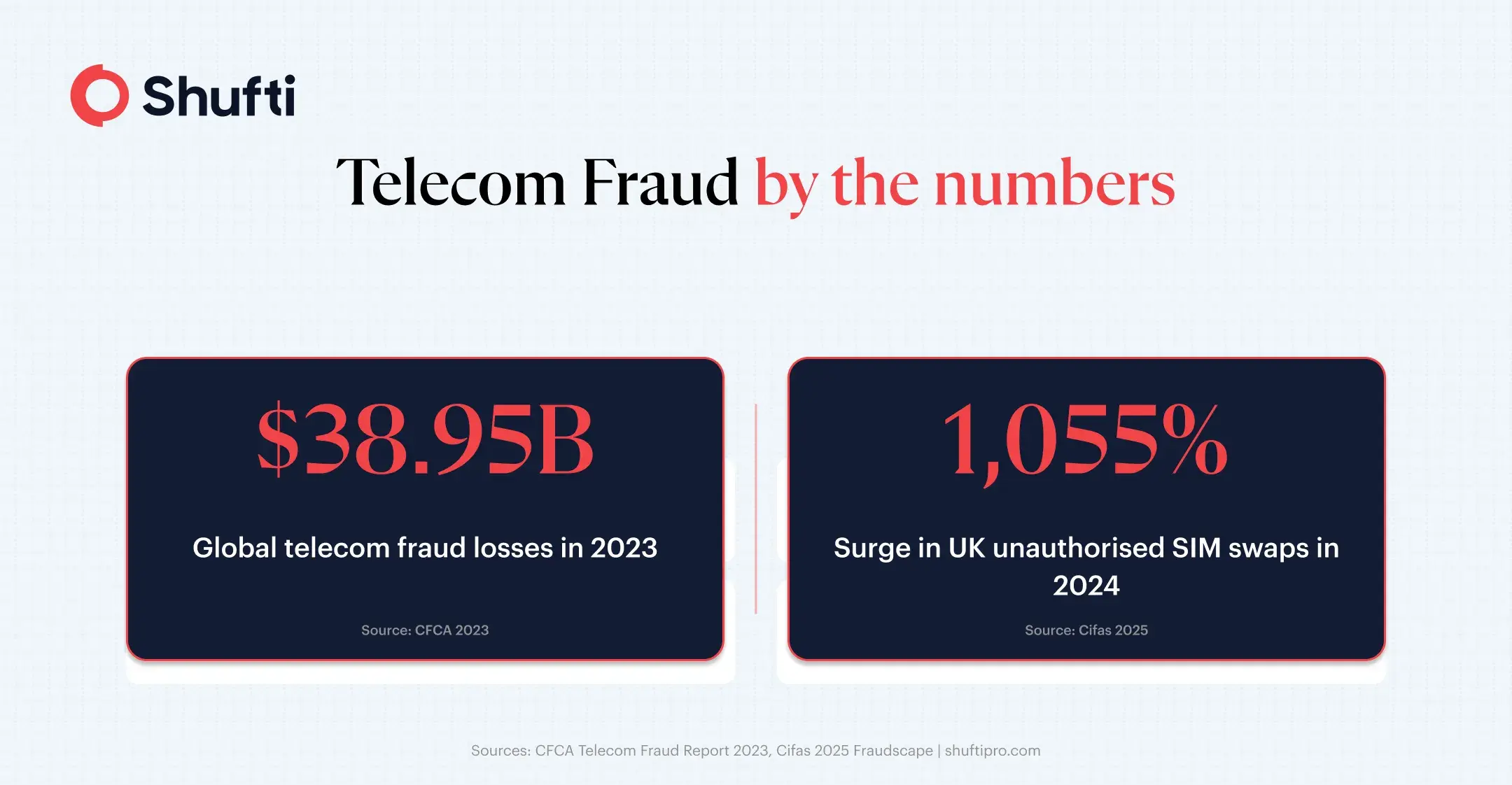
Unauthorised SIM swaps in the UK jumped 1,055% year-on-year in 2024, reaching nearly 3,000 confirmed cases according to Cifas’s 2025 Fraudscape report. Behind most of those cases sat the same gap: an operator that could not reliably verify a subscriber’s address at onboarding or at account change. For telecoms and utility providers, address verification sits at the centre of both fraud prevention and regulatory compliance, yet many still treat it as a data-entry field rather than a verified control. This guide covers how telecom KYC works, what the FCC, Ofcom, and EU ePrivacy rules require, and how document-based and doc-less address checks stop fraud before it reaches the network.
What is the telecom KYC verification process?
Telecom KYC verification is the process of confirming that a subscriber is who they claim to be before a SIM card, broadband line, or utility account is activated. Telecom KYC verification runs at three points in the subscriber lifecycle: initial onboarding, account changes such as SIM swap requests, and periodic re-verification triggered by risk signals. The three moving parts are identity verification, address verification, and document authentication. The balance between them shifts based on product type, regulatory regime, and the risk profile of the individual subscriber.
Customer onboarding and SIM registration
When a customer signs up for a mobile plan or a broadband service, the operator must link an identity to a physical address before service goes live. That address check separates a legitimate subscriber from a fraudster using a synthetic identity or stolen credentials. Customer onboarding for telecoms now means collecting an address, confirming it is real and linked to the declared identity, and generating an audit record the regulator can examine. The FCC’s SIM swap and port-out fraud rules, adopted in December 2023, formalised this obligation for US wireless carriers. Authentication at account changes is now a federal requirement, not an operational choice.
Address verification in telecom versus banking
Unlike banking, where a proof of address primarily satisfies anti-money-laundering (AML) requirements, telecom address verification serves three purposes simultaneously: it confirms the subscriber lives where they claim, validates service eligibility and coverage area, and satisfies data-accuracy obligations under national telecoms acts. ISP address verification and mobile operator checks face distinct pressures: high onboarding volumes, prepaid accounts with minimal registration friction, and a subscriber base that rarely interacts with a physical branch. A KYC onboarding approach built for banking does not translate directly. Telecom requires its own verification workflow.
Why fake address fraud and SIM swap attacks target telecoms
Telecoms are an attractive attack surface for identity fraud because a compromised phone number opens far more than a voice service. It enables two-factor authentication bypass, SIM swap-driven account takeover on banking and crypto platforms, and synthetic identity account creation at scale. Fraud prevention for telecoms starts with understanding where in the subscriber lifecycle the address is the weakest point of control.
AI-generated utility bill fraud
The most common address fraud in telecom onboarding today is the submission of a fabricated utility bill as proof of residency. As of 2024, AI-generated documents have reached a quality level where standard optical character recognition (OCR) checks cannot detect the forgery without forensic metadata analysis. Operators that rely on document uploads without forensic Document Intelligence checks, examining Exif data, PDF metadata, and layout fingerprints, are routinely onboarding subscribers whose declared addresses cannot be confirmed as real. This fake address problem compounds with every subsequent account added through the same verification gap.
SIM swap fraud and address manipulation
SIM swap fraud works by convincing an operator’s customer service team that a legitimate account holder wants their number moved to a new SIM card. Address data is central to this attack: fraudsters present forged utility bills or correspondence that matches the victim’s registered address to pass the telecom identity check. Telecom fraud losses reached an estimated $38.95 billion globally in 2023, a 12% rise on the prior year. Weak address verification at the SIM swap step is one of the most frequently exploited vectors in that figure.
What KYC compliance regulations apply to telecoms and utilities?
KYC compliance for telecoms is not a single-country concern. Three major regulatory frameworks tightened the rules around subscriber identity and address verification between 2023 and 2025, namely the FCC in the United States, Ofcom in the United Kingdom, and the EU ePrivacy Directive. Each carries different requirements, enforcement timelines, and documentation standards that directly affect how telecoms and utility providers collect and validate customer address data.
USA – FCC SIM swap rules
In the United States, FCC rules effective January 2024 require wireless providers to use secure customer authentication before redirecting a phone number to a new device or carrier, and to notify customers immediately when a SIM change or port-out request is made. For US telecoms, this translates to a verified address requirement at SIM change. An operator must confirm the requesting party’s identity against the address on the registered account. Address verification at account changes is now a federal compliance obligation for wireless carriers.
UK – Ofcom enforcement programme
In the United Kingdom, Ofcom’s enforcement programme on phone and text scams requires mobile operators to maintain accurate subscriber records and conduct due diligence on account changes. Ofcom’s 2025 mobile messaging consultation extended utility KYC compliance requirements to business message senders, mandating Know Your Customer checks before high-volume messaging accounts are activated. For consumer mobile accounts, Ofcom’s general conditions require telecoms to hold verified subscriber data, including physical address, as a condition of their operating authorisation.
EU – ePrivacy Directive address data requirements
In the European Union, the ePrivacy Directive governs how telecoms collect and process subscriber data, including address records. As of 2025, member state transpositions require that subscriber address data be accurate, lawfully collected, and protected against unauthorised access. The eIDAS 2.0 digital identity wallet mandate, requiring national wallet availability by 2027, will shift how address evidence is submitted at onboarding, moving toward verified digital credentials in place of scanned utility bills.
How do telecoms and utilities verify customer addresses?
Telecom and utility providers now run address verification through three distinct methods, often in a cascading sequence that starts with the least-friction check and escalates when risk signals or regulatory requirements demand stronger evidence. Identity verification for utilities and telecoms covers doc-less database checks, document-based proof of address, and API-driven digital KYC, each serving a different onboarding or account-change scenario.
Utility bill verification and document proof of address
Document-based proof of address, including utility bill verification, bank statement submission, or official government correspondence, remains standard for regulated account activations, high-value contracts, and any SIM change that triggers a risk flag. The subscriber submits a document. The system runs OCR to extract the address and then applies forensic analysis to verify that the document has not been AI-generated or tampered with. Accepted document types vary by jurisdiction but typically include utility bills, bank statements, council tax letters, and official government correspondence.
Doc-less database address verification
For standard consumer onboarding where speed matters, doc-less address verification cross-references the subscriber’s declared address against government registries, telecom databases, and credit bureau records. In markets with mature bureau infrastructure, including the UK, US, Germany, and Australia, this check returns a result in under three seconds without requiring any document upload. ISP address verification at the provisioning stage often runs this method to confirm service eligibility and validate the subscriber address in a single step. Where bureau coverage is thin, the system escalates automatically to document proof of address.
Digital KYC and address verification API for telecoms
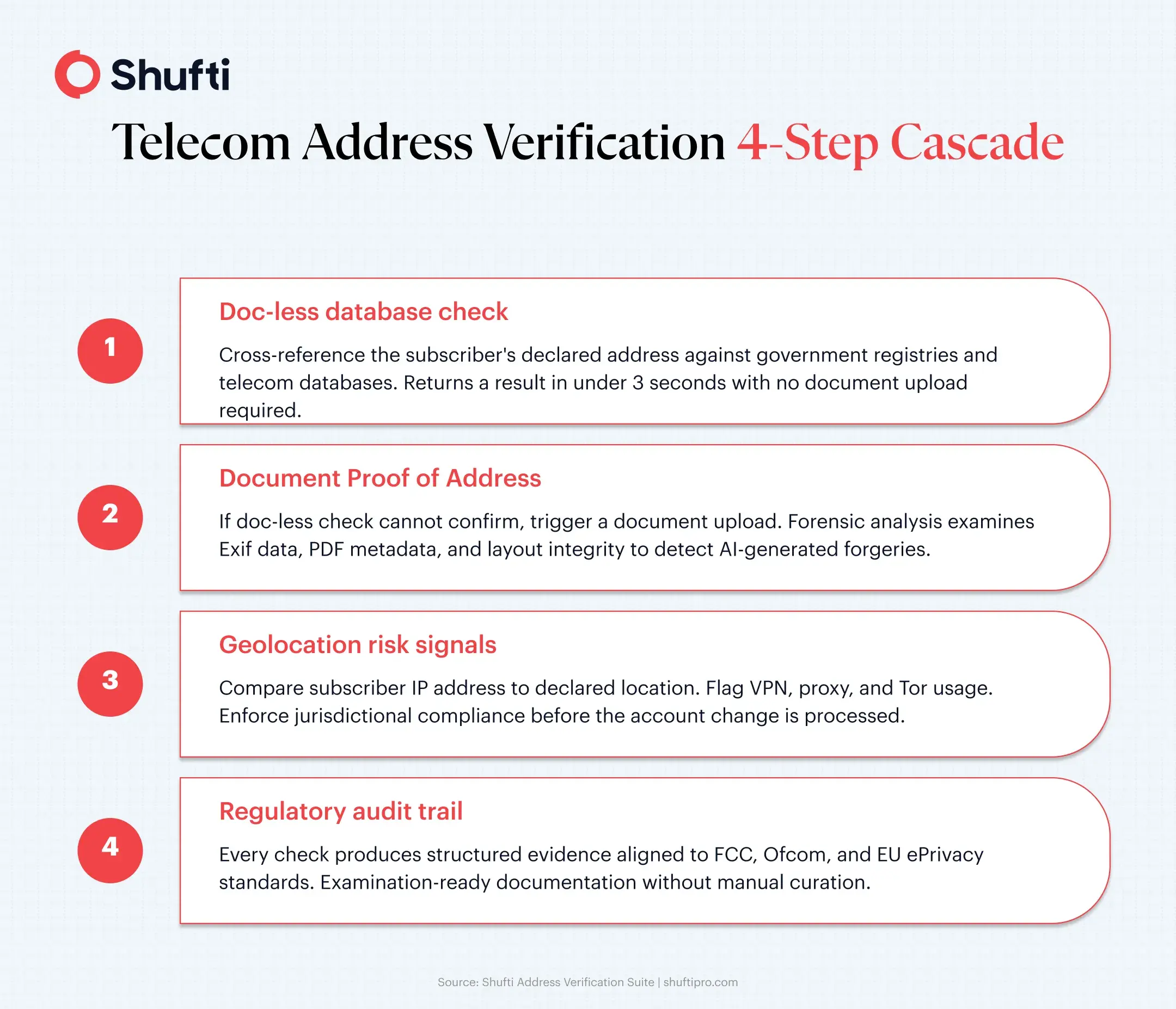
Digital KYC for utilities and telecoms increasingly runs through a dedicated address verification API that handles both doc-less cross-referencing and document proof of address within a single integration. The configurable workflow attempts a doc-less check first. If the address cannot be confirmed, it triggers a document upload request with forensic analysis on the returned file. Geolocation risk signals, which compare the subscriber’s IP address to the declared location, add a fraud-detection layer that catches address mismatches before they reach the main verification step. The complete flow produces a unified audit trail that satisfies regulatory evidence requirements without requiring manual review. For guidance on how address verification fits into broader telecom identity verification programmes, the approach is consistent across mobile, broadband, and utility sectors.
How Shufti helps telecoms verify customer addresses
Telecom compliance teams most often discover an address verification gap during an Ofcom audit or FCC inquiry, when subscriber records show self-declared address fields with no verification evidence attached. The gap is usually a workflow problem: the system collected an address but never confirmed it with the audit depth that regulators now require.
Shufti’s address verification runs a doc-less cross-reference first, checking the subscriber’s declared address against government registries and telecom databases in under three seconds. Where a SIM swap event, a high-risk account change, or a regulatory rule demands documentary evidence, the workflow escalates automatically to Document Proof of Address with forensic analysis on the uploaded utility bill, examining Exif data, PDF metadata, and layout integrity. Every check produces a structured audit trail aligned to FCC, Ofcom, and EU documentation standards, so the compliance team holds examination-ready evidence without manual curation.
To see Shufti’s telecom address verification cascade on your onboarding volumes, request a demo.
Frequently Asked Questions
What is the telecom KYC process?
Telecom KYC involves confirming a subscriber's identity and address before activating a SIM card, mobile plan, or broadband account. Operators collect identity documents, verify the declared address, and produce an audit trail. The FCC and Ofcom now require this at onboarding and at account changes such as SIM swaps.
How do telecoms verify customer addresses?
Most telecoms start with a doc-less database check, cross-referencing the declared address against government registries and credit bureaus in under three seconds. Where that check cannot confirm the address, the system escalates to document proof of address, typically a utility bill or bank statement verified for authenticity and forensic integrity.
What compliance requirements apply to telecom address verification?
In the US, FCC rules effective January 2024 require wireless providers to authenticate customers before processing SIM changes. In the UK, Ofcom requires accurate subscriber records and due diligence at account changes. The EU ePrivacy Directive mandates lawful collection and accuracy of subscriber address data across member states.
How do telecoms prevent fraud using address verification?
Telecoms prevent fraud by combining doc-less address cross-referencing with document forensics on submitted utility bills to detect AI-generated forgeries. Geolocation risk signals flag IP-versus-address mismatches early. At SIM swap requests, address re-verification against the registered subscriber record blocks most impersonation attempts before the account change is processed.
What is digital KYC onboarding for telecoms?
Digital KYC onboarding for telecoms verifies a new subscriber's identity and address through digital channels, with no branch visit required. It combines database checks, document scanning, and forensic analysis, producing a compliance-ready audit trail that meets FCC, Ofcom, and EU regulatory standards.