



 Face Verification
 Address Verification
 Document Verification
 Age Verification
 VideoIdent
 Fast ID
 Docless Verification
 Consent Verification
 NFC Verification
 Business Verification
 Due Diligence
 Investor Verification
 E-Signature

 QES
QES
 AML Screening
 Transaction Monitoring
 Adverse Media
 Business AML Screening
 PEP & RCA
 Sanctions
 Watchlist
 Behavioural Biometrics
 Device Fingerprinting
 Biometric Face Authentication
 MFA
MFA
 Fraud Hub
 Onboarding
 Ongoing Monitoring
 KYC
KYC
 KYB
KYB
 KYI
KYI
 Age Assurance
 Identity Verification
 Workforce IAM
 Candidate Verification
 Compliance
 Fraud prevention
 Trust & safety
 Global expansion
 Product Managers
 Compliance Officers
 Fraud Analysts
 Developers
 Deepfake
 Bonus Abuse / Promotion Abuse
 Account Takeover
 Synthetic Identity Fraud
 Document Fraud
 Impersonation Fraud
 Multi-Accounting
 Fraud Networks
 Chargeback Fraud
 Money Mule Activity
 Party Fraud
 Regulatory & Compliance Risks
 Fintech
 Crypto
 iGaming
 Forex
Forex
 Social Network
 Marketplace
 Banking
 Gig Economy
 Payments
 Ride Hailing
 Adult Content
 Blind Spot Audit
 Deepfake Detector
 Liveness Spoofs
 Document Originality
 Document Deepfake
 Global Trust Platform
 Journey Builder
 Case Management
 Shufti AI
 Fraud Analytics
 Vendor Comparison
 Brand Personalisation
 IDV Modes
 AI Compliance Co-Pilot
 OCR
OCR
 Secure Capture
 Deployment Options
 Identity Methods
 API Documentation
 Mobile SDKs
 Service Status
 Help Center
 Contact Us
 Technical Support
 Supported Documents
 Supported Countries
 Content library
 Blogs
Blogs
 News
News
 Reports
 Insights
 Knowledgebase
 ROI calculator
 About
About
 Career
 Press Release
 Certifications
 Partnership
 Awards
 Events & Webinar
 Interactive Demo
 Podcast Studio
 Spotlight Studio
Crypto Fraud Prevention: Safeguarding Exchanges and Wallets

TL;DR
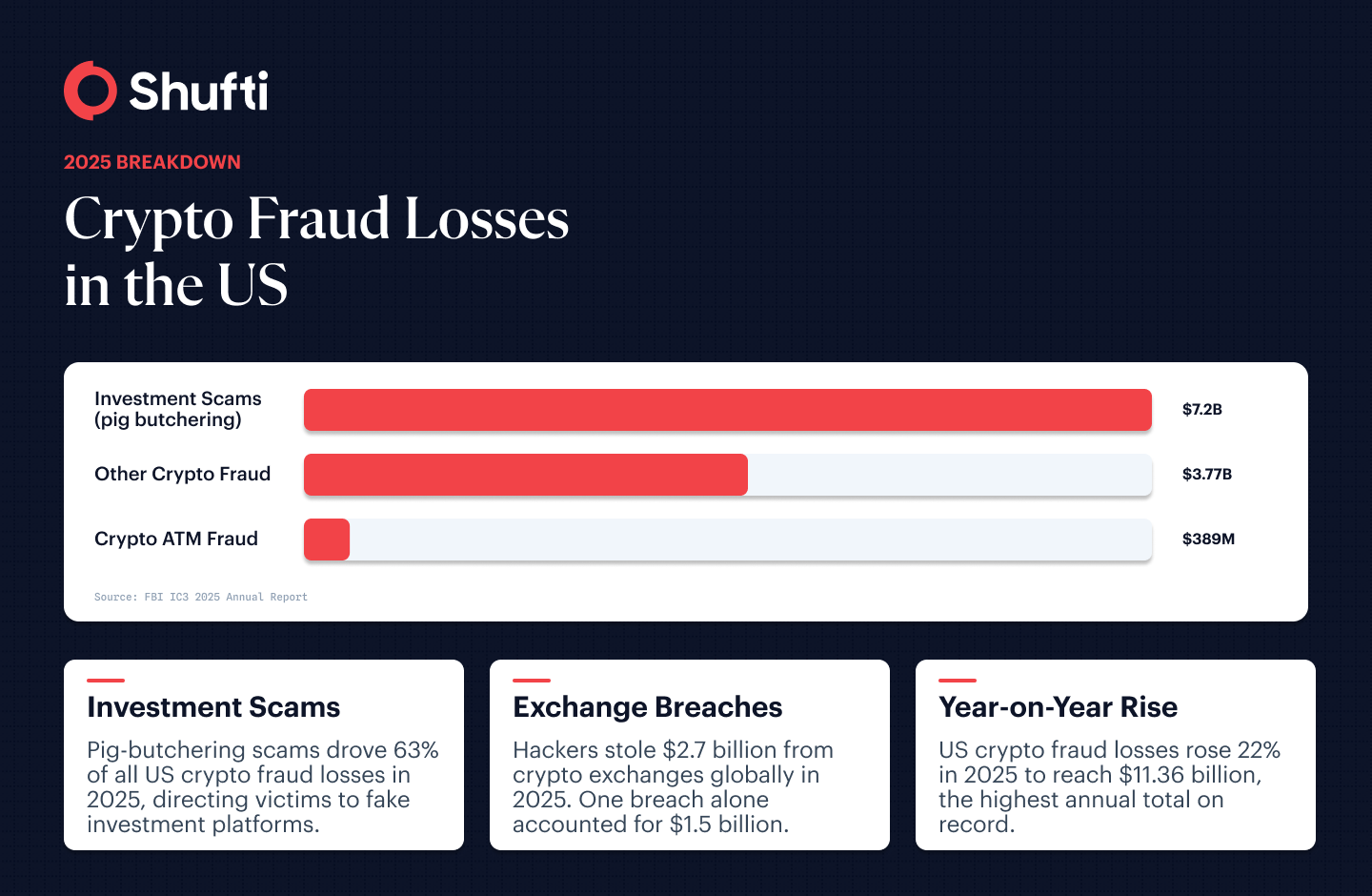
- U.S. crypto fraud losses topped $11 billion in 2025 across 181,565 complaints.
- Hackers stole over $2.7 billion directly from platforms and protocols that year.
- Threats hit at onboarding, active trading, wallet custody, and cross-protocol transfers.
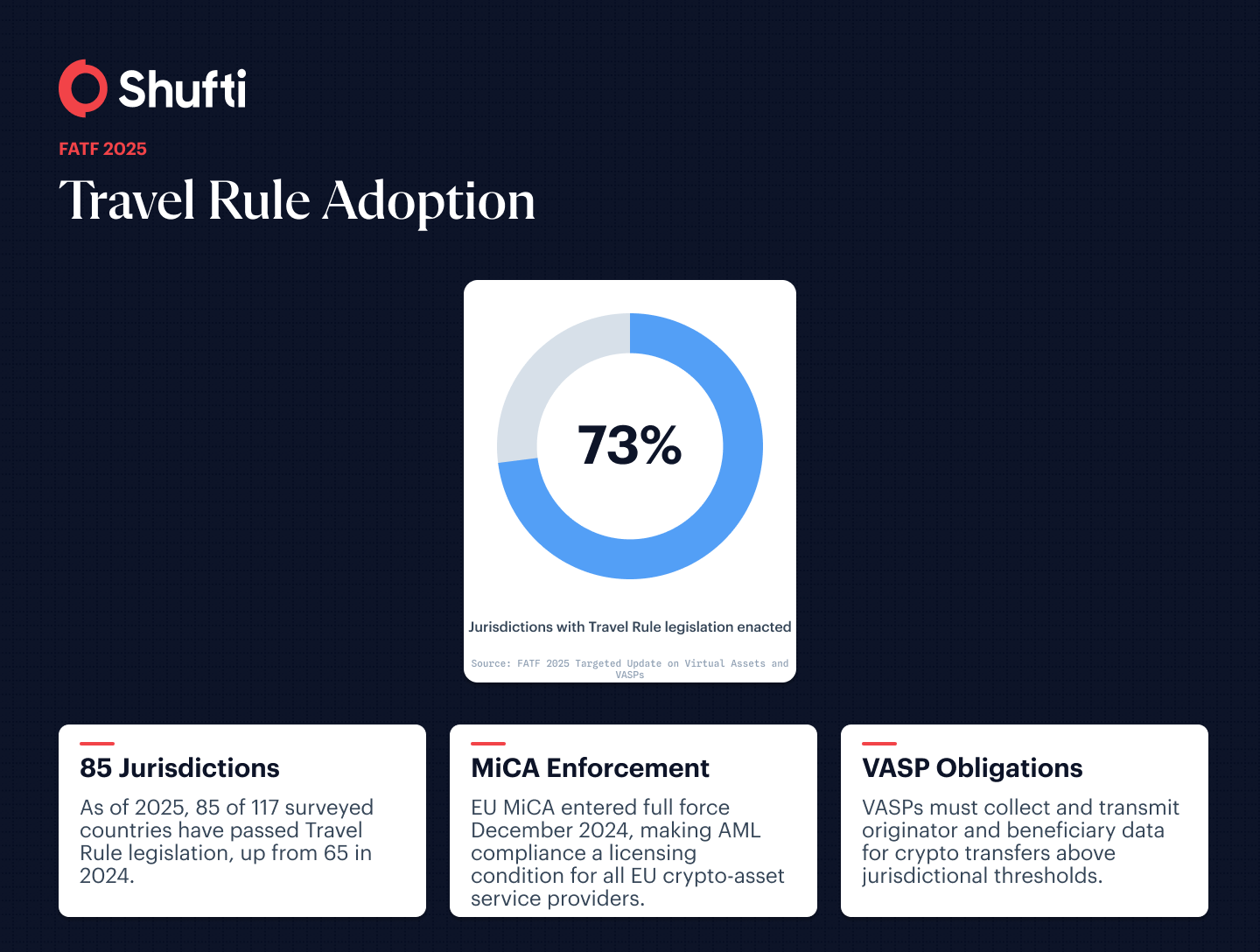
- As of 2025, 85 of 117 surveyed jurisdictions have enacted Travel Rule legislation.
- MiCA makes AML compliance a licensing condition for EU crypto-asset service providers.
Crypto fraud losses in the US totalled more than $11 billion in 2025, with 181,565 complaints filed involving cryptocurrency, according to the FBI Internet Crime Complaint Center. Investment fraud was the primary driver, accounting for nearly half of all scam-related losses that year.
At the exchange level, hackers stole over $2.7 billion directly from platforms and protocols in the same period, with a single breach responsible for $1.5 billion.
For compliance officers and security teams at crypto platforms, these aren’t statistics to monitor at a distance. They are the conditions under which every onboarding decision, every transaction approval, and every sanctions check is made.
Crypto fraud prevention has moved well past a basic KYC checkbox. Exchanges, wallet providers, and DeFi-adjacent platforms are now managing simultaneous pressure from enforcement-ready regulators, sophisticated fraud networks, and customers who expect onboarding in seconds.
This article maps the threat landscape, the regulatory obligations that now sit alongside it, and what a layered approach to cryptocurrency fraud prevention actually requires in practice.
The Fraud Landscape Crypto Platforms Face
The threats targeting crypto platforms don’t concentrate at a single point in the customer lifecycle. They hit at onboarding, at active trading, at wallet custody, and across cross-protocol transfers, exploiting different vulnerabilities depending on whether the target is a centralized exchange, a custodial wallet, or a DeFi protocol.
| Platform type | Dominant fraud vectors | Why is it vulnerable |
| Exchanges | Account takeover, synthetic identity, insider threats | High-value targets, bulk fraudulent account creation |
| Wallets | Phishing, seed-phrase harvesting, drainer contracts | No real-time wallet-level screening before funds move |
| DeFi / Web3 | Rug pulls, flash loan attacks, oracle manipulation, bridge exploits | Often no formal registration, ambiguous governance |
Exchange-targeted attacks
Crypto exchanges are high-value targets by design. The $1.5 billion single-exchange breach recorded in 2025 illustrates the scale of what a successful attack looks like. The attack surface includes account takeover through credential stuffing and social engineering, synthetic identity fraud at registration, and insider threats.
Investment scams also route through the exchange infrastructure. Fraudsters register accounts in bulk, direct victims to deposit funds on compromised platforms, and exploit weak KYC controls at onboarding to accumulate fraudulent accounts before platforms detect the pattern.
Wallet vulnerabilities
Wallet fraud prevention sits at the custody layer: protecting private keys, detecting unusual transaction patterns, and screening outgoing transfers before they reach high-risk addresses.
Custodial wallets face account takeover risk comparable to exchanges. Non-custodial wallets face phishing campaigns, seed-phrase harvesting, and drainer contracts that empty wallets in a single transaction.
In both cases, the absence of real-time wallet-level screening means stolen funds can move before the account holder or the platform detects the breach.
DeFi and Web3-specific threats
DeFi fraud detection presents a structurally different challenge. Many DeFi protocols operate without formal user registration, which makes traditional KYC controls difficult to apply at the protocol layer. The dominant fraud vectors include rug pulls, flash loan attacks, oracle manipulation, and bridge exploits.
From a compliance standpoint, the ambiguity of DeFi governance structures creates jurisdiction risk. This is particularly acute where DeFi platforms interact with regulated VASPs through bridging or liquidity provision, bringing those interfaces into scope for AML obligations on DeFi platforms.
Regulatory Pressure Is No Longer Optional
The compliance obligations for crypto platforms have hardened across every major jurisdiction. For exchanges and VASPs, the question is no longer whether to implement AML controls but how to implement them in a way that meets multi-jurisdictional standards without creating processing delays that slow legitimate customer journeys.
Travel Rule obligations for VASPs
As of 2025, 85 of 117 surveyed jurisdictions have enacted Travel Rule legislation, up from 65 in 2024, according to FATF’s 2025 Targeted Update on Virtual Assets and VASPs. The Travel Rule requires VASPs to collect and transmit originator and beneficiary identity information for crypto transfers above threshold amounts.
For exchanges, this means implementing originator identification at the sending end and recipient screening at the receiving end, in real time, across transfers that may touch multiple jurisdictions with differing implementation timelines and threshold values.
MiCA requirements for EU crypto platforms
MiCA entered full force on 30 December 2024, making AML compliance a licensing condition for all crypto-asset service providers operating in the EU. Non-compliance fines reach up to €5 million or between 3% and 12.5% of annual turnover.
For exchanges and wallet providers with EU customers, MiCA’s AML requirements are not additive to existing obligations. They are the licensing baseline. Platforms still operating under national transitional arrangements at the enforcement date were required to meet full MiCA standards immediately.
Blockchain fraud detection through transaction monitoring
Effective cryptocurrency fraud prevention extends beyond onboarding checks into the transaction layer. Blockchain fraud detection draws on on-chain data, including wallet risk scores, cluster analysis, and transaction graph tracing, to flag transfers involving addresses linked to sanctioned entities, darknet markets, mixers, and other high-risk counterparties.
The challenge for compliance teams is integrating this real-time screening into existing AML workflows without creating manual review queues that exceed team capacity. Platforms that manage this effectively treat on-chain screening as a continuous process rather than a one-time account-opening check.
What Does Effective Crypto Exchange Security Look Like in Practice?
Knowing the threat landscape and the regulatory framework is the starting point for any crypto exchange security strategy. The operational question is how compliance and security teams layer controls across onboarding, active accounts, and live transactions, without building a process so friction-heavy that legitimate users abandon the platform before completing registration.
Onboarding KYC: the first line of defence
Effective onboarding KYC combines document verification with biometric matching, confirming that the person presenting the document is the same individual submitting the selfie, alongside sanctions and PEP screening before account access is granted.
For platforms operating under MiCA and the Travel Rule, identity data captured at onboarding also becomes the originator information required for outgoing crypto transfers.
The onboarding step does double duty: it stops fraudulent account creation, and it creates the identity record the entire compliance stack references from that point forward. KYC and AML compliance for e-wallets covers how this same logic applies at the wallet layer.
Wallet fraud prevention through ongoing screening
Wallet fraud prevention extends past the point of registration. Accounts that clear onboarding checks can be compromised later through account takeover, or they can be registered legitimately and then used for fraud.
Ongoing monitoring, including periodic re-checks against updated watchlists, adverse media scanning, and transaction pattern analysis, gives platforms a mechanism to detect risk changes after onboarding is complete.
When a wallet’s transaction profile shifts sharply, or the account appears in newly published adverse media, the platform has a signal to act before losses materialize.
DeFi fraud detection at the interface layer
For platforms with DeFi exposure, whether through native DeFi functionality or bridging to external protocols, DeFi fraud detection requires controls at the interface layer rather than only at user registration.
Screening the wallet addresses that interact with DeFi pools and bridges, flagging transfers to high-risk smart contract addresses, and applying enhanced due diligence to large DeFi interactions are steps compliance teams are operationalizing now, ahead of clearer regulatory guidance specific to DeFi-facing obligations.
The Grant Thornton 2026 crypto compliance overview notes that exchange and wallet operators are increasingly building DeFi interface monitoring into core AML programs rather than treating it as an out-of-scope edge case.
How Shufti helps crypto platforms fight fraud at every layer
The friction compliance teams describe most often at crypto platforms is structural. Separate tools for KYC onboarding, AML screening, and transaction monitoring rarely share data or generate a unified audit trail. When fraud routes through that gap, it often isn’t caught until the loss has already been recorded.
Shufti connects identity verification at onboarding, ongoing AML screening across 100,000+ data sources and 3,500+ global watchlists, and real-time transaction screening into a single integration.
For exchanges and wallet providers running MiCA licensing obligations and Travel Rule compliance in parallel, the identity data captured at KYC feeds directly into the transaction layer, without manual data transfer or reconciliation across separate vendor systems. Compliance teams get one audit trail across the full customer lifecycle, from registration through every subsequent transfer.
Frequently Asked Questions
What are the most common types of crypto fraud?
The most common types include investment scams (pig butchering), account takeover, synthetic identity fraud at registration, phishing and seed-phrase theft targeting wallet users, and exchange hacks. In DeFi, rug pulls and flash loan attacks are prevalent. Investment fraud was the leading category of scam-related losses in 2025, according to the FBI IC3.
How do crypto exchanges prevent fraud?
Exchanges use layered controls: KYC verification at onboarding to screen out synthetic identities, AML screening against sanctions lists and PEP databases, real-time transaction monitoring to flag suspicious transfers, and ongoing account monitoring for post-registration risk changes. EU exchanges implement MiCA-mandated AML conditions and Travel Rule originator-beneficiary screening for cross-border transactions.
How do you protect a crypto wallet from fraud?
Platform-side wallet fraud prevention includes real-time screening of outgoing transfers against high-risk address databases, transaction pattern anomaly detection, and periodic re-checks against updated watchlists and adverse media. On the user side, hardware wallet storage for large holdings and never sharing seed phrases with any service remain the most effective controls.
What is blockchain fraud detection?
Blockchain fraud detection uses on-chain data, including wallet risk scoring, transaction graph tracing, and cluster analysis, to flag transfers involving sanctioned addresses, mixers, and darknet wallets. It runs at the transaction level, evaluating transfer behaviour rather than the account holder's identity, and operates continuously rather than as a one-time check.
What is DeFi fraud and how is it detected?
DeFi fraud refers to exploits targeting decentralized protocols: rug pulls, flash loan attacks, oracle manipulation, and bridge exploits. Detection relies on monitoring smart contract interactions for anomalous behaviour, screening wallet addresses interacting with DeFi interfaces, and applying enhanced due diligence to large or unusual DeFi transactions.